Salivary vs. Serum Circadian Biomarkers: A Comprehensive Reliability Assessment for Research and Clinical Applications
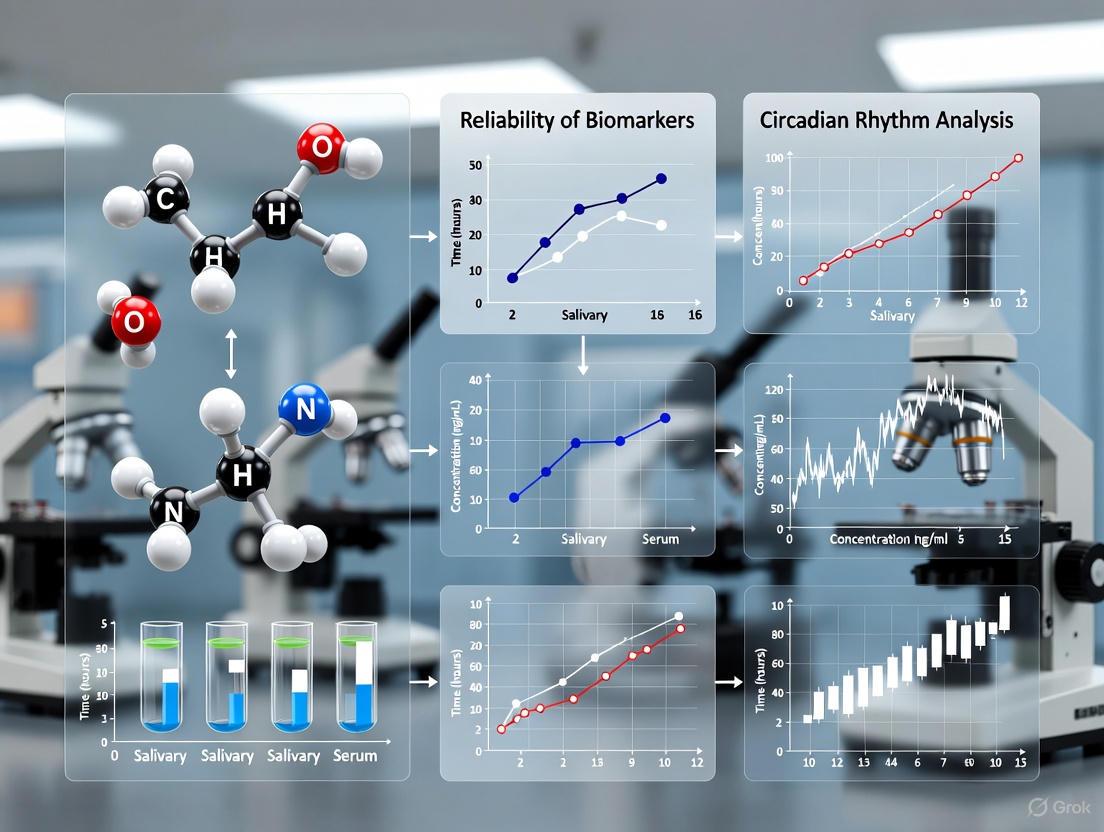
This article provides a critical evaluation of the reliability of salivary biomarkers as non-invasive alternatives to serum for assessing circadian rhythms.
Salivary vs. Serum Circadian Biomarkers: A Comprehensive Reliability Assessment for Research and Clinical Applications
Abstract
This article provides a critical evaluation of the reliability of salivary biomarkers as non-invasive alternatives to serum for assessing circadian rhythms. Targeting researchers and drug development professionals, it synthesizes current evidence on foundational principles, methodological protocols, and analytical challenges. The review covers key circadian markers like melatonin and cortisol, detailing their dynamics in different biological matrices. It explores advanced detection technologies, addresses pre-analytical and analytical confounding factors, and presents rigorous validation studies comparing salivary and serum biomarker performance across health and disease states. The analysis concludes that saliva offers a robust, practical medium for circadian rhythm assessment, with significant implications for chronotherapy, diagnostics, and personalized medicine.
Core Circadian Biomarkers: Physiological Basis and Matrix-Specific Dynamics
Melatonin and Cortisol as Primary Circadian Phase Markers
In the field of chronobiology, the accurate assessment of circadian phase is fundamental for both research and clinical practice. The endogenous circadian system, governed by the suprachiasmatic nucleus (SCN) in the hypothalamus, orchestrates near-24-hour rhythms in virtually all physiological processes, from sleep-wake cycles to hormone secretion and metabolism [1] [2]. While direct measurement of SCN activity is not feasible in humans, circadian biomarkers serve as reliable proxies for assessing the timing of this internal clock. Among these, melatonin and cortisol have emerged as the two primary endocrine markers that most accurately reflect circadian phase [1] [2] [3]. These hormones provide a window into the internal circadian landscape, enabling researchers and clinicians to diagnose circadian rhythm disorders, optimize chronotherapy, and investigate the links between circadian disruption and disease [2] [3] [4].
The growing interest in circadian medicine has intensified the need for rigorous comparison of these biomarkers and the methodologies for their assessment. This guide provides a comprehensive, data-driven comparison of melatonin and cortisol as circadian phase markers, with particular emphasis on their measurement in salivary versus serum matrices—a central consideration in contemporary circadian biomarker research.
Comparative Analysis of Circadian Biomarkers
Physiological Profiles and Phase Determination
Melatonin and cortisol exhibit distinct yet complementary circadian profiles that reflect their different roles in sleep-wake regulation. Melatonin, synthesized by the pineal gland, signals the onset of the biological night. Its secretion is tightly suppressed by light and rises sharply in the evening under dim light conditions [1] [2]. This rise, termed Dim Light Melatonin Onset (DLMO), is widely considered the gold standard marker for assessing circadian phase [1] [2] [4]. In contrast, cortisol, a glucocorticoid produced by the adrenal cortex, peaks rapidly upon awakening—a phenomenon known as the Cortisol Awakening Response (CAR)—and gradually declines throughout the day, reaching its nadir around midnight [5] [2]. The approximately 12-hour phase opposition between these hormones is illustrated in Figure 1.
Table 1: Core Physiological Characteristics of Melatonin and Cortisol
| Characteristic | Melatonin | Cortisol |
|---|---|---|
| Primary Source | Pineal gland | Adrenal cortex |
| Circadian Peak | Biological night (~2-4 AM) | Morning (~30-45 min after awakening) |
| Primary Phase Marker | Dim Light Melatonin Onset (DLMO) | Cortisol Awakening Response (CAR) |
| Key Regulatory Factor | Light exposure (suppressive) | Sleep-wake transition (entrained) |
| Phase Determination Precision | High (SD: 14-21 min) [2] | Moderate (SD: ~40 min) [2] |
| Stability as Phase Marker | High (direct SCN output) | Moderate (influenced by stress, HPA axis) |
Methodological Approaches for Phase Assessment
Determining DLMO requires sampling over a 4-6 hour window, typically from 5 hours before to 1 hour after habitual bedtime [2]. The most common analytical approach uses a fixed threshold (e.g., 3-4 pg/mL in saliva or 10 pg/mL in serum), though variable thresholds and specialized algorithms like the "hockey-stick" method have been developed to accommodate individual differences in melatonin production [2]. CAR assessment requires precise sampling at awakening, 30, and 45 minutes post-awakening to capture the characteristic spike [2]. Both biomarkers demand strict protocol controls: DLMO measurement requires dim light conditions (<10-30 lux) to prevent suppression of melatonin secretion, while CAR assessment necessitates strict adherence to sampling times and documentation of awakening time [1] [2].
Analytical Methodologies: Comparing Sensitivity and Specificity
The accurate quantification of melatonin and cortisol presents analytical challenges due to their low concentrations in biological fluids, particularly in saliva. Two primary analytical platforms dominate circadian research: immunoassays and liquid chromatography-tandem mass spectrometry (LC-MS/MS).
Table 2: Comparison of Analytical Platforms for Circadian Biomarker Measurement
| Parameter | Immunoassays (ELISA) | Liquid Chromatography-Tandem Mass Spectrometry (LC-MS/MS) |
|---|---|---|
| Principle | Antibody-based detection | Physical separation and mass-based detection |
| Sensitivity | Moderate (may struggle with low salivary concentrations) | High (excellent for low analyte levels) [2] |
| Specificity | Subject to cross-reactivity with metabolites [2] | Excellent (minimal cross-reactivity) [2] |
| Multiplexing Capability | Limited (typically single analyte) | High (simultaneous measurement of multiple hormones) [2] |
| Throughput | High | Moderate to high |
| Cost | Lower | Higher |
| Sample Volume | Smaller | Larger |
| Ideal Application | High-throughput screening, large cohort studies | Research requiring high precision and accuracy |
Immunoassays, particularly enzyme-linked immunosorbent assays (ELISA), offer cost-effectiveness and high throughput, making them suitable for large-scale studies [5]. However, their limitations in specificity due to antibody cross-reactivity can compromise accuracy, particularly for melatonin which has several metabolites with similar structures [2]. In contrast, LC-MS/MS provides superior specificity and sensitivity, effectively distinguishing between structurally similar compounds and enabling precise measurement of low hormone concentrations in saliva [2]. The enhanced performance of LC-MS/MS comes with higher instrumentation costs and technical expertise requirements, but its capacity for simultaneous analysis of multiple hormones without additional time or cost makes it particularly valuable for comprehensive circadian assessments [2].
Sample Matrix Comparison: Saliva Versus Serum
The choice between salivary and serum sampling represents a critical decision point in circadian study design, with significant implications for protocol feasibility, participant burden, and data reliability.
Table 3: Saliva vs. Serum for Circadian Biomarker Measurement
| Characteristic | Saliva | Serum |
|---|---|---|
| Collection Method | Non-invasive (passive drool or swab) | Invasive (venipuncture or catheter) |
| Participant Burden | Low (suitable for frequent sampling and home collection) | High (typically requires clinical setting) |
| Sampling Frequency | High (suitable for dense phase mapping) | Limited by practicality and participant tolerance |
| Analyte Concentration | Lower (reflects free, biologically active fraction) | Higher (includes protein-bound fraction) |
| Protocol Compliance | Generally higher for ambulatory studies | Requires clinical supervision |
| Ideal for | DLMO assessment, CAR, outpatient studies, pediatric populations | Research requiring highest analyte concentration, precise pharmacokinetics |
Salivary measurement offers distinct advantages for circadian research, primarily due to its non-invasive nature which enables frequent sampling with minimal participant disruption [2] [4]. This is particularly valuable for capturing the dynamic patterns of hormone secretion necessary for precise phase determination, such as the rapid rise of melatonin at DLMO or the sharp spike of cortisol at CAR [2]. Saliva measures the biologically active, free fraction of these hormones, providing a more physiologically relevant measure of bioavailable hormone than serum [2]. However, the lower concentrations of hormones in saliva, particularly for melatonin, can challenge the sensitivity limits of some analytical platforms [2].
Serum measurement provides higher hormone concentrations and potentially better analytical reliability, particularly for melatonin [2]. The invasive nature of blood sampling, however, presents significant limitations for circadian protocols. Frequent venipuncture is impractical and ethically concerning, while indwelling catheters require clinical settings that disrupt natural sleep and behaviors—potentially confounding the very rhythms researchers seek to measure [2]. Despite these limitations, serum remains valuable when the highest analytical sensitivity is required or when comparing free and protein-bound hormone fractions.
Experimental Protocols and Research Applications
Standardized Sampling Protocols
Robust circadian assessment requires meticulous attention to sampling protocols. For DLMO determination using saliva, participants should provide samples every 30-60 minutes in the 4-6 hours before their habitual bedtime [2]. Sampling must occur under dim light conditions (<10-30 lux) with documentation of light exposure [2]. Participants should refrain from eating, drinking caffeine or alcohol, or brushing teeth for at least 30 minutes before each sample [5]. Samples should be immediately refrigerated or frozen, then centrifuged to remove mucins and cellular debris before analysis [5] [6].
For CAR assessment, participants should collect saliva immediately upon awakening, then at 30 and 45 minutes post-awakening [2]. Strict adherence to timing is critical, and electronic monitoring devices can verify compliance [2]. Participants should record exact awakening time and any deviations from protocol.
Emerging Technologies and Innovative Approaches
Recent technological advances are expanding the frontiers of circadian biomarker measurement. Wearable biosensors that passively monitor cortisol and melatonin in sweat represent a promising development for continuous, real-time circadian assessment without the need for active sample collection [7]. One validation study demonstrated strong agreement between sweat and salivary measurements for both cortisol (r=0.92) and melatonin (r=0.90), enabling continuous tracking of circadian phase and amplitude [7].
Simultaneously, computational approaches are being developed to estimate circadian phase from wearable-derived data streams such as heart rate and activity [8]. These digital biomarkers can capture different aspects of circadian disruption, including misalignment between central and peripheral clocks and between internal rhythms and sleep-wake cycles [8]. While not replacing direct hormone measurement, these approaches offer scalable alternatives for large population studies and longitudinal monitoring of circadian disruption in real-world settings [8].
Figure 1: Circadian Regulation and Measurement Pathways. This diagram illustrates the pathway from light input through central circadian regulation to biomarker secretion and measurement in different biological matrices. The suprachiasmatic nucleus (SCN) integrates light information and coordinates hormonal outputs through neural and endocrine pathways. Dashed lines indicate emerging measurement approaches.
The Scientist's Toolkit: Essential Research Reagent Solutions
Table 4: Essential Reagents and Materials for Circadian Biomarker Research
| Reagent/Material | Function/Application | Key Considerations |
|---|---|---|
| Salivary Collection Devices (e.g., Salivettes) | Standardized saliva sample collection | Choose cotton-free versions for melatonin assessment [5] |
| Dim Light Melatonin Onset Kits | Specialized reagents for DLMO assessment | Include specific antibodies with low cross-reactivity [2] |
| Human Melatonin ELISA Kit | Immunoassay-based melatonin quantification | Sensitivity: ≤4.688 pg/mL; Intra-assay CV% <8 [5] |
| Human Cortisol ELISA Kit | Immunoassay-based cortisol quantification | Sensitivity: ≤0.234 ng/mL; Intra-assay CV% <8 [5] |
| LC-MS/MS Calibration Standards | Reference materials for mass spectrometry | Certified reference materials ensure accurate quantification [2] |
| Sample Preservation Solutions (e.g., RNAprotect) | Stabilize samples for gene expression studies | 1:1 ratio with saliva optimizes RNA yield and quality [4] |
| Passive Sweat Biosensors | Continuous hormone monitoring | Enable real-time tracking of circadian phase [7] |
Melatonin and cortisol remain the preeminent biomarkers for human circadian phase assessment, each with distinct strengths and applications. Melatonin, particularly through DLMO determination, provides the most precise measure of central circadian timing, with methodological standardization continuing to improve its reliability [1] [2]. Cortisol, through CAR assessment, offers valuable complementary information about HPA axis function and its interaction with the circadian system, though with greater susceptibility to confounding factors [2].
The choice between salivary and serum matrices involves important trade-offs between analytical reliability, practical feasibility, and participant burden. Salivary measurement has emerged as the preferred approach for most circadian studies due to its non-invasive nature and capacity for frequent sampling, despite challenges with low hormone concentrations [2] [4]. Serum retains value when maximum analytical sensitivity is required or when protein-binding fractions are of interest [2].
Future directions in circadian biomarker research include the refinement of wearable biosensors for continuous monitoring [7], the development of computational methods to estimate circadian phase from physiological data streams [8], and the integration of multi-omics approaches to capture the complexity of circadian regulation across biological systems [4]. These advances promise to deepen our understanding of circadian biology and enhance our ability to diagnose and treat circadian rhythm disorders across diverse patient populations.
The Suprachiasmatic Nucleus (SCN) and Peripheral Clock Synchronization
The mammalian circadian system is a hierarchical timing network essential for coordinating physiology and behavior with the 24-hour solar day. At its apex lies the suprachiasmatic nucleus (SCN), a bilateral structure in the ventral hypothalamus containing approximately 20,000 neurons that function as the master circadian pacemaker [9]. The SCN receives light input directly from the retina via the retinohypothalamic tract, synchronizing its rhythm to the external light-dark cycle [9]. Beyond the SCN, virtually all tissues and organ systems contain peripheral clocks that generate local circadian rhythms in gene expression and cellular function [10].
The relationship between central and peripheral clocks has been conceptualized through two primary models. The "master-slave" model posits that the SCN alone synchronizes peripheral oscillators, which lack independent environmental responsiveness [10]. In contrast, the more contemporary "orchestra" model envisions the SCN as a conductor coordinating peripheral clocks that retain capacity to respond to non-photic zeitgebers (time-giving cues) such as feeding schedules, thereby enabling tissue-specific circadian optimization [10]. This framework is crucial for understanding how systemic circadian coordination is maintained and how its disruption contributes to disease pathogenesis.
Molecular Mechanisms of Circadian Timing
Core Clock Gene Feedback Loops
The molecular circadian clock operates through a series of interlocked transcriptional-translational feedback loops (TTFLs) that are conserved from cyanobacteria to humans [9] [10]. At its core, the transcription factors CLOCK and BMAL1 form a heterodimer that activates transcription of genes including the Period family (Per1, Per2, Per3) and Cryptochrome family (Cry1, Cry2) by binding to E-box enhancer elements in their promoters [9] [11].
Following translation, PER and CRY proteins progressively accumulate, form complexes in the cytoplasm, and translocate back to the nucleus where they suppress CLOCK-BMAL1-mediated transcription, thereby completing the primary negative feedback loop with a period of approximately 24 hours [9] [11]. An adjacent stabilizing loop involves the nuclear receptors REV-ERBα and RORα, which regulate Bmal1 expression by competing for ROR response elements in its promoter [11].
Table 1: Core Components of the Circadian Molecular Clock
| Component | Type | Primary Function |
|---|---|---|
| CLOCK | Transcription Factor | Forms heterodimer with BMAL1; activates Per and Cry transcription |
| BMAL1 | Transcription Factor | Forms heterodimer with CLOCK; primary transcriptional activator |
| PER1/2/3 | Regulatory Protein | Forms repressor complex with CRY; inhibits CLOCK-BMAL1 activity |
| CRY1/2 | Regulatory Protein | Forms repressor complex with PER; inhibits CLOCK-BMAL1 activity |
| REV-ERBα | Nuclear Receptor | Represses Bmal1 transcription; stabilizes circadian rhythm |
| RORα | Nuclear Receptor | Activates Bmal1 transcription; counterbalances REV-ERBα |
Post-Translational Regulation
The timing, stability, and subcellular localization of core clock components are extensively regulated through post-translational modifications. Casein kinases 1δ and ε (CK1δ/ε) and glycogen synthase kinase 3β (GSK3β) phosphorylate PER proteins, influencing their stability, dimerization, and nuclear entry [11] [10]. The balance between CK1δ/ε phosphorylation and dephosphorylation by protein phosphatase 1 (PP1) appears particularly important for regulating PER protein localization [10]. These modifications create precisely timed delays essential for generating approximately 24-hour molecular oscillations.
SCN Architecture and Neural Synchronization
Functional Organization
The SCN exhibits notable functional heterogeneity, with distinct subregions differentially involved in rhythm generation and entrainment. The ventral SCN (core) receives direct retinal innervation and expresses the neuropeptides vasoactive intestinal polypeptide (VIP) and gastrin-releasing peptide (GRP), making it particularly responsive to light cues [9]. In contrast, the dorsal SCN (shell) is sparsely innervated by the retina, contains vasopressin (AVP)-expressing neurons, and receives strong input from the ventral SCN [9].
This anatomical specialization enables differential entrainment responses. Following a shift in the light-dark cycle, ventral SCN neurons rapidly reset their phase, while dorsal SCN neurons maintain their original rhythm for several cycles [9]. This creates transient internal desynchrony during jet lag, with the ventral SCN's narrow electrical activity profile reflecting high synchrony among its neuronal population [9].
Intercellular Coupling Mechanisms
The SCN generates a coherent circadian output through multiple synchronizing mechanisms. Individual SCN neurons function as autonomous oscillators with intrinsic periods ranging from 22 to 28 hours [9]. synaptic communication via neurotransmitters including GABA and VIP promotes phase synchronization [9]. gap junctions facilitate direct electrical and metabolic coupling between neurons [9]. VIP signaling is particularly crucial for maintaining synchrony in the SCN network.
The robustness of the SCN's electrical activity rhythm depends critically on phase synchronization between individual cells. Seasonal photoperiod changes induce dramatic alterations in waveform that are primarily mediated by changes in neuronal synchrony rather than single-cell activity patterns [9]. Under short photoperiods, SCN neurons exhibit tight phase clustering, while long photoperiods produce broader phase distributions [9].
Diagram Title: SCN Organization and Peripheral Clock Synchronization
Peripheral Clock Organization and Function
Peripheral clocks operate in tissues throughout the body, including the cardiovascular system, liver, kidney, immune system, and endocrine organs [10]. While these oscillators utilize the same core molecular machinery as the SCN, they are differentially sensitive to non-photic zeitgebers. Feeding-fasting cycles represent particularly potent entrainment signals for metabolic tissues such as the liver, kidney, and pancreas [10].
The cardiovascular clock regulates circadian rhythms in blood pressure, heart rate, and endothelial function [10]. Blood pressure characteristically dips at night and rises during daytime, with "non-dipping" patterns associated with increased cardiovascular risk [10]. Molecular studies have revealed circadian oscillations of clock genes in vascular smooth muscle cells, endothelial cells, and cardiac tissue, regulating processes like thrombus formation through circadian expression of thrombomodulin and plasminogen activator inhibitor-1 (PAI-1) [10].
The immune clock generates daily rhythms in immune cell trafficking, cytokine production, and inflammatory responses [10]. Disruption of these rhythms contributes to the pathogenesis of immune-mediated disorders, while many inflammatory conditions exhibit diurnal symptom fluctuations [10].
Circadian Biomarkers: Salivary versus Serum Analysis
Methodological Comparison
Monitoring circadian rhythmicity in humans requires reliable biomarkers that can be repeatedly sampled with minimal invasiveness. The table below compares key methodological features of salivary and serum biomarkers for circadian assessment.
Table 2: Comparison of Salivary versus Serum Biomarkers for Circadian Research
| Parameter | Salivary Biomarkers | Serum Biomarkers |
|---|---|---|
| Collection Method | Non-invasive saliva collection | Phlebotomy (invasive) |
| Stress Induction | Minimal | Significant (needle-related anxiety) |
| Sample Frequency | High-frequency sampling feasible | Limited by practicality and ethics |
| Free vs. Bound Hormone | Measures free, biologically active fraction | Measures total (free + protein-bound) |
| Cortisol Correlation | Correlates with free serum cortisol | Reference standard but includes protein-bound fraction |
| Primary Advantages | Suitable for home collection; ideal for shift work studies | Comprehensive metabolic panel possible |
| Key Limitations | Lower analyte concentrations; food contamination risk | Stress effects on HPA axis markers |
Analytical Performance and Correlation
Substantial evidence supports the validity of salivary cortisol measurements as indicators of hypothalamic-pituitary-adrenal (HPA) axis activity. Research comparing parallel circadian rhythms in salivary and serum cortisol concentrations documented nearly identical acrophases (peak times), with serum cortisol peaking at 10:50 AM and salivary cortisol at 10:00 AM [12]. While a statistically significant correlation exists between salivary and serum cortisol (r=0.32, p<0.001), the strength of this association is moderate, reflecting that saliva measures the free physiologically active cortisol fraction while serum includes protein-bound cortisol [12].
Salivary biomarker research has expanded beyond cortisol to include inflammatory mediators. A study of 352 adolescents found that later bedtime was associated with increased serum IL-6 (0.05 pg/mL increase, p=0.01), while severe sleep debt (≥2 hours) elevated both salivary IL-6 (0.38 pg/mL, p=0.01) and serum CRP (0.61 μg/mL, p=0.02) [6]. These findings demonstrate that salivary inflammatory biomarkers can detect circadian disruption with clinical relevance.
Novel Transcriptomic Approaches
Emerging methodologies now enable circadian assessment through salivary transcriptomics. A comprehensive integrative analysis measured RNA levels of core clock genes (ARNTL1, NR1D1, and PER2) in saliva, demonstrating robust circadian oscillations that correlated with hormonal rhythms [4]. This approach found significant correlations between the acrophases of ARNTL1 gene expression and cortisol, with both correlating with individual bedtime [4]. The TimeTeller methodology optimizes saliva collection using RNAprotect preservative (1:1 ratio) with 1.5 mL saliva volume, yielding sufficient RNA quality for circadian profiling [4].
Experimental Protocols for Circadian Research
Salivary Biomarker Collection Protocol
Participant Preparation: Participants should refrain from eating, drinking (except water), brushing teeth, or using mouthwash for at least 30 minutes before sample collection [6].
Sample Collection: Participants provide 4 mL of unstimulated whole saliva by passive drooling into a conical tube placed in a cup of crushed ice [6]. For transcriptomics, collect 1.5 mL saliva mixed 1:1 with RNAprotect [4].
Sample Processing: Centrifuge samples at 2800 rpm for 20 minutes at 4°C. Transfer supernatants to barcoded storage tubes and freeze at -80°C until analysis [6].
Temporal Sampling Strategy: Collect samples at 3-4 time points per day over 2 consecutive days to establish circadian profiles. Fixed intervals should cover morning, afternoon, and evening timepoints [4].
Serum/Plasma Collection Protocol
Blood Collection: Draw blood samples into appropriate collection tubes (e.g., SST tubes for serum). For cortisol rhythm assessment, collect serial samples every 2 hours over a 24-hour period under controlled conditions [12].
Sample Processing: Allow blood to clot at room temperature for 30 minutes, then centrifuge at 3000 rpm for 15 minutes. Aliquot serum into storage tubes and freeze at -80°C [6].
Multiplex Analysis: Thaw samples overnight at 4°C and keep on ice during assay procedures. Analyze biomarkers using multiplex magnetic bead panels on systems such as the Luminex 200 [6].
Electrical Activity Recording in SCN
In vivo Recording: In freely moving animals, record SCN electrical activity using implanted electrodes. Document the close correspondence between SCN firing patterns and behavioral activity rhythms [9].
In vitro Recording: Maintain SCN slices in interface chambers perfused with artificial cerebrospinal fluid. Record extracellular electrical activity using microelectrodes, demonstrating preserved circadian rhythms in firing frequency [9].
Light Response Assessment: Measure light-induced changes in electrical activity in SCN neurons, with approximately 32-38% of SCN neurons responding to light stimulation in rodents [9].
Signaling Pathways in Circadian Synchronization
Diagram Title: Core Circadian Molecular Feedback Loop
Pathophysiological Implications and Therapeutic Applications
Circadian Disruption in Disease
SCN dysfunction and circadian misalignment contribute to numerous pathological conditions. Aging and sleep deprivation reduce circadian amplitude in the SCN, while physical exercise has amplitude-enhancing effects [9]. Circadian rhythm deterioration is a recognized risk factor for neurodegenerative diseases, cancer, depression, and sleep disorders [9].
The circadian system significantly influences drug addiction, with substance abuse altering molecular rhythms in limbic brain regions [11]. Genetic studies have linked circadian gene polymorphisms to increased vulnerability to addiction, while drugs of abuse can directly entrain locomotor activity rhythms, sometimes independent of the SCN [11].
Chronotherapeutic Approaches
The growing understanding of circadian biology has stimulated therapeutic innovation targeting the clock system. The MAPEC study demonstrated that bedtime administration of antihypertensive medication significantly improved cardiovascular outcomes compared to morning dosing, establishing the principle of chronotherapy [10].
Novel approaches are engineering circadian responsiveness into therapeutic systems. A synthetic biology platform utilizing the melatonin receptor 1A (MTNR1A) was developed to create a circadian-inducible gene switch that activates therapeutic transgene expression specifically during nighttime melatonin peaks [13]. This system successfully regulated GLP-1 expression in a mouse model of type-2 diabetes, demonstrating the potential of circadian-regulated cell therapies [13].
The Scientist's Toolkit: Essential Research Reagents
Table 3: Key Research Reagents for Circadian Rhythm Investigation
| Reagent/Resource | Application | Function/Utility |
|---|---|---|
| Luminex 200 System | Multiplex biomarker quantification | Simultaneous measurement of multiple cytokines/hormones in saliva or serum [6] |
| RNAprotect Reagent | Saliva transcriptomics | Preserves RNA integrity in saliva samples for gene expression analysis [4] |
| TimeTeller Assay | Salivary circadian profiling | Quantifies core clock gene expression (ARNTL1, NR1D1, PER2) from saliva RNA [4] |
| cAMP Response Element (CRE) Reporter | Melatonin signaling assessment | Measures MTNR1A activation via cAMP pathway in engineered systems [13] |
| Sleeping Beauty Transposon System | Stable cell line generation | Genomic integration of circadian switch components for long-term studies [13] |
| MTNR1A Agonists (Ramelteon, Tasimelteon) | Circadian gene switch control | Pharmacologically tunable inputs for synthetic circadian circuits [13] |
The suprachiasmatic nucleus orchestrates circadian physiology through a complex system of neural and hormonal outputs that synchronize peripheral clocks throughout the body. The comparison between salivary and serum biomarkers reveals distinct advantages for each approach, with salivary measures offering non-invasive assessment of free hormone fractions and transcriptomic rhythms, while serum provides comprehensive metabolic profiling. Emerging methodologies that leverage salivary transcriptomics and engineered circadian sensors are expanding our ability to monitor and therapeutically target the circadian system. These advances hold significant promise for developing chronotherapeutic strategies across a broad spectrum of diseases, from metabolic disorders to neurodegeneration, ultimately enabling more precise alignment of treatments with biological rhythms.
Diurnal Rhythm Patterns in Serum vs. Salivary Compartments
The accurate assessment of circadian rhythms is fundamental to advancing our understanding of human physiology and developing chronotherapeutic interventions. Diurnal rhythms, the 24-hour oscillations in biological processes, govern critical functions including hormone secretion, metabolism, and sleep-wake cycles [2] [14]. For researchers and drug development professionals, selecting the appropriate biological matrix—serum or saliva—represents a significant methodological decision with profound implications for data reliability, clinical applicability, and practical implementation. Serum has traditionally been the gold standard for hormone assessment due to its well-characterized composition and direct reflection of circulatory biomarkers. However, salivary measurement has gained substantial traction as a non-invasive alternative that reflects the biologically active, free fraction of hormones [15] [16].
This comparison guide objectively evaluates the performance characteristics of serum versus salivary compartments for assessing diurnal rhythms, focusing on analytical performance, methodological considerations, and practical applications. The broader thesis context emphasizes that while salivary biomarkers demonstrate robust correlation with serum measurements for specific analytes, methodological standardization and understanding of compartment-specific variations are paramount for reliable circadian research. Emerging evidence suggests that over 26% of the human plasma proteome exhibits diurnal oscillations, highlighting the pervasive nature of temporal biological variation and the critical need for standardized assessment protocols [14]. The choice between serum and salivary compartments therefore transcends mere convenience, directly influencing diagnostic accuracy, statistical power in research, and ultimately, the validity of scientific conclusions in chronobiology and drug development.
Comparative Analysis of Serum and Salivary Compartments
Fundamental Characteristics and Practical Implementation
Table 1: Fundamental Characteristics of Serum and Salivary Sampling Compartments
| Characteristic | Serum/Plasma Compartment | Salivary Compartment |
|---|---|---|
| Invasiveness | Highly invasive (venipuncture) | Minimally invasive (passive drool or swab) |
| Sample Collection | Requires trained phlebotomist, clinical setting | Self-collection possible, suitable for ambulatory and home settings |
| Analyte Composition | Total hormone concentration (free + protein-bound) | Free, biologically active fraction of hormones |
| Primary Circadian Markers | Cortisol, melatonin, proteome (138 proteins show diurnal variation [14]) | Cortisol, melatonin, cortisone, core-clock gene expression |
| Ideal Applications | Comprehensive proteomic analysis, diagnostic validation, pharmacokinetic studies | Diurnal slope assessment, awakening response, ecological momentary assessment, pediatric and geriatric populations |
| Key Technological Platforms | LC-MS/MS, Immunoassays, High-throughput mass spectrometry [14] | LC-MS/MS, Immunoassays, RNA sequencing for gene expression [4] |
The biological basis for salivary measurement lies in the passive diffusion of free, unbound hormones from circulation into salivary glands [16]. This fundamental difference in composition means that salivary measurements reflect the biologically active fraction of hormones, which may have distinct physiological relevance compared to total serum concentrations. For circadian research, this is particularly important for hormones like cortisol, where the free fraction is metabolically active. Saliva also enables measurement of local circadian processes, including clock gene expression in oral mucosal cells, providing insights into peripheral circadian clocks [4].
Analytical Performance and Method-Specific Variations
Table 2: Analytical Performance Comparison for Key Circadian Biomarkers
| Biomarker | Sampling Compartment | Correlation Between Compartments | Method-Specific Considerations | Key Performance Findings |
|---|---|---|---|---|
| Cortisol | Serum | Reference standard | LC-MS/MS preferred for specificity; immunoassays show cross-reactivity | Systematic bias between IA and LC-MS/MS in saliva [15] |
| Saliva | Strong correlation with serum-free cortisol (LC-MS/MS) [15] | IA concentrations consistently higher than LC-MS/MS [15] | Robust circadian rhythm detectable; suitable for CAR assessment | |
| Melatonin | Serum | Gold standard for DLMO | LC-MS/MS provides superior sensitivity for low concentrations | Significant rhythm observed with peak at 3:30 AM, nadir at 2:45 PM [17] |
| Saliva | Moderate correlation with serum, method-dependent [17] | ELISA shows negatively biased correlation with LC-MS/MS in serum [17] | Requires highly sensitive assays; suitable for DLMO assessment with proper calibration | |
| Proteomic Markers | Serum/Plasma | Reference standard for circulating proteins | Mass spectrometry reveals 26% of plasma proteome shows diurnal variation [14] | 36 clinically utilized biomarkers exhibit diurnal variation [14] |
| Saliva | Emerging field with potential for specific biomarkers | Limited data on diurnal variation of salivary proteins | Non-invasive advantage for repeated sampling; research ongoing |
The analytical methodology employed significantly influences measurement accuracy, particularly for salivary biomarkers. Immunoassays, while widely accessible and cost-effective, demonstrate systematic biases compared to liquid chromatography-tandem mass spectrometry (LC-MS/MS). A comparative study of salivary cortisol measurements found that immunoassay concentrations were consistently higher than those measured using LC-MS/MS, emphasizing the importance of methodological consistency in longitudinal studies [15]. This systematic bias underscores the necessity of reporting analytical methods in research publications and maintaining methodological consistency within studies.
For proteomic analyses, serum remains the predominant matrix, with recent research revealing that approximately 26% of the human plasma proteome exhibits diurnal oscillations [14]. This includes 36 clinically utilized biomarkers such as albumin, amylase, and cystatin C, suggesting that temporal variation could significantly impact diagnostic accuracy if not properly controlled. While comprehensive diurnal proteomic data for saliva is more limited, salivary proteomics represents an emerging frontier with particular promise for point-of-care applications and repeated sampling designs [18].
Experimental Protocols for Diurnal Rhythm Assessment
Standardized Sampling Protocols for Circadian Research
Serum/Plasma Sampling Protocol:
- Sample Collection: Venous blood collected via venipuncture or indwelling catheter every 1-3 hours over a 24-hour period [16] [14]. For circadian phase assessment, more frequent sampling (60-90 minute intervals) during phase transitions provides higher resolution.
- Processing: Samples allowed to clot for 20-40 minutes (serum) or immediately mixed with anticoagulant (plasma), followed by centrifugation at 3000g for 12 minutes [16]. Aliquot and store at -80°C until analysis.
- Controlled Conditions: Standardize participant posture (seated at 45-degree angle for waking samples, supine for nocturnal samples), minimize tourniquet use, control light exposure (<10 lux during nocturnal sampling), and implement standardized meal timing [14].
- Analytical Methods: LC-MS/MS preferred for high specificity and sensitivity; commercial immunoassays widely used but require validation for cross-reactivity [15] [17].
Salivary Sampling Protocol:
- Sample Collection: Passive drool into sterile tubes or using specialized swabs. For cortisol awakening response (CAR), samples immediately upon waking, then 15, 30, and 45 minutes post-awakening. For diurnal profiles, 2-hour intervals typically sufficient [16].
- Pre-collection Restrictions: Participants should avoid eating, drinking, or brushing teeth for at least 30 minutes prior to sample collection. Document consumption of coffee, alcohol, or medication that may influence measurements.
- Storage: Samples can be stored at room temperature for up to 1 week, refrigerated for up to 3 weeks, or frozen at -80°C for long-term storage [16].
- Analytical Considerations: LC-MS/MS provides superior specificity for low-concentration analytes like melatonin; appropriate preservation methods required for RNA analysis in gene expression studies [4] [17].
Data Interpolation and Modeling Approaches
For experimental designs with unequal sampling frequencies between serum and salivary biomarkers, mathematical interpolation techniques can optimize data utility. Research demonstrates that second- and third-degree polynomial regressions provide optimal models for interpolating salivary cortisol data, allowing researchers to estimate 24-hour cortisol output without introducing significant bias [16]. This approach is particularly valuable when integrating multiple biomarkers with different half-lives or sampling requirements into unified analytical frameworks.
Biological Basis and Signaling Pathways
The hypothalamic-pituitary-adrenal (HPA) axis serves as the primary neuroendocrine system governing cortisol secretion, demonstrating a robust circadian rhythm with peak concentrations in the morning and nadir at night. The central pacemaker in the suprachiasmatic nucleus (SCN) integrates light information and synchronizes peripheral clocks throughout the body, including those in the adrenal cortex and salivary glands [2]. This hierarchical organization ensures coordinated temporal regulation across physiological systems, but also introduces compartment-specific variations in measurable biomarkers.
The molecular machinery of circadian timing involves transcriptional-translational feedback loops of core clock genes (CLOCK, BMAL1, PER, CRY) that drive rhythmic expression of downstream targets [2] [4]. These clock genes exhibit synchronized phasing across peripheral tissues, validating the use of accessible tissues like salivary glands for circadian assessment. Research demonstrates significant correlations between the acrophases of ARNTL1 (BMAL1) gene expression in saliva and cortisol rhythms, confirming the coordination between transcriptional and endocrine circadian systems [4].
The Scientist's Toolkit: Essential Research Reagent Solutions
Table 3: Essential Research Reagents and Materials for Circadian Biomarker Assessment
| Reagent/Material | Application | Function | Compartment-Specific Considerations |
|---|---|---|---|
| LC-MS/MS Systems | High-specificity biomarker quantification | Gold standard for hormone detection; minimizes cross-reactivity | Essential for salivary melatonin due to low concentrations; provides reference values for method validation [15] [17] |
| Enzyme-Linked Immunosorbent Assays (ELISAs) | High-throughput hormone screening | Cost-effective for large sample numbers; established protocols | Systematic bias possible in saliva; requires validation against LC-MS/MS [15] |
| RNAprotect Solution | Salivary gene expression studies | Preserves RNA integrity for transcriptomic analysis | Optimal 1:1 ratio with saliva volume for maximal RNA yield [4] |
| Evotips (Evosep System) | High-throughput proteomic analysis | Standardized sample loading for LC-MS/MS proteomics | Enables large-scale diurnal proteomic studies in serum [14] |
| Cortisol-Binding Globulin Assays | Serum free cortisol calculation | Quantifies cortisol protein binding | Critical for relating total serum cortisol to free biologically active fraction [15] |
| Actigraphy Devices | Activity-rest cycle monitoring | Objective sleep-wake assessment; DLMO prediction | Enables at-home circadian phase assessment complementary to serum/salivary measures [19] |
| Dim Light Melatonin Onset (DLMO) Kits | Circadian phase assessment | Standardized melatonin measurement for phase determination | At-home saliva collection feasible with high correlation to lab-based assessment (r=0.91-0.93) [19] |
The comparative analysis of serum and salivary compartments for diurnal rhythm assessment reveals a nuanced landscape where methodological selection must align with specific research objectives and practical constraints. Serum remains the gold standard for comprehensive biomarker analysis, particularly with the recent recognition that 26% of the plasma proteome exhibits diurnal variation [14]. This widespread temporal regulation underscores the critical importance of controlling for sampling time in biomedical research and clinical diagnostics. Conversely, salivary assessment offers compelling advantages for ecological momentary assessment, pediatric populations, and studies requiring high-frequency sampling outside clinical settings.
Future directions in circadian biomarker research will likely focus on standardizing sampling protocols across compartments, establishing time-specific reference ranges for clinical biomarkers, and developing integrated analytical approaches that combine data from multiple matrices. Technological innovations in biosensing platforms and point-of-care devices show particular promise for salivary diagnostics, potentially enabling real-time circadian monitoring in ambulatory settings [18]. Additionally, the emerging field of salivary transcriptomics for core clock gene expression assessment offers exciting opportunities to simultaneously evaluate endocrine and molecular circadian rhythms from a single, easily accessible compartment [4].
For researchers and drug development professionals, the decision between serum and salivary compartments should be guided by specific study requirements rather than default preferences. Serum provides comprehensive biomarker coverage and established reference values, while saliva offers practical advantages for frequent sampling and assessment of biologically active hormone fractions. By understanding the performance characteristics, methodological considerations, and appropriate applications of each compartment, scientists can optimize their circadian research designs and contribute to advancing the field of chronobiology toward more precise, personalized medical applications.
Inflammatory Biomarkers (CRP, IL-6) and Metabolic Indicators in Circadian Regulation
The circadian clock, an endogenous timekeeping system that operates with a period of approximately 24 hours, orchestrates a wide array of physiological processes, including immune function and metabolism. This hierarchical network consists of a central pacemaker in the suprachiasmatic nucleus (SCN) of the hypothalamus and peripheral clocks in virtually every organ and tissue [20]. The molecular clockwork involves transcriptional-translational feedback loops driven by core clock genes (CLOCK, BMAL1, PER, CRY, REV-ERBα, and RORs) that generate rhythmic expression of numerous output genes [20]. Emerging evidence indicates that inflammatory biomarkers, particularly C-reactive protein (CRP) and interleukin-6 (IL-6), exhibit robust circadian oscillations and serve as critical mediators between circadian disruption and metabolic dysfunction. IL-6 is a pleiotropic cytokine involved in immune regulation and energy metabolism, while CRP is an acute-phase protein synthesized by the liver in response to IL-6 stimulation [21] [22]. The reliability of measuring these biomarkers in different biological matrices—particularly saliva versus serum—is a fundamental consideration for advancing circadian medicine and optimizing chronotherapeutic interventions for metabolic disorders.
Comparative Analysis of Salivary vs. Serum Biomarkers in Circadian Research
The choice between saliva and serum as biological matrices for circadian biomarker assessment involves balancing analytical performance, practical feasibility, and biological relevance. The table below summarizes key comparative aspects for CRP and IL-6 measurement.
Table 1: Comparison of Serum vs. Saliva for Measuring Circadian Inflammatory Biomarkers
| Aspect | Serum/Plasma | Saliva |
|---|---|---|
| Invasiveness | Invasive (venipuncture) | Non-invasive |
| Collection Feasibility | Requires clinical setting; difficult for dense time-series | Suitable for high-frequency, at-home sampling |
| Analytical Sensitivity | Generally higher absolute concentrations | Lower concentrations; requires high-sensitivity assays |
| Circadian Rhythm Correlation | Robust, well-documented rhythms for CRP and IL-6 | Detectable rhythms for IL-6; more variable for CRP |
| Key Experimental Findings | Strong association between late bedtime and elevated IL-6 [23] | Sleep debt ≥2h significantly increases IL-6 levels [23] |
| Major Advantages | Gold standard for systemic concentration | Captures local inflammation; ideal for circadian phase assessment |
Serum measurements reflect systemic inflammatory status and remain the gold standard for clinical diagnosis. However, salivary biomarker analysis has gained prominence in circadian research due to its non-invasive nature, which enables dense sampling over 24 hours without disrupting sleep or causing stress—a critical advantage for capturing precise circadian phase and waveform [4]. Research involving 352 adolescents demonstrated that later bedtime significantly correlated with elevated serum IL-6 (increase of 0.05 pg/mL, p=0.01), while severe sleep debt (≥2 hours) was associated with increased salivary IL-6 (rise of 0.38 pg/mL, p=0.01) and serum CRP (increase of 0.61 μg/mL, p=0.02) [23]. This evidence confirms that both matrices can reliably detect circadian and sleep-related inflammatory disruptions, albeit reflecting potentially different biological compartments.
Experimental Data: Circadian Disruption and Biomarker Dynamics
Impact of Sleep Timing and Sleep Debt
Human studies have provided quantitative data linking specific sleep parameters to inflammatory biomarker levels. The following table consolidizes key findings from adolescent research, highlighting the differential effects on salivary and serum biomarkers.
Table 2: Sleep-Related Inflammatory Biomarker Changes in Adolescent Cohort Studies
| Sleep Parameter | Biomarker Change | Matrix | Magnitude of Change | P-value |
|---|---|---|---|---|
| Later Bedtime | IL-6 Increase | Serum | 0.05 pg/mL | 0.01 |
| Sleep Debt (≥2 hours) | IL-6 Increase | Saliva | 0.38 pg/mL | 0.01 |
| Sleep Debt (≥2 hours) | CRP Increase | Serum | 0.61 μg/mL | 0.02 |
| Social Jetlag | IL-6, VEGF, Adiponectin, Leptin Changes | Serum & Saliva | Significant associations reported | < 0.05 |
Beyond simple sleep duration, the timing of sleep appears to be a potent modulator of inflammation. Studies indicate that bedtime variables show more statistically significant associations with inflammatory biomarkers (CRP, IL-6, IL-8, IL-10, VEGF, MCP-1) and metabolic biomarkers (adiponectin, leptin, insulin) than sleep duration variables alone [23]. Furthermore, body mass index (BMI) has been identified as a full mediator in the relationship between late bedtime and increased serum levels of CRP, IL-6, and insulin, suggesting an adiposity-dependent pathway for circadian disruption to influence systemic inflammation [23].
Sex and Diet as Modulating Factors
Animal studies reveal that the relationship between IL-6 and circadian-metabolic processes is not uniform but is significantly modulated by sex and diet. Research using IL-6 knockout (KO) mice demonstrates a sex- and diet-dependent disruption of circadian locomotor and metabolic rhythms [21]. Male IL-6 KO mice exhibited impaired light-driven circadian rhythms under standard diet conditions and metabolic misalignment under high-fat diet (HFD), whereas female IL-6 KO mice showed greater circadian resilience under standard conditions but increased vulnerability to HFD-induced circadian disruption [21]. Furthermore, IL-6 emerged as a novel regulator of the food-entrainable oscillator (FEO), linking food anticipatory activity and metabolic cycles in a sex-dependent manner [21]. These findings position IL-6 as a critical mediator of circadian-metabolic plasticity, shaping trade-offs between circadian stability and metabolic homeostasis.
Methodological Protocols for Circadian Biomarker Assessment
Saliva Collection and Processing Protocol
For reliable measurement of circadian inflammatory biomarkers in saliva, standardized protocols are essential:
- Sample Collection: Participants should provide unstimulated whole saliva samples (e.g., 1.5-4 mL) directly into pre-chilled conical tubes placed in crushed ice after rinsing their mouth with water [23] [4]. Collection should occur after an overnight fast (≥12 hours) to avoid dietary contamination.
- Sample Processing: Samples must be centrifuged at 2800 rpm for 20 minutes at 4°C to separate supernatants from solids [23].
- Preservation and Storage: For RNA analysis, adding RNAprotect reagent at a 1:1 ratio to saliva helps preserve nucleic acid integrity [4]. Supernatants should be aliquoted into barcoded storage tubes and frozen at -80°C until analysis.
- Biomarker Quantification: Multiplex magnetic bead panels (e.g., Luminex 200 system) can simultaneously measure multiple inflammatory biomarkers (CRP, IL-6, IL-8, IL-10, VEGF, MCP-1) in 25 μL of saliva supernatant [23].
Serum Collection and Processing Protocol
- Blood Draw and Processing: Collect blood in serum separation tubes (SST) with clot activator [23]. Centrifuge at 3000 rpm for 15 minutes at room temperature.
- Storage: Pipette serum into Eppendorf tubes and store at -80°C. Transport frozen samples on dry ice to maintain stability.
- Hormonal Circadian Markers: For cortisol assessment, which shows a characteristic diurnal rhythm peaking in the morning, saliva sampling is also applicable and advantageous for circadian phase assessment [2].
Experimental Workflow for Circadian Studies
The following diagram illustrates a comprehensive experimental workflow for assessing circadian inflammatory biomarkers, integrating both salivary and serum approaches.
Diagram 1: Circadian Biomarker Assessment Workflow
Molecular Pathways Connecting Circadian Clocks to Inflammation
Core Clock Regulation of Inflammatory Processes
The molecular circadian clock and inflammatory signaling pathways engage in extensive bidirectional crosstalk. Core clock components directly regulate immune cell function and inflammatory mediator production, while inflammatory signals can in turn feedback to modulate clock gene expression.
The following diagram illustrates the key molecular pathways linking the circadian clock to the regulation of CRP and IL-6.
Diagram 2: Circadian-Inflammatory-Metabolic Crosstalk
The central SCN clock synchronizes peripheral clocks through neural, endocrine, and behavioral signals [20]. In peripheral tissues, the core clock transcription factors CLOCK and BMAL1 drive the expression of clock-controlled genes through E-box elements in their promoters, including those involved in inflammation. IL-6 gene expression shows circadian regulation, contributing to its diurnal rhythm in circulation [21]. Furthermore, IL-6 protein activates the JAK-STAT signaling pathway, promoting immune cell activation and contributing to metabolic disturbances such as insulin resistance [24]. IL-6 also stimulates hepatic production of CRP, creating an integrated inflammatory rhythm. Disruption of the core clock machinery (e.g., through genetic ablation, shift work, or mistimed feeding) can therefore directly potentiate inflammatory responses and metabolic dysfunction.
Table 3: Essential Reagents and Resources for Circadian Biomarker Research
| Reagent/Resource | Function/Application | Example Specifications |
|---|---|---|
| Luminex Multiplex Assays | Simultaneous quantification of multiple inflammatory biomarkers (CRP, IL-6, etc.) in small sample volumes | Luminex 200 system with magnetic bead panels [23] |
| High-Sensitivity ELISA Kits | Detection of low-abundance cytokines in saliva | Commercial ELISA kits for IL-6 with high sensitivity [24] |
| RNAprotect Reagent | Stabilization of RNA in saliva samples for gene expression analysis | 1:1 ratio with saliva for optimal RNA preservation [4] |
| TaqMan Genotyping Assays | Analysis of genetic polymorphisms in circadian/inflammatory genes | Real-time PCR with specific probes for IL-6 SNPs [24] |
| TimeTeller Kits | Assessment of circadian phase from core clock gene expression in saliva | Analyzes ARNTL1, NR1D1, PER2 rhythms [4] |
| Cortisol/Melatonin ELISA | Gold-standard circadian phase markers | Salivary dim light melatonin onset (DLMO) assessment [2] |
The comparative analysis of CRP and IL-6 in serum versus saliva reveals that both matrices provide valuable, complementary information for circadian research. Serum offers higher sensitivity and reflects systemic inflammation, while saliva enables non-invasive, dense sampling critical for precise circadian phase assessment. The integration of these biomarkers with metabolic indicators and core clock gene expression profiles provides a powerful multidimensional approach to understanding circadian regulation of inflammation. Future research directions should include developing standardized protocols for salivary biomarker measurement, establishing consensus thresholds for circadian disruption, and exploring therapeutic strategies that target the circadian-inflammation axis to mitigate metabolic disease risk. The emerging field of chronotherapy—optimizing treatment timing to align with endogenous rhythms—holds particular promise for inflammatory and metabolic disorders, potentially leveraging circadian biomarker profiles to personalize intervention timing.
Mechanisms of Biomarker Transfer from Blood to Saliva
The pursuit of reliable, non-invasive diagnostic tools has positioned saliva as a compelling biofluid for clinical and research applications. Understanding the mechanisms by which biomarkers are transported from the bloodstream into saliva is fundamental to interpreting salivary data, especially for circadian rhythm research where precise temporal profiling is critical. Saliva serves as a "mirror of the body" [25], reflecting systemic physiological states through a complex transfer process. For circadian research, which relies on accurate rhythm detection of hormones like cortisol and melatonin, appreciating these mechanisms is vital for methodological rigor [2]. This guide objectively compares saliva and serum for biomarker analysis, detailing transfer pathways, presenting comparative experimental data, and providing standardized protocols to inform researchers and drug development professionals.
Anatomical and Physiological Basis of Biomarker Transfer
The transfer of biomarkers from the circulation into saliva is facilitated by the unique anatomical structure of the salivary glands. Saliva is produced by acinar cells within the salivary glands, which are highly permeable and enveloped by a rich capillary network [25]. This close vascular association allows for the exchange of blood-borne molecules.
Biomarkers primarily enter salivary fluid via two routes [25]:
- Paracellular Transport: A passive process involving the ultrafiltration of serum constituents through extracellular spaces or tight junctions between acinar cells. This pathway is typically favored by small molecules.
- Transcellular Transport: Involves active or passive movement of molecules directly through the acinar cells, via mechanisms such as passive diffusion or active transport.
The following diagram illustrates these primary pathways and influencing factors.
The composition of final saliva is further modified as the fluid passes through the glandular ducts, where reabsorption and secretion processes occur [26]. The degree of correlation between serum and salivary levels of a given biomarker depends heavily on its specific transport mechanism. For instance, small, lipophilic molecules like steroid hormones diffuse freely, leading to strong blood-saliva correlations, whereas larger or protein-bound molecules may show weaker correlations [25].
Comparative Analysis of Saliva vs. Serum
Advantages and Limitations
The choice between saliva and serum involves a trade-off between analytical performance and practical application.
- Table 1: Comparative Profile: Saliva vs. Serum
| Feature | Saliva | Serum |
|---|---|---|
| Collection Method | Non-invasive (passive drool, swabs) [27] [28] | Invasive (venipuncture) [28] |
| Patient Comfort & Safety | High; painless, minimal risk, suitable for vulnerable populations and frequent sampling [28] [25] | Low; discomfort, risk of bruising/infection [28] |
| Logistical Handling | Simple; no clotting, easier storage/transport [25] | Complex; requires processing (centrifugation), specific storage conditions |
| Cost | Generally lower | Generally higher |
| Analyte Concentration | Lower; often requires highly sensitive assays [27] [25] | Higher; standard assays typically sufficient |
| Correlation to Systemic Levels | Variable; mechanism-dependent, can be high for some biomarkers (e.g., cortisol) [26] [25] | Direct; reflects systemic circulation |
| Potential Confounders | Oral health, periodontal disease, blood contamination, diet, smoking, salivary flow rate [27] | Fewer direct confounders, but affected by systemic health status |
Quantitative Biomarker Correlation Data
Empirical studies reveal significant variability in how well salivary biomarker levels reflect those in serum, which is a critical consideration for experimental design.
- Table 2: Blood-Saliva Correlation for Select Biomarkers
| Biomarker Class | Example Biomarker | Observed Correlation / Key Finding | Experimental Context |
|---|---|---|---|
| Cytokines | Multiple (IL-1β, IL-6, IL-8, TNF-α, etc.) | Little to no correlation between plasma and passive drool saliva samples [28] | 50 healthy adults; plasma vs. passive drool; multiplex assay [28] |
| Stress Hormones | Cortisol | Strong correlation reported, making it a reliable salivary marker [26] | Common finding in psychoneuroendocrinology research [26] |
| General Health Indicators | Urea, Calcium, Triglycerides | Similar dynamic in saliva and serum across age [29] | Pig model; longitudinal study from weaning to fattening [29] |
| Inflammation/Immunity | IgG, C-reactive Protein (CRP) | Significant response in both fluids, but magnitude differs (e.g., 6.8-fold vs. 2.1-fold increase for IgG in saliva vs. serum during infection) [29] | Pig model of A. pleuropneumoniae infection [29] |
| Infection & Tissue Damage | Adenosine Deaminase (ADA), Lactate Dehydrogenase (LDH) | Changes detected only in saliva during infection (3.1 and 7.1-fold increase, respectively) [29] | Pig model of A. pleuropneumoniae infection [29] |
Methodological Protocols for Salivary Biomarker Research
Standardized Saliva Collection and Processing
Robust protocols are essential to mitigate confounding factors and ensure reproducible results in salivary bioscience [27].
Basic Protocol 1: Saliva Collection by Passive Drool Method [27]
- Pre-collection Instructions: Participants should avoid eating, drinking, smoking, or oral hygiene activities for at least one hour before sample collection. A water rinse immediately prior to collection is recommended to reduce contaminants.
- Collection: The participant allows saliva to pool in the mouth floor and passively drools through a sterile straw into a pre-chilled cryovial. Unstimulated whole saliva collected this way is considered the "gold standard" for many analytes [28].
- Timing and Context: Document time of day, recent activities (sleep, exercise), dietary intake, medication use, and menstrual cycle phase. These variables can be controlled statistically in analyses.
Basic Protocol 2: Processing, Storage, and Characterization [27]
- Processing: Saliva samples should be centrifuged (e.g., 2,600 x g for 15 minutes at 4°C) to separate the clear supernatant from cellular debris.
- Storage: The supernatant (salivary supernatant) is aliquoted and stored at -70°C or below until assay.
- Characterization: Assess and record salivary properties like flow rate (mL/min), pH, and visible blood contamination using a standardized visual assessment scale.
Key Experimental Workflow
The following diagram outlines a comprehensive workflow for a salivary biomarker study, integrating protocols for handling confounders.
The Scientist's Toolkit: Essential Research Reagent Solutions
Successful salivary biomarker research requires specific reagents and tools to ensure analyte stability and data quality.
- Table 3: Essential Research Reagents and Materials
| Item | Function/Application |
|---|---|
| Saliva Collection Aid (e.g., Salimetrics) | Aids in the passive drool collection process, guiding saliva directly into the cryovial [25]. |
| RNA/DNA Stabilizing Solution (e.g., RNAprotect) | Preserves nucleic acids in saliva for transcriptomic or epigenetic studies (e.g., circadian gene expression) [4]. |
| Cryogenic Vials | For storage of saliva supernatants at ultra-low temperatures (-70°C) to preserve biomarker integrity [27]. |
| Enzyme Immunoassay (EIA) or ELISA Kits | For quantifying specific biomarkers (e.g., cortisol, cytokines) in salivary supernatant. |
| Multiplex Suspension Array Kits (e.g., Bio-Plex) | Allows simultaneous quantification of multiple analytes (e.g., 27-plex cytokine panel) from a small saliva volume [28]. |
| LC-MS/MS (Liquid Chromatography-Tandem Mass Spectrometry) | The gold standard for specific and sensitive quantification of low-concentration hormones like melatonin and cortisol in saliva [2]. |
| Cotinine & Transferrin Assay Kits | Critical for quantifying patient-specific confounders: cotinine for objective verification of smoking status, and transferrin as a marker for blood contamination [27]. |
Special Considerations for Circadian Biomarker Research
Research on circadian rhythms places unique demands on biomarker measurement, where saliva offers distinct advantages for dense temporal sampling.
Critical Circadian Markers and Measurement:
- Melatonin: The Dim Light Melatonin Onset (DLMO) is the gold standard for assessing circadian phase [2]. Salivary DLMO is typically defined as the time when melatonin concentration crosses a fixed threshold (e.g., 3–4 pg/mL) [2]. Saliva is ideal for the frequent sampling (e.g., every 30-60 minutes in the evening) required for DLMO calculation without causing patient stress or sleep disruption.
- Cortisol: The Cortisol Awakening Response (CAR), a sharp rise within 30–45 minutes after waking, is a key circadian and stress marker [2]. Non-invasive saliva collection allows participants to take samples immediately upon waking at home, ensuring ecological validity.
Methodological Imperatives for Circadian Studies:
- Standardized Sampling Time: Accurate rhythm assessment requires strict adherence to predetermined sampling times across participants. The timing of sample collection is the most crucial variable [30] [2].
- Controlled Conditions: Melatonin sampling must occur in dim light (<10 lux) to avoid suppression of secretion [2]. Participant posture and recent food intake should also be controlled as they can influence biomarker levels.
- Analytical Sensitivity: Low concentrations of melatonin in saliva necessitate highly sensitive detection methods. LC-MS/MS is superior to immunoassays due to its enhanced specificity and lower detection limits, minimizing cross-reactivity issues [2].
Saliva is a biologically rich and information-dense biofluid whose utility in research hinges on a clear understanding of the mechanisms governing biomarker transfer from blood. While it presents undeniable advantages in cost, safety, and patient compliance, its application requires careful methodological consideration. The correlation between salivary and serum levels is not universal but is biomarker-specific, influenced by transport mechanisms, physiology, and oral environment.
For circadian research, saliva is an invaluable medium for profiling hormones like melatonin and cortisol, provided that rigorous protocols for collection, processing, and analysis are followed. By employing standardized methods, accounting for key confounders, and leveraging sensitive analytical techniques, researchers can reliably use saliva to advance our understanding of circadian biology and develop non-invasive diagnostic and therapeutic monitoring tools.
Advanced Detection Methods and Circadian Biomarker Applications
The accurate quantification of biomarkers is fundamental to advancing circadian rhythm research and therapeutic development. The choice between immunoassays and liquid chromatography-tandem mass spectrometry (LC-MS/MS) represents a critical methodological crossroads, particularly in the evolving field of salivary biomarker analysis. This guide provides an objective comparison of these analytical platforms, focusing on their performance characteristics in detecting key circadian hormones such as cortisol and melatonin. As researchers increasingly utilize non-invasive salivary sampling to study circadian patterns, understanding the analytical capabilities and limitations of these techniques becomes paramount for generating reliable, reproducible data in both basic research and clinical applications.
Analytical Technique Comparison: Core Principles and Characteristics
Table 1: Fundamental Characteristics of Immunoassays and LC-MS/MS
| Feature | Immunoassays | LC-MS/MS |
|---|---|---|
| Detection Principle | Antibody-antigen binding, often with chemiluminescence or electrochemical signal detection [31] | Separation by liquid chromatography followed by mass-to-charge ratio detection [2] [31] |
| Sample Throughput | High, amenable to full automation [31] | Lower, requires more hands-on technical expertise [2] [31] |
| Specificity | Susceptible to cross-reactivity with structurally similar compounds [2] [31] | Very high, distinguishes analytes based on precise molecular mass and fragmentation pattern [2] [31] [32] |
| Sensitivity | Generally sufficient for many biomarkers (e.g., cortisol) [33] | Superior for low-abundance analytes (e.g., salivary melatonin and estradiol) [2] [32] |
| Development & Operational Cost | Lower initial investment and operational complexity [31] | High initial capital cost and requires specialized technical expertise [2] [31] |
| Multiplexing Capability | Designed for specific targets; multiplex panels available | Can measure multiple analytes simultaneously in a single run with method development [2] |
Performance Data in Circadian Biomarker Analysis
Diagnostic Performance for Cortisol Measurement
Recent comparative studies provide quantitative data on the performance of modern immunoassays versus the reference standard LC-MS/MS. A comprehensive evaluation of four new direct immunoassays for urinary free cortisol (UFC) demonstrated strong correlations with LC-MS/MS (Spearman coefficients ranging from 0.950 to 0.998) [33] [31]. All immunoassays showed a proportionally positive bias compared to LC-MS/MS. For diagnosing Cushing's syndrome, these immunoassays exhibited high diagnostic accuracy, with Areas Under the Curve (AUC) ranging from 0.953 to 0.969, sensitivities from 89.66% to 93.10%, and specificities from 93.33% to 96.67% [33] [31]. However, the optimal cut-off values varied significantly between platforms (178.5 to 272.0 nmol/24 h), underscoring the need for method-specific reference ranges [33] [31].
Table 2: Diagnostic Performance of Immunoassays for Urinary Free Cortisol vs. LC-MS/MS [33] [31]
| Immunoassay Platform | Correlation with LC-MS/MS (Spearman's r) | AUC for CS Diagnosis | Sensitivity (%) | Specificity (%) |
|---|---|---|---|---|
| Autobio A6200 | 0.950 | 0.953 | 89.66 | 93.33 |
| Mindray CL-1200i | 0.998 | 0.969 | 93.10 | 96.67 |
| Snibe MAGLUMI X8 | 0.967 | 0.963 | 92.11 | 94.81 |
| Roche 8000 e801 | 0.951 | 0.958 | 90.32 | 95.83 |
Similar performance issues appear in salivary cortisol measurement. Immunoassays can lead to remarkable underdetection of hypercortisolism, suggesting the need for method-specific cut-offs (e.g., 41 nmol/L for Elecsys gen I and 33 nmol/L for Access) rather than a universal 50 nmol/L threshold when performing dexamethasone suppression tests [34]. One study found that a particular immunoassay overestimated basal cortisol by 32.5% and post-dexamethasone cortisol by 6.1%, while another platform consistently underestimated cortisol compared to LC-MS/MS [34].
Performance in Salivary Sex Hormone and Melatonin Analysis
The performance gap between techniques widens for low-concentration analytes in saliva. A direct comparison of ELISA and LC-MS/MS for salivary sex hormones revealed poor ELISA performance for estradiol and progesterone, though it was more comparable to LC-MS/MS for testosterone [32]. Machine-learning classification models demonstrated significantly better results with LC-MS/MS data, underscoring its superiority for creating valid hormonal profiles [32].
For melatonin, the gold-standard circadian phase marker, immunoassays suffer from cross-reactivity and limited specificity, which is particularly problematic given the low abundance of this analyte in saliva [2]. LC-MS/MS has emerged as a superior alternative, offering enhanced specificity, sensitivity, and reproducibility for salivary hormone measurement, making it particularly valuable for determining dim light melatonin onset (DLMO) with high precision [2].
Experimental Protocols for Circadian Biomarker Assessment
Protocol for Salivary Circadian Hormone Collection and Analysis
Circadian rhythm assessment requires stringent sampling protocols to yield biologically meaningful data. The following workflow outlines standard procedures for collecting and analyzing salivary circadian biomarkers.
For DLMO assessment, a 4-6 hour sampling window from 5 hours before to 1 hour after habitual bedtime is typically sufficient [2]. Samples should be collected under dim light conditions, as light exposure suppresses melatonin production. The Cortisol Awakening Response (CAR) requires sampling immediately upon waking, then at 30, 45, and 60 minutes post-awakening to capture the characteristic rise [2]. Unstimulated whole saliva should be collected, and participants must refrain from eating, drinking, or brushing teeth for at least 30 minutes prior to collection [30] [35]. Samples should be centrifuged to remove debris and stored at -80°C until analysis [2] [4].
LC-MS/MS Methodology for Salivary Hormone Quantification
Liquid chromatography-tandem mass spectrometry represents the gold standard for hormonal circadian biomarker analysis due to its superior specificity. The protocol typically involves: 1.) Sample Preparation: Saliva samples are thawed and centrifuged. Internal standards (e.g., cortisol-d4 for cortisol analysis) are added to account for matrix effects and ionization efficiency [31]. 2.) Liquid Chromatography: Samples are injected into a UPLC system with a C8 or C18 reverse-phase column. A binary mobile phase (e.g., water and methanol) provides separation of analytes from interfering substances [31]. 3.) Mass Spectrometry: Separation occurs on a triple quadrupole mass spectrometer operating in positive electrospray ionization mode. Detection uses Multiple Reaction Monitoring (MRM) of specific transitions (e.g., 363.2 → 121.0 for cortisol) [31]. 4.) Data Analysis: Quantification is achieved by comparing analyte peak areas to those of internal standards using a calibration curve [31].
Saliva vs. Serum: Matrix Considerations in Circadian Research
The choice between saliva and serum involves important trade-offs between analytical practicality and biological relevance.
Table 3: Saliva vs. Serum for Circadian Biomarker Research
| Matrix | Advantages | Limitations | Primary Applications in Circadian Research |
|---|---|---|---|
| Saliva | Non-invasive, suitable for frequent sampling at home [35] [36], reflects biologically active free hormone fraction [2], minimal stress during collection [35] | Lower analyte concentrations [2], potential for contamination, requires highly sensitive detection methods [2] [32] | Dim Light Melatonin Onset (DLMO) [2], Cortisol Awakening Response (CAR) [2], circadian phase assessment in field settings [4] |
| Serum | Higher analyte concentrations, standardized collection protocols, established reference ranges | Invasive collection alters HPA axis, not practical for dense sampling, requires clinical settings | Gold standard for total hormone concentrations, diagnostic confirmation (e.g., Cushing's syndrome) [33] [34] |
Saliva offers unique advantages for circadian studies as its collection is non-invasive, stress-free, and feasible in ambulatory settings, allowing for dense sampling that captures dynamic circadian patterns without disrupting natural behaviors [35] [36]. However, the lower analyte concentrations in saliva, particularly for melatonin, demand highly sensitive analytical methods like LC-MS/MS [2] [32]. Serum provides higher analyte levels but its collection is invasive, potentially influencing the very physiological systems (e.g., HPA axis) under investigation.
Decision Framework for Analytical Method Selection
The choice between immunoassays and LC-MS/MS depends on multiple factors, including the specific research question, analyte properties, and resource constraints. The following decision pathway provides a structured approach to method selection.
The Scientist's Toolkit: Essential Research Reagents and Materials
Table 4: Key Research Reagent Solutions for Circadian Biomarker Analysis
| Item | Function | Application Notes |
|---|---|---|
| Saliva Collection Aid (e.g., Salivette) | Standardized saliva collection | Minimizes contamination; essential for CAR and DLMO studies [2] |
| RNAprotect Solution | Preserves RNA for gene expression studies | 1:1 ratio with 1.5 mL saliva optimal for transcriptomic analysis [4] |
| Internal Standards (e.g., cortisol-d4) | Normalizes LC-MS/MS quantification | Corrects for matrix effects and recovery variations; essential for accuracy [31] |
| Cortisol Immunoassay Kits | High-throughput cortisol screening | Method-specific cut-offs must be established and validated [33] [34] |
| LC-MS/MS Mobile Phases (e.g., methanol, water) | Chromatographic separation of analytes | High-purity solvents reduce background noise and improve sensitivity [31] |
| Dim Light Apparatus | Controls light exposure during DLMO | <50 lux required for valid melatonin onset assessment [2] |
The comparison between immunoassays and LC-MS/MS reveals a nuanced landscape where method selection must align with specific research objectives. Immunoassays offer practical advantages for high-throughput screening of abundant analytes like cortisol, with modern platforms showing improved correlation to LC-MS/MS. However, LC-MS/MS remains superior for low-concentration analytes, multiplexed analyses, and research requiring the highest specificity. As circadian medicine advances toward personalized chronotherapeutic interventions, the precision offered by LC-MS/MS for defining individual circadian phase using salivary biomarkers will likely make it the preferred technology for rigorous circadian biomarker research, despite its greater operational complexity and cost.
Standardized Protocols for Salivary Collection and Handling
The accurate assessment of circadian rhythms is a critical component of biomedical research, particularly in the development of chronotherapeutics and the understanding of sleep disorders, shift work health impacts, and neuroendocrine function. Circadian rhythms are endogenous, near-24-hour cycles that orchestrate a wide range of physiological processes in humans, including the sleep-wake cycle, hormone secretion, metabolism, and behavior [37]. Within this field, biological matrices for biomarker measurement present researchers with significant methodological choices, primarily between blood-based collections (serum/plasma) and saliva.
Salivary bioscience has emerged as a fundamental discipline because saliva collection is minimally invasive, cost-effective, and suitable for repeated sampling in ambulatory settings—critical advantages for capturing diurnal patterns [38] [39]. The hormones melatonin (which rises in the evening) and cortisol (which peaks shortly after awakening) represent crucial biochemical markers of circadian phase [37]. When these rhythms become misaligned, there is an increased risk for neurodegenerative and psychiatric disorders, metabolic syndrome, sleep disturbances, and even certain cancers [37]. This comparison guide objectively evaluates standardized protocols for salivary collection and handling against serum-based approaches, providing researchers with evidence-based methodologies to optimize data quality in circadian biomarker research.
Saliva vs. Serum: A Comparative Analysis for Circadian Biomarkers
The selection of an appropriate biological matrix is fundamental to circadian research design. Both saliva and serum offer distinct advantages and limitations that must be considered in relation to research objectives, participant populations, and analytical requirements.
Table 1: Comparative Analysis of Saliva and Serum for Circadian Biomarker Research
| Parameter | Saliva | Serum |
|---|---|---|
| Collection Method | Non-invasive (passive drool, swabs) | Invasive (venipuncture) |
| Participant Burden | Low, enabling frequent home collection | High, typically requires clinical setting |
| Risk of Sampling Error | Higher without supervision [40] | Lower with trained phlebotomist |
| Analytical Sensitivity | Challenging for low-abundance analytes [37] | Higher analyte concentrations [37] |
| Ideal For | Diurnal curves, ambulatory studies, pediatric populations | Single-point clinical diagnostics, analytes with low salivary secretion |
| Key Circadian Markers | Cortisol Awakening Response (CAR), Dim Light Melatonin Onset (DLMO) [37] | Melatonin (full profile), cytokines, comprehensive metabolomics [41] |
| Representative Performance (COVID-19) | Sensitivity: 0.78, Specificity: 0.83 [41] | Sensitivity: 0.97, Specificity: 0.97 [41] |
While blood is generally regarded as the best body fluid for evaluation of systemic processes, substitution of saliva samples would be less invasive and more convenient [28]. However, correlations between biomarker levels in blood and saliva are not consistent enough to support simple substitution of one for another without validation [28]. Serum outperforms saliva in diagnostic sensitivity for certain conditions, as demonstrated in a COVID-19 study where serum showed superior sensitivity (0.97) compared to saliva (0.78) for differentiating infected participants [41]. Nevertheless, for circadian research specifically targeting the cortisol awakening response (CAR) or dim light melatonin onset (DLMO), saliva remains the preferred matrix due to sampling feasibility for frequent measurements.
Diagram 1: Biofluid Selection Decision Pathway
Standardized Saliva Collection Protocols
Pre-Collection Considerations and Participant Preparation
Several critical factors must be addressed prior to sample collection to minimize pre-analytical variability:
Collection Timing: Most hormones display a diurnal rhythm. Cortisol research is especially impacted by its rhythm through the course of the day-night cycle [38]. For dim light melatonin onset (DLMO) assessment, a 4–6 hour sampling window, from 5 hours before to 1 hour after habitual bedtime is typically sufficient [37].
Participant Preparation: Participants should not brush their teeth within 45 minutes prior to sample collection to avoid blood contamination. Dental work should not be performed within 24 hours prior to sample collection [38]. Researchers should screen participants for oral health problems or injuries [38].
Dietary Restrictions: Participants should avoid eating, drinking, or smoking for at least one hour prior to saliva collection [28] [40]. Stimulants like caffeine should be avoided during this period as they may interfere with certain analytes.
Mouth Rinsing: For improved sample quality, participants should rinse their mouth with water 10 minutes prior to saliva collection to remove food debris and reduce potential interference [39].
Collection Methods: Comparative Experimental Data
The selection of collection methodology significantly impacts analyte recovery and data quality. Different collection methods have been systematically evaluated for their effects on biomarker measurement.
Table 2: Comparison of Saliva Collection Methods and Their Effects on Analytes
| Collection Method | Protocol | Advantages | Disadvantages | Effect on Key Analytes |
|---|---|---|---|---|
| Passive Drool | Allow saliva to pool under tongue, gently expel through straw into tube [38] | Considered "gold standard"; no material interference [28] | Can be challenging for some populations; requires practice | Minimal interference; recommended for steroids [38] |
| Salimetrics Oral Swab (SOS) | Place swab under tongue for 2 minutes until saturated [39] | Excellent for frail populations; high compliance [39] | Potential for incomplete saturation if timed incorrectly | Closely matches passive drool values [38] |
| Cotton-Based Swabs | Traditional cotton roll or swab placement in mouth | Widely available; inexpensive | Significant interference with many analytes [38] | Reduces DHEA, testosterone, estradiol, progesterone; affects sIgA [40] |
| Filter Paper | Place filter paper in sublingual pocket for 1 minute [28] | Easy transport; room temperature storage [28] | Volume estimation challenging; may not suit all assays | Similar to passive drool for some cytokines [28] |
The passive drool method is considered a promising alternative for minimizing potential sources of error, and large volumes of saliva can be collected in a short time using this method [40]. However, for special populations such as cognitively impaired older adults, the swab method using specifically validated devices (like Salimetrics Children's Swabs) has demonstrated feasibility, high compliance, and yields quality specimens [39].
Not all swabs are developed using the same material composition. The material composition of the swab itself can impact analyte recovery, and researchers should use a swab that has been validated for the measurement of the analyte of interest [38]. Use of cotton as a swab material has been demonstrated as a source of variable results and is not recommended if consistent results are desired [38].
Diagram 2: Collection Method Selection
Special Considerations for Circadian Biomarkers
Circadian research presents unique methodological challenges that require specialized approaches:
Cortisol Awakening Response (CAR): To accurately capture CAR, samples should be collected immediately upon awakening, then at 30, 45, and 60 minutes post-awakening [39]. The CAR is a sharp rise in cortisol levels within 20–30 minutes of waking and is regulated by different mechanisms than the rest of the diurnal cortisol cycle [37].
Dim Light Melatonin Onset (DLMO): Assessment requires sampling under dim light conditions (<10 lux) in the evening, typically every 30-60 minutes beginning 5 hours before and continuing until 1 hour after habitual bedtime [37]. DLMO is typically defined as the time when interpolated melatonin concentrations reach 3–4 pg/mL in saliva [37].
Diurnal Profiles: For comprehensive diurnal assessment, collection times should be strategically scheduled throughout the day (e.g., on awakening, 30 min post-awakening, midday, late afternoon, and evening) [39]. Accurate recording of collection times is critical for interpreting circadian patterns.
Sample Handling and Storage Protocols
Proper handling and storage of saliva samples is critical for maintaining analyte integrity. Pre-analytical errors at this stage can irrevocably compromise data quality.
Temperature and Stability Considerations
Immediate Handling: Salimetrics recommends that all samples be frozen immediately after collection [38]. If this is not possible, researchers should consider that some unstable analytes can change rapidly at room temperature (e.g., peptides and proteins) [38].
Short-Term Storage: If a freezer is not available, specimens can be stored at 4°C to prevent bacterial growth and further degradation of salivary molecules for no longer than 6 hours [40]. For room temperature storage, maximum 30-90 minutes is recommended [40].
Long-Term Storage: Specimens should be stored at or below -20°C for short-term storage, and at -80°C for long-term preservation (several years) with little or no degradation [40]. Lowering the incubation temperature lowers the degradation rate of salivary proteome [40].
Processing and Freeze-Thaw Considerations
Centrifugation: After thawing saliva samples, vortex and centrifuge at 1,500 × g for 15 minutes to precipitate mucins and other insoluble materials [39]. This creates a less viscous, more easily pipettable solution.
Aliquoting: For multi-analyte testing, aliquot samples immediately after collection and centrifugation to avoid repeated freeze-thaw cycles [38]. Multiple freeze-thaws should be avoided as they can dramatically impact most biological measures [38].
Tube Selection: Use only high-quality polypropylene collection tubes and vials to store samples. Polystyrene or other non-validated plastic tubes can adversely affect the measured values of analytes [38].
Analytical Techniques: Immunoassay vs. Mass Spectrometry
The selection of analytical methodology significantly impacts the sensitivity, specificity, and reliability of circadian biomarker measurement.
Immunoassays (ELISA): Traditionally, immunoassays have been used for hormone measurement, but they suffer from cross-reactivity and limited specificity which is especially problematic for low-abundance analytes like melatonin [37]. However, they remain widely used for cortisol and salivary alpha-amylase measurement with established protocols [39].
Liquid Chromatography-Tandem Mass Spectrometry (LC-MS/MS): LC-MS/MS has emerged as a superior alternative, offering enhanced specificity, sensitivity, and reproducibility for salivary and serum hormones [37]. This method enables simultaneous analysis of both cortisol and melatonin without additional cost or time, providing a more comprehensive insight into circadian interactions [37].
For melatonin measurement specifically, LC-MS/MS is particularly advantageous due to the low concentrations present in saliva and the need for high sensitivity to establish accurate DLMO. When comparing a variable threshold with a fixed 3 pg/mL threshold for DLMO determination, the variable method produced estimates 22–24 minutes earlier, but closer to physiological onset in 76% of cases [37].
The Scientist's Toolkit: Essential Research Reagent Solutions
Table 3: Essential Materials for Salivary Biomarker Research
| Item | Function | Representative Examples |
|---|---|---|
| Saliva Collection Devices | Absorb or collect saliva with minimal interference | Salimetrics Oral Swabs (SOS), Passive Drool Funnels, Sarstedt Salivettes [38] [39] |
| Storage Tubes | Maintain analyte integrity during storage | Polypropylene tubes (validated for saliva); avoid polystyrene [38] |
| Protease/RNase Inhibitors | Preserve protein and RNA integrity during storage | RNase inhibitors for RNA analysis; protease inhibitor cocktails [40] |
| Assay Kits | Quantify specific biomarkers | Salimetrics Cortisol/ELLA, Salivary α-Amylase ELISA kits [39] |
| Internal Standards | Enable precise quantification in mass spectrometry | Isotopically labeled cortisol-d4, melatonin-d4 for LC-MS/MS [37] |
| Blood Contamination Tests | Identify samples compromised by blood | Salimetrics Blood Contamination Assay Kit [38] |
Standardized protocols for salivary collection and handling are fundamental to generating reliable, reproducible data in circadian rhythm research. The comparative data presented in this guide demonstrates that method selection should be driven by specific research questions, target analytes, and participant populations. Saliva offers distinct advantages for frequent sampling of circadian patterns, particularly for cortisol and melatonin, while serum provides higher sensitivity for comprehensive biomarker panels.
Robust experimental data confirms that collection devices significantly impact analytical results, with cotton-based materials introducing substantial variability for many steroids and proteins. Researchers should prioritize passive drool methods when feasible, or validated synthetic swabs when working with special populations. Proper handling—including immediate freezing, appropriate tube selection, and minimal freeze-thaw cycles—preserves analyte integrity throughout the analytical pipeline.
As circadian medicine continues to advance, standardized salivary bioscience methodologies will play an increasingly critical role in both basic research and clinical applications. By adhering to these evidence-based protocols, researchers can minimize pre-analytical variability and enhance the statistical power of their circadian biomarker studies.
Dim Light Melatonin Onset (DLMO) and Cortisol Awakening Response (CAR) Assessment
The accurate assessment of circadian phase is fundamental to understanding sleep-wake disorders, optimizing chronotherapies, and investigating the links between circadian disruption and disease. Dim Light Melatonin Onset (DLMO) and the Cortisol Awakening Response (CAR) represent two crucial endocrine markers of the human circadian system. A central question in circadian biomarker research concerns the reliability of salivary versus serum measurements. Salivary sampling offers a non-invasive, feasible method for ambulatory studies, while serum sampling provides a direct measure of systemic hormone concentrations. This guide objectively compares the performance, methodologies, and experimental data associated with these two approaches, providing a framework for researchers and drug development professionals to select optimal assessment strategies.
Dim Light Melatonin Onset (DLMO) Assessment
DLMO is widely regarded as the gold standard for assessing the phase of the endogenous circadian clock, marking the time of evening onset of melatonin secretion under dim light conditions [42] [43] [2].
DLMO Calculation Methods: A Performance Comparison
Several methods exist for calculating DLMO from hormonal data, each with distinct advantages and limitations. A 2023 repeatability and agreement study directly compared four common methods [42].
Table 1: Comparison of DLMO Calculation Methods
| Method | Description | Key Findings | Advantages | Limitations |
|---|---|---|---|---|
| Visual Estimation | Subjective estimation by trained chronobiologists [42]. | Used as a reference standard in comparative studies [42]. | Incorporates expert judgment. | Subjective and requires multiple raters to ensure reliability [42]. |
| Fixed Threshold | DLMO = time when interpolated melatonin concentration crosses a predefined absolute threshold (e.g., 10 pg/mL serum, 3-4 pg/mL saliva) [2]. | Shows good repeatability; agreement with visual estimation is good but inferior to hockey stick in some studies [42]. | Simple, widely used. | Problematic for low melatonin producers; threshold is assay-dependent [2]. |
| Dynamic Threshold | DLMO = time when melatonin exceeds 2 standard deviations above the mean of 3+ baseline samples [2]. | Shows good repeatability [42]. | Accounts for individual baseline levels. | Unreliable with few or inconsistent baseline samples; can produce inaccurate phase estimates [2]. |
| Hockey Stick | An objective, automated algorithm that estimates the point of change from baseline to rise [42] [2]. | Excellent repeatability and superior agreement with visual estimation (ICC: 0.95, mean difference: 5 min) [42]. | Objective, automated, reliable for both salivary and plasma samples [42] [2]. | Requires specific software or programming for implementation. |
The "hockey stick" method demonstrates equivalent or superior performance compared to other methods and is recommended for its objectivity and reliability [42].
Experimental Protocols for DLMO Assessment
A standardized protocol is critical for obtaining reliable DLMO measurements.
Sample Collection Workflow: The following diagram illustrates the core steps for DLMO assessment.
Detailed Methodological Considerations:
- Sampling Protocol: DLMO assessment typically uses a 4–6 hour sampling window, from 5 hours before to 1 hour after habitual bedtime, collecting samples hourly or every 30 minutes [2]. The protocol must be conducted under dim light conditions (< 8 lux) to prevent light-induced melatonin suppression [42] [43].
- Biological Matrix:
- Saliva: Offers non-invasive collection, ideal for field studies and vulnerable populations. It measures free, biologically active melatonin. Concentrations are lower (~1/3 of plasma), requiring highly sensitive assays [2].
- Serum/Plasma: Provides a direct systemic measure and higher hormone concentrations. It is invasive, requires venipuncture, and is less suitable for frequent sampling in ambulatory settings [2].
- Analytical Techniques: Liquid Chromatography-Tandem Mass Spectrometry (LC-MS/MS) is emerging as the gold standard due to its high specificity, sensitivity, and reproducibility, overcoming the cross-reactivity issues common in immunoassays [2].
Cortisol Awakening Response (CAR) Assessment
CAR is a distinct surge in cortisol levels that occurs 30–45 minutes after morning awakening, reflecting the integrity of the HPA axis and its interaction with the circadian system [44] [45].
CAR and Health Outcomes: Key Associations
Research has linked a blunted (flattened) CAR to various health conditions, while a heightened CAR is also associated with certain states.
Table 2: Health Conditions Associated with a Blunted Cortisol Awakening Response
| Health Condition | Association with CAR | Supporting Evidence |
|---|---|---|
| Obesity | Inverse association with BMI and waist circumference; heavier weight correlates with more blunted CAR [45]. | Observed in large adult studies (n > 6,800) and clinically evident in obese children [45]. |
| Type 2 Diabetes | CAR is often blunted compared to healthy individuals; association may be more significant in men and Caucasian populations [45]. | Dysregulation of the HPA axis is implicated in diabetes pathogenesis [45]. |
| Chronic Stress & Severe Depression | A blunted CAR is a reliable marker of HPA axis dysfunction, associated with burnout, PTSD, and chronic fatigue syndrome [45]. | A "flexible CAR" (higher on weekdays) is linked to psychological resilience, while chronic stress leads to receptor downregulation and blunting [45]. |
| Long-Term Stability | Moderate to low rank-order stability in adolescence; mean CAR increases with physical maturation [46]. | Tracking coefficients of 0.24 over three years in adolescents, indicating developmental influences [46]. |
Experimental Protocols for CAR Assessment
Precise timing and adherence to protocol are even more critical for CAR than for DLMO due to the sharp, time-dependent nature of the response.
Sample Collection Workflow: The diagram below outlines the critical steps for accurate CAR assessment.
Detailed Methodological Considerations:
- Sampling Protocol: CAR requires intensive sampling upon awakening. The standard protocol involves collecting samples immediately upon awakening (S1), then at 30 minutes (S2), and optionally at 45 or 60 minutes (S3) post-awakening [44] [45]. The exact timing of each sample must be recorded. Participants should avoid eating, drinking caffeinated beverages, smoking, or brushing teeth before completing the series [44].
- Biological Matrix: Saliva is the predominant matrix for CAR research due to the feasibility of at-home collection and its correlation with free cortisol levels [44] [45]. Serum can be used but introduces significant practical hurdles for a sampling protocol that requires multiple precise time points immediately after waking.
- Calculation: The CAR is often expressed as the Area Under the Curve with respect to Increase (AUCI), which captures the dynamic change in cortisol from awakening over the first 30-60 minutes [44]. A healthy CAR typically shows an increase of at least 50% from S1 to S2 [45].
The Scientist's Toolkit: Essential Research Reagent Solutions
Table 3: Key Materials and Reagents for Circadian Biomarker Research
| Item | Function/Application | Specific Examples / Notes |
|---|---|---|
| Salivary Collection Devices | Non-invasive collection of saliva for hormone analysis. | Salivettes, plain cotton swabs, or passive drool kits. Must be compatible with the downstream assay. |
| PAXgene Blood RNA Tubes | Stabilize RNA for gene expression analysis in circadian transcriptomics. | Used in novel biomarkers like BloodCCD to assess circadian rhythm disruption from blood [47]. |
| LC-MS/MS Kits | High-specificity quantification of melatonin and cortisol. | Kits with optimized sample preparation protocols for saliva and serum/plasma are preferred over immunoassays [2]. |
| Luminex Multiplex Assay Kits | Simultaneous measurement of multiple biomarkers (e.g., cytokines, metabolic markers). | Useful for exploring correlates of circadian disruption, such as inflammatory markers like IL-6 and CRP [6]. |
| Cortisol/Melatonin Immunoassay Kits | Traditional hormone quantification by ELISA or RIA. | More accessible but may suffer from cross-reactivity; requires validation against gold-standard methods [2]. |
| Actigraphy Devices | Objective monitoring of rest-activity cycles, a behavioral circadian marker. | Wrist-worn accelerometers (e.g., Fitbit) used to calculate markers like interdaily stability and relative amplitude [43] [48]. |
The assessment of DLMO and CAR provides complementary insights into the human circadian system. Current evidence strongly supports the reliability of salivary measurements for both markers when protocols are rigorously followed. Salivary sampling enables the ecological validity of ambulatory studies, which is crucial for investigating circadian rhythms in real-world contexts.
Future directions in the field include the development of fully objective biomarkers, such as the Blood Clock Correlation Distance (BloodCCD)—a transcriptomic-based method to assess circadian disruption from a single blood sample [47]. Furthermore, the integration of data from wearable devices (providing markers like relative amplitude of heart rate) with traditional endocrine measures offers a powerful, multi-modal approach to capturing circadian health in relation to conditions like metabolic syndrome [48]. For researchers, the choice between salivary and serum biomarkers should be guided by the specific research question, weighing the need for high-frequency, feasible sampling against the analytical requirements of the chosen assay.
Gene Expression Analysis (e.g., ARNTL1, PER2) in Saliva for Clock Status
The accurate assessment of an individual's internal circadian clock status is crucial for both fundamental chronobiology research and the growing field of circadian medicine. Traditionally, circadian phase has been evaluated through hormone measurements in blood or complex physiological tests. However, gene expression analysis of core clock genes in saliva has emerged as a robust, non-invasive alternative that offers significant practical advantages for research and clinical applications. This guide provides an objective comparison of this methodology against established techniques, focusing on performance characteristics, experimental protocols, and reliability within the broader context of circadian biomarker research.
The molecular circadian machinery, consisting of transcriptional-translational feedback loops involving core clock genes such as ARNTL1 (BMAL1), PER, CRY, and CLOCK, drives approximately 24-hour oscillations in nearly all cells [2]. While the suprachiasmatic nucleus (SCN) acts as the master pacemaker, peripheral clocks throughout the body remain synchronized [4]. Research validates that saliva, as a peripheral tissue, reflects this synchronization, with circadian gene expression phases aligned across peripheral tissues [4]. This biological foundation supports the use of salivary gene expression as a legitimate window into systemic circadian timing.
Comparative Performance: Salivary vs. Serum Circadian Biomarkers
The selection of a biomatrix for circadian assessment involves balancing analytical performance, practical feasibility, and biological relevance. The table below provides a structured comparison of primary biomarker categories.
Table 1: Comprehensive Comparison of Circadian Biomarkers in Saliva and Serum/Plasma
| Biomarker Category | Specific Markers | Biological Matrix | Key Performance Characteristics | Practical Considerations |
|---|---|---|---|---|
| Gene Expression | ARNTL1 (BMAL1), PER2, PER1, NR1D1 | Saliva | AUC for cognitive impairment: 0.876 (BMAL1 alone), 0.913 (3-gene panel) [49]; Correlates with cortisol acrophase and bedtime [4] | Non-invasive, suitable for home sampling; requires RNA stabilization; qRT-PCR analysis |
| Endocrine Hormones | Melatonin (DLMO), Cortisol (CAR) | Saliva | DLMO: Gold standard phase marker [2]; Cortisol: Correlates with ARNTL1 acrophase [4] | Non-invasive; sensitive to light (melatonin); requires strict sampling protocols; LC-MS/MS preferred for specificity [2] [15] |
| Endocrine Hormones | Melatonin, Cortisol (total/free) | Serum/Plasma | Higher analyte concentration than saliva [15]; DLMO remains gold standard [2] | Invasive sampling limits frequency; requires clinical setting; superior reliability for some analytes [2] |
| Inflammatory Proteins | IL-6, CRP, VEGF | Saliva | IL-6 significantly elevated with later bedtime and sleep debt [23] | Non-invasive; levels can reflect systemic inflammation; influenced by local oral inflammation |
| Inflammatory Proteins | IL-6, CRP, VEGF | Serum | CRP, IL-6 elevated with sleep disturbance [23]; Stronger associations with MetS for HR-based circadian markers [50] | Invasive; standard for systemic inflammation levels; confounded by multiple factors |
Experimental Protocols for Salivary Gene Expression Analysis
Sample Collection and Storage
Robust sample collection is the critical first step for reliable gene expression data.
- Participant Preparation: Participants should refrain from eating, drinking (except water), and brushing teeth for at least 30-60 minutes before sample collection [23] [4].
- Collection Method: Collect unstimulated whole saliva (typically 1.5-4 mL) by passive drool into sterile conical tubes placed on ice [23] [4]. Using salivettes with cotton swabs is an alternative but may introduce contaminants.
- Sample Stabilization: Immediately mix saliva with a stabilizing agent like RNAprotect at a 1:1 ratio to preserve RNA integrity [4]. This is essential for samples not processed immediately.
- Processing and Storage: Centrifuge samples (e.g., 2800 rpm for 20 min at 4°C) to pellet cells and debris. Transfer the supernatant (containing RNA) to storage tubes and freeze at -80°C until RNA extraction [23].
RNA Extraction and Gene Expression Analysis
- RNA Extraction: Use standard phenol-chloroform extraction kits or silica-membrane columns optimized for saliva. Saliva samples typically yield lower RNA concentrations and purity than blood, requiring careful handling [4].
- Reverse Transcription: Convert extracted RNA to complementary DNA (cDNA) using a reverse transcriptase enzyme with random hexamers and/or oligo-dT primers.
- Quantitative PCR (qPCR): Perform qPCR with gene-specific primers and probes for target genes (e.g., ARNTL1, PER2, PER1) and reference genes (e.g., GAPDH, ACTB). Use a standardized cycling protocol.
- Data Analysis: Calculate relative gene expression using the ΔΔCq method. Normalize target gene Cq values to reference genes and then to a control sample. Acrophase (peak time) and amplitude of expression rhythms can be determined from time-series data using algorithms like TimeTeller [4].
Table 2: Key Research Reagent Solutions for Salivary Circadian Gene Expression Analysis
| Reagent/Material | Function | Example Specifications |
|---|---|---|
| RNA Stabilization Reagent | Preserves RNA integrity immediately after collection by inhibiting RNases | RNAprotect Saliva Reagent (QIAGEN), used at 1:1 ratio with saliva [4] |
| RNA Extraction Kit | Isolates high-quality total RNA from saliva samples | miRNeasy Mini Kit (QIAGEN); Phenol-chloroform based kits [4] |
| Reverse Transcription Kit | Synthesizes cDNA from extracted RNA for downstream qPCR | High-Capacity cDNA Reverse Transcription Kit (Applied Biosystems) |
| qPCR Master Mix | Provides enzymes, dNTPs, and buffer for quantitative PCR | TaqMan Gene Expression Master Mix; SYBR Green Master Mix |
| Primer/Probe Assays | Gene-specific reagents for amplifying and detecting target clock genes | TaqMan assays for ARNTL1 (Hs00154147m1), PER2 (Hs00256143m1), etc. |
Analytical Workflows and Pathway Visualization
The following diagrams illustrate the core experimental workflow and the underlying molecular biology of the circadian clock that these experiments aim to measure.
Diagram 1: Salivary Gene Expression Workflow. This flowchart outlines the key steps from sample collection to data analysis for assessing circadian gene expression in saliva [23] [4].
Diagram 2: Core Circadian Clock Feedback Loop. This diagram illustrates the core transcriptional-translational feedback loop of the molecular circadian clock. The CLOCK:BMAL1 complex drives the expression of PER and CRY genes, whose protein products eventually inhibit CLOCK:BMAL1 activity, creating a self-sustaining ~24-hour oscillation [2].
Gene expression analysis of ARNTL1 and PER2 in saliva represents a methodologically valid and reliable approach for determining human circadian clock status. The primary advantage of saliva lies in its non-invasive nature, enabling dense, ecologically valid sampling in home, work, or free-living environments without the need for clinical supervision [4]. This is a significant logistical and economic advantage over serial blood sampling.
Evidence for its validity is growing. Salivary circadian gene expression not only correlates with gold-standard phase markers like DLMO but also shows clinical predictive power. For instance, attenuated diurnal variation of BMAL1 and PER1 in shift workers is strongly associated with early cognitive impairment (AUC 0.876-0.913) [49]. Furthermore, the acrophase of ARNTL1 expression correlates with both cortisol rhythms and individual bedtime, demonstrating its biological relevance [4].
However, the choice of biomatrix is context-dependent. For precise phase assessment like DLMO, salivary melatonin measured with LC-MS/MS remains the gold standard due to its direct relationship to SCN output [2]. Serum may still be preferred for measuring low-abundance analytes where higher concentrations improve assay reliability [15]. For researchers and drug developers, salivary gene expression offers a balanced solution, providing molecular-level insights into the peripheral clock with a practicality that facilitates larger cohort studies and longitudinal monitoring, ultimately advancing the field of circadian medicine.
The study of biological rhythms is revolutionizing fields beyond traditional chronobiology, offering innovative tools for forensic science, optimized therapeutic strategies, and mental health monitoring. This expansion is particularly relevant to the ongoing research debate concerning the reliability of salivary versus serum biomarkers for assessing circadian function. While serum biomarkers have long been the gold standard, salivary biomarkers offer a non-invasive alternative with growing empirical support. This guide objectively compares the performance of emerging applications across forensic timing, chronotherapy, and stress monitoring technologies, providing experimental data and methodologies that highlight their transformative potential in research and drug development.
Forensic Timing: The Biological Clock as a Postmortem Witness
Experimental Protocol and Performance Data
A significant innovation in forensic science is the use of circadian clock gene expression to estimate the time of death. A 2023 study analyzed the expression of two core clock genes, BMAL1 and NR1D1, in 318 human heart tissues with known times of death [51]. The experimental protocol involved:
- Tissue Collection: Cardiac tissue samples were collected during autopsies with precisely documented times of death.
- RNA Extraction and Analysis: Total RNA was extracted from tissues and reverse-transcribed to cDNA. Gene expression levels of BMAL1 and NR1D1 were quantified using real-time RT-PCR.
- Ratio Calculation: The NR1D1/BMAL1 (N/B) ratio was calculated for deaths occurring in the morning (3:00-8:59), while the inverse BMAL1/NR1D1 (B/N) ratio was used for evening deaths (15:00-20:59). These ratios amplify the circadian signal as the genes oscillate in opposite phases [51].
The table below summarizes the quantitative performance of this method:
Table 1: Forensic Timing Accuracy Based on Clock Gene Ratios
| Gene Ratio Threshold | Time of Death Estimation Window | Case Count (n) | Specificity | Limitations/Exceptions |
|---|---|---|---|---|
| N/B Ratio > 25 | 1:00 - 10:00 | 40 | 100% for morning deaths | Method unreliable in infants, elderly (>70), and chronic brain injury [51]. |
| N/B Ratio > 40 | 3:00 - 9:00 | 23 | 100% for morning deaths | |
| B/N Ratio > 1.5 | 14:00 - 22:00 | 39 | 100% for evening deaths | |
| B/N Ratio > 4.0 | 15:00 - 20:00 | 11 | 100% for evening deaths |
This biological method is particularly valuable as it estimates the actual time of death, unlike many classical methods that only estimate the postmortem interval and are highly influenced by environmental conditions [51].
Chronotherapy: Timing Benzodiazepine Administration for Acute Agitation
Experimental Insights and Comparative Efficacy
Chronotherapy involves aligning medication administration with biological rhythms to optimize efficacy and minimize adverse effects. A 2025 review of 29 studies investigated the circadian influence on benzodiazepine (BZD) pharmacokinetics and pharmacodynamics for managing acute agitation in emergency departments [52].
- Circadian Basis: The GABAergic system, targeted by BZDs, exhibits significant diurnal and circadian variations. Furthermore, the activity of drug-metabolizing enzymes for BZDs like diazepam fluctuates throughout the 24-hour cycle [52].
- Methodological Approach: The review analyzed randomized controlled trials, prospective open-label studies, and retrospective reviews. A key challenge identified was that most studies (22 of 29) did not report the time of day of patient recruitment, highlighting a significant gap in standard clinical reporting [52].
The data from studies that did report timing suggests a circadian pattern in sedation efficacy. The table below compares the outcomes of different pharmacological interventions, noting their recruitment timeframes.
Table 2: Comparative Sedative Efficacy in Acute Agitation Management
| Source (Study Design) | Intervention | Dosing Time/Enrollment Period | Key Outcome: Time to Sedation/Efficacy |
|---|---|---|---|
| Barbic et al. (RCT) [52] | IM Ketamine vs. IM Midazolam + Haloperidol | 0800 - 0000 | Ketamine had a significantly shorter time to adequate sedation. |
| Bieniek et al. (RCT) [52] | IV Haloperidol + Lorazepam vs. IV Lorazepam | 0700 - 1500 | The combination was significantly more effective at 60 min (100% vs. 55%). |
| Nobay et al. (RCT) [52] | IM Midazolam vs. IM Lorazepam | 0800 - 2300 | Midazolam had a shorter time to onset of sedation and more rapid arousal. |
| TREC Group (RCT) [52] | IM Midazolam vs. IM Haloperidol + Promethazine | June-Dec. (95% 0800-0000) | Midazolam was more rapidly sedating. |
The findings suggest that aligning BZD dosing with circadian rhythms could enhance treatment outcomes. For instance, the combination of haloperidol and lorazepam was significantly more effective than lorazepam alone during the morning and daytime hours (0700-1500) [52]. This underscores the need for more time-of-day-specific reporting in clinical trials to refine chronotherapeutic protocols.
Stress Monitoring: Wearables and Biomarkers
Wearable Sensor Technology and Machine Learning
The use of wearable devices for stress monitoring represents a major frontier in personalized health. These systems typically use physiological signals and machine learning (ML) models to detect stress states.
- Experimental Workflow: A 2025 systematic review outlined a common protocol [53]:
- Data Acquisition: Physiological signals like Electrodermal Activity (EDA), Photoplethysmography (PPG) for Heart Rate Variability (HRV), and accelerometry are collected from wearables.
- Feature Extraction: Key features such as HRV metrics (e.g., SDNN, RMSSD), skin conductance level, and respiratory rate are extracted.
- Model Training & Classification: ML models like Random Forest (RF), Support Vector Machines (SVM), and Deep Neural Networks (DNN) are trained to classify stress states.
- Performance Comparison: These models have demonstrated high predictive accuracy, with some studies reporting up to 99% accuracy in controlled settings [53]. Deep learning approaches, such as converting 1D physiological signals into 2D RGB images for convolutional neural network analysis, have achieved accuracies of 90.96% and F1-scores of 91.67% [54].
However, a critical limitation exists in consumer-grade devices. A 2025 study found almost no correlation between self-reported stress and the stress scores from Garmin smartwatches, as the devices primarily rely on heart rate, which also elevates during positive emotional states like excitement and physical exercise [55].
Salivary vs. Serum Inflammatory Biomarkers in Sleep and Circadian Research
The reliability of salivary biomarkers as proxies for systemic levels is a central thesis in circadian research. A 2023 study with 352 adolescents provides direct comparative data on salivary and serum inflammatory biomarkers in the context of sleep and circadian disruption [23] [6].
- Methodology: Saliva and serum samples were collected from adolescents after an overnight fast. Levels of nine inflammatory and metabolic biomarkers (e.g., CRP, IL-6, IL-8, IL-10, VEGF, adiponectin) were measured using multiplex magnetic bead panels. Sleep timing parameters (bedtime, sleep debt, social jetlag) were assessed via questionnaires [23] [6].
- Key Findings on Biomarker Reliability:
- Serum Biomarkers: Later bedtime was significantly associated with elevated serum IL-6 (0.05 pg/mL increase, p=0.01). Sleep debt ≥2 hours was linked to higher serum CRP (0.61 μg/mL increase, p=0.02) [23] [6].
- Salivary Biomarkers: Severe sleep debt (≥2 hours) was associated with a significant increase in salivary IL-6 (0.38 pg/mL, p=0.01) [23] [6].
- Comparative Performance: The study concluded that inflammatory biomarkers (CRP, IL-6, IL-8) had more statistically significant associations with bedtime variables than with sleep duration variables. Furthermore, BMI was identified as a full mediator between late bedtime and increased serum levels of CRP, IL-6, and insulin, indicating a complex pathway between circadian disruption, metabolism, and inflammation [23] [6].
Table 3: Association of Sleep Parameters with Salivary vs. Serum Biomarkers
| Sleep Parameter | Significant Biomarker Associations | Key Findings (Change in Level, p-value) |
|---|---|---|
| Late Bedtime | Serum IL-6 | Increase of 0.05 pg/mL (p=0.01) [6]. |
| Sleep Debt (≥2 h) | Salivary IL-6 | Increase of 0.38 pg/mL (p=0.01) [6]. |
| Sleep Debt (≥2 h) | Serum CRP | Increase of 0.61 μg/mL (p=0.02) [6]. |
| Social Jetlag | Serum IL-6, VEGF, Adiponectin, Leptin | Statistically significant associations observed [6]. |
This data supports the utility of salivary biomarkers, particularly for cytokines like IL-6, as a non-invasive and reliable method for capturing inflammation related to circadian misalignment.
Integrated Pathways and Workflows
The Gut-Brain-Circadian Axis in Mood Disorders
Emerging research integrates these applications within a systemic framework, such as the gut-brain-circadian axis in anxiety and depression [56]. This model posits that disruption of circadian rhythms alters gut microbiota diversity, dampens oscillations in microbial metabolites like short-chain fatty acids (SCFAs), destabilizes HPA axis regulation, and enhances neuroinflammation.
Diagram Title: The Gut-Brain-Circadian Axis in Mood Disorders
Workflow for Forensic Time of Death Estimation
The methodology for estimating the time of death using circadian gene expression follows a precise molecular biology workflow.
Diagram Title: Forensic Time of Death Estimation Workflow
The Scientist's Toolkit: Essential Research Reagents and Materials
Table 4: Key Research Reagent Solutions for Circadian and Biomarker Studies
| Item/Tool | Primary Function in Research | Example Application Context |
|---|---|---|
| Multiplex Magnetic Bead Panels (Luminex) | Simultaneously quantify multiple biomarkers (cytokines, hormones) from a single small-volume sample. | Measuring panels of inflammatory biomarkers (IL-6, CRP, etc.) in serum and saliva samples [6]. |
| Real-time RT-PCR (qPCR) | Precisely quantify gene expression levels of target genes. | Analyzing the expression of circadian clock genes (BMAL1, NR1D1) in tissue samples [51]. |
| Wearable Actigraphs | Objectively monitor longitudinal sleep-wake patterns, physical activity, and light exposure. | Validated tool for research in chronomedicine to assess circadian rhythms in real-life settings [57]. |
| Multimodal Wearable Sensors (EDA, PPG, ACC) | Capture physiological signals (electrodermal activity, heart rate, movement) for stress and state recognition. | Collecting data for machine learning models to classify stress states (baseline, stress, amusement) [53] [54]. |
| Gramian Angular Field (GASF/GADF) & Markov Transition Field (MTF) | Encode 1D time-series physiological data into 2D images for deep learning analysis. | Converting ECG, EDA, and other signals into RGB images for input into convolutional neural networks [54]. |
The emerging applications in forensic timing, chronotherapy, and stress monitoring demonstrate the expanding utility of circadian principles across diverse fields. The data shows that biological clock gene expression can reliably estimate the time of death within specific windows, while chronotherapeutic approaches promise to optimize drug efficacy. In stress monitoring, wearable sensors paired with advanced ML models show high accuracy, though consumer device interpretations require caution. Crucially, the comparative data on salivary and serum biomarkers reinforces that salivary diagnostics provide a reliable, non-invasive method for measuring inflammatory responses to circadian disruption, validating their growing role in large-scale cohort studies and personalized medicine approaches. These technologies collectively represent a move towards more precise, predictive, and personalized health monitoring and intervention.
Confounding Factors, Stability Challenges, and Protocol Optimization
The reliability of data in circadian rhythm research is fundamentally dependent on the stringent control of pre-analytical variables. These factors, which include the timing of sample collection, conditions of light exposure, and choices in collection methodology, introduce significant variability that can obscure true biological signals and compromise the validity of scientific conclusions. This is particularly critical when comparing the fidelity of different biological matrices, such as saliva and serum. Serum has traditionally been the gold standard for biomarker quantification due to its well-characterized composition and lower susceptibility to local oral influences. In contrast, saliva offers a non-invasive, cost-effective alternative suitable for frequent sampling in ambulatory settings, which is vital for capturing circadian rhythms. However, its composition is influenced by both systemic and local factors, and analyte concentrations are generally lower, posing distinct analytical challenges [23] [6]. The broader thesis this guide supports is that while saliva presents a highly promising tool for circadian research, a rigorous, standardized approach to pre-analytical protocols is not merely beneficial but essential to ensure its data is as reliable as that derived from serum. The following sections will objectively compare the performance of salivary and serum biomarkers by examining the impact of key pre-analytical variables, supported by experimental data and detailed methodologies.
The Impact of Sampling Time on Circadian Biomarker Measurements
The timing of biological sample collection is arguably the most crucial pre-analytical variable in circadian research. The concentrations of many biomarkers fluctuate predictably over the 24-hour cycle, and collecting samples at an incorrect time can lead to a complete misinterpretation of the physiological state.
Experimental Evidence of Diurnal Variation
Salivary Alpha-Amylase: A foundational study with 76 healthy volunteers collected saliva samples immediately after waking and at hourly intervals throughout the day. The results demonstrated a distinct diurnal pattern: a sharp decrease within the first 30-60 minutes after awakening, followed by a steady increase throughout the afternoon and evening. This profile was found to be relatively robust against momentary influences like stress or food intake, underscoring its value as a marker for sympathetic nervous system activity, provided the time of day is strictly controlled [58].
Inflammatory Biomarkers and Sleep Timing: A more recent study of 352 adolescents investigated the relationship between sleep parameters and inflammatory biomarkers. The research found that later bedtime was significantly associated with elevated serum interleukin-6 (IL-6) levels (increase of 0.05 pg/mL, p=0.01). Furthermore, severe sleep debt (≥2 hours) was linked to increases in both salivary IL-6 (0.38 pg/mL, p=0.01) and serum C-reactive protein (CRP) (0.61 μg/mL, p=0.02). This evidence directly ties the timing of behavior (sleep) to measurable changes in circadian-inflammatory physiology [23] [6].
Core Circadian Hormones: The classic circadian hormones, melatonin and cortisol, exhibit the most pronounced and time-sensitive rhythms. Melatonin peaks in the middle of the biological night, while cortisol peaks shortly after morning awakening [59] [2]. Reproducing these 24-hour profiles from both blood and saliva has been demonstrated as a feasible approach, even from small sample volumes, highlighting the importance of timed collection for accurate phase determination [60].
Table 1: Characteristic Diurnal Rhythms of Key Biomarkers
| Biomarker | Biological Matrix | Peak Concentration | Nadir Concentration | Key Influencing Factors |
|---|---|---|---|---|
| Melatonin | Saliva, Serum | Middle of the night (02:00-04:00) | During the day | Light exposure, beta-blockers, NSAIDs |
| Cortisol | Saliva, Serum | 30-45 min after awakening | Around midnight | CAR, psychological stress, awakening time |
| Alpha-Amylase | Saliva | Afternoon/Evening | 60 min after awakening | Chronic stress, sympathetic tone |
| IL-6 | Serum, Saliva | Evening/Late bedtime | Varies | Sleep debt, BMI, inflammatory state |
Detailed Experimental Protocol for Determining Dim Light Melatonin Onset (DLMO)
Objective: To determine the DLMO, the gold-standard marker for assessing the phase of the endogenous circadian clock [2].
Materials:
- Salivary sample collection tubes (e.g., Salivette)
- Dim red light source (<10 lux)
- Freezer (-20°C or -80°C)
- LC-MS/MS kit or sensitive ELISA for melatonin quantification
Method:
- Participant Preparation: Participants should refrain from using beta-blockers or non-steroidal anti-inflammatory drugs (NSAIDs) prior to the study, as these can suppress melatonin. They should avoid caffeine and heavy exercise on the test day.
- Sampling Environment: Sampling must occur in dim light conditions (<10 lux, using red light) to prevent melatonin suppression.
- Sampling Schedule: Samples are collected for 4-6 hours, typically from 5 hours before to 1 hour after the participant's habitual bedtime. A common protocol involves sampling every 30-60 minutes.
- Sample Handling: Participants provide saliva samples passively (without stimulation). Samples are immediately refrigerated and then centrifuged and frozen at -20°C or -80°C within 24 hours.
- Data Analysis: DLMO is most commonly calculated as the time when melatonin concentration crosses a fixed threshold (e.g., 3-4 pg/mL in saliva) on a rising curve. Alternatively, a variable threshold (2 standard deviations above the mean of three baseline values) or a "hockey-stick" algorithm can be used [2].
The Influence of Light Exposure on Circadian Biomarker Integrity
Light is the primary zeitgeber for the central circadian clock in the suprachiasmatic nucleus. Inappropriate light exposure, especially at night, can significantly alter biomarker levels, representing a major source of pre-analytical error.
Mechanisms and Evidence of Light-Induced Disruption
The core mechanism involves light-sensitive retinal ganglion cells that project to the suprachiasmatic nucleus. Light exposure at night acutely suppresses the production of melatonin by the pineal gland [59]. This suppression can alter the amplitude and timing of the melatonin rhythm, which in turn can have downstream effects on the regulation of other circadian processes, including the immune and metabolic systems reflected in inflammatory biomarkers [23] [61].
A study on Arctic residents provided a compelling real-world example. It found that the timing and dynamic range of blue light exposure (BLE), rather than just the photoperiod, were significant predictors of blood lipid profiles. Specifically, elevated nighttime BLE was associated with higher total cholesterol (TC) and low-density lipoprotein cholesterol (LDL-C), while an earlier BLE acrophase was linked to higher high-density lipoprotein cholesterol (HDL-C). This demonstrates how environmental light exposure patterns can directly influence metabolically relevant biomarkers [61].
The following diagram illustrates the pathway through which light exposure disrupts circadian biomarker measurements, starting from the pre-analytical phase.
Comparison of Collection Methods: Saliva vs. Serum
The choice between saliva and serum involves a trade-off between analytical robustness and practical feasibility. The table below provides a structured comparison based on key performance criteria.
Table 2: Objective Comparison of Serum versus Saliva for Circadian Biomarker Research
| Characteristic | Serum/Plasma | Saliva | Comparative Experimental Data & Implications |
|---|---|---|---|
| Invasiveness | High (venipuncture) | Low (non-invasive) | Saliva enables high-frequency, at-home sampling crucial for circadian phase assessment (e.g., DLMO) without stressing the participant [60] [4]. |
| Analyte Concentration | High | Generally lower | Melatonin in saliva is ~30% of plasma levels. Requires highly sensitive detection methods (LC-MS/MS) for reliable quantification, especially for low producers [2]. |
| Stability of Analytes | Variable; some analytes sensitive to freeze-thaw | Variable; enzymes like α-amylase stable, hormones may degrade | Melatonin in dried saliva stains on cotton was stable for up to 4 weeks, whereas cortisol showed significant decay, highlighting analyte-specific stability concerns [60]. |
| Influence of Local Factors | Minimal | High (oral health, flow rate, local inflammation) | Salivary IL-6 and CRP levels can reflect both systemic inflammation and local oral inflammation, potentially confounding interpretation [23] [6]. |
| Standardization of Collection | Well-established protocols | Protocols vary (e.g., stimulated vs. unstimulated) | Unstimulated whole saliva collection is preferred for most assays. Stimulation can alter composition and analyte concentrations [4] [58]. |
| Primary Research Application | Gold standard for quantification, discovery proteomics | Ambulatory monitoring, frequent temporal sampling, pediatric/psychiatric studies | Studies show saliva is optimal for assessing peripheral clock gene expression and for protocols requiring repeated sampling over consecutive days [4]. |
Detailed Experimental Protocol for Parallel Saliva and Serum Collection
Objective: To collect matched saliva and serum samples for the simultaneous analysis of circadian biomarkers in both matrices, allowing for direct comparison and validation.
Materials:
- Serum: Blood collection tubes (e.g., SST tubes), venipuncture kit, centrifuge.
- Saliva: Saliva collection tubes (e.g., Salivette or conical tubes without stimulants).
- Centrifuge, freezer (-80°C), dry ice for transport.
Method:
- Saliva Collection: Participants should rinse their mouth with water 5-10 minutes before sampling. They then provide an unstimulated whole saliva sample by passive drooling into a pre-chilled tube placed on ice for ~5 minutes until 1-2 mL is collected. For RNA studies, a preservative like RNAprotect at a 1:1 ratio is used [4].
- Serum Collection: Blood is drawn via venipuncture into a serum separator tube. The tube is left to clot at room temperature for 30 minutes.
- Processing:
- Saliva: Centrifuge at 2800-3000 rpm for 15-20 minutes at 4°C. The supernatant is carefully aliquoted into cryotubes and immediately frozen at -80°C [23] [6].
- Serum: Centrifuge at 3000 rpm for 15 minutes at room temperature. The supernatant (serum) is aliquoted without disturbing the clot barrier and frozen at -80°C [6].
- Storage and Transport: Samples should be stored at -80°C and transported on dry ice to prevent freeze-thaw cycles and preserve biomarker integrity.
The workflow for this integrated protocol, from participant preparation to final analysis, is summarized below.
The Scientist's Toolkit: Essential Research Reagent Solutions
Successful circadian biomarker research requires specific reagents and materials to maintain pre-analytical integrity. The following table details key solutions for different stages of the workflow.
Table 3: Essential Research Reagent Solutions for Circadian Biomarker Studies
| Category | Product/Kit Examples | Critical Function in Research |
|---|---|---|
| Saliva Collection | Salivette (Sarstedt), RNAprotect (Qiagen) | Standardizes sample volume and collection method. RNAprotect stabilizes RNA for gene expression studies (e.g., clock genes like ARNTL1, PER2) from saliva [4]. |
| Hormone Assay Kits | Melatonin ELISA (IBL International), Cortisol ELISA (Salimetrics) | Enables quantification of low-concentration hormones. Saliva-optimized ELISAs are designed for greater sensitivity, though cross-reactivity can be an issue [60] [2]. |
| Multiplex Biomarker Assays | Luminex xMAP (R&D Systems), MSD U-PLEX | Allows simultaneous measurement of multiple inflammatory biomarkers (e.g., IL-6, CRP, VEGF) from a single small-volume sample of saliva or serum, conserving precious samples [23] [6]. |
| Gold-Standard Analytics | Liquid Chromatography Tandem Mass Spectrometry (LC-MS/MS) | Provides superior specificity and sensitivity for hormone quantification (melatonin, cortisol), avoiding immunoassay cross-reactivity issues. Considered the reference method [2]. |
| RNA Extraction & Analysis | TimeTeller kit, MiRNAsay Mini Kit (Qiagen) | Facilitates RNA extraction from saliva and subsequent analysis of circadian clock gene expression (ARNTL1, PER2, NR1D1), linking molecular rhythms to hormonal data [4]. |
The pursuit of reliable circadian biomarker data demands rigorous attention to pre-analytical variables. As objectively compared in this guide, both serum and saliva have distinct roles in the researcher's arsenal. Serum offers analytical robustness and is indispensable for biomarker discovery and validation. Saliva, while requiring careful control for local influences and the use of sensitive detection methods, provides an unparalleled window into dynamic circadian processes through its suitability for high-density, ambulatory sampling. The experimental data and protocols detailed herein demonstrate that the accuracy of findings in circadian research—whether for diagnostic purposes, chronotherapy optimization, or mechanistic studies—is inextricably linked to a disciplined, standardized approach to sampling time, light exposure, and collection methodology. Future advancements will likely depend on the continued development and widespread adoption of such standardized protocols, particularly for saliva, to fully realize its potential as a reliable matrix in circadian biomarker research.
Biomarker Stability in Dried and Stored Salivary Samples
The pursuit of reliable biomarkers for circadian rhythm research presents unique challenges, where the timing of sample collection is as critical as the analytical method itself. Within this context, saliva has emerged as a highly attractive biofluid due to the non-invasive nature of its collection, which allows for frequent, stress-free sampling throughout the 24-hour cycle—a crucial advantage for capturing dynamic circadian fluctuations. Compared to serum, which requires venipuncture and poses significant logistical hurdles for dense temporal sampling, saliva enables researchers and clinicians to obtain insights into circadian phase and amplitude in real-world settings. However, the broad adoption of salivary biomarkers hinges on a detailed understanding of their stability during storage and transport, particularly for dried sample formats that offer enhanced convenience for longitudinal and remote studies.
This guide provides an objective comparison of the stability performance of biomarkers in dried and liquid salivary samples, contextualized within the framework of circadian research reliability. It synthesizes current experimental data, details key methodologies for stability assessment, and offers practical tools to inform the design of robust salivary biomarker studies.
Comparative Stability of Salivary vs. Serum Biomarkers
The choice between saliva and serum involves a fundamental trade-off between sampling convenience and analytical stability. Serum, while invasive to collect, has a long history of standardization and generally demonstrates excellent biomarker stability when frozen promptly at -80°C, though some analytes like TRAIL can degrade significantly over multiple years [62]. Saliva, in contrast, offers unparalleled ease of collection but presents greater stability challenges due to the presence of endogenous bacteria and proteases [63].
Table 1: Comparative Diagnostic Performance of Saliva vs. Serum in Disease Detection
| Biofluid | Disease Context | Key Biomarkers | Sensitivity | Specificity | Key Advantage for Circadian Research |
|---|---|---|---|---|---|
| Saliva | Oral Squamous Cell Carcinoma [64] | Exosomal TNF-α and OAZ1 | 80% | 90% | Non-invasive, frequent sampling possible |
| Serum | COVID-19 Infection [41] | Triglycerides, Bile Acids | 97% | 97% | Established stability protocols |
| Saliva | COVID-19 Infection [41] | Not Specified | 78% | 83% | Home-based collection feasibility |
| Serum | Tuberculosis [65] | IL-6, IL-2, SAP, SAA | Significantly Higher | Significantly Higher | Higher concentration of systemic markers |
For circadian studies, this comparison is critical. While serum may offer superior performance for some systemic markers, the ability to collect saliva repeatedly without disrupting sleep or causing stress makes it uniquely suited for capturing the rhythmic nature of circadian biology, provided stability is managed.
Stability of Biomarkers in Liquid and Dried Saliva
The stability of salivary biomarkers is highly dependent on storage temperature and time. A comprehensive study measuring 16 different analytes in liquid saliva provides critical data for planning sample handling protocols [63].
Table 2: Stability of Selected Biomarkers in Liquid Saliva Under Different Storage Conditions
| Analyte | Room Temperature | 4°C | -20°C | -80°C |
|---|---|---|---|---|
| Alpha-amylase (AMY) | Stable at 3 hours [63] | Stable at 3 hours [63] | Data not specified | Data not specified |
| Lactate Dehydrogenase (LD) | Changes at 72 hours [63] | Changes at 7 days [63] | Changes at 14 days [63] | Stable for 3 months [63] |
| Uric Acid (UA) | Changes at 72 hours [63] | Changes at 7 days [63] | Data not specified | Data not specified |
| Total Esterase (TEA) | Changes at 6 hours [63] | Changes at 6 hours [63] | Changes at 3 months [63] | Changes at 3 months [63] |
| Hydrogen Peroxide (H₂O₂) | Changes at 6 hours [63] | Changes at 6 hours [63] | Changes at 3 months [63] | Changes at 3 months [63] |
| Lipase (Lip) | Changes at 24 hours [63] | Changes at 24 hours [63] | Changes at 14 days [63] | Data not specified |
The data indicates a clear hierarchy of stability: for short-term storage, 4°C is superior to room temperature, and for long-term storage, -80°C is essential for preserving the integrity of many analytes.
Drying saliva on filters presents a promising alternative for ambient storage. Research shows that air-drying saliva on polyvinylidene fluoride (PVDF) filters with sucrose as a lyoprotectant helps preserve biomolecular structure by forming a protective glassy state and reducing degradation-associated conformational changes in proteins and DNA [66]. FTIR spectral analysis confirmed that saliva dried without a lyoprotectant exhibited a higher content of extended β-sheet protein structures, indicative of denaturation, compared to sucrose-protected samples [66]. One study demonstrated that DNA could be recovered from dried saliva samples without loss after one day of storage at ~50% relative humidity (RH), whereas exposure to 75% and 95% RH led to a marked decrease in recoverable DNA [66].
Experimental Protocols for Assessing Salivary Biomarker Stability
To ensure the reliability of circadian data, researchers must employ rigorous protocols for testing and maintaining biomarker stability. The following sections detail key methodologies.
Protocol for Evaluating Storage Stability in Liquid Saliva
This protocol is adapted from a comprehensive stability study that measured 16 analytes under various conditions [63].
- Sample Collection: Collect unstimulated saliva via passive drool from fasting participants into plain tubes. Centrifuge samples at 5,000 x g for 5 minutes at 4°C to remove cells and debris. Aliquot the supernatant.
- Experimental Storage: Store aliquots under different conditions to test stability:
- Short-Term: Room temperature (~22°C) and 4°C, analyzing aliquots at 3, 6, 24, and 72 hours, then 7 and 14 days.
- Long-Term: -20°C and -80°C, analyzing aliquots at 14 days, 1, 3, and 6 months.
- Data Analysis: Measure analyte concentrations at each time point using standardized, validated assays (e.g., colorimetric assays). Compare results to the baseline measurement (freshly processed sample). A significant change in concentration indicates instability under the tested condition.
Protocol for Drying Saliva with Lyoprotection for Ambient Storage
This protocol is derived from research on filter-dried saliva for DNA and biomolecular preservation [66].
- Sample Preparation: Mix clarified saliva with a lyoprotectant solution, such as sucrose, to a final concentration of 10% w/v.
- Drying Process: Deposit the saliva-sucrose mixture onto a PVDF membrane filter. Dry the filter using a stream of dry air at ambient temperature to accelerate the process and minimize degradation during drying.
- Storage and Analysis: Store the dried filters under controlled humidity conditions (e.g., in sealed containers with saturated salt solutions to maintain specific RH levels). To recover analytes, rehydrate a punch of the filter in an appropriate buffer. The biomolecular integrity of the recovered sample can be assessed using methods like FTIR spectroscopy or PCR [66].
Essential Research Reagent Solutions for Salivary Biomarker Studies
Successful biomarker stability research relies on a suite of specialized reagents and tools.
Table 3: Key Research Reagent Solutions for Salivary Biomarker Studies
| Reagent / Tool | Function in Research | Application Example |
|---|---|---|
| Lyoprotectants (Sucrose) | Stabilizes biomolecules during drying by replacing hydrogen bonds with water, preventing denaturation. | Preserving protein structure and DNA in filter-dried saliva for ambient storage [66]. |
| Protease & RNase Inhibitors | Suppresses enzymatic degradation of proteins and RNA by salivary enzymes. | Maintaining integrity of protein-based circadian biomarkers (e.g., cortisol) or RNA in liquid saliva during processing. |
| PVDF Membrane Filters | Serve as a support medium for drying and storing saliva samples. | Used as a substrate for creating stable, dry saliva spots for biobanking [66]. |
| Commercial Exosome Isolation Kits | Enrich exosomes from saliva for analysis of protected cargo like mRNA and proteins. | Isolating salivary exosomes to analyze exosomal mRNA biomarkers for diagnostic purposes [64]. |
| Standardized Saliva Collection Kits | Provides a consistent, closed system for collecting, stabilizing, and transporting saliva. | Enabling at-home collection of saliva samples by study participants for longitudinal circadian studies. |
The stability of biomarkers in salivary samples is a manageable variable, not an insurmountable obstacle. The experimental data clearly shows that while salivary biomarkers are inherently less stable than their serum counterparts, strategic handling—employing immediate freezing at -80°C for liquid samples or utilizing lyoprotectant-enhanced drying for ambient storage—can effectively preserve their integrity. For circadian rhythm research, where the fidelity of temporal patterns is paramount, the advantages of saliva's non-invasive collection often outweigh its stability challenges. By adhering to validated protocols and understanding the stability profiles of their target analytes, researchers can confidently leverage salivary biomarkers to unlock new insights into the complex workings of the human circadian clock.
Impact of Medications, Diet, and Age on Circadian Biomarker Levels
The accurate measurement of circadian biomarkers is fundamental to advancing our understanding of health and disease. In both research and clinical settings, a central question persists: which biological matrix—saliva or serum—provides the most reliable data? This question is not merely technical but profoundly impacts the interpretation of how external factors influence our internal clocks. The circadian system, governed by the suprachiasmatic nucleus, regulates nearly every physiological process through transcriptional-translational feedback loops of core clock genes like CLOCK, BMAL1, PER, and CRY [67]. These molecular rhythms manifest in hormonal oscillations, particularly melatonin and cortisol, which serve as primary biomarkers for assessing circadian phase in humans [37].
The selection of sampling matrix influences methodological approaches, analytical precision, and ultimately, the reliability of findings regarding how medications, nutritional intake, and aging disrupt or entrain circadian rhythms. Saliva offers non-invasive collection suitable for frequent sampling in real-world settings, while serum provides direct insight into systemic circulation but requires more invasive procedures [4] [37]. This review systematically compares these matrices while examining key factors that confound circadian biomarker measurements, providing researchers with evidence-based guidance for optimizing circadian study design in drug development and clinical research.
Analytical Comparison of Primary Circadian Biomarkers
The two most established circadian biomarkers, melatonin and cortisol, present distinct advantages and limitations across different biological matrices. Their accurate measurement is crucial for determining circadian phase markers like Dim Light Melatonin Onset (DLMO) and Cortisol Awakening Response (CAR).
Table 1: Comparison of Saliva vs. Serum for Circadian Biomarker Analysis
| Characteristic | Saliva | Serum/Plasma |
|---|---|---|
| Melatonin Measurement | Non-invasive, ideal for frequent sampling; lower concentrations (pg/mL range) challenge analytical sensitivity [37] | Higher concentrations; more invasive collection; remains gold standard for DLMO determination [37] |
| Cortisol Measurement | Excellent for CAR assessment; reflects free, biologically active hormone [68] [37] | Measures total cortisol; affected by cortisol-binding globulin levels; invasive for frequent sampling [68] |
| DLMO Assessment | Suitable with sensitive assays; fixed threshold typically 3-4 pg/mL [37] | Gold standard; fixed threshold typically 10 pg/mL [37] |
| CAR Assessment | Ideal matrix due to non-invasive frequent sampling [68] [37] | Less practical for the required frequent sampling within first awakening hour [68] |
| Key Advantages | Non-invasive, suitable for ambulatory and home collection, reflects bioavailable hormone [4] [37] | Higher analyte concentration, potentially better reproducibility [37] |
| Major Limitations | Variable composition, potential for degradation, requires sensitive detection methods [37] | Invasive collection, not ideal for frequent sampling, influenced by binding proteins [68] [37] |
| Impact of Medications | Affected by beta-blockers, antidepressants, NSAIDs [37] | Oral estrogen and pregnancy inflate total cortisol measurements [68] |
The analytical platform selection significantly impacts data quality. Immunoassays, while widely available, suffer from cross-reactivity issues, particularly problematic for low-concentration salivary melatonin. Liquid chromatography-tandem mass spectrometry (LC-MS/MS) has emerged as a superior alternative, offering enhanced specificity, sensitivity, and reproducibility for both salivary and serum hormones [37]. The choice between salivary and serum biomarkers should be guided by specific research questions, considering the trade-offs between analytical precision and practical sampling feasibility.
Impact of Medications on Circadian Biomarker Measurements
Direct Interference with Biomarker Levels
Numerous medication classes directly alter the production, secretion, or clearance of circadian biomarkers, potentially confounding research outcomes. These effects must be carefully considered in study design and data interpretation.
Table 2: Medication Effects on Circadian Biomarkers
| Medication Class | Specific Medications | Effect on Melatonin | Effect on Cortisol | Mechanism of Action |
|---|---|---|---|---|
| Beta-Blockers | Propranolol, Atenolol | Suppresses secretion [37] | Not specified | Reduces noradrenergic stimulation of pineal gland [37] |
| Antidepressants | SSRIs, TCAs, MAOIs | Can artificially elevate levels [37] | Blunted CAR associated with chronic stress/depression [68] | Serotonergic effects on pineal function; HPA axis modulation [68] [37] |
| Anti-inflammatory Drugs | NSAIDs (Ibuprofen) | Suppresses production [37] | Not specified | COX inhibition reducing prostaglandin-mediated synthesis [37] |
| Hormonal Agents | Oral Contraceptives | Artificially elevates levels [37] | Increases cortisol-binding globulin [68] | Alters binding proteins and metabolic clearance [68] [37] |
| Hypertensive Agents | Beta-blockers | Suppresses secretion [37] | Not specified | Reduces noradrenergic stimulation of pineal gland [37] |
Impact on Molecular Clock Machinery
Beyond hormonal biomarkers, medications can influence the core molecular clock mechanism. For instance, high-dose biotin supplements—common in hair and nail supplements—can artifactually lower TSH and raise free T4 in certain immunoassays, potentially disrupting the interpretation of thyroid-axis influences on circadian physiology [68]. This underscores the necessity of documenting supplement usage and considering washout periods when feasible.
Dietary Influences on Circadian Rhythms
Macronutrient Composition and Clock Gene Expression
Emerging evidence reveals that diet composition significantly influences peripheral circadian clocks, creating a bidirectional relationship between feeding patterns and circadian physiology. Animal studies demonstrate that high-fat diets decrease the amplitude of clock gene expression in the liver, while high-fat/high-sugar intake induces tissue-specific alterations in clock gene rhythmicity [69]. Human research is beginning to validate these findings, with correlation analyses revealing that macronutrient intake associates with clock gene expression in a time- and BMI-dependent manner [69].
Notably, the same macronutrient can have divergent effects depending on tissue context and metabolic status. In individuals with healthy BMI, BMAL1 and CRY expression correlates with lipid and protein intake, while in overweight/obesity groups, CLOCK expression strongly associates with both lipid and carbohydrate intake [69]. These findings suggest that metabolic status fundamentally alters how peripheral clocks respond to nutritional signals.
Meal Timing and Circadian Entrainment
Time-restricted eating (TRE), where food intake is limited to 6-10 hours daily, typically during daytime hours, has emerged as a potent synchronizer of peripheral clocks [70]. TRE aligns food intake with natural circadian rhythms in metabolism—insulin secretion and sensitivity peak in the morning and decline at night, resulting in greater glucose excursions from evening meals compared to identical morning meals [70].
Late-night eating disrupts this natural rhythm, elevating total and LDL cholesterol while reducing fat oxidation, thereby increasing obesity risk [70]. The pro-atherogenic lipid profile observed in night shift workers—elevated VLDL, triglycerides, and LDL with reduced HDL—further underscores the metabolic consequences of mistimed eating [70]. These findings highlight meal timing as a crucial variable in circadian research design and interpretation.
Age-Related Changes in Circadian Physiology
Aging introduces systematic alterations in circadian function that researchers must account for when designing studies and interpreting biomarker data across different age groups.
Hormonal Rhythm Alterations
With advancing age, the circadian system exhibits predictable changes: melatonin amplitude decreases, cortisol rhythms flatten, and the timing of circadian phases advances (shifts earlier) [71] [67]. The robust nighttime melatonin peak in young adults diminishes significantly in older populations, potentially complicating DLMO assessment [71]. Similarly, the characteristic cortisol awakening response may blunted with age, reflecting broader changes in hypothalamic-pituitary-adrenal axis regulation [68] [71].
These hormonal changes parallel age-related alterations in core body temperature rhythms, which show reduced amplitude and earlier timing in older adults [71]. The master clock in the suprachiasmatic nucleus shows functional decline with aging, with a greater than 50% reduction in neuron firing rate, contributing to system-wide circadian deterioration [67].
Molecular and Metabolic Changes
At the molecular level, aging affects the core clock mechanism through multiple pathways. Telomere length exhibits a circadian pattern that declines with aging, while SIRT1—a key regulator of clock protein deacetylation—declines, disrupting the metabolic-epigenetic loop that maintains circadian function [67]. NAD+ metabolic dysfunction serves as another key link between circadian disruption and age-related metabolic disorders [67].
These molecular changes manifest in physiological outcomes: aging is associated with advanced sleep onset, fragmented sleep, reduced sleep quality, and increased susceptibility to metabolic disorders including obesity, insulin resistance, and type 2 diabetes [67]. The bidirectional relationship between aging and circadian function means that circadian disruption may potentially accelerate aging through epigenetic mechanisms [67].
Experimental Protocols for Circadian Biomarker Assessment
Dim Light Melatonin Onset (DLMO) Protocol
DLMO remains the gold standard for assessing circadian phase in humans. The standard protocol involves serial sample collection under dim light conditions (<10-30 lux) during the 4-6 hours preceding habitual bedtime [37]. Sampling frequency typically occurs every 30-60 minutes using saliva or serum. For salivary DLMO, a fixed threshold of 3-4 pg/mL or a variable threshold (two standard deviations above baseline) determines the onset time [37]. The "hockey-stick" algorithm developed by Danilenko et al. offers an objective, automated alternative that shows better agreement with expert visual assessment than fixed or dynamic threshold methods [37]. Critical considerations include controlling ambient light, prohibiting food intake during sampling, and documenting medication use that might affect melatonin secretion.
Cortisol Awakening Response (CAR) Assessment
CAR provides insight into hypothalamic-pituitary-adrenal axis dynamics and its circadian regulation. The standard protocol requires participants to collect saliva immediately upon waking (time 0) and at 30, 45, and 60 minutes post-awakening [68] [37]. Strict timing adherence is essential, as minutes significantly impact results. Participants should avoid eating, drinking caffeinated beverages, brushing teeth, or smoking during the collection period. Sample stability can be enhanced using preservatives like sodium azide, and samples should be stored at -20°C or -80°C until analysis [37]. CAR is typically calculated as the area under the curve or the difference between peak and waking values.
Core Clock Gene Expression Analysis
Molecular assessment of circadian phase through clock gene expression in peripheral tissues has gained traction. Saliva presents a promising non-invasive matrix for this purpose. The optimized protocol involves collecting 1.5 mL saliva with a 1:1 ratio of RNA preservative (e.g., RNAprotect) [4]. RNA extraction followed by reverse transcription quantitative PCR (RT-qPCR) targets core clock genes like ARNTL1 (BMAL1), NR1D1 (REV-ERBα), and PER2, which show robust circadian oscillations in saliva [4]. This approach enables molecular circadian phenotyping in real-world settings and can be combined with hormonal measures for comprehensive circadian profiling.
Visualization of Circadian Signaling Pathways
Circadian Regulation and Modulation Pathway - This diagram illustrates the hierarchical organization of the circadian system, from environmental inputs through the molecular clock mechanism to physiological outputs, highlighting points where age, medications, and diet exert modulating effects.
The Scientist's Toolkit: Essential Research Reagents and Materials
Table 3: Essential Research Reagents for Circadian Biomarker Studies
| Reagent/Material | Specific Application | Function & Importance | Technical Considerations |
|---|---|---|---|
| Salivette Collection Devices | Salivary hormone collection | Standardized saliva collection; absorbs potential contaminants [37] | Different versions (cotton, polyester) may affect analyte recovery |
| RNAprotect Stabilization Reagent | Salivary gene expression | Preserves RNA integrity for clock gene analysis [4] | 1:1 ratio with saliva optimizes yield; enables transport at ambient temperature [4] |
| LC-MS/MS Systems | Hormone quantification | High specificity/sensitivity for low-concentration salivary biomarkers [37] | Superior to immunoassays by avoiding cross-reactivity; requires specialized expertise [37] |
| Dim Light Apparatus | DLMO assessment | Controls light exposure (<10-30 lux) during evening sampling [37] | Critical for accurate phase assessment; portable systems enable home testing |
| Portible Actigraphs | Activity rhythm monitoring | Objective sleep-wake and rest-activity cycle data [8] | Complements biomarker data; provides behavioral context |
| Luminex Multiplex Assays | Inflammatory biomarker panels | Simultaneous measurement of multiple cytokines from small sample volumes [23] | Enables comprehensive immune profiling alongside circadian measures |
The reliability of circadian biomarker research depends on careful consideration of biological matrix selection and methodological rigor. Serum provides higher analyte concentrations and remains the gold standard for certain applications like DLMO assessment, while saliva offers unparalleled advantages for frequent sampling in ecological settings, particularly for CAR and molecular rhythms. The impact of medications, dietary patterns, and age-related changes introduces significant variability that must be controlled through rigorous study design, appropriate sampling protocols, and sensitive analytical methods.
Future directions point toward integrated approaches combining hormonal assays with gene expression analysis in accessible tissues like saliva, leveraging technological advances in LC-MS/MS and wearable monitoring. Such multidimensional assessment will provide more comprehensive circadian phenotyping, essential for advancing chronotherapeutic drug development and personalized medicine approaches that account for individual circadian biology.
Addressing Matrix Effects and Low Concentration Challenges in Saliva
Saliva is increasingly recognized as a valuable, non-invasive biospecimen for circadian rhythm research, offering significant advantages over serum for the repeated sampling necessary to capture diurnal patterns of hormone secretion [27] [4]. Its composition reflects both local oral conditions and systemic physiology, positioning it as a potential mirror to overall health [27] [72]. However, the path to reliable salivary diagnostics is fraught with two major analytical challenges: the presence of matrix effects that interfere with assay accuracy, and the inherently low concentration of key biomarkers, which often sit at the detection limit of conventional platforms [2] [37]. These challenges are particularly acute in circadian research, where precise quantification of hormones like melatonin and cortisol is paramount for determining critical phase markers such as the Dim Light Melatonin Onset (DLMO) and the Cortisol Awakening Response (CAR) [73] [2]. This guide objectively compares the performance of various sampling protocols and analytical technologies, providing a framework for researchers to navigate the complexities of salivary bioscience and generate robust, reproducible data in the context of circadian rhythm studies.
Comparative Analysis of Saliva vs. Serum for Circadian Biomarker Research
The choice between saliva and serum involves a critical trade-off between analytical convenience and biochemical complexity. The table below summarizes the key performance characteristics of each matrix for circadian research.
Table 1: Performance Comparison of Saliva and Serum for Key Circadian Biomarkers
| Characteristic | Saliva | Serum/Plasma | Research Implications |
|---|---|---|---|
| Collection Method | Non-invasive (passive drool, swabs) [27] [38] | Invasive (venipuncture) | Enables frequent, at-home sampling for dense circadian phase mapping [4]. |
| Analyte Concentration | Low (e.g., salivary melatonin ~3-4 pg/mL for DLMO) [2] [37] | Higher (e.g., serum melatonin ~10 pg/mL for DLMO) [2] [37] | Demands highly sensitive analytical platforms (e.g., LC-MS/MS) for accurate quantification [2]. |
| Matrix Complexity | High (enzymes, mucins, food residues, bacteria) [72] [74] | High (proteins, lipids) | Both require sample prep; saliva's viscosity is a unique challenge for immunoassay flow [75]. |
| Biologically Relevant Fraction | Free, unbound hormone (e.g., for cortisol) [73] | Total hormone (free + protein-bound) | Saliva better reflects biologically active hormone levels, a key advantage for endocrine profiling [73]. |
| Major Pre-Analytical Concerns | Flow rate, blood contamination, oral health, time since last food/drink [27] [38] | Stress of venipuncture, time of day | Saliva collection requires strict participant instruction and screening to control for confounders [27]. |
Navigating Analytical Challenges: Methods and Technologies
Understanding and Mitigating Matrix Effects
Matrix effects arise from the complex mixture of components in saliva that are not the target analyte but can interfere with its accurate measurement. These include mucins that increase viscosity, bacterial enzymes that may degrade analytes, food particles, and blood contamination from periodontal disease [27] [74] [75]. These interferents can cause false elevations or suppressions in signal, compromising data integrity.
The following workflow diagram outlines a standardized protocol for saliva collection and processing, designed to proactively minimize these matrix effects before analysis.
Key methodological steps from the diagram include:
- Pre-Collection Rinse: Participants should rinse their mouths with water to remove food residue and debris, then wait 1 hour after eating, drinking, or oral hygiene before sample collection [27] [38].
- Passive Drool Method: This is the gold-standard collection method. It involves allowing saliva to pool in the mouth and then funneling it through a short straw into a collection tube. This method avoids the analyte entrapment and chemical interference associated with cotton-based swabs [27] [38].
- Visual Inspection and Blood Contamination Screening: Samples should be visually inspected for discoloration. For populations at high risk for oral health problems, a blood contamination assay is recommended, as blood can significantly skew biomarker levels [27] [38].
- Centrifugation and Aliquoting: Prompt centrifugation separates the clear supernatant from cell debris and mucins. The supernatant should be immediately aliquoted into high-quality polypropylene tubes to avoid repeated freeze-thaw cycles, which degrade many analytes [6] [38] [75].
- Documentation: Critical parameters like collection time, flow rate (volume collected divided by time), and pH should be recorded, as they are essential covariates for interpreting results of flow-dependent analytes like alpha-amylase and SIgA [27] [38].
Quantifying Low-Abundance Circadian Biomarkers
The low concentration of key circadian hormones in saliva is a primary challenge. Melatonin, for instance, requires a functional sensitivity at the picogram-per-milliliter level for accurate DLMO determination [2] [37]. The table below compares the two primary analytical platforms used for this purpose.
Table 2: Comparison of Analytical Platforms for Low-Abundance Salivary Biomarkers
| Platform | Principle | Sensitivity & Specificity | Throughput & Cost | Best Suited For |
|---|---|---|---|---|
| Immunoassays (e.g., ELISA) | Antibody-antigen binding with enzymatic or fluorescent detection [75] | Moderate sensitivity; vulnerable to cross-reactivity with structurally similar molecules [2] [37] | High-throughput; lower cost per sample; widely available | High-concentration analytes (e.g., cortisol for CAR); large-scale screening studies |
| Liquid Chromatography-Tandem Mass Spectrometry (LC-MS/MS) | Physical separation (LC) followed by mass-to-charge detection (MS/MS) [2] [37] | High sensitivity and superior specificity; can distinguish between parent drug and its metabolites [2] [37] | Lower throughput; higher capital and operational cost | Gold-standard for melatonin (DLMO); low-concentration analytes; when highest data rigor is required |
For definitive circadian phase assessment, particularly for DLMO, LC-MS/MS is the superior technology. Its enhanced specificity avoids overestimation of melatonin levels due to cross-reacting substances, a known issue with immunoassays [2] [37]. This is critical for identifying "low melatonin producers" and for studies involving participants taking medications that may interfere with immunoassay results.
The Scientist's Toolkit: Essential Reagents and Materials
Successful salivary bioscience requires careful selection of consumables and reagents. The following table details key items for a rigorous circadian study.
Table 3: Essential Research Reagent Solutions for Salivary Circadian Research
| Item | Function & Importance | Key Considerations |
|---|---|---|
| Polypropylene Collection Tubes | Primary container for saliva collection and storage [38] [75] | Critical: Polystyrene or other plastics can adsorb analytes, artificially lowering measured concentrations [38]. |
| Passive Drool Funnel/Straw | Aids in the hygienic collection of unstimulated whole saliva [27] | Prefers over cotton swabs, which can retain analytes and alter flow rate calculations, introducing variability [38]. |
| Citric Acid (0.1 M) Solution | Preservation solution for unstable proteinaceous analytes like pepsin [75] | Stabilizes specific analytes during storage; not required for all biomarkers. Optimal storage is analyte-dependent [38]. |
| Protein Precipitation Reagents (e.g., Acetonitrile) | Initial sample clean-up to remove interfering proteins before LC-MS/MS analysis [74] | A simple pre-treatment step that significantly reduces matrix effects in mass spectrometry [74]. |
| Solid-Phase Extraction (SPE) Cartridges | Advanced sample purification and analyte concentration [74] | Used to further clean samples and pre-concentrate low-abundance analytes, improving the signal-to-noise ratio [74]. |
| Certified Reference Materials | Calibrators and quality controls with known analyte concentrations [2] | Essential for validating the accuracy and precision of any analytical method, especially when comparing across studies [2]. |
Circadian Rhythm Case Study: Melatonin and Cortisol
The relationship between core circadian biomarkers and their measurement in saliva is illustrated below. DLMO, derived from salivary melatonin, is the gold-standard marker for internal circadian time, while CAR provides insight into HPA axis dynamics and its interaction with the circadian system [73] [2] [37].
Experimental Protocol for DLMO and CAR Assessment
-
- Sample Collection: Collect saliva samples every 30–60 minutes in the evening (e.g., from 5 hours before to 1 hour after habitual bedtime) under dim light conditions (<10–30 lux).
- Sample Handling: Use passive drool into polypropylene tubes. Stimulants like chewing gum should be avoided as they can interfere with melatonin levels. Samples should be frozen at –20°C or –80°C until assay.
- Analysis: Measure melatonin via a sensitive method like LC-MS/MS. DLMO is typically calculated as the time when melatonin concentration crosses a fixed threshold (e.g., 3–4 pg/mL in saliva) or two standard deviations above the mean of baseline daytime values.
-
- Sample Collection: Participants provide saliva samples immediately upon waking (0 min), and then at +30, and +45 minutes post-awakening. Timing must be exact.
- Sample Handling: Similar to DLMO, use passive drool and freeze samples promptly. Participants must record their wake time and any deviations from the protocol.
- Analysis: Cortisol can be measured with a robust ELISA or LC-MS/MS. The CAR is often calculated as the area under the curve (AUC) with respect to the ground or the mean increase from the waking sample.
Saliva has firmly established its utility in circadian rhythm research, provided its unique challenges are met with rigorous methodologies. The path to reliable data requires a conscious and justified choice of collection protocol to manage matrix effects and an analytical platform with sufficient sensitivity to quantify low-abundance hormones accurately. For the highest level of analytical rigor in determining phase markers like DLMO, LC-MS/MS is the unequivocal gold standard, outperforming immunoassays in sensitivity and specificity. As the field of salivary bioscience advances, the standardization of protocols and the adoption of advanced technologies will be paramount in solidifying saliva's role in the non-invasive diagnosis of circadian rhythm disorders and the development of chronotherapies.
In the pursuit of scientific rigor and reproducible results, normalization strategies serve as foundational processes that account for technical variability, enabling accurate biological comparisons. This is particularly crucial in circadian biology, where precise measurement of rhythmic biomarkers informs our understanding of health and disease. Normalization, defined as the process of returning something to a normal condition or state, attempts to account for bias or errors to make samples more comparable [76]. In system-wide -omics analyses and physiological measurements, proper normalization ensures that observed differences reflect true biological variation rather than experimental artifact.
Within circadian research, the choice between salivary and serum biomarkers presents distinct methodological challenges requiring specialized normalization approaches. This guide objectively compares two fundamental normalization categories: total protein normalization for molecular analyses and flow rate considerations for salivary collection. By examining their technical performance, practical implementation, and applicability to circadian rhythm studies, we provide researchers with evidence-based recommendations for optimizing experimental reliability across diverse research settings.
Total Protein Normalization: Principles and Applications
Theoretical Foundation and Technical Implementation
Total protein normalization (TPN) represents a significant advancement over traditional housekeeping protein approaches for Western blot analysis. Unlike single-protein reference methods that rely on the assumed constant expression of proteins like GAPDH, actin, or tubulin, TPN utilizes the entire protein content of each sample as an internal standard [77] [78]. This approach effectively controls for variations in sample loading, transfer efficiency during blotting, and protein quantification inaccuracies [77].
The technical workflow for TPN involves staining the total protein content on membranes after transfer, typically using fluorescent dyes (e.g., AzureRed, TotalStainQ), Coomassie Brilliant Blue, Ponceau Red, Amido Black, or SYPRO Ruby staining [77] [78]. Stain-free technologies offer particular advantages by incorporating trihalo compounds into electrophoresis gels that covalently bind tryptophan residues upon UV activation, creating fluorescent complexes proportional to protein content without additional wash or destaining steps [78]. The signal for the protein of interest is then normalized to the total protein signal within the same lane, providing a comprehensive reference that accounts for the complete sample composition.
Experimental Evidence and Performance Comparison
Recent investigations have systematically compared TPN against traditional housekeeping protein normalization, revealing superior performance characteristics. In a 2025 study examining primary mature human adipocytes, TP exhibited the lowest variance among technical replicates compared to all investigated housekeeping proteins and demonstrated closer alignment with expected values when loaded as a protein gradient [78]. The research found TP consistently showed lower intra- and inter-individual variability across metabolically similar individuals compared to housekeeping proteins, establishing it as the preferred method for reliable protein expression analysis in these primary cells [78].
The limitations of housekeeping proteins further highlight the advantages of TPN. Traditional reference proteins often lose proportionality at high protein loads, represent only a fraction of the total sample, and may exhibit expression changes under experimental conditions that compromise their reliability [77]. TPN provides a larger useful dynamic range, is not dependent on the expression stability of a single protein, and offers additional quality control information about electrophoresis and transfer consistency [77].
Table 1: Comparative Analysis of Normalization Methods for Western Blotting
| Parameter | Total Protein Normalization | Housekeeping Protein Normalization |
|---|---|---|
| Basis of Normalization | Entire protein content in lane | Single reference protein (e.g., GAPDH, actin) |
| Dynamic Range | Large useful dynamic range | Limited by reference protein expression |
| Expression Stability | Not dependent on single protein consistency | Vulnerable to experimental manipulation effects |
| Technical Considerations | Accounts for loading, transfer, and electrophoresis variations | Only controls for loading inconsistencies |
| Linearity | Maintains proportionality across protein loads | Loses proportionality at high loads |
| Implementation Requirements | Specialized stains and compatible imaging systems | Standard immunodetection equipment |
Practical Implementation Protocol
For researchers implementing TPN, the following protocol adapted from established methodologies ensures optimal results:
Protein Separation and Transfer: After standard SDS-PAGE separation, transfer proteins to PVDF or nitrocellulose membranes using standard protocols [77].
Total Protein Staining: Incubate the membrane with a compatible fluorescent total protein stain (e.g., TotalStain Q) according to manufacturer specifications. AzureRed and TotalStainQ are particularly recommended for their compatibility with downstream detection [77].
Membrane Imaging: Image the stained blot using an appropriate imaging system (e.g., Azure Sapphire FL, Azure 500Q) with the appropriate excitation/emission settings for the chosen stain [77].
Immunodetection: Proceed with standard blocking, antibody incubation, and target protein detection steps without destaining when using compatible fluorescent stains [77].
Quantification and Normalization: Quantify both target protein and total protein signals using appropriate software. Calculate normalized values by dividing target protein signal by total protein signal for each lane [77] [78].
Critical best practices include using sufficient stain to completely submerse the blot, randomizing lane loading across the gel, avoiding edge effects, establishing linearity ranges for each stain, and performing dilution series to determine the protein detection range [77]. Following these protocols ensures that TPN provides accurate, reproducible normalization that enhances data reliability.
Flow Rate Normalization in Salivary Biomarker Research
Theoretical Foundation in Circadian Biology
Salivary collection represents a non-invasive alternative to blood sampling for circadian biomarker assessment, particularly valuable for capturing dynamic rhythms across multiple time points in ambulatory settings [4] [2]. However, salivary flow rate exhibits substantial inter-individual and intra-individual variability influenced by factors including age, sex, medication, health status, and collection methodology [4] [79] [80]. This variability directly impacts analyte concentration, necessitating normalization strategies to distinguish true biological rhythms from collection artifacts.
The fundamental principle underlying flow rate normalization recognizes that salivary analyte concentrations represent the interaction between secretion rates and oral clearance. Without accounting for flow rate differences, concentration measures alone may misrepresent true systemic levels [79] [80]. This is particularly critical for circadian biomarkers like cortisol and melatonin, where accurate phase determination depends on precise concentration measurements across multiple time points [2].
Measurement Methodologies and Technical Comparisons
Several methodologies exist for quantifying salivary flow rate, each with distinct advantages and limitations:
Passive Drool Test (PDT): Considered the current gold standard, PDT involves participants tilting their head forward to allow saliva to pool and passively drool into a collection vial for a timed period (typically 5-20 minutes) [80]. The collected volume is measured, and flow rate is calculated as volume per unit time (mL/min). While providing direct measurement, PDT is time-intensive, requires staff training, and may cause participant discomfort, limiting clinical utility [80].
Absorptive Methods: Techniques utilizing specialized absorptive materials (e.g., Material Quick Absorber) collect saliva directly from salivary ducts [79]. The absorbed saliva is quantified by weighing the material before and after collection, calculating flow rate based on collection time and saliva density. This approach offers clinical convenience but may introduce material-specific variability [79].
Electronic Devices: Innovative devices like the BokaFlo system provide rapid flow rate assessment by measuring saliva volume collected under the tongue using calibrated disposable devices [80]. This methodology demonstrates good correlation with PDT (sensitivity 0.76, specificity 0.84 for detecting hyposalivation) and offers substantial time efficiency, requiring approximately 1 minute versus 5-20 minutes for PDT [80].
Table 2: Comparison of Salivary Flow Rate Measurement Methods
| Method | Procedure | Time Requirement | Advantages | Limitations |
|---|---|---|---|---|
| Passive Drool Test (PDT) | Unstimulated drooling into collection tube | 5-20 minutes | Gold standard, direct measurement | Time-intensive, participant discomfort |
| Absorptive Methods | Paper strip placement at duct openings | 3-5 minutes | Targeted collection, clinical convenience | Potential material absorption variability |
| Electronic Devices (BokaFlo) | Disposable device under tongue with electronic reading | ~1 minute | Rapid results, high sensitivity/specificity | Device cost, technical training required |
Normalization Protocols and Application to Circadian Biomarkers
For accurate circadian assessment, flow rate normalization should follow standardized protocols:
Standardized Collection Conditions: Implement consistent pre-collection restrictions (no eating, drinking, or oral hygiene for 15-60 minutes before sampling) and maintain consistent body posture across collections [2] [80].
Simultaneous Flow Rate and Analytic Measurement: Collect sufficient saliva volume for both flow rate determination and biomarker analysis from the same collection procedure [80].
Calculation of Normalized Values: Apply the formula: Normalized Concentration = (Measured Concentration × Reference Flow Rate) / Actual Flow Rate, where reference flow rate typically represents the study population mean or individual baseline [79].
Hyposalivation Identification: Define and account for clinically low flow rates (≤0.1 mL/min) that may require specialized normalization approaches or sample exclusion [80].
The impact of proper flow normalization is particularly significant for cortisol assessment in circadian research, where the cortisol awakening response (CAR) shows exquisite sensitivity to collection timing and methodology [2]. Similarly, dim light melatonin onset (DLMO) determination benefits from flow rate normalization, especially in populations with naturally variable salivary production or medication-induced xerostomia [2].
Integration in Circadian Biomarker Research
Complementary Roles in Salivary versus Serum Methodologies
The selection between salivary and serum biomarkers involves fundamental tradeoffs where normalization strategies play decisive roles in data quality. Salivary collection offers non-invasive, ambulatory sampling ideal for capturing high-frequency circadian patterns across multiple time points, particularly for melatonin and cortisol [4] [2]. However, this approach necessitates rigorous flow rate normalization to account for collection variability. Serum measurements provide higher analyte concentrations and reduced methodological variability but lack the practical advantages for dense circadian sampling [2].
Recent methodological advances demonstrate the growing robustness of salivary circadian assessment. Research confirms that salivary core clock gene expression (ARNTL1, PER2, NR1D1) shows strong synchronization with peripheral tissue clocks, validating saliva as a biologically relevant matrix for molecular circadian analysis [4]. Additionally, standardized preservation methods (e.g., RNAprotect at 1:1 ratio with 1.5mL saliva) maintain nucleic acid integrity for gene expression studies [4]. For endocrine biomarkers, technological improvements in liquid chromatography-tandem mass spectrometry (LC-MS/MS) have enhanced sensitivity and specificity for low-concentration salivary analytes, potentially reducing the normalization burden through superior detection capabilities [2].
Experimental Evidence Linking Normalization to Diagnostic Accuracy
The clinical relevance of proper normalization is exemplified in studies of circadian disruption in vulnerable populations. A 2025 cross-sectional study of 300 shift workers found that attenuated diurnal variation in salivary circadian genes (PER1, BMAL1) was strongly associated with cognitive impairment [49]. Specifically, evening BMAL1 expression achieved an AUC of 0.876 for identifying cognitive impairment (81.3% sensitivity, 78.0% specificity), with a combined three-gene panel further improving diagnostic accuracy (AUC 0.913) [49]. These findings highlight how rigorous normalization practices enable detection of biologically significant circadian alterations with potential clinical utility.
The relationship between normalization methodology and experimental outcomes can be visualized through the following workflow:
This integrated approach demonstrates how complementary normalization strategies converge to support robust circadian biomarker development.
The Scientist's Toolkit: Essential Research Reagents and Materials
Table 3: Essential Research Materials for Implementation of Normalization Strategies
| Category | Specific Products/Technologies | Primary Function | Application Context |
|---|---|---|---|
| Total Protein Stains | AzureRed, TotalStain Q, SYPRO Ruby, Coomassie Brilliant Blue | Fluorescent or colorimetric detection of total protein on membranes | Western blot normalization |
| Compatible Imaging Systems | Azure Sapphire FL, Azure 500Q | Multiplexed detection of total protein stains and target antigens | Fluorescent Western blot analysis |
| Salivary Collection Aids | BokaFlo system, Material Quick Absorber, Salivettes | Standardized collection and flow rate measurement | Salivary biomarker studies |
| Nucleic Acid Preservation | RNAprotect Cell Reagent | Stabilization of RNA in salivary samples | Gene expression studies |
| Analytical Platforms | LC-MS/MS systems | High-sensitivity quantification of low-abundance biomarkers | Salivary melatonin/cortisol detection |
| Reference Materials | NIST-traceable standards, Counting beads | Calibration and standardization | Flowmeter calibration, cell counting |
Normalization strategies represent fundamental methodological considerations that directly impact data quality and biological interpretation in circadian research. Total protein normalization offers demonstrable advantages over traditional housekeeping protein approaches for Western blot analysis, providing superior technical variance, dynamic range, and reliability across diverse experimental conditions [77] [78]. Similarly, flow rate normalization addresses critical pre-analytical variability in salivary biomarker assessment, particularly relevant for circadian applications requiring multiple daily measurements [4] [2] [80].
The integration of these complementary normalization approaches strengthens the methodological foundation for circadian biomarker research, potentially bridging molecular and endocrine perspectives on rhythm disruption. As circadian medicine advances toward clinical applications, rigorous normalization practices will be essential for developing robust diagnostic and therapeutic applications based on reliable biomarker assessments. Researchers should prioritize implementing these evidence-based normalization strategies to enhance data quality, reproducibility, and biological insight across the spectrum of circadian investigations.
Validation Studies and Diagnostic Performance in Health and Disease
Correlation Strength Between Salivary and Serum Biomarker Concentrations
The pursuit of non-invasive diagnostic tools has positioned saliva as a critical biofluid in clinical and research settings. For researchers investigating circadian biomarkers, understanding the correlation strength between salivary and serum concentrations is fundamental to establishing saliva's reliability. This relationship is complex, influenced by a biomarker's molecular characteristics, its transport mechanism from blood, and considerable oral metabolism [81].
This guide provides a comparative analysis of salivary and serum biomarker performance, presenting objective data to help scientists determine when saliva serves as a valid surrogate for serum measurements.
Quantitative Correlation Data Across Biomarker Types
The table below summarizes experimental correlation data for various biomarkers, providing a clear comparison of their performance across biofluids.
Table 1: Correlation Strength Between Salivary and Serum Biomarker Concentrations
| Biomarker Category | Specific Biomarker | Correlation Strength | Key Findings | Research Context |
|---|---|---|---|---|
| Inflammatory Markers | C-Reactive Protein (CRP) | Strong & Bidirectional | A significant cross-lagged relationship was found with BMI z-scores over time [82]. | Adolescent Obesity [82] |
| Procalcitonin (PCT) | Perfect Diagnostic Accuracy | Salivary PCT (>68.5 pg/ml) showed an AUC of 1.000, matching serum IL-10 performance [83]. | Pediatric Pneumonia [83] | |
| Interleukin-10 (IL-10) | Perfect Diagnostic Accuracy | Serum IL-10 achieved an AUC of 1.000, with salivary measurements closely mirroring serum results [83]. | Pediatric Pneumonia [83] | |
| Metabolites | Shared Metabolites | Moderate to Strong | NMR spectroscopy showed moderate to strong correlations for specific metabolites, though saliva is not a simple blood ultrafiltrate [81]. | Healthy Young Individuals [81] |
| Exosomal mRNAs | TNF-α & OAZ1 (Panel) | High Diagnostic Power | A salivary exosomal panel showed an AUC of 0.89, outperforming serum-derived markers for OSCC diagnosis [64]. | Oral Squamous Cell Carcinoma (OSCC) [64] |
| General Biomarkers | ACE2, TMPRSS2, IL-17A | Positive Correlation | A positive correlation was observed between saliva, NPS, and serum for all studied markers [84]. | COVID-19 [84] |
Detailed Experimental Protocols for Correlation Studies
To ensure the validity and reproducibility of correlation studies, rigorous and standardized protocols are essential. The following methodologies are commonly employed in the field.
Saliva and Serum Collection and Processing
Sample Collection:
- Saliva: Participants should refrain from eating, drinking, or smoking for at least 30 minutes prior to collection. The passive drool method is frequently used, where subjects allow saliva to pool in the oral cavity before depositing it into a sterile container [84] [82]. For circadian rhythm studies, this process is repeated at designated times throughout the 24-hour cycle.
- Serum: Blood is drawn via venipuncture into collection tubes. Tubes are left to clot at room temperature for 10-20 minutes before centrifugation to separate serum [83].
Sample Processing:
- Saliva: Samples are typically subjected to a freeze-thaw cycle to aid in mucin breakdown, followed by centrifugation at high speed (e.g., 10,000× g for 10 minutes) to remove cellular debris and obtain a clear supernatant for analysis [84].
- Serum: After clotting, blood samples are centrifuged at 2,000-3,000 RPM for 20 minutes. The supernatant (serum) is carefully aliquoted without disturbing the sediment [83].
Analytical Techniques for Biomarker Quantification
1. Enzyme-Linked Immunosorbent Assay (ELISA)
- Principle: This immunoassay uses antibodies immobilized on a plate to capture the target biomarker. A detection antibody and enzyme-mediated colorimetric reaction enable quantification.
- Application: Widely used for measuring proteins and cytokines (e.g., CRP, IL-6, IL-10, PCT) in both saliva and serum [82] [83]. Salivary samples may require dilution to fit within the assay's dynamic range.
- Protocol Outline: Coating with capture antibody → Blocking → Sample and standard incubation → Washing → Detection antibody incubation → Washing → Enzyme substrate addition → Stop solution → Plate reading and data analysis.
2. Nuclear Magnetic Resonance (NMR) Spectroscopy
- Principle: NMR identifies and quantifies metabolites based on the magnetic properties of atomic nuclei in a magnetic field, providing a comprehensive metabolic profile.
- Application: Ideal for broad metabolomic studies, as used in comparing serum and salivary metabolomes [81]. It requires minimal sample preparation and is highly reproducible.
- Protocol Outline: Sample preparation (buffer addition) → Loading into NMR tube → Data acquisition → Spectral processing and multivariate statistical analysis.
3. Luminex Multiplex Immunoassay
- Principle: This high-throughput technology uses color-coded magnetic beads coated with antibodies, allowing for the simultaneous quantification of multiple biomarkers in a single small-volume sample.
- Application: Highly effective for cytokine/chemokine panels, as demonstrated in tuberculosis biomarker discovery [85].
- Protocol Outline: Bead and sample incubation → Washing → Detection antibody incubation → Washing → Streptavidin-PE incubation → Washing → Bead suspension → Analysis on a Luminex instrument.
Physiological Pathways and Experimental Workflow
The following diagram illustrates the physiological pathway of biomarkers from blood to saliva, which is crucial for understanding the basis of correlation studies.
Diagram 1: Physiological Pathway from Serum to Salivary Biomarker. This illustrates the journey of biomarkers from the bloodstream to collected saliva, highlighting oral metabolism as a key factor influencing the final concentration.
The standardized workflow for conducting a correlation study is outlined in the diagram below.
Diagram 2: Experimental Workflow for Correlation Studies. This chart outlines the key steps for a rigorous correlation study, emphasizing concurrent sample collection and appropriate statistical validation.
The Scientist's Toolkit: Essential Research Reagents & Materials
Successful correlation research relies on specific laboratory reagents and tools. The following table details essential items for setting up these experiments.
Table 2: Key Research Reagent Solutions for Salivary Biomarker Studies
| Reagent/Material | Function/Application | Example Use Case |
|---|---|---|
| Salivary CRP ELISA Kit | Quantifies C-reactive protein levels in saliva; critical for obesity-inflammation studies. | Assessing bidirectional relationship with BMIz in adolescent cohorts [82]. |
| Total Exosome Isolation Kit | Isolates exosomes from saliva and serum for downstream RNA/protein analysis. | Enriching tumor-derived biomarkers like exosomal mRNA for OSCC diagnosis [64]. |
| Luminex Cytokine Panel | Multiplexed quantification of numerous cytokines/chemokines from a single small sample volume. | Discovering novel salivary biomarker combinations for tuberculosis diagnosis [85]. |
| Salivary Cytokine Panel | Measures a defined set of inflammatory cytokines (e.g., IL-1β, IL-6, IL-8, TNF-α) in saliva. | Investigating associations between cytokine levels and metabolic health [82]. |
| Passive Drool Collection Aid | Non-invasive device (e.g., funnel) that facilitates the direct collection of saliva into a vial. | Standardizing the pre-analytical phase of saliva collection for metabolomic profiling [81] [84]. |
The correlation between salivary and serum biomarkers is not uniform but is instead highly biomarker-specific. Strong, clinically useful correlations are established for specific inflammatory markers like CRP, PCT, and IL-10 [82] [83]. However, the pervasive influence of oral metabolism means that saliva is not a simple ultrafiltrate of blood, leading to moderate correlations for many metabolites [81].
For circadian biomarker research, these findings are particularly significant. The non-invasive nature of saliva collection allows for the high-frequency sampling necessary to track diurnal rhythms without disrupting the subject's sleep or causing stress, which itself could confound biomarker measurements. Researchers must therefore validate the correlation for their specific biomarker of interest within their study's context, paying meticulous attention to standardized collection timing and protocols to ensure data reliability.
Biomarker Dynamics in Inflammation, Metabolic Disorders, and Sleep Disruption
The accurate measurement of biological molecules is fundamental to understanding the complex interplay between inflammation, metabolic health, and sleep patterns. In circadian rhythm research, which examines the approximately 24-hour cycles that govern numerous physiological functions, the choice of biological matrix for biomarker assessment is critical. The hormones melatonin and cortisol represent crucial biochemical markers of the circadian phase, with melatonin signaling the onset of the biological night and cortisol peaking shortly after awakening [2]. While blood-based serum and plasma samples have traditionally been the gold standard for biomarker quantification, saliva has emerged as a promising alternative matrix, offering non-invasive collection and potential for frequent sampling. This guide provides an objective comparison of salivary and serum biomarkers in the context of circadian, inflammatory, and metabolic research, supporting investigators in selecting appropriate methodologies for their specific research objectives.
Comparative Performance of Salivary vs. Serum Biomarkers
Diagnostic Accuracy and Correlation Between Matrices
Table 1: Correlation Between Salivary and Serum/Plasma Biomarkers Across Physiological States
| Biomarker | Physiological Context | Correlation Coefficient | Statistical Significance | Key Finding | Source |
|---|---|---|---|---|---|
| IL-6 | Third molar surgery | rs = 0.1535 | p = 0.048 | Weak positive correlation | [86] |
| CST5 | Third molar surgery | rs = -0.2542 | p = 0.00098 | Significant negative correlation | [86] |
| IL-8 | Third molar surgery | Not correlated | N/A | Much more strongly expressed in saliva than plasma | [86] |
| VEGFA | Third molar surgery | Not correlated | N/A | Much more strongly expressed in saliva than plasma | [86] |
| S100B | Traumatic Brain Injury | Significant parallel concentrations | p < 0.05 | Similar diagnostic performance for TBI severity | [87] |
| Melatonin | Circadian rhythm assessment | Method-dependent | N/A | Requires different thresholds (saliva: 3-4 pg/mL; serum: 10 pg/mL) | [2] |
Research consistently demonstrates that while some biomarkers show correlation between saliva and serum, many exhibit significant differences in concentration and potentially in biological relevance. A comprehensive study comparing 92 inflammatory biomarkers in saliva and plasma found major differences in their expression levels, with IL-8, VEGFA, CDCP1, IL-6, IL-1 alpha, OSM, TNFSF14, CCL28, EN-RAGE, and CASP-8 expressed much more strongly in saliva than in plasma [86]. This suggests that saliva samples do not provide the same information on systemic inflammation processes as those found in plasma, but may offer unique insights into local inflammatory responses.
For specific clinical applications, salivary biomarkers have demonstrated remarkable diagnostic performance. In traumatic brain injury (TBI) assessment, salivary S100B showed high specificity (86.7%) for mild cases, while plasma S100B demonstrated excellent sensitivity (100%) for severe TBI detection [87]. Both matrices effectively discriminated mild from severe injuries, with area under the curve (AUC) values of 0.85 and 0.87 for salivary and plasma S100B, respectively, when correlated with Glasgow Coma Scale scores [87].
Analytical Considerations for Circadian Biomarker Measurement
Table 2: Methodological Comparison for Primary Circadian Biomarkers
| Parameter | Melatonin | Cortisol |
|---|---|---|
| Primary Circadian Marker | Dim Light Melatonin Onset (DLMO) | Cortisol Awakening Response (CAR) |
| Sample Type Comparison | Saliva preferred for time-series sampling; serum for single-point accuracy | Saliva preferred due to non-invasive nature and stress-free collection |
| Typical Salivary Threshold | 3-4 pg/mL for DLMO | N/A - diurnal pattern more relevant |
| Typical Serum Threshold | 10 pg/mL for DLMO | N/A - diurnal pattern more relevant |
| Optimal Sampling Window | 4-6 hours (from 5h before to 1h after habitual bedtime) | Immediately upon waking, then 30min, 45min, and 60min post-awakening |
| Key Measurement Methods | Immunoassays vs. LC-MS/MS (preferred for sensitivity/specificity) | Immunoassays vs. LC-MS/MS (preferred for sensitivity/specificity) |
| Major Confounders | Light exposure, sleep deprivation, melatonin supplements, beta-blockers | Stress, awakening time variability, smoking, food intake |
The measurement of circadian biomarkers requires special methodological considerations. For melatonin assessment, the Dim Light Melatonin Onset (DLMO) is considered the most reliable marker of internal circadian timing, typically requiring collection over a 4-6 hour window in dim light conditions [2]. Several methods exist for determining DLMO, including fixed threshold (10 pg/mL in serum or 3-4 pg/mL in saliva), variable threshold (2 standard deviations above baseline), and the "hockey-stick" algorithm, with no universal standard currently established [2].
Cortisol measurement focuses on the Cortisol Awakening Response (CAR), which serves as an index of hypothalamic-pituitary-adrenal (HPA) axis activity and is influenced by circadian timing, sleep quality, and psychological stress [2]. While melatonin-based methods offer greater precision for circadian phase assessment (standard deviation of 14-21 minutes versus approximately 40 minutes for cortisol), cortisol remains a valuable alternative when melatonin measurement is confounded by supplements, medications, or other factors [2].
Experimental Protocols for Biomarker Assessment
Protocol for Salivary and Serum Inflammatory Biomarker Analysis
The following protocol is adapted from studies investigating inflammatory biomarkers in relation to sleep parameters and surgical inflammation:
Sample Collection
- Participant Preparation: Participants should refrain from eating, drinking, or oral hygiene procedures for at least 1 hour before saliva collection to ensure sample integrity [64]. For circadian studies, maintain consistent collection times relative to individual sleep-wake cycles.
- Saliva Collection: Collect unstimulated whole saliva (approximately 1-4 mL) into sterile conical tubes placed in a cup of crushed ice. For objective quantification, consider using standardized collection kits like the Norgen Biotek Saliva Collection and Preservation Kit [64].
- Serum Collection: Draw peripheral blood (typically 5-10 mL) into serum separation tubes. Allow samples to clot at room temperature for 30-60 minutes before processing [6].
- Processing: Centrifuge saliva samples at 1000-2800 rpm for 10-20 minutes at 4°C to remove cellular debris [6]. For serum, centrifuge at 2000-3000 rpm for 10-15 minutes at 4°C. Aliquot supernatants and store at -80°C until analysis [6].
Biomarker Quantification
- Multiplex Immunoassays: Utilize multiplex magnetic bead-based panels (e.g., Luminex xMAP technology) for simultaneous quantification of multiple inflammatory biomarkers (e.g., CRP, IL-6, IL-8, IL-10, VEGF, MCP-1, adiponectin, leptin, insulin) [6]. This approach conserves precious sample volume while providing comprehensive inflammatory profiles.
- OLINK Proseek Platform: For broader biomarker discovery, employ proximity extension assay technology that allows simultaneous measurement of 92 cytokines, chemokines, and growth factors with minimal sample volume requirements [86].
- Quality Control: Include appropriate standards, controls, and duplicates in each assay run. For longitudinal studies, analyze samples from the same participant in the same batch to minimize inter-assay variability.
Data Analysis
- Normalization: Account for potential differences in sample concentration using normalization procedures appropriate for the analytical platform.
- Statistical Analysis: Employ mixed-effect multiple linear regression models to account for clustering or repeated measures when examining relationships between biomarker levels and sleep parameters or clinical outcomes [6].
Protocol for Circadian Biomarker Assessment
The following protocol focuses on the measurement of melatonin and cortisol for circadian phase assessment:
Study Design Considerations
- Sampling Scheme: For DLMO assessment, collect samples every 30-60 minutes over a 4-6 hour window starting 5 hours before habitual bedtime [2]. For CAR, collect samples immediately upon waking, then at 30, 45, and 60 minutes post-awakening.
- Environmental Control: Maintain dim light conditions (<10-30 lux) during evening melatonin sampling, as light exposure can suppress melatonin production [2].
- Participant Instructions: Provide detailed protocols for at-home sample collection, including precise timing procedures, sample handling requirements, and restrictions on food, caffeine, and smoking before sampling.
Sample Processing and Analysis
- Analytical Method Selection: Choose between immunoassays (more accessible but potentially less specific) and liquid chromatography-tandem mass spectrometry (LC-MS/MS; superior specificity, sensitivity, and reproducibility, especially for low-abundance analytes like salivary melatonin) [2].
- Phase Calculation: Determine DLMO using consistent threshold methods (fixed or variable) across all participants in a study, with visual inspection to confirm automated calculations [2].
Confounding Factors
- Medication Review: Document use of medications known to affect melatonin (beta-blockers, NSAIDs, antidepressants) or cortisol (corticosteroids) levels [2].
- Sleep-Wake History: Record sleep patterns and timing for several days before assessment, as sleep deprivation can affect circadian phase markers [2].
Signaling Pathways and Biomarker Dynamics
The relationship between sleep disruption, inflammation, and metabolic dysfunction involves complex interconnected biological pathways. The following diagram illustrates key mechanistic relationships supported by recent research findings:
Pathway 1: Sleep Disruption to Systemic Inflammation Research demonstrates that later bedtime and significant sleep debt (≥2 hours) trigger increased levels of inflammatory biomarkers including CRP, IL-6, IL-8, and MCP-1 in both serum and saliva [6]. Adolescents with severe sleep debt showed significantly elevated serum CRP (0.61 μg/mL, p=0.02) and salivary IL-6 (0.38 pg/mL, p=0.01) compared to those with minimal sleep debt [6]. Later bedtime was specifically associated with elevated serum IL-6 (0.05 pg/mL, p=0.01) [6].
Pathway 2: BMI as a Mediating Factor Body Mass Index (BMI) plays a crucial mediating role in the relationship between sleep disruption and biomarker changes. In adolescent populations, BMIz was identified as a full mediator in the relationship between late bedtime and increased serum levels of CRP, IL-6, and insulin [6], indicating that sleep timing effects on inflammation and metabolism are partially explained by weight-related pathways.
Pathway 3: Bidirectional Inflammation-Metabolism Interactions Chronic inflammation contributes to metabolic dysfunction through multiple mechanisms, including insulin resistance and impaired glucose tolerance. Inflammatory cytokines such as IL-6 and TNF-α interfere with insulin signaling pathways, while metabolic biomarkers like adiponectin, leptin, and insulin themselves exhibit inflammatory properties [6] [88]. This creates a vicious cycle wherein inflammation begets metabolic dysfunction, which in turn perpetuates inflammatory states.
Experimental Workflow for Comparative Biomarker Studies
The following diagram outlines a standardized workflow for studies comparing salivary and serum biomarkers in circadian and inflammation research:
This workflow highlights several critical methodological considerations:
- Simultaneous Collection: Saliva and blood samples should be collected at the same time point to enable valid matrix comparisons [64].
- Standardized Processing: Consistent centrifugation conditions, aliquot procedures, and storage protocols are essential for maintaining sample integrity and minimizing pre-analytical variability [6].
- Appropriate Analytical Methods: Selection of detection platforms should consider the specific biomarkers of interest, required sensitivity, and sample volume limitations.
The Scientist's Toolkit: Essential Research Reagents and Materials
Table 3: Essential Research Materials for Salivary and Serum Biomarker Studies
| Category | Specific Product/Kit | Primary Application | Key Features |
|---|---|---|---|
| Sample Collection | Norgen Biotek Saliva Collection and Preservation Kit | Saliva collection and stabilization | Maintains sample integrity, inhibits degradation |
| Serum separation tubes (SST) | Blood collection for serum preparation | Contains clot activator for efficient serum separation | |
| Exosome Isolation | Total Exosome Isolation Kit (Thermo Fisher) | Exosome enrichment from serum and saliva | Compatible with multiple sample types, maintains vesicle integrity |
| Biomarker Analysis | Luminex xMAP multiplex assays | Simultaneous quantification of multiple biomarkers | High-throughput, minimal sample volume requirements |
| OLINK Proseek Inflammation Panel | Comprehensive inflammation profiling | Measures 92 cytokines, chemokines, and growth factors | |
| Circadian Assessment | Salivary melatonin/cortisol immunoassays | Hormone quantification in saliva | Optimized for salivary matrix, appropriate sensitivity |
| LC-MS/MS systems | Gold-standard hormone quantification | Superior specificity and sensitivity for low-concentration analytes | |
| Specialized Equipment | Luminex 200 system | Multiplex biomarker detection | Magnetic bead-based technology for high-plex analysis |
| Refrigerated centrifuges | Sample processing | Maintains sample integrity during processing |
This toolkit represents essential resources for conducting rigorous comparisons between salivary and serum biomarkers. The selection of appropriate collection materials is particularly critical, as variations in collection methods can significantly impact biomarker measurements [64]. For circadian applications, specialized kits designed specifically for salivary hormone measurement provide optimized performance compared to assays originally developed for serum or plasma [2].
The comparative analysis of salivary and serum biomarkers reveals a complex landscape with distinct advantages and limitations for each matrix. Serum biomarkers continue to provide robust measures of systemic inflammation and metabolic status, with well-established correlations to clinical outcomes. Conversely, salivary biomarkers offer unique opportunities for non-invasive, frequent sampling that is particularly valuable for circadian research and point-of-care applications.
The decision to utilize serum, saliva, or both matrices should be guided by specific research questions, target biomarkers, and practical considerations regarding sample collection. While some biomarkers show strong correlation between matrices, many exhibit distinct patterns reflecting their different biological origins and functions. Emerging technologies continue to enhance the sensitivity and multiplexing capabilities for both sample types, promising increasingly sophisticated approaches to understanding the dynamic relationships between sleep, inflammation, and metabolic health.
For researchers investigating circadian rhythm disorders, a combined approach utilizing salivary melatonin for phase assessment alongside targeted serum inflammatory markers may provide the most comprehensive assessment of circadian function and its systemic consequences. As methodological standards continue to evolve, rigorous validation of biomarkers across matrices will remain essential for advancing our understanding of the complex interplay between circadian disruption and physiological function.
Age, Sex, and Production Phase Influences on Biomarker Reference Intervals
The establishment of reliable reference intervals (RIs) is a cornerstone of clinical diagnostics and biomarker research. These intervals, which define the expected range of biomarker values in healthy populations, are critically influenced by demographic factors including age and sex, as well as pre-analytical procedures. The growing interest in salivary biomarkers as a non-invasive alternative to blood-based measurements introduces additional complexity, particularly for circadian rhythm research where collection timing is paramount. This guide systematically compares the performance and reliability of salivary versus serum biomarkers by examining current evidence on RI determinants, analytical methodologies, and stability under various collection conditions. Data presented herein provide researchers and drug development professionals with a framework for selecting appropriate matrices and establishing robust RIs for circadian biomarker studies.
Reference intervals (RIs), conventionally defined as the central 95% of values in a healthy reference population, are essential for interpreting laboratory test results and biomarker data [89]. The Clinical and Laboratory Standards Institute (CLSI) guidelines recommend establishing RIs through cohort studies involving at least 120 healthy individuals for each analyte [89]. However, these intervals are not static; they are significantly influenced by physiological variables including age, sex, ethnicity, and circadian rhythms. Furthermore, the matrix choice—serum/plasma versus saliva—introduces additional variability that must be characterized for proper interpretation.
The pursuit of non-invasive diagnostics has positioned saliva as an attractive alternative to blood-based biomarkers. Saliva is a complex fluid containing a wide array of molecular constituents, including proteins, nucleic acids, hormones, and metabolites [26] [25]. Its composition is influenced by both local oral environment and systemic physiological changes, as substances from blood can enter saliva through passive diffusion, active transport, or ultrafiltration across the highly permeable salivary glands [25]. This relationship to systemic circulation makes saliva a potentially valuable matrix for monitoring physiological status, though with distinct concentration profiles and stability considerations compared to blood.
Determinants of Biomarker Reference Intervals
Influence of Age and Sex
Age and sex are among the most significant biological variables affecting biomarker levels, necessitating stratified RIs for accurate clinical interpretation. Table 1 summarizes age- and sex-specific RIs for various biomarkers across different matrices.
Table 1: Age- and Sex-Specific Reference Intervals for Various Biomarkers
| Biomarker | Matrix | Population | Reference Interval | Age/Sex Influence |
|---|---|---|---|---|
| GFAP [90] | Plasma | Adults (18-<50 years) | ≤38 pg/mL | Strong positive correlation with age (Spearman's r=0.832) |
| Adults (≥50-<70 years) | ≤73 pg/mL | |||
| Adults (≥70 years) | ≤156 pg/mL | |||
| LCN2 [91] | Plasma | Children (2-16 years) | 14.2-123.3 ng/mL | Continuous positive correlation with age |
| TRAIL [91] | Plasma | Children (2-16 years) | 57.4-71.4 pg/mL | Continuous negative correlation with age |
| IP-10 [91] | Plasma | Children (2-16 years) | 36.7-168.1 pg/mL | No significant association with age |
| AD Biomarkers [92] | Plasma | Chinese Adults | Aβ42: 2.31-25.96 pg/mLAβ40: 12.71-283.6 pg/mLp-tau181: 0.83-18.36 pg/mL | Significant sex/age differences observed but no stratification required per Harris-Boyd test |
For neurological conditions like Alzheimer's disease, plasma biomarkers including amyloid-β (Aβ) species and phosphorylated tau proteins demonstrate complex relationships with demographic factors. While one large multicenter study established combined RIs for Chinese adults without stratification (Aβ42: 2.31-25.96 pg/mL; Aβ40: 12.71-283.6 pg/mL; p-tau181: 0.83-18.36 pg/mL) [92], the researchers noted significant differences in some biomarkers between sexes and age groups. For instance, they observed higher p-tau181 and p-tau217 levels in males and age-related increases in Aβ40, though statistical testing indicated partitioning was not required for this population.
Age-related changes in biomarker levels often reflect underlying physiological processes. The strong positive correlation between glial fibrillary acidic protein (GFAP) and age (Spearman's r=0.832) [90] likely mirrors increased astrocytic activation associated with normal brain aging. Similarly, lipocalin-2 (LCN2) shows a continuous positive correlation with age throughout childhood, while TNF-related apoptosis-inducing ligand (TRAIL) demonstrates a negative correlation [91]. These patterns highlight the necessity of age-stratified RIs, particularly during developmental periods and advanced age.
Circadian and Production Phase Considerations
Circadian rhythms introduce temporal variability in biomarker levels that must be accounted for in both research and clinical settings. While the search results do not provide explicit data on circadian variation for the specific biomarkers listed in Table 1, the influence of diurnal patterns is well-established for many physiological biomarkers, particularly hormones like cortisol.
The production phase—referring to the time of day when samples are collected—can significantly impact measured biomarker concentrations. For salivary biomarkers specifically, flow rate variations throughout the day may further compound circadian influences on analyte concentrations. This temporal dimension is especially critical in circadian rhythm research, where precisely timed collections are essential for accurate rhythm characterization.
Salivary versus Serum Biomarkers: A Comparative Analysis
Analytical Performance and Reliability
Salivary biomarkers present distinct advantages and challenges compared to their serum counterparts. Table 2 compares key performance characteristics between matrices.
Table 2: Performance Comparison of Serum/Plasma versus Salivary Biomarkers
| Characteristic | Serum/Plasma | Saliva | Implications |
|---|---|---|---|
| Collection | Invasive; requires trained phlebotomist | Non-invasive; self-collection possible | Saliva enables frequent sampling for circadian studies |
| Analyte Concentration | Higher concentrations | Typically 10-1000x lower than blood | Saliva requires highly sensitive detection methods |
| Short-term Reliability | High | Strong test-retest correlations (mean r=0.67 over 2 hours) [93] | Saliva suitable for single timepoint measurements |
| Long-term Stability | High | Improved with averaged samples (mean r=0.27 over 18 months) [93] | Multiple samples recommended for longitudinal studies |
| Pre-analytical Stability | Variable | Requires strict temperature control; unstable at room temperature [92] | Standardized collection protocols essential |
The analytical performance of salivary immune biomarkers demonstrates strong short-term reliability with test-retest correlations averaging r=0.67 over a 2-hour interval [93]. This supports the use of single saliva samples for cross-sectional assessments. However, long-term stability over 18 months shows considerably weaker correlations (mean r=0.18 for single samples), though reliability improves significantly when averaging multiple samples within a session (mean r=0.27) [93]. This has important implications for circadian rhythm research, where multiple collections across the day would enhance reliability for longitudinal studies.
Pre-analytical procedures significantly impact biomarker integrity in both matrices. Plasma Alzheimer's biomarkers remain stable for 22-28 hours at 2-8°C and for 30 days at -20°C to -80°C, with ≤5 freeze-thaw cycles having minimal impact [92]. Saliva biomarkers similarly require careful temperature control, though comprehensive stability profiles for salivary circadian biomarkers require further characterization.
Correlation Between Matrices
The physiological relationship between salivary and serum biomarker concentrations varies by analyte class. Small, non-protein-bound molecules typically demonstrate stronger blood-saliva correlations due to passive diffusion across the salivary gland epithelium [25]. For protein biomarkers, the correlation is more variable due to both local production in the oral environment and selective transport mechanisms.
Saliva is considered an "ultrafiltrate" of blood for many analytes, with salivary concentrations reflecting the biologically active, unbound fraction [94]. This property is particularly valuable for therapeutic drug monitoring and hormone assessment, including circadian rhythm studies. However, this relationship also results in substantially lower concentrations in saliva compared to blood—typically 10 to 1000-fold lower depending on the analyte [25]—necessitating highly sensitive detection methods.
Methodological Considerations for Biomarker Studies
Establishment of Reference Intervals
The process of establishing reliable RIs follows standardized methodologies with specific considerations for different matrices. Figure 1 illustrates the general workflow for RI establishment, highlighting key decision points where matrix-specific considerations apply.
Figure 1: Workflow for Establishing Biomarker Reference Intervals with Matrix-Specific Considerations
For both plasma and salivary biomarkers, RI establishment begins with careful definition of the reference population and application of inclusion/exclusion criteria. Age and sex stratification follows, as detailed in Section 2.1. Sample collection then diverges based on matrix, with plasma requiring venipuncture and specific handling conditions (centrifugation, stability at 2-8°C for 22-28 hours, long-term storage at -20°C to -80°C) [92], while saliva collection involves choices between unstimulated and stimulated methods, mucin removal, and oral health assessment [94].
Statistical analysis typically employs non-parametric methods to determine the 2.5th to 97.5th percentiles, with verification in independent cohorts. For Alzheimer's plasma biomarkers, this approach yielded verification rates of 93.33% to 99.14% across multiple clinical centers [92].
The Scientist's Toolkit: Essential Research Reagents and Materials
Table 3: Essential Research Materials for Biomarker Studies
| Category | Item | Specific Examples | Function/Application |
|---|---|---|---|
| Sample Collection | Saliva collection devices | Salivette system (Sarstedt) [94], SalivaBio Swabs (Salimetrics) [93] | Standardized saliva collection with synthetic fiber or cotton swabs |
| Blood collection devices | EDTA tubes for plasma, serum separator tubes | Anticoagulant preservation for plasma biomarkers | |
| Stabilization & Storage | Protein stabilizers | Protease inhibitor cocktails | Prevent biomarker degradation in saliva |
| RNA stabilizers | RNALater for transcriptomic studies | Preserve salivary RNA for gene expression analysis | |
| Storage containers | Cryogenic vials for -80°C storage | Long-term preservation of samples | |
| Analytical Techniques | Immunoassay platforms | MSD S-Plex assays [90], Lumipulse system [90] | High-sensitivity protein quantification |
| Molecular detection | Quantitative PCR (qPCR) [95], Microarray systems [95] | Nucleic acid detection and quantification | |
| Specialized Reagents | Multiplex assay kits | R&D Systems multiplex immunoassay kits [93] | Simultaneous quantification of multiple analytes |
The selection of appropriate collection methods is particularly critical for salivary biomarkers. Unstimulated collection methods (passive drool) are preferred for quantitative applications, as stimulation with citric acid or chewing may alter biomarker concentrations [94]. The Salivette system is among the most widely used devices, consisting of a sterile swab and collection tube [94]. For infant and pediatric populations, specialized swabs like the SalivaBio Infant Swab (Salimetrics) enable collection from challenging populations [94].
Analytical platforms must provide sufficient sensitivity to detect biomarkers at the typically low concentrations found in saliva. The MSD S-Plex GFAP assay demonstrates strong analytical performance with coefficients of variation below 12% [90], while multiplex immunoassay kits from R&D Systems enable efficient multi-analyte profiling [93].
The establishment of reliable biomarker reference intervals requires careful consideration of age, sex, and production phase influences, with matrix-specific methodologies for serum versus salivary applications. Serum biomarkers generally offer higher analyte concentrations and established stability profiles, while salivary biomarkers provide non-invasive collection advantages particularly valuable for circadian rhythm research and pediatric populations. The emerging evidence supporting strong short-term reliability of salivary biomarkers supports their use in study designs incorporating multiple daily collections to capture circadian patterns.
Future directions in biomarker RI research should include more comprehensive characterization of circadian variation across different demographic groups, development of standardized collection protocols for salivary biomarkers, and continued refinement of highly sensitive detection methods. By applying the systematic approaches outlined in this guide—including appropriate demographic stratification, matrix-specific methodologies, and rigorous validation—researchers can advance the field of circadian biomarker research and develop more personalized diagnostic and monitoring tools.
Receiver Operating Characteristic (ROC) Analysis of Diagnostic Accuracy
Receiver Operating Characteristic (ROC) analysis is a fundamental statistical method used to evaluate the performance of diagnostic tests in classifying subjects into dichotomous categories, typically "diseased" or "non-diseased" [96]. Originally developed during World War II for analyzing radar signals, ROC curves were later adopted in psychology and medicine, becoming a standard tool for assessing diagnostic accuracy across various medical fields [97] [96]. In circadian biomarker research, where determining accurate diagnostic thresholds is critical for identifying rhythm disruptions, ROC analysis provides an objective framework for comparing the discriminatory capacity of salivary and serum biomarkers.
The ROC curve graphically represents the relationship between a test's sensitivity (true positive rate) and 1-specificity (false positive rate) across all possible threshold values [97]. This visualization helps researchers and clinicians select optimal cut-off points that balance the trade-offs between correctly identifying true cases while minimizing false alarms. The area under the ROC curve (AUC) serves as a crucial summary measure of overall diagnostic performance, with values ranging from 0.5 (no discriminative ability, equivalent to random chance) to 1.0 (perfect discrimination) [96]. In the context of circadian rhythm assessment, ROC analysis enables direct comparison between established serum biomarkers and emerging salivary alternatives, providing evidence-based guidance for clinical adoption.
Fundamental Principles of ROC Curves
Core Components and Terminology
Understanding ROC analysis requires familiarity with its foundational concepts derived from diagnostic classification. When a diagnostic test is applied to a population, there are four possible outcomes based on the agreement between test results and actual disease status [97]. True positives (TP) represent cases where the test correctly identifies diseased individuals, while true negatives (TN) are cases where the test correctly identifies non-diseased individuals. Conversely, false positives (FP) occur when non-diseased individuals are incorrectly classified as diseased, and false negatives (FN) occur when diseased individuals are incorrectly classified as non-diseased [97].
From these four outcomes, two essential metrics are derived for ROC construction. Sensitivity (also called true positive rate) measures the proportion of actual positives correctly identified by the test (TP/[TP+FN]) [96]. Specificity measures the proportion of actual negatives correctly identified by the test (TN/[TN+FP]) [96]. In ROC space, the curve plots sensitivity on the y-axis against 1-specificity (the false positive rate) on the x-axis for all possible threshold values [97]. The ideal test would produce a point in the upper left corner of the ROC graph, representing 100% sensitivity and 100% specificity, though this is rarely achieved in practice [97].
Area Under the Curve (AUC) Interpretation
The area under the ROC curve (AUC) provides a single numeric summary of diagnostic performance that is independent of any specific threshold [96]. The AUC value represents the probability that a randomly selected diseased subject will have a higher test result than a randomly selected non-diseased subject [98]. The following table illustrates the standard interpretation of AUC values in diagnostic research:
| AUC Value | Diagnostic Discrimination | Clinical Interpretation |
|---|---|---|
| 0.90-1.00 | Excellent | Very accurate discrimination between groups |
| 0.80-0.90 | Good | Good discrimination with moderate accuracy |
| 0.70-0.80 | Fair | Limited but potentially useful discrimination |
| 0.60-0.70 | Poor | Questionable diagnostic utility |
| 0.50-0.60 | Fail | No better than random chance |
In circadian biomarker research, AUC values facilitate direct comparison between different biomarkers and sampling matrices. For example, a study investigating salivary circadian gene expression for detecting early cognitive impairment in shift workers reported an AUC of 0.876 for evening BMAL1 expression, indicating good discriminatory power [49].
Methodological Approaches to ROC Analysis
Parametric vs. Nonparametric Methods
ROC analytical techniques can be broadly categorized into parametric and nonparametric approaches, each with distinct advantages and limitations [96]. Parametric methods assume the test results follow a specific distribution (typically normal) in both diseased and non-diseased populations. These methods produce smooth ROC curves and allow for comparisons at any sensitivity or specificity value, but they may yield improper ROC curves if distributional assumptions are violated [96]. Nonparametric (empirical) methods do not require distributional assumptions and plot the actual observed data points, resulting in characteristic jagged or staircase-shaped curves [96]. While more robust to distributional violations, nonparametric approaches only allow comparisons at observed sensitivity and specificity values.
For comparing multiple diagnostic tests, specialized statistical approaches have been developed. The nonparametric method developed by DeLong et al. for comparing correlated ROC curves has been widely adopted, particularly for studies where each patient undergoes multiple tests [99]. When comparing more than two diagnostic groups, extensions such as ROC surface analysis and volume under the surface (VUS) metrics have been proposed, though these require more complex statistical modeling and larger sample sizes [98].
Sample Size Considerations and Power Analysis
Appropriate sample size planning is crucial for reliable ROC analysis, particularly in circadian research where effect sizes may be modest. Sample size requirements depend on several factors, including the expected AUC, desired precision, and the relative sizes of diseased and non-diseased groups [99]. Methods for power calculation in multi-reader, multi-test diagnostic studies have been developed that account for correlations between tests and readers [99]. Generally, larger samples are needed to detect smaller differences between tests or to achieve precise estimates of the AUC. In circadian biomarker applications, where participant burden for repeated sampling is high, careful consideration of statistical power is essential for designing informative studies.
Comparative Analysis: Salivary vs. Serum Circadian Biomarkers
Experimental Data on Diagnostic Performance
Recent research has generated direct comparative data on the diagnostic accuracy of salivary versus serum biomarkers for assessing circadian rhythmicity. The following table summarizes key findings from contemporary studies:
| Biomarker | Sample Matrix | AUC Value | Diagnostic Application | Reference |
|---|---|---|---|---|
| BMAL1 (evening) | Saliva | 0.876 | Early cognitive impairment in shift workers | [49] |
| Three-gene panel (PER1, BMAL1, CLOCK) | Saliva | 0.913 | Early cognitive impairment in shift workers | [49] |
| Cortisol | Saliva | Not specified | Circadian phase assessment | [2] |
| Melatonin (DLMO) | Saliva | Not specified | Circadian phase assessment (gold standard) | [2] |
| IL-6 | Serum & Saliva | Significant associations | Sleep timing and inflammation | [23] |
| CRP | Serum & Saliva | Significant associations | Sleep debt and inflammation | [23] |
The strong performance of salivary circadian gene expression markers is particularly noteworthy. In the study of shift workers, evening BMAL1 expression achieved 81.3% sensitivity and 78.0% specificity for detecting cognitive impairment at the optimal threshold, demonstrating clinical potential [49]. The combination of multiple circadian genes into a panel further improved diagnostic accuracy (AUC 0.913), suggesting synergistic value in multi-analyte approaches [49].
Methodological Protocols for Biomarker Assessment
Standardized protocols are essential for reliable circadian biomarker measurement in both saliva and serum. For salivary gene expression analysis, studies have optimized collection methods using 1.5 mL saliva with a 1:1 ratio of RNAprotect preservative to ensure RNA quality [4]. Samples are typically collected at multiple timepoints (3-4 per day) over consecutive days to capture circadian patterns, with processing involving centrifugation at 2800 rpm for 20 minutes at 4°C before storage at -80°C [4] [23]. RNA extraction followed by qRT-PCR analysis of core clock genes (ARNTL1/BMAL1, PER1, PER2, NR1D1, CLOCK) provides the quantitative data for ROC analysis [4] [49].
For hormonal biomarkers in saliva, collection protocols must carefully control potential confounders. Melatonin assessment for dim light melatonin onset (DLMO) determination requires sampling under dim light conditions (<10-30 lux) during a 4-6 hour window before habitual bedtime [2]. Cortisol sampling should account for the cortisol awakening response (CAR), with collections immediately upon waking and at 30-45 minute intervals thereafter [2]. Both biomarkers demonstrate robust correlations between salivary and serum levels, though absolute concentrations differ due to plasma protein binding and transfer mechanisms [2].
Serum biomarker protocols involve venipuncture with collection in serum separator tubes, centrifugation at 3000 rpm for 15 minutes, and storage at -80°C until analysis [23]. Multiplex immunoassays or LC-MS/MS platforms provide simultaneous quantification of multiple biomarkers, with LC-MS/MS offering superior specificity for low-concentration analytes like melatonin [2].
Technical Implementation and Visualization
Signaling Pathways in Circadian Regulation
The molecular machinery governing circadian rhythms involves transcriptional-translational feedback loops that oscillate with approximately 24-hour periodicity. The following diagram illustrates these core regulatory pathways:
Core Circadian Regulatory Pathway
This diagram depicts the fundamental negative feedback loop where CLOCK and BMAL1 proteins activate transcription of PER, CRY, REV-ERB, and ROR genes [2]. The PER and CRY proteins then form complexes that inhibit CLOCK-BMAL1 activity, completing the approximately 24-hour cycle [2]. REV-ERB and ROR provide additional regulatory layers by competitively regulating BMAL1 expression [2]. These molecular oscillations generate rhythmic outputs that coordinate physiological processes, including the secretion of melatonin and cortisol which serve as key circadian biomarkers [2].
Experimental Workflow for Biomarker Validation
The process of validating circadian biomarkers for diagnostic applications follows a structured workflow encompassing sample collection, processing, analysis, and statistical evaluation:
Circadian Biomarker Validation Workflow
This workflow begins with careful study design that includes participant recruitment representing target populations (e.g., shift workers, circadian rhythm disorder patients) and establishes a sampling schedule that captures relevant circadian phases [49] [2]. Simultaneous collection of serum and saliva samples at multiple timepoints enables direct matrix comparisons [23]. Processing protocols are matrix-specific, with saliva often requiring RNA stabilization for gene expression analysis and both matrices needing proper storage to preserve biomarker integrity [4] [23]. Analytical platforms are selected based on the target biomarker, with LC-MS/MS preferred for hormonal assays due to superior specificity and multiplex immunoassays enabling efficient cytokine profiling [2]. Following data acquisition, rhythm parameters such as acrophase (peak time), amplitude, and mesor (mean level) are extracted using cosine fitting or similar algorithms [4]. ROC analysis then evaluates the diagnostic utility of these parameters for classifying individuals based on circadian status or related health outcomes [49] [96]. The final validation stage assesses clinical applicability through performance metrics including sensitivity, specificity, and likelihood ratios at optimal thresholds [96].
Essential Research Reagents and Materials
Successful implementation of circadian biomarker studies requires specific research tools and laboratory materials. The following table details key solutions and their applications in salivary and serum biomarker research:
| Research Tool | Specific Function | Application in Circadian Research | |
|---|---|---|---|
| RNAprotect Tissue Reagent | RNA stabilization in saliva samples | Preserves RNA integrity for gene expression analysis of circadian genes | [4] |
| PaxGene Blood RNA System | RNA stabilization in blood samples | Maintains RNA quality for peripheral blood circadian gene expression | [4] |
| Luminex xMAP Technology | Multiplex biomarker quantification | Simultaneous measurement of multiple cytokines/inflammatory markers | [23] |
| LC-MS/MS Systems | High-sensitivity hormonal analysis | Precise quantification of melatonin and cortisol in saliva and serum | [2] |
| qRT-PCR Reagents | Gene expression quantification | Analysis of core clock gene expression (BMAL1, PER1, PER2, etc.) | [49] |
| Cosinor Analysis Software | Circadian rhythm parameter estimation | Determines acrophase, amplitude, and mesor from time-series data | [4] |
These specialized tools address the unique challenges of circadian biomarker research, particularly the need for robust analyte preservation in saliva, sensitive detection of low-concentration hormones, and appropriate mathematical modeling of rhythmic patterns. The selection of specific reagents and platforms should consider the target biomarkers, required sensitivity, and sample volume constraints, with salivary approaches generally offering advantages in participant acceptability for high-density sampling designs [4] [2].
ROC analysis provides a robust statistical framework for evaluating the diagnostic accuracy of circadian biomarkers across different biological matrices. The growing body of comparative evidence demonstrates that salivary biomarkers can achieve diagnostic performance comparable to, and in some cases exceeding, conventional serum biomarkers for assessing circadian rhythm disruptions [49]. Salivary gene expression panels show particular promise, with AUC values exceeding 0.90 for detecting cognitive impairment in shift workers [49]. The methodological principles and experimental protocols detailed in this guide provide researchers with the necessary tools to conduct rigorous comparisons between salivary and serum biomarkers in circadian applications. As the field advances toward non-invasive sampling approaches, ROC analysis will continue to play a crucial role in validating novel biomarkers and establishing clinically relevant diagnostic thresholds for circadian rhythm disorders.
Circadian rhythm disruption is increasingly recognized as a significant contributor to a wide spectrum of health disorders, from metabolic diseases to neurological impairments. Accurate detection of circadian misalignment is therefore critical for both clinical assessment and occupational health monitoring. Within this field, a central thesis has emerged regarding the comparative reliability of salivary versus serum biomarkers for circadian function. While serum biomarkers have traditionally served as the gold standard for physiological measurement, salivary biomarkers offer a non-invasive alternative that is particularly valuable for repeated sampling in real-world settings. This guide objectively compares the performance of these approaches across multiple clinical and occupational case studies, examining their methodological frameworks, analytical performance, and practical applicability for researchers and drug development professionals.
The following analysis synthesizes findings from recent investigations that have directly or indirectly compared these biomarker sources, with particular emphasis on their correlation with circadian parameters, practicality in longitudinal sampling, and performance in detecting disruption across diverse populations.
Comparative Analysis of Salivary and Serum Biomarkers
Table 1: Comparative Performance of Salivary vs. Serum Circadian Biomarkers
| Biomarker | Sample Source | Detection Method | Circadian Parameter | Key Findings | Study Context |
|---|---|---|---|---|---|
| Inflammatory Markers (IL-6, CRP) | Serum & Saliva | Multiplex magnetic bead panels (Luminex) | Late bedtime, sleep debt | Serum IL-6 significantly elevated with later bedtime (0.05 pg/mL, p=0.01); Salivary IL-6 increased with severe sleep debt ≥2h (0.38 pg/mL, p=0.01); Serum CRP elevated with sleep debt (0.61 μg/mL, p=0.02) [23] [6]. | Adolescents (n=352); Cross-sectional design [23] [6]. |
| Melatonin | Blood Plasma | Immunoassay | Circadian phase | Significantly reduced melatonin in night-shift workers vs. controls (p=0.037) [100]. | Healthcare workers (n=59); Shift work study [100]. |
| Core Clock Gene Expression | Saliva | RNA extraction & qPCR (TimeTeller) | Peripheral clock phase | ARNTL1 gene expression acrophase correlated with cortisol acrophase and individual bedtime; Validated saliva for circadian rhythm assessment [4]. | Healthy adults (n=21); Method validation study [4]. |
| Neurodegenerative Markers (S100B, NSE) | Blood Serum | Immunoassay | Night-shift disruption | Elevated S100B (p=0.003) and post-shift NSE (p=0.010) in night-shift workers [100]. | Healthcare workers (n=59); Pre-post shift design [100]. |
| Cortisol | Saliva | Immunoassay | Diurnal rhythm | Acrophase correlated with ARNTL1 gene expression and bedtime [4]. | Healthy adults (n=6); Integrated multi-omics approach [4]. |
Experimental Protocols for Circadian Biomarker Assessment
Protocol 1: Assessing Inflammatory Biomarkers in Adolescent Sleep Patterns
Objective: To determine the association between sleep timing parameters (bedtime, sleep duration, sleep debt, social jetlag) and levels of inflammatory biomarkers in serum and saliva [23] [6].
Population: 352 adolescents aged 16-19 years from Kuwaiti public high schools [23] [6].
Sample Collection:
- Serum: Collected in 7.5 mL SST tubes after overnight fast (≥12 h), centrifuged at 3000 rpm for 15 min, stored at -80°C [6].
- Saliva: Unstimulated whole saliva (4 mL) collected before breakfast, placed on crushed ice, centrifuged at 2800 rpm for 20 min at 4°C, supernatant stored at -80°C [6].
Biomarker Analysis:
- Method: Multiplex magnetic bead panels on Luminex 200 system [6].
- Analytes: CRP, IL-6, IL-8, IL-10, VEGF, MCP-1, adiponectin, leptin, insulin [23] [6].
- Sleep Assessment: Validated questionnaires for bedtime, sleep duration, sleep debt, and social jetlag [6].
Statistical Analysis: Mixed-effect multiple linear regression modeling with school as random effect; mediation analysis for BMI effects [23] [6].
Protocol 2: Evaluating Neurodegenerative Parameters in Shift Workers
Objective: To investigate the relationship between circadian rhythm/sleep disturbances and neurodegenerative markers in shift-working healthcare professionals [100].
Population: 30 night-shift healthcare workers and 29 daytime workers (controls) at a university hospital [100].
Study Design:
- Assessment Tools: Pittsburgh Sleep Quality Index (PSQI), Morningness-Eveningness Questionnaire (MEQ), 25-item sociodemographic and work conditions questionnaire [100].
- Sample Collection: Single morning blood samples analyzed for S100B, neuron-specific enolase (NSE), and melatonin levels; subject group provided pre- and post-shift samples [100].
- Biomarker Analysis: Immunoassays for S100B, NSE, and melatonin [100].
Statistical Analysis: Between-group comparisons for questionnaire scores and biomarker levels; within-subject pre-post shift comparisons; relationship analysis between sleep quality and biomarkers [100].
Protocol 3: Molecular Circadian Profiling Using Salivary Gene Expression
Objective: To validate a non-invasive method for assessing circadian rhythms via core clock gene expression in saliva [4].
Population: 21 healthy participants (age 25-43) with samples from 4-19 participants per experiment [4].
Sample Collection:
- Saliva Collection: 1.5 mL saliva mixed 1:1 with RNAprotect, collected at 3-4 time points/day over 2 consecutive days [4].
- RNA Extraction: Optimized protocol for high-quality RNA sufficient for gene expression analysis [4].
Gene Expression Analysis:
- Method: TimeTeller kits for core clock gene expression (ARNTL1, NR1D1, PER2) [4].
- Integration: Correlated with hormonal data (cortisol, melatonin) and cell composition analysis [4].
Chronotype Assessment: Morningness-Eveningness Questionnaire (MEQ-SA) for chronotype determination [4].
Visualization of Methodologies and Biological Relationships
Circadian Biomarker Assessment Workflow
Circadian Rhythm Regulation Pathway
The Scientist's Toolkit: Essential Research Reagents and Materials
Table 2: Key Research Reagent Solutions for Circadian Biomarker Studies
| Reagent/Material | Application | Specific Function | Example Implementation |
|---|---|---|---|
| Luminex Multiplex Bead Panels | Multiplex biomarker quantification | Simultaneous measurement of multiple inflammatory biomarkers (CRP, IL-6, IL-8, IL-10, etc.) from small sample volumes [23] [6]. | Used for analyzing serum and saliva samples from adolescents in sleep studies [6]. |
| RNAprotect Reagent | RNA stabilization | Preserves RNA integrity in saliva samples during collection and storage, preventing degradation [4]. | Mixed 1:1 with saliva samples for circadian gene expression studies [4]. |
| TimeTeller Kits | Core clock gene expression analysis | Quantitative analysis of circadian gene expression (ARNTL1, NR1D1, PER2) from saliva RNA [4]. | Validated for assessing peripheral clock rhythms in human saliva samples [4]. |
| Pittsburgh Sleep Quality Index (PSQI) | Sleep quality assessment | Validated questionnaire measuring sleep quality and disturbances over one-month interval [100] [3]. | Administered to healthcare workers to quantify sleep disturbances related to shift work [100]. |
| Morningness-Eveningness Questionnaire (MEQ) | Chronotype assessment | Determines individual circadian phase preference (morningness-eveningness) [100] [3]. | Used to classify participants' chronotypes in shift work and biomarker studies [100] [4]. |
| Fitbit Charge 2 | Activity and sleep tracking | Wearable device for continuous monitoring of activity, heart rate, and sleep patterns in real-world settings [8]. | Deployed in large-scale study of medical interns to quantify circadian disruption [8]. |
The comparative evidence indicates that both salivary and serum biomarkers provide valuable but distinct insights into circadian function. Serum biomarkers maintain superior established validity for specific endocrine and neurological markers like melatonin and S100B, particularly in controlled clinical studies [100]. Conversely, salivary biomarkers offer compelling advantages for inflammatory marker assessment and enable novel molecular approaches through gene expression analysis that are impossible with serum [4]. The emerging methodology of salivary gene expression profiling represents a significant advancement for circadian research, providing direct access to the molecular clock machinery in a non-invasive format.
For drug development professionals, these findings suggest a strategic approach: serum biomarkers may remain preferred for definitive endpoint validation in clinical trials, while salivary biomarkers enable more frequent sampling for circadian phase assessment and better adherence in longitudinal studies. The choice between these approaches should be guided by specific research objectives, population characteristics, and the need for molecular versus systemic circadian measures. Future methodological developments will likely continue to enhance the reliability and expand the applications of salivary circadian biomarkers across both clinical and occupational settings.
Conclusion
Salivary biomarkers present a scientifically valid and methodologically feasible alternative to serum for circadian rhythm assessment, with strong correlations demonstrated for key hormones like cortisol and melatonin. The non-invasive nature of saliva collection enables high-frequency sampling critical for capturing circadian dynamics, facilitating applications in clinical chronotherapy, occupational health, and forensic science. However, methodological standardization remains essential for reliable implementation. Future research should focus on establishing standardized reference intervals, expanding proteomic and transcriptomic salivary panels, and validating these biomarkers in diverse pathological conditions to fully realize the potential of saliva in personalized circadian medicine and drug development.
References
- 1. Methodological Insights into the Detection of Melatonin and ... [https://pubmed.ncbi.nlm.nih.gov/40723877/]
- 2. Circadian Biomarkers in Humans: Methodological Insights ... [https://www.mdpi.com/2218-273X/15/7/1006]
- 3. Methods for Assessment of Sleep and Circadian Rhythms in ... [https://pmc.ncbi.nlm.nih.gov/articles/PMC12540570/]
- 4. Comprehensive integrative analysis of circadian rhythms in ... [https://www.nature.com/articles/s44323-025-00035-3]
- 5. Melatonin and Cortisol Concentration Before and After CPAP ... [https://pmc.ncbi.nlm.nih.gov/articles/PMC12442905/]
- 6. The relationship between sleep and salivary and serum ... [https://pmc.ncbi.nlm.nih.gov/articles/PMC10250646/]
- 7. Circadian inference of rhythmicity using comparative ... [https://www.sciencedirect.com/science/article/pii/S2590137025000834]
- 8. The real-world association between digital markers of ... [https://www.nature.com/articles/s41746-024-01348-6]
- 9. Synchronization of Biological Clock Neurons by Light and ... [https://pmc.ncbi.nlm.nih.gov/articles/PMC4456861/]
- 10. Advances in understanding the peripheral circadian clocks [https://pmc.ncbi.nlm.nih.gov/articles/PMC3425819/]
- 11. A role for the circadian genes in drug addiction - PMC [https://pmc.ncbi.nlm.nih.gov/articles/PMC2635341/]
- 12. Monitoring the circadian rhythm of serum and salivary ... [https://www.sciencedirect.com/science/article/abs/pii/S0739724013000519]
- 13. Regulation of therapeutic protein release in response to ... [https://www.nature.com/articles/s41467-025-64761-9]
- 14. Diurnal rhythm of the human plasma proteome - PMC [https://pmc.ncbi.nlm.nih.gov/articles/PMC12374474/]
- 15. Comparative analysis of salivary cortisol measurements ... [https://www.sciencedirect.com/science/article/pii/S2352551724000398]
- 16. Optimization of Serum and Salivary Cortisol Interpolation ... [https://pmc.ncbi.nlm.nih.gov/articles/PMC12030809/]
- 17.
Circadian/diurnal rhythm profiles of serum and salivary ... [https://www.endocrine-abstracts.org/ea/0086/ea0086p93]
- 18. From Saliva to Diagnosis: A Scoping Review of Conventional ... [https://pmc.ncbi.nlm.nih.gov/articles/PMC12427769/]
- 19. Integrating Assessment of Circadian Rhythmicity to Improve ... [https://pmc.ncbi.nlm.nih.gov/articles/PMC11832606/]
- 20. Circadian rhythms: influence on physiology, pharmacology ... [https://pmc.ncbi.nlm.nih.gov/articles/PMC8015932/]
- 21. - IL decodes sex and diet-dependent 6 and circadian rhythms metabolic [https://pubmed.ncbi.nlm.nih.gov/40412648/]
- 22. of the inflammatory biomarkers Comparison - IL , TNF-α, and 6 to... CRP [https://journal-inflammation.biomedcentral.com/articles/10.1186/s12950-025-00442-0]
- 23. The relationship between sleep and salivary and serum ... [https://www.frontiersin.org/journals/medicine/articles/10.3389/fmed.2023.1175483/full]
- 24. Frontiers | Interleukin- levels and their haplotypes are associated with... [https://www.frontiersin.org/journals/immunology/articles/10.3389/fimmu.2025.1679644/full]
- 25. Salivary Biomarkers: Toward Future Clinical and ... [https://pmc.ncbi.nlm.nih.gov/articles/PMC3811231/]
- 26. Promising applications of human-derived saliva biomarker ... [https://www.nature.com/articles/s41368-022-00209-w]
- 27. Methodological Considerations in Saliva‐Based Biomarker ... [https://pmc.ncbi.nlm.nih.gov/articles/PMC12560811/]
- 28. Comparison of Biomarkers in Blood and Saliva in Healthy ... [https://pmc.ncbi.nlm.nih.gov/articles/PMC3350846/]
- 29. Effect of age and disease on saliva and serum biomarkers ... [https://www.nature.com/articles/s41598-025-10203-x]
- 30. Circadian fluctuations in saliva biochemical composition [https://pubmed.ncbi.nlm.nih.gov/40932231/]
- 31. Comparative evaluation of four new immunoassays and LC ... [https://pmc.ncbi.nlm.nih.gov/articles/PMC12205834/]
- 32. Comparing immunoassay and mass spectrometry ... [https://www.sciencedirect.com/science/article/pii/S0306453025001027]
- 33. Comparative evaluation of four new immunoassays and LC ... [https://pubmed.ncbi.nlm.nih.gov/40584217/]
- 34. Impact of old and current immunoassays on the 1 mg ... [https://pubmed.ncbi.nlm.nih.gov/40659360/]
- 35. Saliva and serum biomarkers in oral diseases [https://pmc.ncbi.nlm.nih.gov/articles/PMC11688012/]
- 36. Salivary biomarkers: novel noninvasive tools to diagnose ... [https://www.nature.com/articles/s41368-023-00231-6]
- 37. Circadian Biomarkers in Humans: Methodological Insights into ... [https://pmc.ncbi.nlm.nih.gov/articles/PMC12293921/]
- 38. Saliva Collection and Handling Recommendations [https://salimetrics.com/saliva-collection-handbook/]
- 39. Collecting Saliva and Measuring Salivary Cortisol ... [https://pmc.ncbi.nlm.nih.gov/articles/PMC4111113/]
- 40. Compliance with Saliva Collection Protocol in Healthy ... [https://pmc.ncbi.nlm.nih.gov/articles/PMC6036086/]
- 41. An integrated analysis and comparison of serum, saliva ... [https://www.nature.com/articles/s41598-022-16123-4]
- 42. A comparison of four methods to estimate dim light ... [https://pubmed.ncbi.nlm.nih.gov/36519316/]
- 43. Assessment of Circadian Rhythms - PMC - PubMed Central [https://pmc.ncbi.nlm.nih.gov/articles/PMC6857846/]
- 44. Daily Life Stress and the Cortisol Awakening Response [https://pmc.ncbi.nlm.nih.gov/articles/PMC3527370/]
- 45. The Cortisol Awakening Response Test [https://www.diagnostechs.com/2024/08/02/the-cortisol-awakening-response-test/]
- 46. Long-term stability of the cortisol awakening response over ... [https://www.sciencedirect.com/science/article/pii/S0306453012002223]
- 47. Blood Clock Correlation Distance (BloodCCD) as a novel ... [https://www.nature.com/articles/s44276-025-00176-9]
- 48. Detection and Analysis of Circadian Biomarkers for Metabolic ... [https://pmc.ncbi.nlm.nih.gov/articles/PMC12311872/]
- 49. Salivary Circadian Gene Expression as a Molecular ... [https://pubmed.ncbi.nlm.nih.gov/40986222/]
- 50. Detection and Analysis of Circadian Biomarkers for Metabolic ... [https://medinform.jmir.org/2025/1/e69328]
- 51. Application and limitation of a biological clock-based ... [https://www.nature.com/articles/s41598-023-33328-3]
- 52. Chronotherapeutic considerations of benzodiazepine ... [https://pmc.ncbi.nlm.nih.gov/articles/PMC11877154/]
- 53. Use of machine learning for predicting stress episodes ... [https://www.sciencedirect.com/science/article/pii/S0010482525015197]
- 54. A deep learning approach to stress recognition through ... [https://pmc.ncbi.nlm.nih.gov/articles/PMC12216374/]
- 55. Smartwatches offer little insight into stress levels ... [https://www.theguardian.com/technology/2025/aug/08/smartwatches-offer-little-insight-into-stress-levels-researchers-find]
- 56. The gut–brain–circadian axis in anxiety and depression [https://www.frontiersin.org/journals/psychiatry/articles/10.3389/fpsyt.2025.1697200/full]
- 57. Wearables in Chronomedicine and Interpretation of ... [https://www.mdpi.com/2075-4418/15/3/327]
- 58. Determinants of the diurnal course of salivary alpha-amylase [https://www.sciencedirect.com/science/article/abs/pii/S030645300700039X]
- 59. Light at Night and Night Shift Work: Circadian Disruption Studies [https://www.ncbi.nlm.nih.gov/books/NBK571600/]
- 60. Estimating trace deposition time with circadian biomarkers [https://pmc.ncbi.nlm.nih.gov/articles/PMC2955220/]
- 61. Timing and Amplitude of Light Exposure, Not Photoperiod ... [https://www.mdpi.com/2079-7737/14/7/799]
- 62. Impact of Serum Sample Storage on the Stability of TRAIL, ... [https://www.medrxiv.org/content/10.1101/2025.01.22.25320787v1]
- 63. Changes of salivary biomarkers under different storage ... [https://pmc.ncbi.nlm.nih.gov/articles/PMC6366950/]
- 64. Evaluation of salivary and serum Exosomal mRNAs as ... [https://www.nature.com/articles/s41598-025-22246-1]
- 65. Differential Expression of Host Biomarkers in Saliva and ... [https://pmc.ncbi.nlm.nih.gov/articles/PMC3845251/]
- 66. Spectral fingerprinting to evaluate effects of storage ... [https://www.nature.com/articles/s41598-020-78306-1]
- 67. Progress in understanding how clock genes regulate aging ... [https://pmc.ncbi.nlm.nih.gov/articles/PMC12500579/]
- 68. Sleep Quality & Circadian Rhythm: The Best Biomarkers to ... [https://superpower.com/best-biomarkers/sleep-quality-circadian-rhythm?srsltid=AfmBOorJl-5usTcPChkLGhcC719etw68UCorOsip1pDgMsFRkBGkft2n]
- 69. Association between dietary intake and the expression of ... [https://www.frontiersin.org/journals/nutrition/articles/10.3389/fnut.2025.1663559/full]
- 70. Established dietary interventions and time-restricted eating ... [https://pmc.ncbi.nlm.nih.gov/articles/PMC12490224/]
- 71. Age is Just a Number, but Circadian Physiology Keeps Time [https://www.sciencedirect.com/science/article/pii/S246886732500063X]
- 72. Saliva as a non-invasive matrix for assessing xenobiotic ... [https://www.nature.com/articles/s41368-025-00390-8]
- 73. Sleep Quality & Circadian Rhythm: The Best Biomarkers to ... [https://superpower.com/best-biomarkers/sleep-quality-circadian-rhythm?srsltid=AfmBOoqMaI2lL7JlRsN6C9pGSrM84g7CvbChEiyvWUG7zJMvfFkAEacA]
- 74. Matrix Effects—A Challenge toward Automation of ... [https://www.sciencedirect.com/science/article/pii/S1535553510000158]
- 75. Optimization of Saliva Collection and ... [https://www.mdpi.com/1424-8220/20/1/325]
- 76. What is Normalization? The Strategies Employed in Top- ... [https://pmc.ncbi.nlm.nih.gov/articles/PMC6789750/]
- 77. Total Protein Normalization [https://azurebiosystems.com/western-blotting-applications/total-protein-normalization/]
- 78. Superior normalization using total protein for western blot ... [https://journals.plos.org/plosone/article?id=10.1371/journal.pone.0328136]
- 79. A simple measurement of parotid salivary flow using ... [https://www.sciencedirect.com/science/article/pii/019607099190005Z]
- 80. The use of BokaFlo™ instrument to measure salivary flow [https://bmcoralhealth.biomedcentral.com/articles/10.1186/s12903-021-01477-4]
- 81. Human Serum and Salivary Metabolomes: Diversity ... [https://pubmed.ncbi.nlm.nih.gov/38068926/]
- 82. Prospective Associations Between Salivary Biomarkers of ... [https://pmc.ncbi.nlm.nih.gov/articles/PMC12181989/]
- 83. Diagnostic and prognostic utility of salivary and serum ... [https://www.frontiersin.org/journals/pediatrics/articles/10.3389/fped.2025.1627451/full]
- 84. Analysis of Biomarker Levels in Nasopharyngeal Swabs ... [https://www.mdpi.com/2075-1729/15/2/324]
- 85. Exploring novel salivary host biomarkers for immunological ... [https://www.sciencedirect.com/science/article/abs/pii/S1472979225000642]
- 86. Methodological comparison between salivary and plasma ... [https://bmcoralhealth.biomedcentral.com/articles/10.1186/s12903-025-07368-2]
- 87. Comparative analysis of plasma and salivary S100B as ... [https://www.sciencedirect.com/science/article/abs/pii/S0735675725004395]
- 88. A Focus on Obesity and Type 2 Diabetes Mellitus [https://www.mdpi.com/2227-9059/13/10/2443]
- 89. Modeling Multivariate Distributions of Lipid Panel Biomarkers ... [https://pmc.ncbi.nlm.nih.gov/articles/PMC12523935/]
- 90. Validation of a plasma GFAP immunoassay and ... [https://pubmed.ncbi.nlm.nih.gov/40842193/]
- 91. Defining age-specific reference intervals for biomarkers ... [https://www.sciencedirect.com/science/article/pii/S0009898124022253]
- 92. Establishment and verification of reference intervals for ... [https://pubmed.ncbi.nlm.nih.gov/41098319/]
- 93. The Short-Term Reliability and Long-Term Stability of ... [https://pmc.ncbi.nlm.nih.gov/articles/PMC6754758/]
- 94. Saliva as a matrix for therapeutic drug monitoring and ... [https://link.springer.com/article/10.1007/s43440-025-00732-7]
- 95. Salivary biomarker development using genomic, proteomic ... [https://genomemedicine.biomedcentral.com/articles/10.1186/gm383]
- 96. Receiver operating characteristic curve: overview and ... [https://pmc.ncbi.nlm.nih.gov/articles/PMC8831439/]
- 97. Receiver operating characteristic [https://en.wikipedia.org/wiki/Receiver_operating_characteristic]
- 98. (PDF) A Parametric Comparison of Diagnostic with Three... Accuracy [https://www.academia.edu/108875342/A_Parametric_Comparison_of_Diagnostic_Accuracy_with_Three_Ordinal_Diagnostic_Groups]
- 99. Power Calculation for Comparing in... Diagnostic Accuracies [https://pmc.ncbi.nlm.nih.gov/articles/PMC4305439/]
- 100. The association between circadian rhythm and sleep ... [https://pubmed.ncbi.nlm.nih.gov/41178805/]