Navigating Steroid Hormone Immunoassay Cross-Reactivity: From Mechanistic Insights to Advanced Troubleshooting
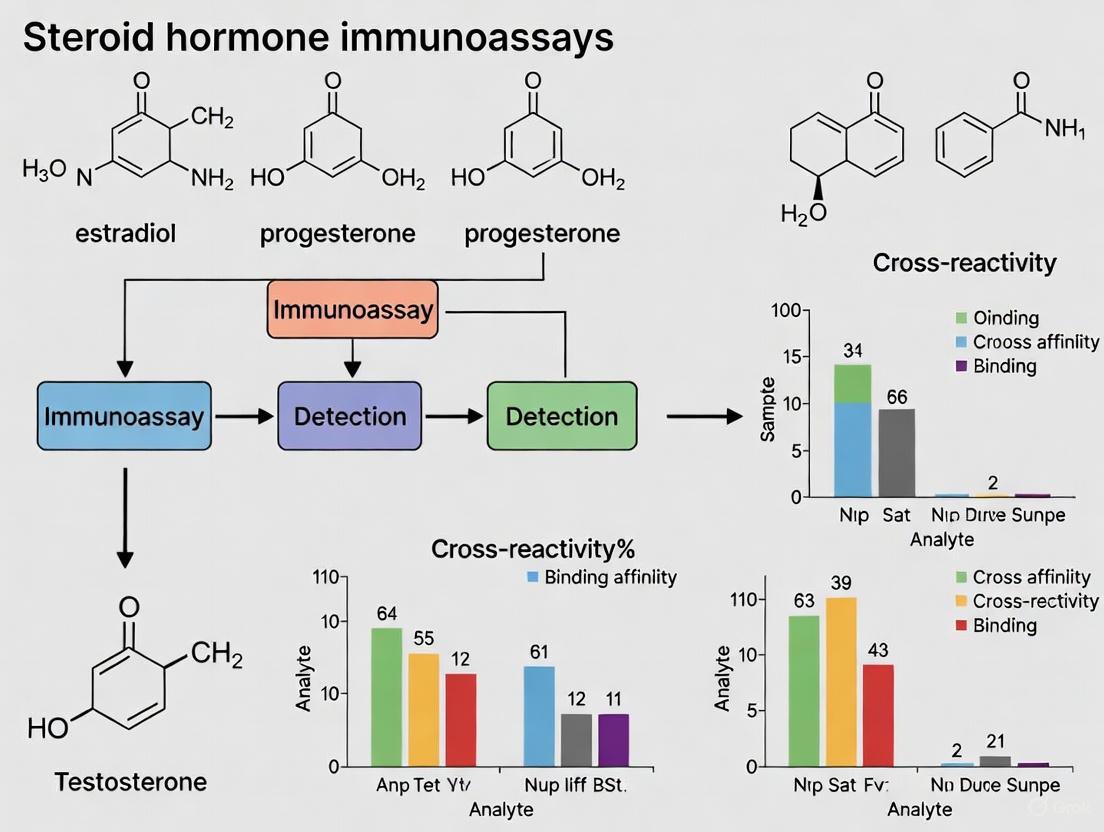
Steroid hormone immunoassays are indispensable in clinical and research settings but are frequently compromised by cross-reactivity, leading to inaccurate results and potential misdiagnosis.
Navigating Steroid Hormone Immunoassay Cross-Reactivity: From Mechanistic Insights to Advanced Troubleshooting
Abstract
Steroid hormone immunoassays are indispensable in clinical and research settings but are frequently compromised by cross-reactivity, leading to inaccurate results and potential misdiagnosis. This article provides a comprehensive framework for understanding, identifying, and resolving cross-reactivity issues. It explores the foundational principles of structural similarity driving antibody cross-reactivity, details methodological approaches for its detection and prediction, and outlines systematic troubleshooting protocols. Furthermore, it validates liquid chromatography-tandem mass spectrometry (LC-MS/MS) as a definitive comparative method for confirmation and high-complexity testing. Designed for researchers, scientists, and drug development professionals, this guide synthesizes current evidence and best practices to enhance the reliability of steroid hormone data in both development and diagnostic pipelines.
Understanding the Core Problem: The Science Behind Immunoassay Cross-Reactivity
Fundamental Principles of Competitive and Sandwich Immunoassays
Immunoassays are biochemical tests that measure the presence or concentration of a molecule (analyte) in a solution through the use of antibodies or antigens [1]. The two main formats used in research and diagnostics are competitive and sandwich (non-competitive) immunoassays. Their fundamental principles, best suited for different types of analytes, are compared below.
Table 1: Fundamental Comparison of Competitive and Sandwich Immunoassays
| Characteristic | Competitive Immunoassay | Sandwich Immunoassay |
|---|---|---|
| Principle | Labeled and unlabeled analyte compete for a limited number of antibody binding sites [2] [1]. | The analyte is captured between two antibodies, each binding a different epitope [2] [1]. |
| Best For | Small molecules (e.g., steroids, hormones, drugs) [2] [3]. | Large molecules with multiple epitopes (e.g., proteins, cytokines) [2] [3]. |
| Signal Relationship | Signal is inversely proportional to analyte concentration [3]. | Signal is directly proportional to analyte concentration [3]. |
| Sensitivity & Robustness | Less sensitive to some errors; good reproducibility [3]. | Highly sensitive and robust due to two-site binding [3]. |
| Primary Risk | Requires low-concentration reagents for high specificity [4]. | Risk of cross-reactivity and non-specific binding [3]. |
Diagram 1: Workflow comparison of competitive vs. sandwich immunoassays.
Troubleshooting Cross-Reactivity in Steroid Hormone Immunoassays
Frequently Asked Questions (FAQs)
Q1: What is cross-reactivity, and why is it a major concern in steroid hormone research?
Cross-reactivity occurs when an antibody binds to molecules structurally similar to the target analyte, leading to false positives or overestimation of the true hormone concentration [5] [6]. In steroid hormone assays, this is a critical issue because steroids share a common cholesterol-derived backbone and differ only by minor functional groups. This can lead to clinically significant inaccuracies, such as:
- Prednisolone and 6-methylprednisolone producing substantial false elevations in cortisol immunoassays [5].
- 21-Deoxycortisol causing falsely high cortisol readings in patients with 21-hydroxylase deficiency [5].
- Anabolic steroids (e.g., methyltestosterone) interfering with testosterone immunoassays [5].
Q2: Which immunoassay format is more susceptible to cross-reactivity, and how can this be managed?
Competitive immunoassays are generally more susceptible to cross-reactivity because they rely on a single antibody recognizing a single epitope, which might be present on multiple related steroid molecules [7]. The degree of cross-reactivity is not a fixed property of the antibody; it can be modulated by the assay conditions. Using lower concentrations of antibodies and labeled antigens can make a competitive assay more specific and reduce cross-reactivity [4].
Q3: How can I experimentally investigate potential cross-reactivity in my assay?
To systematically evaluate cross-reactivity, follow this spiking protocol [5]:
- Prepare Solutions: Spike a range of physiologically relevant concentrations of the suspected cross-reactant into a pooled, analyte-free matrix (e.g., steroid-stripped serum or plasma).
- Run the Assay: Analyze these spiked samples alongside your standard calibrators.
- Calculate % Cross-Reactivity: Use the formula:
% Cross-Reactivity = (Observed Apparent Analyte Concentration / Actual Cross-Reactant Concentration) × 100[5].
Q4: My immunoassay results for mouse serum estradiol are inconsistent. What could be wrong?
This is a common pitfall. Many commercial immunoassay kits are designed and validated for human serum. Using them for other sample types (e.g., mouse serum) or matrices (e.g., cell culture media) without re-validation can yield unreliable results. Always perform a spike-and-recovery experiment and parallelism (serial dilution) in your specific sample matrix to confirm the assay's performance [8] [9].
Q5: What is the "Prozone effect," and could it affect my sandwich assay?
The Prozone effect (or hook effect) is a phenomenon in one-step sandwich assays where an extremely high concentration of analyte saturates both the capture and detection antibodies, preventing the formation of the "sandwich" complex. This leads to a falsely low signal and underestimated concentration [7]. If you suspect this, always rerun the assay at multiple sample dilutions; if the measured concentration increases with dilution, the Prozone effect is likely present.
Troubleshooting Guide: Common Interference Scenarios
Table 2: Troubleshooting Common Immunoassay Interferences
| Problem | Possible Cause | Solution |
|---|---|---|
| Falsely High Result | Cross-reactivity from structurally similar steroids or drugs [5] [7]. | 1. Use an LC-MS/MS method for confirmation [8].2. Switch to a more specific monoclonal antibody [6].3. Use a heterologous assay format [4]. |
| Falsely Low Result | Prozone effect (in sandwich assays) [7]; or interfering substances (e.g., hemolysis, lipids) [7]. | Rerun the sample at multiple serial dilutions. If the measured concentration increases, Prozone is confirmed [7]. |
| Poor Reproducibility | Matrix effects from different sample types (serum vs. plasma vs. culture media) [9]. | Validate the assay in your specific sample matrix using spike-and-recovery and parallelism tests [9]. |
| High Background Noise | Non-specific binding of antibodies [9]. | Optimize the composition and concentration of the blocking buffer (e.g., BSA, casein, host serum) during assay development [9]. |
Diagram 2: Logical flowchart for diagnosing immunoassay interference.
Essential Reagents and Experimental Protocols
The Scientist's Toolkit: Key Research Reagent Solutions
Table 3: Essential Materials for Immunoassay Development
| Reagent / Material | Function / Explanation | Example Uses & Notes |
|---|---|---|
| Monoclonal vs. Polyclonal Antibodies | Monoclonal: Single epitope specificity, higher selectivity. Polyclonal: Multiple epitopes, can increase signal but risk cross-reactivity [6]. | Use monoclonal for capture in sandwich assays to ensure specificity. Polyclonals can be used for detection for signal amplification [6]. |
| Blocking Buffers | Proteins (e.g., BSA, casein) or serums used to coat unused binding sites on the solid phase to minimize non-specific binding and background noise [9]. | A poorly optimized blocking buffer is a major source of high background. Test different blockers during assay development [9]. |
| Matrix Diluent | The analyte-free solution used to dilute standards and samples. It should mimic the sample matrix to avoid differential matrix effects [9]. | For serum samples, use stripped serum or a buffered protein solution. Never dilute standards in plain assay buffer if samples are in serum [9]. |
| Enzyme Labels & Substrates | Enzymes like HRP or ALP are conjugated to detection antibodies. Their reaction with a substrate produces a measurable signal (color, light) [9] [1]. | Chemiluminescent substrates generally offer higher sensitivity than colorimetric ones (e.g., TMB) [2] [9]. |
Detailed Protocol: Spiking Experiment for Cross-Reactivity Assessment
This protocol is adapted from established guidelines for immunoassay interference testing [5].
Objective: To determine the percent cross-reactivity of a suspected compound in your steroid hormone immunoassay.
Materials:
- Stock solution of the pure target steroid (analyte).
- Stock solution of the pure suspected cross-reactant.
- Analyte-free matrix (e.g., charcoal-stripped serum or assay buffer).
- Your standard immunoassay kit or reagents.
Method:
- Prepare Calibrators: Prepare a standard calibration curve of your target analyte in the analyte-free matrix according to your assay's protocol.
- Prepare Cross-Reactant Samples: Spike the suspected cross-reactant into the same analyte-free matrix at a minimum of five concentrations covering the expected physiological or pathological range. For example, if studying cortisol cross-reactivity with prednisolone, prepare prednisolone concentrations from 0.1 to 100 µg/mL [5].
- Run the Assay: Analyze all calibrators and cross-reactant samples in the same run, preferably in duplicate.
- Data Analysis:
- Calculate the apparent concentration of the target analyte for each cross-reactant sample using the standard curve.
- For each cross-reactant concentration, calculate the percent cross-reactivity:
% Cross-Reactivity = (Apparent Analyte Concentration / Actual Cross-Reactant Concentration) × 100[5]. - The overall cross-reactivity for the compound is often reported as the value at the concentration that gives 50% inhibition (IC50) in a competitive assay, but a range or an average can also be informative.
Interpretation: A cross-reactivity value above 0.5-1% is often considered potentially clinically significant, depending on the normal concentration ranges of the target and cross-reactant [5].
Structural Similarity as the Primary Driver of Cross-Reaction
Why Do Cross-Reactions Occur in Steroid Hormone Immunoassays?
Cross-reactivity in immunoassays refers to the phenomenon where an antibody binds to an antigen that is structurally similar, but not identical,, to the target it was raised against [10]. In the context of steroid hormone immunoassays, this is a significant limitation because the immune system's ability to discriminate between antigens is determined by the precise molecular fit between an antibody's paratope (binding site) and an antigen's epitope (the specific region of the antigen that is recognized) [11].
Structurally similar steroid hormones can bind to the same paratope if they share key molecular features. An epitope typically involves about 15 amino acids, but only about 5 of these contribute most of the binding energy [11]. Similarly, an antibody's paratope is also comprised of about 15 amino acids, with a similar subset responsible for the strength of the interaction [11]. Therefore, if a cross-reacting steroid molecule shares critical functional groups or three-dimensional shape with the target hormone, it can fit into the antibody's binding site and produce a false positive signal [12] [5].
The diagram below illustrates this core concept of structural similarity leading to assay interference.
How Can We Predict and Test for Potential Cross-Reactants?
A key strategy for troubleshooting is to proactively identify compounds with a high potential for cross-reactivity before they cause problems in clinical or research data.
1. Computational Prediction using Molecular Similarity A powerful in silico method for prediction involves calculating the two-dimensional (2D) molecular similarity between a candidate compound and the target steroid hormone [12] [5].
- Methodology: This technique uses "molecular fingerprints"—mathematical representations of a molecule's structure—and compares them using similarity coefficients [12].
- Key Algorithm: A common and effective approach uses MDL public keys (a specific type of 2D fingerprint) with the Tanimoto similarity coefficient [12] [5]. The Tanimoto coefficient ranges from 0 (maximally dissimilar) to 1 (identical).
- Interpretation: Research on steroid hormone assays has shown that compounds with high cross-reactivity (≥5%) almost always have a Tanimoto similarity to the target hormone of 0.867 or higher [5]. This provides a quantitative threshold for prioritizing compounds for experimental testing.
2. Experimental Validation of Cross-Reactivity Computational predictions must be confirmed with laboratory experiments. The standard method for quantifying cross-reactivity in competitive immunoassays is as follows [4] [5]:
- Procedure:
- Prepare samples spiked with known concentrations of the potential cross-reactant.
- Run these samples through the immunoassay and record the apparent concentration of the target steroid.
- Calculate the percent cross-reactivity using the formula:
% Cross-reactivity = [IC₅₀ (Target Analyte) / IC₅₀ (Tested Cross-Reactant)] × 100%Here, IC₅₀ is the concentration that causes a 50% decrease in the assay's signal [4].
- Classification: Results are often categorized for interpretation [5]:
- Strong Cross-Reactivity: ≥ 5%
- Weak Cross-Reactivity: 0.5% - 4.9%
- Very Weak Cross-Reactivity: 0.05% - 0.49%
- Not Cross-Reactive: < 0.05%
The following table summarizes experimental cross-reactivity data for common interferents in cortisol and testosterone immunoassays, illustrating the link between high structural similarity and significant interference.
| Target Assay | Cross-Reactant | Reported Cross-Reactivity | Potential Clinical Impact |
|---|---|---|---|
| Cortisol | Prednisolone | ≥ 5% [5] | Falsely elevated cortisol in patients on this medication [5] |
| Cortisol | 6-Methylprednisolone | ≥ 5% [5] | Falsely elevated cortisol in patients on this medication [5] |
| Cortisol | 21-Deoxycortisol | ≥ 5% [5] | False positives in 21-hydroxylase deficiency [5] |
| Testosterone | Methyltestosterone | ≥ 5% [5] | Falsely elevated testosterone in users of this anabolic steroid [5] |
| Testosterone | Danazol | Data varies by assay [13] | Can cause overestimation [13] |
| Testosterone | DHEA-S | Reported in some assays [5] | Can cause overestimation [5] |
Which Experimental Factors Can Alter Cross-Reactivity?
Cross-reactivity is not an immutable property of the antibody alone; it can be significantly influenced by assay design and conditions [4]. Understanding this is crucial for troubleshooting.
- Assay Format and Reagent Concentration: Research has demonstrated that the same antibody can show different cross-reactivity profiles in different assay formats (e.g., fluorescence polarization immunoassay vs. enzyme immunoassay). Assays with sensitive detection and low concentrations of antibodies and reagents tend to be more specific and show lower cross-reactivity. This is because low-affinity interactions (which cause cross-reactivity) are less favored under these conditions [4].
- Incubation Time: Shorter contact or incubation times can favor the specific, high-affinity binding between the antibody and its intended target, while minimizing the opportunity for lower-affinity cross-reactive binding to occur [6].
The workflow below integrates both computational prediction and experimental optimization for a comprehensive troubleshooting approach.
The Scientist's Toolkit: Research Reagent Solutions
The following table details key reagents and tools essential for studying and mitigating cross-reactivity.
| Tool / Reagent | Function in Troubleshooting Cross-Reactivity |
|---|---|
| MDL Public Keys / FCFP_6 | 2D molecular fingerprinting algorithms used to compute structural similarity to the target hormone [12]. |
| Tanimoto Coefficient | A statistical metric for comparing molecular fingerprints; provides a quantitative score for structural similarity [12] [5]. |
| Heterophilic Blocking Tubes (HBT) | Contain blocking agents to neutralize heterophilic antibody interference, which is a different type of interference from structural cross-reactivity but a common confounding factor [13]. |
| Liquid Chromatography-Tandem Mass Spectrometry (LC-MS/MS) | A highly specific reference method used to confirm immunoassay results and definitively identify cross-reactivity [13] [14]. |
| Monoclonal vs. Polyclonal Antibodies | Monoclonal antibodies generally offer higher specificity for a single epitope, while polyclonal antibodies can be more sensitive but also more prone to cross-reactivity [6]. |
How Do I Confirm a Suspected False Positive?
When you encounter an unexpected or clinically inconsistent result, follow this confirmation pathway:
- Investigate: Compare the result with the patient's clinical picture and medication history. Look for known cross-reactants [13] [5].
- Test with Blocking Agents: Use heterophilic blocking tubes (HBT) to rule out interference from heterophilic antibodies. A significant change in the measured value after HBT treatment indicates this type of interference [13].
- Confirm with a Gold Standard: Send the sample for analysis by liquid chromatography-tandem mass spectrometry (LC-MS/MS). LC-MS/MS separates analytes based on their mass and charge, providing superior specificity and is the recommended method for verifying immunoassay results affected by cross-reactivity [13] [14].
What Are the Final Best Practices for Managing Cross-Reactivity?
- Know Your Assay's Limitations: Always consult the manufacturer's package insert for published cross-reactivity data, but be aware that the list is not exhaustive [12] [5].
- Predict Proactively: Use computational 2D similarity modeling during assay development or validation to flag high-risk compounds for testing [12].
- Optimize Assay Conditions: If possible, fine-tune reagent concentrations and incubation times to maximize specificity [4] [6].
- Establish a Confirmatory Pathway: Have a protocol in place, such as sending samples for LC-MS/MS analysis, to investigate any suspect results [13] [14].
Immunoassays are powerful tools for hormone quantification, but their accuracy can be compromised by endogenous interferents—substances naturally present in a patient's sample that are structurally similar to the target analyte. These interferents include precursors, metabolites, and analytes that accumulate in specific disease states. They bind to assay antibodies despite being different from the target hormone, leading to false-positive or falsely elevated results [15] [5]. For researchers and clinicians, recognizing and troubleshooting this interference is critical to avoid misdiagnosis and inappropriate treatment decisions [15] [16]. This guide provides a structured approach to identifying and resolving these challenges within the broader context of troubleshooting cross-reactivity in steroid hormone immunoassay research.
Frequently Asked Questions (FAQs)
FAQ 1: What are the most clinically significant endogenous interferents in cortisol and testosterone immunoassays?
The clinical significance of an interferent depends on its degree of cross-reactivity and its potential concentration in the patient's sample. The following table summarizes key endogenous interferents for cortisol and testosterone assays.
Table 1: Clinically Significant Endogenous Interferents in Common Steroid Hormone Immunoassays
| Target Assay | Endogenous Interferent | Clinical Context for Interference | Estimated Impact |
|---|---|---|---|
| Cortisol | 21-Deoxycortisol | 21-Hydroxylase deficiency (can accumulate to very high concentrations) | Can produce clinically relevant false elevations [5] |
| 11-Deoxycortisol | 11β-Hydroxylase deficiency; post-metyrapone challenge | May produce clinically relevant false elevations [5] | |
| 6β-Hydroxycortisol | Normal metabolite | Lower clinical significance [5] | |
| Testosterone | Dehydroepiandrosterone sulfate (DHEA-S) | Particularly in females and children | Can cause false positives or overestimation [15] [5] [16] |
| Other fetal and placental steroids | In females and children | Can lead to inaccurate results [15] |
FAQ 2: How does the structure of a molecule relate to its potential for cross-reactivity?
Compounds that produce cross-reactivity in steroid hormone immunoassays almost universally share a high degree of structural similarity to the target hormone [5]. The antibody's binding site, which is specific for the target, may have sufficient flexibility to accommodate molecules with similar ring structures, functional groups, or side chains. Two-dimensional molecular similarity calculations can help predict this cross-reactivity, as compounds with high similarity scores are more likely to interfere [5].
FAQ 3: What are the best strategies to confirm and resolve suspected endogenous interference?
When an immunoassay result is clinically implausible, follow this troubleshooting workflow to investigate endogenous interference:
Detailed Protocols:
- Repeat Analysis with an Alternative Methodology: The most definitive approach is to re-analyze the sample using a method with higher specificity. Liquid chromatography-tandem mass spectrometry (LC-MS/MS) is considered the gold standard as it physically separates the target analyte from interferents before detection, virtually eliminating cross-reactivity [5] [16].
- Sample Pre-Treatment: For immunoassay-based confirmation, techniques like sample dilution or extraction (e.g., organic solvent or solid-phase extraction) can be used. These methods may reduce the concentration of the interferent relative to the analyte, though their efficacy is variable [6].
- Consult Manufacturer's Data: Always review the assay's package insert for detailed cross-reactivity studies of known precursors and metabolites. This can provide the first clue to a potential interferent [5].
FAQ 4: Can the design of the immunoassay itself influence susceptibility to interference?
Yes, the assay format and reagent concentrations significantly impact cross-reactivity. Competitive immunoassays, typically used for small molecules like steroids, are generally more susceptible to cross-reaction than non-competitive sandwich assays [15]. Furthermore, research has demonstrated that cross-reactivity is not an immutable property of the antibodies used. Assays utilizing lower concentrations of antibodies and reagents can demonstrate higher specificity and lower cross-reactivity compared to formats requiring higher reagent concentrations, even when using the same antibodies [4].
The Scientist's Toolkit: Key Research Reagent Solutions
When designing or troubleshooting immunoassays for steroid hormones, the selection of reagents is paramount. The following table outlines essential tools and their functions in managing cross-reactivity.
Table 2: Key Research Reagents for Managing Immunoassay Cross-Reactivity
| Reagent / Tool | Function in Troubleshooting | Key Consideration |
|---|---|---|
| Monoclonal Antibodies (mAb) | Provide high specificity by recognizing a single epitope; ideal as a capture antibody to establish assay specificity. | Lower sensitivity compared to polyclonals, as only one antibody binds per antigen [6]. |
| Polyclonal Antibodies (pAb) | A pool of antibodies that bind multiple epitopes; can offer higher sensitivity but may increase cross-reactivity risk. | The epitope is less well-defined, raising the potential for cross-reaction with structurally similar molecules [6]. |
| LC-MS/MS Reference Method | The gold-standard for confirmation; provides high specificity by chromatographically separating analytes prior to detection. | Requires specialized, expensive instrumentation and technical skill [5] [16]. |
| Biotin-Streptavidin System | Common separation system used in automated immunoassays. | Itself susceptible to interference from endogenous biotin and anti-streptavidin antibodies [15] [16]. |
| Two-Dimensional Molecular Similarity Analysis | A computational tool to predict potential cross-reactivity by comparing structural similarity to the target hormone. | Useful for triaging compounds for future experimental testing of assay cross-reactivity [5]. |
Troubleshooting Guides
Guide 1: Addressing Suspected Cross-reactivity in Immunoassays
Problem: A researcher obtains an unexpectedly high steroid hormone measurement that does not align with the clinical or experimental context. The sample is suspected to contain synthetic steroids that may be cross-reacting with the assay antibodies.
Investigation Protocol:
- Verify Result Consistency: First, repeat the analysis on the original sample to rule-out an analytical error. Check internal and external quality control data to ensure the assay is performing as expected [17].
- Review Sample and Protocol: Confirm there were no preanalytical errors, such as the use of an incorrect sample tube (e.g., certain separators gels can adsorb progesterone), improper sample mixing, or inadequate clotting time for serum samples [17].
- Perform a Serial Dilution: Dilute the sample with an appropriate matrix (e.g., assay diluent or steroid-free serum) and re-analyze. A non-linear result (lack of parallelism with the standard curve) strongly suggests interference [16].
- Spike-and-Recovery Experiment: Spike a known amount of the pure target analyte into the patient sample and a control matrix. A significantly lower recovery in the patient sample indicates the presence of an interferent [18] [17].
- Use a Blocking Reagent: Treat the sample with a commercially available blocking reagent (e.g., heterophile blocking tubes) prior to analysis. A significant change in the measured value after treatment suggests interference from heterophile antibodies or human anti-animal antibodies [18] [17].
- Confirm with an Alternative Method: The most definitive step is to re-analyze the sample using a method with higher specificity, such as liquid chromatography-tandem mass spectrometry (LC-MS/MS). Concordant results between the immunoassay and LC-MS/MS indicate a true positive, while a discrepancy confirms immunoassay interference [19] [20].
Guide 2: Validating Immunoassay Specificity Against New Synthetic Steroids
Problem: A drug development team is testing a novel synthetic glucocorticoid and needs to ensure it does not cross-react with common clinical immunoassays, or needs to understand its potential to interfere.
Experimental Protocol for Cross-reactivity Testing:
Preparation of Spiked Samples:
- Obtain a pool of steroid-free human serum or plasma to use as the base matrix.
- Prepare a concentrated stock solution of the test compound (synthetic steroid) in a suitable solvent (e.g., methanol, DMSO), ensuring the final solvent concentration in the sample is low enough (<1-2%) not to affect the assay.
- Spike the matrix with the test compound at multiple concentrations, covering the expected pharmacological range and exceeding it by at least an order of magnitude [19] [21].
- Include a blank sample (matrix only) and a calibrator sample spiked with the pure target analyte.
Analysis and Calculation:
- Analyze all spiked samples in duplicate using the commercial immunoassay under validation, following the manufacturer's instructions.
- Calculate the percent cross-reactivity for each concentration of the test compound using the formula: Cross-reactivity (%) = (Measured Concentration of Target Analyte / Actual Concentration of Test Compound) × 100 [19]
- A cross-reactivity of ≥5% is generally considered strong and likely to be clinically significant, while <0.05% is typically considered non-significant [19].
Data Interpretation:
- Cross-reactivity is not constant and can be concentration-dependent. It is crucial to test across a wide range of concentrations.
- Compare the calculated cross-reactivity against the known pharmacokinetic profile of the test compound. A low cross-reactivity may still cause interference if the drug reaches very high plasma concentrations [19].
Frequently Asked Questions (FAQs)
FAQ 1: Which exogenous compounds most commonly cause cross-reactivity in cortisol and testosterone immunoassays?
Common interferents include synthetic glucocorticoids and anabolic steroids, often due to their high structural similarity to the endogenous hormones. The table below summarizes key data for Roche Elecsys assays [19].
Table 1: Clinically Significant Cross-Reactivity in Roche Elecsys Immunoassays
| Immunoassay | Interfering Compound | Percent Cross-reactivity | Likelihood of Clinical Impact |
|---|---|---|---|
| Cortisol | 6-Methylprednisolone | 249% | High |
| Prednisolone | 148% | High | |
| 21-Deoxycortisol | 45.4% | High in 21-hydroxylase deficiency | |
| 11-Deoxycortisol | 4.6% | High post-metyrapone or in 11β-hydroxylase deficiency | |
| Fludrocortisone | 7.7% | Low | |
| Testosterone | Methyltestosterone | High (exact % not specified) | High |
| Norethindrone | Data Sparse | Potential impact in women | |
| Danazol | Data Sparse | High |
FAQ 2: Beyond cross-reactivity, what other endogenous factors can cause spurious immunoassay results?
Other common sources of interference include:
- Heterophile Antibodies and Human Anti-Animal Antibodies (HAAA): These endogenous antibodies can bind to assay antibodies, causing false elevations or suppressions [18] [16].
- Biotin: High concentrations of biotin (vitamin B7) from supplements can interfere with assays using biotin-streptavidin technology, leading to falsely low or high results depending on the assay format [16].
- High-Dose Hook Effect: In sandwich immunoassays, extremely high analyte concentrations can saturate both capture and detection antibodies, preventing sandwich formation and resulting in a falsely low result [18] [16].
- Sample Matrix Issues: Hemolysis, icterus, and lipemia can interfere with some assays, though modern platforms are generally robust [18] [17].
FAQ 3: When should I consider using mass spectrometry instead of immunoassay for steroid hormone measurement?
Liquid chromatography-tandem mass spectrometry (LC-MS/MS) is the preferred method when:
- The highest level of analytical specificity is required to rule out cross-reactivity [19] [20].
- Measuring steroid hormones in complex matrices like saliva or urine, where cross-reacting metabolites are abundant [20] [22].
- Quantifying multiple steroid hormones simultaneously (multiplexing) [22].
- Validating unexpected or clinically discordant results from an immunoassay [20] [17].
FAQ 4: How can I predict if a new drug candidate might cross-react with an existing steroid hormone immunoassay?
Computational methods can provide initial triage. Studies show that compounds with high cross-reactivity consistently share a high degree of structural similarity (two-dimensional molecular similarity) to the target hormone of the immunoassay [19]. Performing 2D similarity calculations comparing the structure of the new compound to cortisol, testosterone, etc., can help prioritize which compounds warrant experimental testing.
Experimental Workflow and Decision Pathways
The following diagram illustrates the logical workflow for investigating suspected cross-reactivity in a steroid hormone immunoassay, from initial suspicion to resolution.
Figure 1: Cross-reactivity Investigation Workflow.
Research Reagent Solutions
Table 2: Essential Materials for Investigating Immunoassay Interference
| Reagent / Material | Function in Investigation |
|---|---|
| Steroid-Free Serum/Plasma | Serves as a clean matrix for preparing spiked samples in cross-reactivity and recovery experiments [19]. |
| Heterophile Blocking Reagent | Contains inert animal serum antibodies to neutralize heterophile antibodies and HAAA in patient samples, helping to identify this type of interference [18] [17]. |
| Pure Analytical Standards | High-purity compounds (e.g., prednisolone, methyltestosterone) used to spike into matrices to experimentally determine cross-reactivity percentages [19] [21]. |
| Solid-Phase Extraction (SPE) Cartridges | Used for sample cleanup prior to immunoassay or LC-MS/MS, particularly for complex matrices like urine, to remove salts and other interfering components [20] [22]. |
| LC-MS/MS System | Provides a highly specific reference method for confirming analyte concentration and verifying immunoassay results. Essential for definitive interference testing [19] [20] [22]. |
This technical support center is designed for researchers and scientists engaged in the development and application of steroid hormone immunoassays. A primary challenge in this field is assay cross-reactivity, where antibodies bind to structurally similar molecules other than the target analyte, leading to inaccurate results [23]. When these inaccurate assays are translated to clinical settings, the consequences can be severe, including patient misdiagnosis and the initiation of inappropriate treatments [15] [18]. This guide provides a structured, troubleshooting approach to identifying, understanding, and mitigating these risks during the research and development phase.
The following sections present real-world scenarios in an FAQ format, detailing the interference mechanism, clinical consequence, and, crucially, the experimental protocols you can implement to detect and prevent such issues.
Frequently Asked Questions (FAQs) and Case Studies
FAQ 1: How can synthetic glucocorticoids lead to falsely elevated cortisol readings?
- Scenario: A clinical trial subject receiving high-dose prednisolone for an inflammatory condition shows abnormally high cortisol levels in an immunoassay, despite clinical signs of suppression of the natural cortisol axis.
- Interference Mechanism: This is a classic case of cross-reactivity. The antibody in the cortisol immunoassay cannot sufficiently distinguish between the target molecule (cortisol) and the structurally similar synthetic glucocorticoid, prednisolone [5] [15]. The assay recognizes both molecules, generating a falsely elevated signal.
- Clinical Consequence: Misinterpretation of the result could lead to an incorrect diagnosis of Cushing's syndrome or mask a true adrenal insufficiency, potentially causing the continuation or inappropriate adjustment of steroid therapy.
- Troubleshooting Guide:
- Suspect this interference when a patient on synthetic steroids has cortisol results that contradict the clinical picture.
- Confirmatory Experiment: Re-analyze the sample using a reference method, such as liquid chromatography-tandem mass spectrometry (LC-MS/MS), which separates analytes based on mass and charge, effectively eliminating antibody-based cross-reactivity [5] [16].
- Preventive R&D Action: During assay development, extensively test the cross-reactivity of the candidate antibody against a panel of common synthetic steroids and their metabolites. Assays with unacceptably high cross-reactivity (>5%) should be redesigned [5].
FAQ 2: Why does a female patient with virilizing symptoms have a normal immunoassay testosterone result?
- Interference Mechanism: This may be due to the "high-dose hook effect." In a sandwich immunoassay, extremely high concentrations of the analyte (e.g., testosterone from a virilizing tumor) can saturate both the capture and detection antibodies. This prevents the formation of the antibody-antigen-antibody "sandwich" complex, leading to a falsely low or normal signal [16] [24].
- Clinical Consequence: A serious condition, such as an androgen-secreting tumor, could be missed, leading to delayed diagnosis and treatment.
- Troubleshooting Guide:
- Suspect the hook effect when a patient with clear clinical symptoms of hormone excess has unexpectedly low or normal measured levels from a sandwich immunoassay.
- Confirmatory Experiment: Repeat the analysis using a serial dilution of the patient sample (e.g., 1:10, 1:100). If the measured concentration increases proportionally with dilution, the hook effect is confirmed [16] [24].
- Preventive R&D Action: Manufacturers should characterize the dynamic range of their assays and establish protocols for automatic sample dilution when signals are at the upper or lower extremes.
FAQ 3: How can anabolic steroid use affect testosterone monitoring in sports medicine?
- Scenario: An athlete tested for testosterone levels shows a positive result, but subsequent confirmation by mass spectrometry is negative.
- Interference Mechanism: Several anabolic steroids (e.g., methyltestosterone, nandrolone) and precursors (e.g., DHEA sulfate) can cross-react with antibodies in testosterone immunoassays [5] [16]. The assay reports the total immunoreactive signal, which includes these cross-reactants.
- Clinical/Research Consequence: This can lead to a false-positive finding, with significant repercussions for the athlete. In a research setting, it corrupts data on endogenous hormone levels.
- Troubleshooting Guide:
- Suspect cross-reactivity when results from an immunoassay are incongruent with a subject's clinical status or other biochemical markers.
- Confirmatory Experiment: Utilize a highly specific method like LC-MS/MS to differentiate and quantify the individual steroids present [5].
- Preventive R&D Action: For methods intended to monitor androgens in populations where anabolic steroid use is possible, select or develop assays with demonstrated low cross-reactivity against a comprehensive panel of these compounds [5].
Troubleshooting Guide: Key Experimental Protocols
This section provides detailed methodologies for experiments critical to identifying and characterizing cross-reactivity.
Protocol 1: Determining Percent Cross-Reactivity
Purpose: To quantitatively evaluate the specificity of an immunoassay antibody against structurally similar compounds [5] [23].
Materials:
- Purified target analyte and potential cross-reactants
- Test immunoassay kit
- Appropriate matrix (e.g., hormone-stripped serum or plasma)
Method:
- Prepare a calibration curve of the target analyte in the chosen matrix.
- Separately, prepare a series of solutions with increasing concentrations of the potential cross-reactant in the same matrix.
- Run all samples in the test immunoassay according to the manufacturer's protocol.
- For the target analyte, determine the concentration that produces the half-maximal signal (IC₅₀).
- For the cross-reactant, determine its IC₅₀ value from its dose-response curve.
Calculation:
Percent Cross-Reactivity = (IC₅₀ of Target Analyte / IC₅₀ of Cross-Reactant) × 100% [4]
Interpretation: A high percent cross-reactivity indicates a high potential for that compound to cause interference in the assay.
Protocol 2: Investigating the High-Dose Hook Effect
Purpose: To determine if a sandwich immunoassay produces falsely low results at extremely high analyte concentrations [16] [24].
Materials:
- Patient sample with suspected high analyte concentration
- Assay diluent
Method:
- Run the patient sample neat (undiluted) as per standard protocol.
- In parallel, prepare a series of dilutions of the sample (e.g., 1:10, 1:100) using the recommended assay diluent.
- Run all diluted samples in the same assay.
- Multiply the result from each diluted sample by its dilution factor to obtain the "calculated initial concentration."
Interpretation: If the calculated initial concentration from the diluted samples is significantly higher (e.g., >20%) than the result from the neat sample, the hook effect is confirmed. The result from the diluted sample that falls within the assay's linear range is the most accurate.
Research Reagent Solutions
The following table details key reagents and their critical functions in developing and troubleshooting robust steroid hormone immunoassays.
| Reagent/Material | Function in Troubleshooting Cross-Reactivity |
|---|---|
| Monoclonal Antibodies | Provide high specificity by recognizing a single epitope, reducing the risk of cross-reactivity with structurally similar compounds compared to polyclonal antibodies [6]. |
| LC-MS/MS Reference Method | Serves as a "gold standard" for confirmation. It separates molecules by mass, providing definitive analyte identification and quantification, free from antibody cross-reactivity [5] [16]. |
| Hormone-Stripped Serum/Plasma | Provides an analyte-free matrix for preparing calibration standards and for spiking studies to test cross-reactivity, ensuring a clean background for method validation [5]. |
| Structurally Related Compounds | A panel of known metabolites, precursors, and common drugs used for cross-reactivity profiling during assay development to identify potential interferents [5] [18]. |
| Biotin Blocking Reagents | Used to neutralize interference from endogenous biotin (common in patient samples) or from high-dose biotin supplements in assays that use a biotin-streptavidin detection system [15] [16]. |
| Heterophile Antibody Blocking Tubes/Reagents | Contain mixtures of animal immunoglobulins or other blocking proteins to prevent false positives/negatives caused by human anti-animal antibodies (HAAA) or heterophile antibodies in samples [18] [16]. |
Visualization of Workflows
Cross-Reactivity Investigation Pathway
This diagram outlines the logical workflow for investigating suspected immunoassay interference in a clinical or research setting.
Cross-Reactivity Investigation Pathway
Steroid Immunoassay Development & Validation
This flowchart depicts the key stages in developing and validating a robust steroid hormone immunoassay, incorporating checks for cross-reactivity.
Steroid Immunoassay Development & Validation
Detecting and Predicting Interference: Analytical and Computational Strategies
Experimental Protocols for Determining Percent Cross-Reactivity
Core Concepts and Definitions
What is percent cross-reactivity and why is it a critical parameter in steroid hormone immunoassays?
Cross-reactivity refers to the tendency of an antibody in an immunoassay to bind to molecules other than the intended target analyte. These interfering molecules are typically structurally similar to the target hormone and can include endogenous compounds, metabolites, or synthetic drugs. Percent cross-reactivity is a quantitative measure of this interference, calculated as the ratio of the observed "steroid" concentration to the amount of test compound added, multiplied by 100. In steroid hormone research, characterizing cross-reactivity is essential because structurally similar steroids can accumulate to high concentrations in certain disease conditions or during drug administration, leading to clinically significant false positives or negatives [5].
What are the primary limitations of immunoassays that make cross-reactivity testing necessary?
Immunoassays, while scalable and compatible with high-throughput analyzers, are limited by:
- Structural Similarity: The molecular structures of many steroid hormones are very similar, making it challenging to generate antibodies that distinguish between them perfectly [25].
- Interference from Endogenous Compounds: In conditions like 21-hydroxylase deficiency, 21-deoxycortisol can accumulate and cross-react with cortisol assays. Similarly, 11-deoxycortisol can interfere following a metyrapone challenge or in 11β-hydroxylase deficiency [5].
- Interference from Drugs: Administration of steroidal drugs like prednisolone or methyltestosterone can cause false positives in cortisol and testosterone immunoassays, respectively [5].
- Reduced Accuracy at Low Concentrations: Immunoassays may struggle to accurately measure hormones present at very low concentrations, a domain where Liquid Chromatography-Tandem Mass Spectrometry (LC-MS/MS) offers superior performance [26] [25].
Standard Experimental Protocol
The following workflow details the established method for determining percent cross-reactivity, based on guidelines from the National Committee for Clinical Laboratory Standards (NCCLS), now the Clinical and Laboratory Standards Institute (CLSI) [5].
Step-by-Step Methodology:
- Sample Preparation: The test compound (the potential interferent) is spiked into a normal human plasma or serum matrix at a known, specific concentration (e.g., 1,000 ng/mL). A control sample of the unadulterated matrix is also prepared [5].
- Immunoassay Analysis: Both the spiked sample and the control sample are run using the immunoassay under investigation, following the manufacturer's specifications [5].
- Calculation: The apparent concentration of the target analyte measured in the spiked sample is used in the following formula: > % Cross-Reactivity = (Observed Analyte Concentration / Amount of Test Compound Added) × 100 [5]
- Categorization: Based on the result, the cross-reactivity is typically categorized as follows:
- Strong Cross-Reactivity: 5% or greater
- Weak Cross-Reactivity: 0.5% to 4.9%
- Very Weak Cross-Reactivity: 0.05% to 0.49%
- Not Cross-Reactive: Less than 0.05% [5]
Troubleshooting Common Scenarios
A known metabolite is suspected of causing a false positive in our cortisol immunoassay. How do we confirm this?
Follow the standard protocol above to test the specific metabolite. For example, experimental testing of the Roche Elecsys Cortisol assay showed that prednisolone and 6-methylprednisolone exhibit strong cross-reactivity (≥5%). This means that in patients administered these drugs, the immunoassay will report a substantial and clinically misleading false elevation of cortisol [5]. Similarly, 21-deoxycortisol shows strong cross-reactivity, which is particularly relevant for patients with 21-hydroxylase deficiency where this steroid accumulates [5].
Our immunoassay results for testosterone in women are inconsistent. What could be the cause?
Cross-reactivity from other steroids, even with weak percentages, can cause significant inaccuracies when measuring low-concentration analytes like testosterone in women. For instance, norethindrone therapy can impact the immunoassay measurement of testosterone in women [5]. Furthermore, DHEA sulfate has been reported to cross-react with some testosterone immunoassays, which could lead to false elevations [5]. In such cases, the high specificity of LC-MS/MS is recommended for accurate quantification [25].
Comparison of Analytical Techniques
When should we consider using LC-MS/MS instead of immunoassay for steroid hormone analysis?
Liquid Chromatography-Tandem Mass Spectrometry (LC-MS/MS) has become the recommended method for steroid quantification when high specificity and sensitivity are required. The following table compares the two methodologies.
| Parameter | Immunoassay | LC-MS/MS |
|---|---|---|
| Specificity & Cross-reactivity | Low to moderate; prone to cross-reactivity from structurally similar compounds [5] [27]. | Very high; physically separates and identifies compounds based on mass, virtually eliminating cross-reactivity [26] [25]. |
| Sensitivity (LOD) | Varies; often struggles at very low (pediatric/Postmenopausal) concentrations [25]. | Superior; can detect steroids at sub-ng/mL to pg/mL levels (e.g., 0.05–0.5 ng/mL) [26]. |
| Multiplexing Capability | Typically single-analyte or a small panel. | High; can quantify multiple steroids (e.g., 19 steroids) in a single run [26]. |
| Throughput & Cost | High throughput, lower cost per test, easier to operate. | Lower throughput, higher initial investment and operational expertise, but cost-effective for multiplexing. |
| Ideal Use Case | High-volume screening for single analytes where extreme precision is not critical. | Diagnosis of complex endocrine disorders (e.g., CAH), pediatric testing, research, and confirming immunoassay results [25]. |
Research Reagent Solutions
The table below outlines essential materials and reagents required for conducting cross-reactivity studies and for employing confirmatory LC-MS/MS methods.
| Reagent / Material | Function in Protocol | Technical Notes |
|---|---|---|
| Native Analyte & Interferents | Serves as the target standard and potential cross-reactants for spiking experiments. | Source pure reference standards from reputable suppliers (e.g., Steraloids, Sigma-Aldrich) [5]. |
| Blank Matrix | The biological medium (e.g., plasma, serum, saliva) used to prepare spiked and control samples. | Use pooled human plasma/serum from healthy donors to ensure a representative matrix [5] [22]. |
| Solid-Phase Extraction (SPE) Plates | For sample clean-up and pre-concentration in LC-MS/MS workflows to reduce matrix effects. | Oasis HLB 96-well µElution plates are commonly used for high-throughput steroid analysis [26] [22]. |
| Stable Isotope-Labeled Internal Standards | Used in LC-MS/MS to correct for sample loss during preparation and ionization variability. | Essential for achieving high accuracy and precision in quantitative mass spectrometry [26]. |
| LC-MS/MS System with ESI/USI | The analytical platform for confirmatory testing. Provides separation (LC) and highly specific detection (MS/MS). | UniSpray ionization (USI) may provide a 2- to 2.8-fold higher signal response than Electrospray (ESI) [22]. |
Advanced Workflow: From Immunoassay to Confirmatory LC-MS/MS
For laboratories equipped with both technologies, the following integrated workflow ensures the highest data quality.
Implementing this workflow is particularly critical in specific scenarios:
- Diagnosing Congenital Adrenal Hyperplasia (CAH): The Endocrine Society recommends LC-MS/MS over immunoassays for measuring key adrenal steroids like 17-hydroxyprogesterone due to superior specificity and reduced false-positive rates [25].
- Pediatric and Hypogonadal Testing: Accurate measurement of very low testosterone levels is impossible with most immunoassays due to poor sensitivity and specificity; LC-MS/MS is the required method [26] [25].
- Complex Drug Monitoring: When patients are on steroid medications (e.g., prednisolone), LC-MS/MS can differentiate between the drug and endogenous cortisol, avoiding misinterpretation [5].
Leveraging Package Insert Data and Manufacturer Information
This technical support center provides targeted guidance for researchers troubleshooting cross-reactivity in steroid hormone immunoassays. Cross-reactivity, the recognition of structurally similar compounds by assay antibodies, is a major limitation that can compromise data integrity [19] [15]. The following guides and FAQs offer practical strategies to identify, investigate, and mitigate these issues.
Troubleshooting Guides
Guide 1: How to Systematically Investigate Suspected Cross-Reactivity
Unexpected immunoassay results may indicate interference from cross-reacting compounds. Follow this workflow to identify the source.
Step 1: Verify Pre-analytical Conditions. Before investigating cross-reactivity, rule out pre-analytical errors. Confirm sample type (serum is preferred for many assays), collection timing (critical for hormones with diurnal rhythm), and proper storage conditions [15].
Step 2: Consult the Package Insert. The assay's package insert is the primary resource for manufacturer-tested cross-reactivity data. Extract the percentage cross-reactivity for known structurally similar compounds. Be aware that the breadth of tested compounds varies significantly between manufacturers and assays [19] [28].
Step 3: Check for Known Problematic Compounds. Investigate the presence of specific compounds known for high cross-reactivity in your assay system. The table below lists common offenders in steroid hormone immunoassays.
Step 4: Perform a Spike-and-Recovery Experiment.
- Principle: Determine if a suspected cross-reactant added to a sample causes a disproportionate increase in the measured analyte.
- Protocol:
- Split a well-characterized patient sample or pooled matrix into three aliquots.
- Aliquot A (Baseline): Measure the native analyte concentration.
- Aliquot B (Spiked Analyte): Spike with a known concentration of the pure target analyte.
- Aliquot C (Spiked Cross-reactant): Spike with a known concentration of the suspected cross-reacting compound.
- Measure all aliquots and calculate percent recovery.
- Interpretation: Recovery near 100% in Aliquot B but significantly higher than 100% in Aliquot C indicates substantial cross-reactivity [19].
Step 5: Confirm with a Reference Method. Use a highly specific method like liquid chromatography-tandem mass spectrometry (LC-MS/MS) to confirm the true analyte concentration. A significant discrepancy between the immunoassay and LC-MS/MS results strongly suggests interference [19].
Step 6: Document Findings. Record all investigative steps, experimental data, and conclusions. This is crucial for validating your research findings and informing future experiments.
Guide 2: Designing an Experiment to Assess Cross-Reactivity for a Novel Compound
When working with new chemical entities or compounds not listed in the package insert, use this protocol to empirically determine cross-reactivity.
Experimental Protocol for Determining Percent Cross-Reactivity
- Objective: To quantify the cross-reactivity of an untested compound in a competitive steroid hormone immunoassay.
- Materials:
- The immunoassay platform and reagents.
- Purified target analyte standard.
- Purified cross-reactant standard.
- Appropriate matrix (e.g., charcoal-stripped serum).
- Method:
- Prepare Calibrators: Create a standard calibration curve for the target analyte in the matrix, covering the assay's dynamic range.
- Prepare Cross-reactant Solutions: Prepare a series of solutions in the same matrix with known concentrations of the cross-reacting compound under investigation.
- Run Assay: Measure the apparent "analyte" concentration for each cross-reactant solution using the immunoassay.
- Calculate Cross-Reactivity: For each cross-reactant concentration, calculate the percent cross-reactivity using the formula:
- Determine IC50 Ratio: The most standardized measure is the ratio of the concentrations that cause 50% inhibition of the signal (IC50).
- % Cross-reactivity = IC50 (Target Analyte) / IC50 (Cross-reactant) × 100% [4]
Frequently Asked Questions (FAQs)
Q1: The package insert for my cortisol immunoassay lists over 30 tested compounds. How do I quickly identify which cross-reactivities are clinically significant for my research?
Prioritize compounds based on two factors: the percentage of cross-reactivity and the likelihood of that compound being present at high concentrations in your experimental system [19]. For example, a low-percentage cross-reactivity might be insignificant unless the cross-reactant is present in very high doses. The table below summarizes high-priority cross-reactivities for common steroid assays based on this principle.
Q2: I am getting inconsistent cross-reactivity results for the same antibody pair when I use different assay platforms (e.g., ELISA vs. FPIA). Is this possible?
Yes, this is a documented phenomenon. Cross-reactivity is not an intrinsic property of the antibodies alone but is an integral parameter of the entire assay system [4]. Factors that can alter observed cross-reactivity include:
- Reagent Concentrations: Assays run with lower concentrations of antibodies and labeled tracers often demonstrate higher specificity and lower cross-reactivity.
- Assay Format: The type of label (e.g., enzyme, fluorescent tag) and detection method (e.g., fluorescence polarization, chemiluminescence) can influence the avidity of interactions and thus the degree of cross-reactivity.
- Incubation Times: Shifting from equilibrium to kinetic reaction conditions can change the relative binding of compounds with different affinities [4].
Q3: A drug metabolite in my study samples is causing cross-reactivity. The package insert does not list it. What are my options?
When facing an unlisted cross-reactant, you have several options:
- Contact the Manufacturer: Inquire if they have any unpublished data on the compound. They may have tested it during development.
- Empirical Testing: Use the experimental protocol outlined in Guide 2 to determine the percent cross-reactivity for the metabolite in your specific assay conditions.
- Switch to a More Specific Platform: If the interference is severe and cannot be corrected for, the most robust solution is to transition your analysis to a chromatographic method, such as LC-MS/MS, which provides superior specificity by physically separating the analyte from interferents [19] [15].
Q4: How reliable are computational predictions for allergen cross-reactivity, and can they be applied to steroid hormones?
Computational predictions based on molecular similarity show promise. One study on steroid hormone immunoassays found that all compounds with high cross-reactivity also displayed a high degree of two-dimensional structural similarity to the target hormone [19]. While these calculations are excellent for triaging compounds for future experimental testing, they should not replace empirical validation. The three-dimensional conformation of the molecule and the exact epitope recognized by the antibody are critical factors that simple modeling may not fully capture.
Data Presentation: Clinically Significant Cross-Reactivities
This table consolidates data from cross-reactivity studies to highlight interactions most likely to impact research data. Always confirm with your specific assay's package insert.
Table 1: High-Priority Cross-Reactivities in Steroid Hormone Immunoassays
| Target Analyte | Cross-Reactant | % Cross-Reactivity | Context & Likely Impact |
|---|---|---|---|
| Cortisol | 6-Methylprednisolone | 249% | High impact in patients/administered this drug [19]. |
| Prednisolone | 148% | High impact; common glucocorticoid [19]. | |
| 21-Deoxycortisol | 45.4% | High impact in patients with 21-hydroxylase deficiency where levels are elevated [19]. | |
| 11-Deoxycortisol | 4.6% | High impact during metyrapone challenge or in 11β-hydroxylase deficiency [19] [15]. | |
| Testosterone | Methyltestosterone | Information Missing | Several anabolic steroids can cause clinically significant false positives [19]. |
| Norethindrone | Information Missing | May significantly impact testosterone measurement in women on therapy [19]. |
The Scientist's Toolkit: Essential Research Reagents & Materials
Table 2: Key Reagents for Cross-Reactivity Investigation
| Item | Function in Cross-Reactivity Studies |
|---|---|
| Charcoal-Stripped Serum/Plasma | Provides an analyte-free matrix for preparing calibration standards and spiking solutions without endogenous interference. |
| Pure Target Analyte Standard | Essential for creating the calibration curve and for spike-and-recovery experiments to assess assay accuracy. |
| Pure Cross-reactant Standards | Needed to empirically determine the percent cross-reactivity for specific compounds of interest. |
| Stable Isotope-Labeled Internal Standards | Critical for LC-MS/MS confirmation methods to correct for matrix effects and variability in sample preparation. |
| Monoclonal vs. Polyclonal Antibodies | Understanding the antibody type used in your immunoassay is key; monoclonal antibodies generally offer higher specificity, while polyclonal antibodies may have broader cross-reactivity profiles [29]. |
Immunoassays are a cornerstone of clinical diagnostics, particularly for the measurement of steroid hormones like cortisol, testosterone, and estradiol. A significant limitation of these assays is cross-reactivity, where structurally similar compounds interfere by binding to the assay antibodies, leading to false positives or inaccurate quantitation [19]. Interfering molecules can include endogenous steroid precursors, metabolites, or administered drugs such as synthetic glucocorticoids and anabolic steroids [19].
Two-dimensional (2D) molecular similarity analysis is a computational technique that helps predict this cross-reactivity. It is based on the principle that a compound is more likely to cross-react with an immunoassay if it shares a high degree of structural similarity with the target molecule (hapten) used to generate the assay antibodies [12]. This method provides a fast, in silico tool to triage compounds for future testing, potentially identifying cross-reacting compounds that might otherwise go unsuspected [19].
Frequently Asked Questions (FAQs) & Troubleshooting
Q1: What are the most common causes of clinically significant cross-reactivity in steroid hormone immunoassays? Clinically significant cross-reactivity often arises from two main sources:
- Structurally Similar Drugs: For example, prednisolone and 6-methylprednisolone show high cross-reactivity (148% and 249%, respectively) in cortisol immunoassays, which can lead to falsely elevated cortisol readings in patients administered these drugs [19]. Similarly, several anabolic steroids (e.g., methyltestosterone) can cause false positives in testosterone immunoassays [19].
- Endogenous Compounds in Disease States: In patients with 21-hydroxylase deficiency, 21-deoxycortisol can accumulate and produce clinically relevant cross-reactivity for cortisol assays. Likewise, 11-deoxycortisol can interfere in patients with 11β-hydroxylase deficiency or following a metyrapone challenge [19].
Q2: My immunoassay results for a patient do not match the clinical presentation. What could be the cause, and how can I investigate? A discrepancy between laboratory results and clinical findings is a classic indicator of potential assay interference.
- Potential Causes:
- Cross-reactivity: The patient may be taking a medication or have an endogenous compound that cross-reacts with the assay [19] [13].
- Heterophilic Antibodies: These are human antibodies that can interfere with immunoassays, leading to falsely elevated or depressed results. Cases of falsely elevated testosterone due to heterophilic antibodies have been reported, leading to unnecessary investigations and misdiagnosis [13].
- Investigation Pathway:
- Verify the patient's medication history.
- Use a different immunoassay method, if available, as cross-reactivity profiles can vary between manufacturers [13].
- Treat the sample with a heterophilic blocking tube (HBT) to see if the measured value changes [13].
- Confirm the result using a more specific method, such as liquid chromatography-tandem mass spectrometry (LC-MS/MS), which is less susceptible to these interferences [14] [13].
Q3: How can I predict if a new drug compound might cross-react with an existing steroid hormone immunoassay? Two-dimensional molecular similarity analysis is a key tool for this prediction.
- Methodology: The process involves calculating the structural similarity between the new drug compound and the target steroid of the immunoassay. This is typically done using molecular fingerprints and the Tanimoto similarity coefficient [19] [12].
- Interpretation: A high Tanimoto similarity score (closer to 1) suggests a high risk of cross-reactivity. Studies have shown that all compounds with high cross-reactivity also demonstrate a high degree of 2D molecular similarity to the target hormone [19]. This computational approach can help prioritize compounds for empirical cross-reactivity testing.
Q4: Is cross-reactivity a fixed property of an immunoassay? No, cross-reactivity is not an intrinsic, fixed property of the antibodies used. It can be modulated by the format and conditions of the immunoassay [4].
- Assay Format and Reagent Concentration: Research has demonstrated that shifting to an assay format with sensitive detection and lower concentrations of antibodies and competing antigens can result in lower cross-reactivity (i.e., higher specificity). For example, changing the format and reagent concentrations decreased cross-reactivities by up to five-fold for sulfonamide and fluoroquinolone immunoassays [4].
- Practical Implication: This means that the selectivity of an immunodetection system can be influenced without the need to develop new antibodies, simply by optimizing the assay conditions [4].
Experimental Protocols & Workflows
Protocol for Predicting Cross-Reactivity Using 2D Similarity Analysis
This protocol outlines the steps for computationally predicting potential cross-reactive compounds for a steroid hormone immunoassay [19] [12].
Step 1: Define the Target Molecule
- Identify the specific steroid hormone (e.g., cortisol, testosterone) that is the target of the immunoassay. Obtain its chemical structure in a standard format (e.g., SMILES, SDF).
Step 2: Create a Database of Test Compounds
- Compile a database of structures for compounds you wish to test for potential cross-reactivity. This may include:
- Common prescription and over-the-counter drugs.
- Known metabolites of the target hormone and related steroids.
- Illicit drugs and anabolic steroids.
- Endogenous compounds that are structurally related.
Step 3: Calculate Molecular Fingerprints
- Using cheminformatics software (e.g., Discovery Studio, MOE, or open-source tools like RDKit), generate 2D molecular fingerprints for both the target molecule and all test compounds.
- Common fingerprint types include:
Step 4: Compute Similarity Coefficients
- Calculate the pairwise similarity between the target molecule and each test compound using the Tanimoto coefficient. The formula is:
( T(A,B) = \frac{c}{a+b-c} )
Where:
- (a) is the number of bits set in molecule A's fingerprint.
- (b) is the number of bits set in molecule B's fingerprint.
- (c) is the number of common bits set in both fingerprints.
- The Tanimoto coefficient ranges from 0 (maximally dissimilar) to 1 (identical).
Step 5: Interpret the Results
- Rank the test compounds based on their Tanimoto similarity score relative to the target.
- Compounds with high similarity scores (e.g., >0.7) should be prioritized for empirical cross-reactivity testing in the wet-lab immunoassay, as they have a high probability of cross-reacting [19].
The workflow below illustrates the core decision-making process for triaging compounds based on their structural similarity to the assay's target molecule.
Protocol for Empirical Cross-Reactivity Testing
Once compounds are identified computationally, they must be validated experimentally. The following protocol is based on NCCLS Guideline EP7-A [19].
Materials:
- The immunoassay kit and appropriate analyzer.
- Purified standard of the target steroid hormone.
- Purified standards of the test (potential cross-reactive) compounds.
- Normal human plasma or serum (as the matrix).
Procedure:
- Prepare Spiked Samples: Spike the normal human plasma with a series of known concentrations of the test compound. A separate set of samples should be spiked with the target steroid for calibration.
- Run the Assay: Analyze all spiked samples using the immunoassay according to the manufacturer's specifications.
- Calculate Percent Cross-Reactivity:
- For each concentration of the test compound, determine the apparent concentration of the target steroid measured by the assay.
- Percent cross-reactivity is calculated as: ( \text{% Cross-reactivity} = \frac{\text{Apparent concentration of target steroid}}{\text{Actual concentration of test compound}} \times 100 )
Interpretation: Cross-reactivity is often categorized as [19]:
- Strong: ≥ 5% cross-reactivity (high likelihood of clinical significance).
- Weak: 0.5% to 4.9% cross-reactivity.
- Very Weak: 0.05% to 0.49% cross-reactivity.
- Not Cross-Reactive: < 0.05% cross-reactivity.
Data Presentation: Cross-Reactivity Tables
The following tables summarize documented cross-reactivities for common steroid hormone immunoassays, highlighting compounds with the potential for clinically significant interference.
Table 1: Clinically Relevant Cross-Reactivity in Cortisol Immunoassays Compiled data for the Roche Elecsys Cortisol assay [19].
| Compound | Plasma/Serum Concentrations | Cross-Reactivity | Likelihood of Clinical Impact |
|---|---|---|---|
| Prednisolone | Up to 400 ng/mL (pediatric transplant) [19] | 148% | High |
| 6-Methylprednisolone | Up to 1,000 ng/mL (post-dose) [19] | 249% | High |
| 21-Deoxycortisol | Up to 140 ng/mL (21-hydroxylase deficiency) [19] | 45.4% | High in specific deficiencies |
| 11-Deoxycortisol | Up to 250 ng/mL (post-metyrapone) [19] | 4.6% | High in specific deficiencies or tests |
| Corticosterone | 0.18 – 2.0 ng/mL (normal) [19] | 4.6% | Low |
| Canrenone | 10 – 1,000 ng/mL (on spironolactone) [19] | 1.8% | Low, except at peak concentrations |
| 17-Hydroxyprogesterone | Up to 1,005 ng/mL (21-hydroxylase deficiency) [19] | 1.6% | High in specific deficiencies |
Table 2: Interfering Factors in Testosterone Immunoassays Data from multiple sources [19] [13].
| Interfering Factor / Compound | Type of Interference | Effect on Testosterone Measurement |
|---|---|---|
| Methyltestosterone | Cross-reactivity | Falsely elevated |
| Norethindrone | Cross-reactivity | Falsely elevated (particularly in women) [19] |
| Danazol | Cross-reactivity | Overestimated [13] |
| Heterophilic Antibodies | Analytical interference | Falsely elevated or depressed [13] |
| Biotin | Analytical interference (with biotinylated reagents) | Falsely elevated [13] |
The Scientist's Toolkit: Essential Research Reagents & Materials
Table 3: Key Reagents for Cross-Reactivity Investigation
| Item | Function/Brief Explanation |
|---|---|
| Cheminformatics Software (e.g., Discovery Studio, MOE, RDKit) | Used to perform 2D molecular similarity calculations, generate fingerprints, and compute Tanimoto coefficients [12]. |
| Immunoassay Analyzer (e.g., Roche Modular E170, Abbott ARCHITECT) | Platform for running the empirical immunoassays to test for cross-reactivity [19] [13]. |
| Compound Libraries (e.g., Steraloids, Sigma-Aldrich) | Source for purified standard compounds of steroid hormones, metabolites, and potential cross-reactants for spiking experiments [19]. |
| Heterophilic Blocking Tubes (HBT) | Contains blocking reagents to neutralize heterophilic antibody interference in patient samples, helping to identify this type of analytical error [13]. |
| LC-MS/MS System | The gold-standard method for confirming immunoassay results due to its superior specificity. Used to validate true steroid hormone concentrations after interference is suspected [14] [13]. |
| Normal Human Plasma/Serum | Used as a clean matrix for preparing spiked samples in cross-reactivity studies to mimic the patient sample environment [19]. |
The Impact of Assay Format and Reagent Concentration on Specificity
Frequently Asked Questions (FAQs)
1. What is cross-reactivity in immunoassays and why is it a critical issue for steroid hormone research? Cross-reactivity occurs when an antibody binds to structurally similar molecules other than its intended target antigen. This happens due to molecular similarities in epitopes, which are the specific parts of antigens that antibodies recognize [31]. For steroid hormone research, this is particularly problematic because many steroids (like testosterone, progesterone, and estradiol) have very similar chemical structures [32] [18]. This lack of specificity can lead to falsely elevated or falsely low results, compromising data accuracy and leading to incorrect clinical or research conclusions [18].
2. How does changing from a competitive to a sandwich immunoassay format influence specificity? The competitive format is typically used for small molecules like steroid hormones, where the analyte in the sample competes with a labeled analyte for a limited number of antibody binding sites. The sandwich format, used for larger proteins, employs two antibodies for capture and detection. While not directly applicable to most steroids due to their small size, the fundamental difference is that sandwich assays can be more susceptible to interference from heterophilic antibodies, which can bridge the capture and detection antibodies even in the absence of the analyte, causing false positives [18]. Competitive assays, while less prone to this, face greater challenges from cross-reacting steroid metabolites [33].
3. Can I adjust an existing immunoassay to make it more specific without developing a new one? Yes, research indicates that simply shifting to lower concentrations of immunoreagents (antibodies and labeled antigens) can significantly reduce cross-reactivity, making an assay more specific. One study on sulfonamides and fluoroquinolones found that this approach decreased cross-reactivities by up to five-fold [4]. Furthermore, varying the ratio of immunoreactants' concentrations and adjusting the immune interaction time (shifting from equilibrium toward kinetic modes) can also modulate selectivity without the need for new antibodies [4].
4. What are the most common sources of interference in steroid hormone immunoassays? The table below summarizes the primary sources of interference:
Table: Common Sources of Interference in Steroid Hormone Immunoassays
| Interference Type | Description | Potential Impact on Results |
|---|---|---|
| Cross-reactivity [32] [18] | Antibodies binding to structurally similar steroid hormones or metabolites. | Falsely elevated analyte concentration. |
| Heterophile Antibodies [34] [18] | Human antibodies that bind nonspecifically to immunoassay reagents. | Can cause either falsely elevated or falsely depressed values. |
| Human Anti-Animal Antibodies [18] | Antibodies directed against animal immunoglobulins (e.g., from mouse or rabbit). | Similar to heterophile antibodies, can cause false results. |
| Matrix Effects [9] | Components in the sample (serum, plasma) that interfere with antibody binding. | Alters the accuracy of the measurement. |
| Rheumatoid Factor [35] | An autoantibody often present in patients with rheumatoid arthritis. | Can act like heterophile antibodies and cause interference. |
5. My immunoassay shows a good signal but I suspect cross-reactivity. How can I confirm this? A standard method is to perform a cross-reactivity test. You can spike known concentrations of suspected cross-reactants (e.g., other steroid hormones or metabolites) into your sample matrix and run the assay. The cross-reactivity percentage is then calculated using the formula: Cross-reactivity (CR) = [IC₅₀ (Target Analyte) / IC₅₀ (Cross-reactant)] × 100% [4] A high percentage indicates significant cross-reactivity. For definitive confirmation, especially in a clinical setting, comparing your results with those from a mass spectrometry-based method (like LC-MS/MS) is considered the gold standard [33] [34] [32].
Troubleshooting Guides
Guide 1: Addressing High Background and False Positives
Symptoms: High background signal, poor standard curve, and frequent false positive results.
Potential Causes and Solutions:
Table: Troubleshooting High Background and False Positives
| Potential Cause | Recommended Action | Supporting Research |
|---|---|---|
| Insufficient Washing | Ensure complete washing between steps to remove unbound reagents. Invert the plate on absorbent tissue after washing to remove residual fluid [35]. | Protocol guidance from established resources [9] [35]. |
| Ineffective Blocking | Use a fresh, effective blocking buffer (e.g., 1% BSA or 10% host serum in TBS) to cover non-specific binding sites on the solid surface [9] [35]. | Standard immunoassay development protocol [9]. |
| Cross-reactivity | Optimize reagent concentrations; lower concentrations of antibodies and labeled antigens can increase specificity [4]. For critical applications, confirm results with a mass spectrometry-based method [33] [32]. | Experimental confirmation of reagent concentration effect [4]. |
| Heterophile Antibody Interference | Treat samples with a commercial heterophilic blocking reagent (HBR) or re-analyze using a different immunoassay platform that contains blocking agents. LC-MS/MS confirmation is definitive [34] [18]. | Case studies showing resolution of interference with HBR treatment [34]. |
| Conjugate Oversaturation | Titrate the detection antibody-conjugate to determine the optimal concentration that provides signal without oversaturation [35]. | Technical support recommendations [35]. |
Guide 2: Improving Low Sensitivity and Specificity
Symptoms: Weak signal, high variation between replicates, and inability to detect low analyte concentrations accurately.
Potential Causes and Solutions:
Table: Troubleshooting Low Sensitivity and Specificity
| Potential Cause | Recommended Action | Supporting Research |
|---|---|---|
| Suboptimal Reagent Concentrations | Systematically titrate all reagents, including capture antibody, detection antibody, and conjugate. Using lower concentrations can improve specificity [4]. | Mathematical modeling and experimental data showing modulated selectivity [4]. |
| Poor Antibody Affinity | Source antibodies from a different vendor or select a different clone. Affinity-purified antibodies are recommended for optimal results [9]. | Guidelines for critical reagent selection [9]. |
| Inappropriate Sample Matrix | Use a matrix diluent that matches the sample type (e.g., hormone-stripped serum) to minimize matrix interference [9]. | Assay development guidance on matrix selection [9]. |
| Inconsistent Assay Conditions | Maintain consistent incubation times, temperatures, and plate agitation across all runs to reduce variation [35]. | Technical support recommendations for reducing high variation [35]. |
| Fundamental Assay Format Limitation | For steroid hormones at very low concentrations (e.g., in postmenopausal women), consider transitioning to a mass spectrometry-based method (LC-MS/MS) for accurate measurement [33] [32]. | Recognition of immunoassay limitations and CDC standardization efforts for steroid hormones [33]. |
Experimental Protocols for Investigating Specificity
Protocol 1: Determining Cross-Reactivity
Objective: To quantify the degree to which structurally similar compounds interfere with the measurement of the target analyte.
Methodology:
- Prepare Calibrators: Create a standard calibration curve for your target analyte (e.g., Testosterone) as per your assay protocol.
- Prepare Cross-Reactant Solutions: Prepare a series of solutions with known, increasing concentrations of the potential cross-reactant (e.g., Dihydrotestosterone, Androstenedione).
- Run Assay: Analyze these cross-reactant solutions as if they were unknown samples.
- Data Analysis:
- Generate a dose-response curve for both the target analyte and the cross-reactant.
- Determine the concentration of each that produces a 50% inhibition of signal (IC₅₀).
- Calculate the cross-reactivity percentage using the formula: CR (%) = [IC₅₀ (Target) / IC₅₀ (Cross-reactant)] × 100% [4].
Key Materials:
- Purified target analyte and cross-reactants.
- Standard immunoassay reagents (antibodies, buffers, plates).
- Software for non-linear regression analysis of calibration curves [9].
Protocol 2: Optimizing Reagent Concentration to Enhance Specificity
Objective: To lower cross-reactivity by systematically reducing the concentrations of immunoreagents.
Methodology:
- Baseline Establishment: Run your current assay protocol and note the signal strength and cross-reactivity profile.
- Titrate Reagents: Design an experiment where you sequentially reduce the concentration of the primary antibody and the labeled antigen (or conjugate). A checkerboard titration is an efficient approach.
- Evaluate Performance: For each new reagent combination, assess:
- Signal Intensity: Ensure the signal remains robust.
- Precision: Check the coefficient of variation between replicates.
- Cross-Reactivity: Re-run the cross-reactivity protocol (Protocol 1) for the most promising new conditions.
- Validate: Once an optimal condition is found, validate the assay's performance using samples with known values or confirmed by LC-MS/MS.
Key Materials:
- Stock solutions of antibodies and labeled antigens.
- Precision pipettes and liquid handling equipment.
- Reference materials for validation [9].
Visualization of Concepts
Diagram: The Impact of Reagent Concentration on Specificity
This diagram illustrates the theoretical relationship between reagent concentration and assay cross-reactivity, as demonstrated in research [4].
Diagram: Experimental Workflow for Specificity Investigation
This flowchart outlines a systematic approach to troubleshooting and improving immunoassay specificity.
The Scientist's Toolkit: Research Reagent Solutions
Table: Essential Reagents for Optimizing Immunoassay Specificity
| Reagent / Material | Function | Example Application |
|---|---|---|
| Heterophilic Blocking Reagents (HBR) | Blocks interference from heterophile antibodies and other nonspecific binding proteins in patient samples [34] [35]. | Added to sample diluents to reduce false positives/negatives. |
| Protein Stabilizers & Blockers | Coats the solid surface to prevent non-specific binding of assay components, reducing background noise [9] [35]. | Used in blocking buffers (e.g., BSA, casein, host serum). |
| Matrix-Matched Diluents | A sample diluent that mimics the composition of the biological matrix to minimize matrix interference effects [9]. | Diluting standards and samples to maintain a consistent matrix. |
| Affinity-Purified Antibodies | Antibodies purified to bind a specific epitope, offering higher specificity and lower cross-reactivity compared to crude antisera [9]. | Critical for both capture and detection in sandwich or competitive assays. |
| Reference Materials (CRM) | Certified materials with known analyte concentrations, used for standardizing assays and validating accuracy [32]. | Calibrating instruments and creating standard curves. |
| Selective Signal Generation Substrates | Stable, sensitive enzyme substrates (e.g., TMB for HRP) that produce a measurable signal with low background [9] [35]. | Generating the colorimetric, chemiluminescent, or fluorescent signal for detection. |
Immunoassays are widely used in clinical laboratories for measuring plasma/serum concentrations of steroid hormones such as cortisol and testosterone. However, a significant limitation of these assays is interference caused by compounds with structural similarity to the target steroid. This technical support center provides comprehensive troubleshooting guides and FAQs to help researchers and drug development professionals identify, investigate, and resolve cross-reactivity issues in steroid hormone immunoassays, enabling more accurate assessment of clinical significance.
Fundamental Concepts: Cross-Reactivity Mechanisms
What is cross-reactivity and why does it occur?
Cross-reactivity refers to the ability of an immunoassay's antibodies to bind to compounds other than the intended target analyte. This occurs because antibodies recognize specific molecular structures and epitopes, and compounds sharing similar structural features may also bind to the antibody's binding site. The degree of cross-reactivity depends on the structural similarity between the target molecule and interfering compounds, the affinity of antibodies for these compounds, and the specific assay format and conditions [19] [4].
How is cross-reactivity quantitatively measured?
Cross-reactivity is typically expressed as a percentage and calculated using the following formula [4]: Cross-reactivity (CR) = IC50(target analyte)/IC50(tested cross-reactant) × 100% Where IC50 represents the concentration that causes a 50% decrease in the detected signal in competitive immunoassay formats. This standardized measurement allows researchers to compare potential interference across different compounds and assay systems.
Troubleshooting Guides: Identifying and Resolving Cross-Reactivity Issues
Guide 1: Investigating Unexplained Hormone Measurements
Problem: Immunoassay results show unexpectedly elevated hormone levels that don't correlate with clinical presentation.
Investigation Steps:
- Verify Clinical Correlation: Compare laboratory results with patient symptoms and signs. For example, in cases of hyperandrogenism without corresponding clinical features, suspect analytical interference [34].
- Repeat with Alternative Method: Re-test samples using a different immunoassay platform. Different assays may incorporate varying levels of blocking reagents against interferents [34].
- Employ Heterophilic Blocking Agents: Treat samples with heterophilic blocking tubes (e.g., HBT Scantibodies) to assess potential antibody interference [34].
- Confirm with Reference Method: Use liquid chromatography-tandem mass spectrometry (LC-MS/MS) for definitive measurement, as this method is less susceptible to structural cross-reactivity [34] [25].
Case Example: A 57-year-old woman presented with apparent hyperandrogenism and elevated testosterone (>3 ng/ml) on chemiluminescent immunoassay (CLIA). Clinical workup ruled out common causes of hyperandrogenism, and she failed to respond to GnRH agonist treatment. Testosterone measured by a different immunoassay (CMIA) was normal (0.33 ng/ml). LC-MS/MS confirmation showed normal testosterone (0.16 ng/ml), confirming heterophilic antibody interference [34].
Guide 2: Evaluating Drug-Induced Interference
Problem: Medications or their metabolites are suspected of causing false positive results in steroid hormone immunoassays.
Investigation Steps:
- Review Patient Medication History: Identify drugs with structural similarity to target hormones.
- Consult Cross-Reactivity Data: Check package inserts and published literature for known interference.
- Perform Spiking Experiments: Spike drug-free matrix with suspected interfering compounds at therapeutic concentrations to quantify interference.
- Consider Physiological Context: Assess whether metabolite accumulation in disease states might exacerbate typically minor cross-reactivities.
Case Example: Prednisolone shows 148% cross-reactivity with cortisol immunoassays. At concentrations up to 400 ng/mL in pediatric transplant patients, this causes clinically significant false elevation of measured cortisol [19].
Guide 3: Addressing Disease-State Specific Interference
Problem: Endogenous compounds accumulate in specific disease states and interfere with hormone measurements.
Investigation Steps:
- Identify Characteristic Disease Patterns: Recognize disorders with altered steroidogenesis pathways.
- Quantify Cross-Reactive Metabolites: Research known accumulating metabolites in the disease state.
- Calculate Potential Impact: Estimate interference based on metabolite concentrations and cross-reactivity percentages.
- Implement Specific Testing: Use chromatography-based methods for accurate measurement in these special populations.
Case Example: In 21-hydroxylase deficiency, 21-deoxycortisol accumulates to concentrations up to 140 ng/mL and demonstrates 45.4% cross-reactivity in cortisol immunoassays, creating clinically misleading results [19].
Frequently Asked Questions (FAQs)
FAQ 1: Why do we get different cross-reactivity results when using the same antibodies in different assay formats?
Cross-reactivity is not an intrinsic characteristic of antibodies alone but varies with assay format, reagent concentrations, and detection methods. Assays with sensitive detection systems that use low concentrations of antibodies and competing antigens typically demonstrate lower cross-reactivities and higher specificity. Shifting to lower reagent concentrations can decrease cross-reactivities by up to five-fold [4].
FAQ 2: How reliable are manufacturer-provided cross-reactivity data?
Package inserts for commercially available immunoassays show wide variability in the number of compounds tested, measurement methods, and reporting formats. Approximately 50% of package inserts are directly available online, but cross-reactivity data are often sparse for "off-target" drugs and designer compounds. Researchers should verify critical cross-reactivities through independent experiments [36].
FAQ 3: When should we transition from immunoassay to mass spectrometry for steroid hormone testing?
LC-MS/MS should be used when:
- Immunoassay results don't match clinical findings
- Measuring hormones at very low concentrations (e.g., testosterone in women and children)
- Testing patients with known interfering factors (heterophilic antibodies, cross-reactive medications)
- Diagnosing and monitoring conditions requiring high precision (e.g., congenital adrenal hyperplasia)
- Standardizing measurements across laboratories [34] [25]
FAQ 4: What computational approaches can predict potential cross-reactivity issues?
Two-dimensional molecular similarity calculations can help triage compounds for cross-reactivity testing. Compounds with high structural similarity to the target hormone generally show higher cross-reactivity. This computational approach allows prioritization of compounds for experimental validation [19].
FAQ 5: How can we minimize heterophilic antibody interference?
- Use immunoassays with built-in blocking reagents
- Employ heterophilic blocking tubes during sample preparation
- Perform serial dilutions to detect non-linearity
- Utilize alternative assay platforms with different antibody specifications
- Confirm suspicious results with LC-MS/MS [34]
Quantitative Cross-Reactivity Data
Clinically Significant Cross-Reactivities in Steroid Hormone Immunoassays
Table 1: Cross-Reactivity Data for Cortisol Immunoassays
| Compound | Cross-Reactivity | Typical Plasma Concentration | Clinical Significance |
|---|---|---|---|
| 6-Methylprednisolone | 249% | Up to 1,000 ng/mL after administration | High - produces significant false elevation |
| Prednisolone | 148% | Up to 400 ng/mL in pediatric patients | High - clinically significant interference |
| 21-Deoxycortisol | 45.4% | Up to 140 ng/mL in 21-hydroxylase deficiency | Conditionally high - significant in specific diseases |
| 11-Deoxycortisol | 4.6% | Up to 250 ng/mL post-metyrapone | Conditionally significant - context-dependent |
| Corticosterone | 4.6% | 0.18-2.0 ng/mL (normal) | Low - minimal impact at normal concentrations |
| 17-Hydroxyprogesterone | 1.6% | Up to 1,005 ng/mL in 21-OH deficiency | Conditionally significant in deficiency states |
Table 2: Cross-Reactivity Data for Testosterone Immunoassays
| Interference Type | Examples | Impact | Solution |
|---|---|---|---|
| Heterophilic antibodies | Natural or induced antibodies | Falsely elevated levels, misdiagnosis | Use blocking reagents, confirm with LC-MS/MS |
| Structurally similar drugs | Methyltestosterone, anabolic steroids | False positives | Screen medications, use alternative methods |
| Endogenous compounds | DHEA sulfate in certain conditions | Variable interference | Clinical correlation, method-specific evaluation |
| Other interferents | Rheumatoid factors, gammopathies | Inconsistent results | Disease-specific validation |
Experimental Protocols for Cross-Reactivity Assessment
Protocol 1: Determining Cross-Reactivity of New Compounds
Purpose: Systematically evaluate potential cross-reactivity of compounds with steroid hormone immunoassays.
Materials:
- Test compounds (purity >95%)
- Drug-free matrix (appropriate plasma/serum)
- Target immunoassay platform and reagents
- Analytical equipment for sample processing
Methodology:
- Prepare stock solutions of test compounds in appropriate solvent
- Spike drug-free matrix with serial dilutions of test compounds
- Analyze spiked samples alongside calibrators and controls
- Calculate percent cross-reactivity using the formula: % Cross-reactivity = (measured analyte concentration / actual cross-reactant concentration) × 100
- Classify cross-reactivity as:
- Strong: ≥5%
- Weak: 0.5-4.9%
- Very Weak: 0.05-0.49%
- Not Cross-Reactive: <0.05% [19]
Protocol 2: Validating Immunoassay Results Against LC-MS/MS
Purpose: Confirm suspected interference in steroid hormone measurements.
Materials:
- LC-MS/MS system with appropriate chromatography columns
- Sample preparation equipment
- Deuterated internal standards
- Immunoassay platform for comparison
Methodology:
- Split patient samples for parallel testing by immunoassay and LC-MS/MS
- For immunoassay: Follow manufacturer instructions precisely
- For LC-MS/MS:
- Perform liquid-liquid extraction or solid-phase extraction
- Derivatize if necessary for sensitivity enhancement
- Analyze using multiple reaction monitoring (MRM)
- Use stable isotope-labeled internal standards for quantification
- Compare results between methods
- Investigate discrepancies >20% as potential interference [25]
Research Reagent Solutions
Table 3: Essential Materials for Cross-Reactivity Investigation
| Reagent/Material | Function | Application Notes |
|---|---|---|
| Heterophilic Blocking Tubes (HBT) | Neutralize interfering antibodies | Differentiate true analyte from interference |
| Structure Diversified Compound Library | Cross-reactivity screening | Assess assay specificity across chemical space |
| Deuterated Internal Standards | Quantification reference for MS | Improve accuracy of confirmatory testing |
| Charcoal-Stripped Serum | Analyte-free matrix | Preparation of calibration standards |
| Stable Reference Materials | Method comparison | Harmonize results across platforms and laboratories |
Visual Workflows for Problem-Solving
Decision Pathway for Investigating Suspected Interference
Cross-Reactivity Mechanism and Solution Mapping
Advanced Integration: PBPK Modeling for Clinical Significance
Physiologically-based pharmacokinetic (PBPK) modeling provides a powerful approach for evaluating complex clinical scenarios where cross-reactivity may impact therapeutic monitoring. These models integrate physiological information with physicochemical data to simulate drug distribution under various physiological states [37].
Application for Cross-Reactivity Assessment:
- Predict Metabolite Exposure: Simulate concentrations of cross-reacting metabolites in different patient populations
- Identify High-Risk Scenarios: Identify when cross-reacting compounds reach clinically significant concentrations
- Inform Assay Selection: Guide appropriate analytical method choice based on patient-specific factors
Implementation Framework:
- Incorporate known cross-reactivity data into PBPK models
- Simulate special populations (pediatric, hepatic impairment, disease states)
- Compare projected interference levels across demographic groups
- Develop risk-based testing strategies for vulnerable populations [38] [37]
By integrating these troubleshooting approaches, experimental protocols, and advanced modeling techniques, researchers can more effectively assess the clinical significance of steroid hormone measurements and minimize diagnostic errors caused by immunoassay cross-reactivity.
A Systematic Guide to Recognizing and Resolving Spurious Results
FAQ: How can I recognize a potential interference in my steroid hormone immunoassay?
Potential interference should be suspected whenever there is a discordance between your experimental results and other available data [39]. Key clues include:
- Clinical/Biological Discordance: The measured analyte level does not match the clinical presentation, patient's symptoms, or known pathophysiology of the disease [39] [18].
- Historical Discordance: A result is inconsistent with the patient's previous test results without a plausible clinical explanation [39].
- Analytical Discordance: The result is inconsistent with related biomarkers. For example, in thyroid testing, a high TSH level with simultaneously high FT4 and FT3 might be suspicious [39]. Similarly, unexpected relationships between androstenedione, DHEA-S, and testosterone can signal an issue [39].
- Unexpected Recovery: The result does not behave as expected upon sample dilution (showing non-linearity) or when analyzed with a different, more specific method like liquid chromatography-tandem mass spectrometry (LC-MS/MS) [18] [40].
FAQ: What are the common causes of interference in steroid hormone immunoassays?
Interferences can be broadly categorized as follows [39] [18]:
- Endogenous Antibodies: Heterophilic antibodies, human anti-animal antibodies (HAAA), rheumatoid factor, and autoantibodies can bind to reagent antibodies, causing false elevation or suppression of results [39] [18].
- Cross-reactivity: Structurally similar molecules can be mistakenly detected by the assay antibodies [41] [18]. This is a significant issue for steroids due to endogenous precursors, metabolites, and certain drugs.
- Matrix Effects: Conditions like lipemia (high lipids), hemolysis (red blood cell breakage), and icteria (high bilirubin) can interfere with the assay chemistry [39].
- Pre-analytical Errors: These include issues with sample collection (wrong tube type, insufficient fill), transport (inappropriate temperature), and processing (inadequate clotting or centrifugation) [39].
The table below summarizes common cross-reacting substances in steroid hormone immunoassays, a frequent source of interference.
| Assay | Cross-reacting Substance | Source / Context | Potential Clinical Impact |
|---|---|---|---|
| Cortisol | Prednisolone, 6-Methylprednisolone | Pharmacological (administered drugs) | Falsely elevated cortisol [41] |
| 21-Deoxycortisol | Endogenous (21-hydroxylase deficiency) | Falsely elevated cortisol [41] | |
| 11-Deoxycortisol | Endogenous (11β-hydroxylase deficiency) or post-metyrapone challenge | Falsely elevated cortisol [41] | |
| Testosterone | Methyltestosterone, Nandrolone | Pharmacological (anabolic steroids) | Falsely elevated testosterone [41] |
| Norethindrone | Pharmacological (therapy in women) | May impact testosterone measurement in women [41] | |
| Digoxin | Spironolactone, Canrenone | Pharmacological (drugs and metabolites) | Falsely suppressed digoxin [18] |
Systematic Investigation Protocol for Suspected Interference
When you suspect an interference, follow this step-by-step workflow to identify the cause.
Workflow Title: Interference Investigation Pathway
Detailed Methodologies for Key Investigation Steps
1. Excluding Pre-analytical and Basic Analytical Errors First, rule out simple errors [39]:
- Pre-analytical: Confirm correct patient identification, tube type (e.g., serum vs. EDTA plasma), and that the tube was filled and homogenized correctly. Check for visual signs of hemolysis, icterus, or lipemia (HIL).
- Analytical: Verify that internal and external quality controls (IQC/EQC) are within acceptable limits, which helps rule out reagent or instrument malfunction [39].
2. Serial Dilution Test This test checks for the presence of interfering substances that cause non-parallelism with the standard curve [18].
- Protocol:
- Prepare a series of dilutions (e.g., 1:2, 1:4, 1:8) of the patient sample using the appropriate diluent specified by the assay manufacturer (often a zero calibrator or a protein-based buffer).
- Analyze each dilution in the immunoassay.
- Plot the measured concentration against the dilution factor. Multiply the measured concentration by the dilution factor to calculate the "expected" undiluted concentration.
- Interpretation: In a sample without interference, the calculated concentrations across dilutions should be consistent (linear recovery). If a significant interference is present (e.g., from heterophilic antibodies), the recovery will be non-linear, showing a trend of increasing or decreasing calculated concentrations with higher dilution [18].
3. Blocking Reagent Test This test aims to neutralize interfering antibodies like heterophilic antibodies [18].
- Protocol:
- Split the patient sample into two aliquots.
- To the test aliquot, add a commercial heterophile blocking reagent (HBR) or a non-specific immunoglobulin (e.g., mouse serum) as per the manufacturer's instructions.
- The control aliquot is untreated or treated with a neutral buffer.
- Re-measure the analyte concentration in both aliquots.
- Interpretation: A significant change (typically >30%) in the measured concentration in the HBR-treated aliquot compared to the control suggests that heterophilic antibodies were causing the interference [18].
4. Testing for Cross-reactivity If a specific cross-reactant is suspected (e.g., a drug), this can be investigated.
- Protocol:
- Spike and Recovery: Spike a known amount of the pure analyte into the patient sample and measure the recovery. Poor recovery can suggest interference.
- Analyze with LC-MS/MS: The most definitive method is to re-analyze the sample using a highly specific method like LC-MS/MS, which can separate and quantify individual steroids [41] [40]. A significant discrepancy between the immunoassay and LC-MS/MS results strongly indicates cross-reactivity or other specific interferences [40].
The Scientist's Toolkit: Key Research Reagent Solutions
The following table lists essential materials and reagents used to investigate immunoassay interference.
| Item / Reagent | Function / Explanation |
|---|---|
| Heterophile Blocking Reagent (HBR) | A solution of animal immunoglobulins that binds to and neutralizes heterophilic antibodies and human anti-animal antibodies (HAAA) in patient samples, preventing them from interfering with the assay antibodies [18]. |
| Protein-Based Buffer (for Dilutions) | Used for performing serial dilution tests. It maintains the protein matrix of the sample to avoid non-specific effects that can occur with saline-based diluents [18]. |
| LC-MS/MS Instrumentation | Considered the "gold standard" for specificity. Used to confirm suspicious immunoassay results by physically separating steroids before quantification, thereby eliminating most cross-reactivity [41] [40]. |
| Alternative Immunoassay Platform | Using a different manufacturer's immunoassay that employs different antibody specificities or assay formats can help identify method-specific interferences [39] [18]. |
| Sample Tubes (Serum, EDTA, Heparin) | Different assays require specific sample matrices. Using the wrong tube type (e.g., serum for an ACTH test) is a major pre-analytical error. EDTA plasma is often preferred for labile hormones [39]. |
FAQ: What should I do if I confirm an interference?
Once an interference is confirmed:
- Report the Finding: Clearly document the investigation and the likely cause of interference in the patient's report. Communicate this finding directly to the clinician [39] [18].
- Use an Alternative Method: If patient care depends on an accurate result, use an alternative method that is not affected by the interference. For steroid hormones, this is most reliably LC-MS/MS [40].
- Monitor the Patient: The interference may be transient. Re-testing with a new sample collected at a later time may yield an accurate result if the interfering substance (e.g., a drug) has been cleared [18].
Mechanism of the High-Dose Hook Effect
What is the high-dose hook effect and why does it occur?
The high-dose hook effect (also known as the prozone effect) is an interference phenomenon that occurs in one-step sandwich immunoassays when the concentration of the target analyte is extremely high. Instead of reporting an accurately high value, the assay produces a falsely low or even normal result [42] [43] [16]. This effect is particularly problematic in clinical and research settings because it can lead to missed diagnoses or incorrect interpretations of experimental data.
The underlying mechanism involves analyte-mediated saturation of the assay antibodies:
- In a standard one-step sandwich immunoassay, the capture antibody (immobilized on a solid surface), the sample analyte, and the enzyme-labeled detection antibody are all incubated simultaneously [43].
- At extremely high analyte concentrations, both the capture and detection antibody binding sites become overwhelmed by the abundant analyte molecules [44].
- This saturation prevents the formation of the characteristic "sandwich" complex (capture antibody-analyte-detection antibody) because the excess analyte binds separately to each antibody type rather than facilitating their linkage [42] [16].
- During the subsequent wash step, the detection antibodies that are bound directly to analyte (without being part of a sandwich complex) are washed away, resulting in a significantly reduced detection signal despite the high analyte concentration [43].
Table 1: Key Characteristics of Hook Effect-Prone Immunoassays
| Feature | One-Step Sandwich Immunoassay | Two-Step Sandwich Immunoassay |
|---|---|---|
| Procedure | Sample and detection antibody added simultaneously | Sample incubated first, wash step, then detection antibody added |
| Wash Steps | One wash after incubation | Two washes (after sample incubation and after detection antibody) |
| Hook Effect Risk | High | Minimal to none |
| Reason | Excess analyte saturates both antibodies simultaneously | Wash step removes excess analyte before detection antibody addition |
Which analytes and assays are most susceptible to the hook effect?
The hook effect has been documented in various immunoassays, particularly those measuring analytes that can reach extremely high concentrations in certain pathological conditions or experimental settings [43] [16]:
- Hormones: Prolactin (in patients with macroadenomas), human chorionic gonadotropin (hCG, in molar pregnancies or choriocarcinoma), growth hormone, thyroid-stimulating hormone (TSH), calcitonin (in metastatic medullary thyroid carcinoma) [42] [43] [16]
- Tumor Markers: Prostate-specific antigen (PSA), CA125, CA19-9 [43]
- Other Proteins: C-reactive protein (CRP), ferritin, myoglobin, thyroglobulin [45] [46] [16]
In steroid hormone research, the hook effect is particularly concerning for prolactin measurements in patients with large pituitary macroadenomas. One study found the hook effect in 5.6% of 69 patients with macroadenomas, which is clinically significant as it could lead to unnecessary surgery instead of appropriate medical therapy [42].
Detection and Troubleshooting via Serial Dilution
How can researchers detect and confirm the hook effect?
Serial dilution is the gold standard method for both detecting and correcting the hook effect [42] [43] [42]. This straightforward technique involves testing the sample at multiple dilution factors to identify the point where analyte concentration falls within the assay's linear range.
The characteristic pattern indicating a hook effect is non-linear recovery upon dilution:
- A sample without hook effect will show proportional decreases in measured concentration with each dilution (e.g., 1:10 dilution yields approximately 10% of the original measurement)
- A sample with hook effect will show a paradoxical increase in measured concentration after dilution, with results becoming higher as dilution factors increase [46] [47]
Table 2: Typical Dilution Protocols for Hook Effect Detection in Various Analytes
| Analyte | Initial Dilution Factors | Additional Dilutions if Needed | Clinical/Research Context |
|---|---|---|---|
| Prolactin | 1:100 [42] | 1:1000 | Pituitary macroadenomas |
| hCG | 1:10, 1:100 [16] | 1:1000, 1:10000 | Gestational trophoblastic disease |
| Urine Myoglobin | 1:10, 1:50 [46] | 1:400 | Rhabdomyolysis, muscle injury |
| CRP | 1:10, 1:100 [45] | 1:1000 | Severe inflammation, infection |
| Urine Albumin | 1:5, 1:10 [47] | 1:100 | Nephrotic syndrome, glomerular disease |
Detailed Serial Dilution Protocol for Hook Effect Evaluation
The following workflow illustrates the systematic approach to detecting and correcting the hook effect through serial dilution:
Step-by-Step Procedure:
Initial Testing:
Result Comparison:
- Compare the undiluted and diluted results. A significant increase (e.g., 2-10 fold higher) in the diluted sample suggests a hook effect [46] [47].
- For example, in one documented case, a urine myoglobin measurement showed 100.00 nmol/L undiluted but 1,496.46 nmol/L at a 1:50 dilution, confirming a hook effect [46].
Additional Dilutions:
- If a hook effect is suspected, prepare further dilutions (e.g., 1:100, 1:1000) until the measured concentration plateaus or begins to decrease with further dilution [46].
- This identifies the point where the analyte concentration enters the assay's linear range.
Calculation of True Concentration:
Validation:
- Ensure that recovery at the chosen dilution factor falls within acceptable limits (typically 80-120%) [46].
- Document the dilution protocol and results for reporting purposes.
Frequently Asked Questions
How can I prevent the hook effect in my experiments?
Several proactive strategies can minimize the risk of encountering the hook effect:
- Know Your Assay: Understand whether you're using a one-step or two-step immunoassay format. Two-step assays are inherently less susceptible to hook effects due to the intermediate wash step that removes excess analyte [43] [47].
- Routine Dilution: For samples expected to contain high analyte concentrations (e.g., tumor markers in monitoring advanced disease, hormones in certain endocrine disorders), consider performing dilutions routinely [42] [16].
- Automated Flagging: Implement laboratory information system rules to flag potential hook effects based on discordant results (e.g., low albumin with very high total protein in urine samples) [47].
- Method Validation: During assay validation, test samples with extremely high analyte concentrations to determine the "hook point" - the concentration at which the signal begins to decrease [44].
What's the difference between the hook effect and cross-reactivity in steroid hormone immunoassays?
While both can cause inaccurate results, the hook effect and cross-reactivity represent distinct phenomena:
- Hook Effect: Caused by excess of the target analyte itself, leading to falsely low results due to antibody saturation in sandwich immunoassays [43] [16].
- Cross-Reactivity: Occurs when structurally similar molecules (e.g., steroid hormones, metabolites, or drugs) interfere with the antibody-antigen interaction, typically causing falsely elevated results [19] [16].
For example, in cortisol immunoassays, cross-reactivity can occur with prednisolone or 21-deoxycortisol, while the hook effect would occur with extremely high cortisol concentrations themselves [19].
Are there alternatives to serial dilution for detecting the hook effect?
While serial dilution is the most widely used method, alternative approaches include:
- Kinetic Analysis: Monitoring the real-time development of assay signals rather than relying solely on endpoint measurements. The rate of signal development follows different patterns in the hook effect range compared to the linear range [45].
- Two-Step Protocol Modification: Converting a one-step assay to a two-step format by introducing an additional wash step before adding the detection antibody [44].
- Multiple Test Lines: Using lateral flow devices with both sandwich and competitive test lines to extend the dynamic range [45].
The Scientist's Toolkit: Essential Research Reagents
Table 3: Key Research Reagents for Hook Effect Investigation
| Reagent/Equipment | Function in Hook Effect Studies | Example Specifications |
|---|---|---|
| Assay Diluent | Matrix-compatible solution for sample dilution without altering analyte properties | Elecsys Diluent Universal [46] or manufacturer-specific diluents |
| Reference Materials | High-concentration quality controls to validate hook effect detection protocols | Linearity LQ RF/CRP [45] or analyte-specific standards |
| Automated Diluter | Ensures precise and reproducible sample dilutions | Integrated in analyzers like cobas e602 [46] or standalone systems |
| Clinical Specimens | Naturally high-concentration samples for method validation | Residual patient samples [46] with appropriate IRB approval |
| Data Analysis Software | Identifies non-linear recovery patterns and calculates true concentrations | Python scripts for kinetic analysis [45] or laboratory information systems |
Advanced Considerations for Research Applications
Special Considerations for Steroid Hormone Research
When working with steroid hormone immunoassays, several unique factors influence hook effect management:
- Dynamic Range Requirements: Steroid hormones can exhibit extraordinary concentration ranges in different physiological and pathological states. For example, prolactin in macroadenoma patients can exceed 100,000 mU/L, well beyond the linear range of many assays [42].
- Matrix Effects: Dilution protocols must account for matrix differences when measuring steroids in serum, plasma, urine, or cell culture media [46].
- Hook Effect vs. Macrocomplexes: Distinguishing between the hook effect and interference from macrocomplexes (e.g., macroprolactin) is essential, as both can cause discordant results but require different troubleshooting approaches [42] [16].
Implementation in Quality Control Systems
Research laboratories should establish systematic approaches to hook effect detection:
- Risk Assessment: Identify assays and scenarios with the highest hook effect risk based on analyte physiological ranges and clinical contexts.
- Trigger Criteria: Define specific criteria (e.g., unexpected low results in certain clinical contexts) that automatically initiate dilution studies.
- Documentation: Maintain detailed records of hook effect incidents and their resolution to refine future testing protocols.
- Staff Training: Ensure technical personnel can recognize potential hook effects and perform appropriate troubleshooting procedures.
By incorporating these protocols and considerations into routine laboratory practice, researchers can significantly improve the accuracy and reliability of immunoassay data, particularly in steroid hormone research where accurate quantification is essential for valid experimental conclusions.
Interference from Human Anti-Animal Antibodies and Biotin
Immunoassays are powerful analytical techniques widely used in clinical and research laboratories for the quantification of hormones, drugs, and other biomarkers. Despite their high specificity and sensitivity, these assays are susceptible to various interferences that can compromise result accuracy. Human anti-animal antibodies (HAAA) and biotin represent two significant sources of analytical interference in immunoassays, particularly in the context of steroid hormone research. HAAA are endogenous antibodies produced by humans against animal immunoglobulins, while biotin interference arises from high concentrations of this vitamin, especially when the streptavidin-biotin system is used in assay design. These interferences can cause either falsely elevated or falsely depressed results, leading to incorrect data interpretation, misguided conclusions in research, and potential patient harm in diagnostic settings. Understanding their mechanisms, detection methods, and mitigation strategies is crucial for researchers and drug development professionals working with steroid hormone immunoassays [15] [48].
Mechanisms of Interference
Human Anti-Animal Antibodies (HAAA) Interference
HAAA interfere with immunoassays by binding to animal-derived antibodies used as reagents. The most common types are heterophilic antibodies (weak, polyspecific antibodies) and human anti-mouse antibodies (HAMA) (high affinity, specific antibodies).
- Sandwich Immunoassays: In this format, HAAA can form a bridge between the capture and detection antibodies even in the absence of the target analyte. This bridge formation leads to false-positive results because the assay signal is generated without the actual hormone being present. The interference occurs because HAAA recognize and bind to the Fc or Fab regions of the animal antibodies used in the test [48] [34].
- Competitive Immunoassays: In competitive formats, HAAA can bind to the limited amount of labeled antibody, preventing it from interacting with the analyte. This can lead to either false-positive or false-negative results, depending on the specific assay design and the point of antibody binding [34].
Risk factors for HAAA development include exposure to animals or animal products, therapeutic treatments with monoclonal antibodies, vaccinations, and blood transfusions [34].
Biotin Interference
Biotin interference is a major concern in modern immunoassays that utilize the high-affinity biotin-streptavidin (BAS) system for signal amplification or separation. The dissociation constant (KD) of this interaction is approximately 10-15 M, making it one of the strongest non-covalent bonds known. Interference occurs when exogenous biotin in a patient or research sample competes with assay reagents [49] [50].
The mechanism and direction of bias depend on the assay format:
- Competitive Immunoassays (used for small molecules like steroid hormones, T3, T4, vitamin D): Excess biotin saturates the streptavidin-coated solid phase, preventing the binding of biotinylated analyte. This reduces the formation of the analyte-antibody complex on the solid phase, leading to falsely low results for the analyte. In some cases, this can manifest as a false elevation of hormone levels, such as in free T4 assays, creating a picture of pseudo-hyperthyroidism [49] [50].
- Sandwich Immunoassays (used for larger molecules like TSH, LH, PTH): Excess biotin blocks the binding of the biotinylated capture antibody to the streptavidin solid phase. This prevents the formation of the complete "sandwich" complex, resulting in falsely low results for the analyte [49] [50].
The widespread use of high-dose biotin supplements (for hair, skin, nail health, or managing conditions like multiple sclerosis) has made this interference increasingly common. Biotin concentrations exceeding 10 ng/mL are generally considered a risk threshold for interference, though this varies by assay platform [49] [50].
The following diagram illustrates the contrasting interference mechanisms of HAAA and biotin in sandwich and competitive immunoassays.
Quantitative Data on Interference Thresholds
The susceptibility of immunoassays to biotin interference varies significantly across different analytical platforms and manufacturers. The table below summarizes the reported biotin interference thresholds for various hormones, highlighting the variable vulnerability across different assay types.
Table 1: Biotin Interference Thresholds for Common Hormone Assays
| Hormone/Analyte | Assay Type | Reported Biotin Interference Threshold | Direction of Bias |
|---|---|---|---|
| Thyroid Stimulating Hormone (TSH) | Sandwich | >10 ng/mL [49] [50] | Falsely Low |
| Free Thyroxine (FT4) | Competitive | >10 ng/mL [49] [50] | Falsely High |
| Free Triiodothyronine (FT3) | Competitive | >10 ng/mL [49] [50] | Falsely High |
| Parathyroid Hormone (PTH) | Sandwich | >10 ng/mL [49] [50] | Falsely Low |
| Testosterone | Competitive | Varies by platform [34] | Falsely High/Low |
| 17β-Estradiol | Competitive | Varies by platform [51] | Falsely High/Low |
| Cortisol | Competitive | Varies by platform [15] | Falsely High/Low |
| Vitamin D | Competitive | >10 ng/mL [49] | Falsely High/Low |
For HAAA, the prevalence of interference in the general population is estimated to be between 0.2% and 3.7%, but this can rise to as high as 40% in populations with specific exposures (e.g., animal handlers, individuals on therapeutic monoclonal antibodies) [34]. The magnitude of interference from HAAA is highly variable and dependent on the concentration and affinity of the interfering antibodies in the individual sample, making it difficult to establish universal thresholds.
Troubleshooting and Investigation Protocols
A systematic approach is essential when interference is suspected. The following workflow provides a logical sequence for identifying and confirming the presence of HAAA or biotin interference.
Step-by-Step Experimental Investigation
Step 1: Result Inconsistency and Pre-analytical Check The process begins when a laboratory result is discordant with the clinical picture, previous results, or other related biological measurands. Before investigating complex interferences, common pre-analytical errors must be ruled out. This includes verifying sample identification, checking tube type and fill level, inspecting for hemolysis, icterus, or lipemia (HIL), and confirming sample storage and transportation conditions were appropriate [48].
Step 2: Sample Dilution Test Perform a linearity (dilution) study. Serially dilute the patient sample with an appropriate analyte-free matrix (e.g., zero calibrator or diluted serum) and re-assay. In a non-interfered sample, the results should demonstrate linearity, meaning the measured concentration is proportional to the dilution factor. Non-linearity (or non-parallelism) is a strong indicator of interference, as the effect of the interfering substance may not dilute predictably [48].
Step 3: Use of Heterophilic Blocking Reagents If non-linearity is observed, treat the sample with a commercial heterophilic blocking reagent (e.g., HBT from Scantibodies). These reagents contain a mixture of animal immunoglobulins or specific blocking agents that bind and neutralize HAAA. Re-measure the analyte concentration in the treated sample. A significant change (normalization) in the result after treatment confirms HAAA interference [34]. Note: In rare cases, blocking reagents can paradoxically increase interference, so results must be interpreted with caution [34].
Step 4: Method Comparison and Confirmatory Testing Assay the sample using an alternative immunoassay platform that employs different antibody pairs or a different detection system (e.g., switching from a sandwich CLIA to a competitive CMIA). A discrepancy between methods suggests method-specific interference. The gold-standard confirmatory test is to use a non-immunoassay-based method, such as Liquid Chromatography with Tandem Mass Spectrometry (LC-MS/MS), which is not susceptible to HAAA or biotin interference [34].
Step 5: Assessing Biotin Interference If high biotin intake is suspected (e.g., patient or research subject on supplements), the simplest approach is to request a washout period (typically 48-72 hours) and re-sample. The biotin concentration can also be measured directly in the sample. Furthermore, re-testing the sample on an immunoassay platform that does not use the streptavidin-biotin system will provide clarity [49] [50].
Research Reagent Solutions
The table below lists key reagents and materials used for investigating and mitigating interference in steroid hormone immunoassays.
Table 2: Essential Research Reagents for Interference Investigation
| Reagent / Material | Function / Purpose | Example Application |
|---|---|---|
| Heterophilic Blocking Tubes (HBT) | Contains blocking agents to neutralize HAAA in patient samples. | Added to sample prior to analysis; a change in result indicates HAAA interference [34]. |
| Polyclonal Mouse/Goat Serum | Acts as a non-specific blocking agent against a wide range of HAAA. | Added to sample or assay buffer to reduce HAAA binding to assay reagents [52]. |
| Specific Blocking Reagents (e.g., HBR Plus) | Commercial mixtures of purified antibodies and inert proteins designed to block HAAA. | Used in assay diluent or to pre-treat samples to prevent false results [48]. |
| Analyte-Free Matrix | A serum- or protein-based solution with undetectable levels of the target analyte. | Used for performing serial dilution studies to check for non-linearity [48]. |
| Biotin ELISA Kit | Quantifies the concentration of free biotin in a serum or plasma sample. | Directly measures biotin levels to assess potential for interference (>10 ng/mL is concerning) [53]. |
| LC-MS/MS System | A non-immunochemical reference method for definitive analyte quantification. | Provides an accurate result unaffected by protein-based or biotin interferences [34]. |
| Alternative Immunoassay Platform | An immunoassay system that uses different antibody clones or non-biotin chemistry. | Method comparison to identify platform-specific interference [34]. |
Frequently Asked Questions (FAQs)
Q1: What are the most common signs that an immunoassay result might be affected by interference? The most common red flag is a discordance between the laboratory result and the clinical or research context. This includes hormone levels that are pathologically elevated without corresponding symptoms, results that are inconsistent with other related biomarkers (e.g., high testosterone with low LH in a woman), or a sudden, unexplained change from previous results for a stable subject. Failure of the sample to show linearity upon dilution is a key technical indicator [48] [34].
Q2: How long should a research subject stop taking biotin supplements before sample collection to avoid interference? The necessary washout period depends on the dosage consumed. For individuals taking high-dose supplements (e.g., 5-10 mg/day), a washout of 48-72 hours is generally sufficient to reduce serum biotin to non-interfering levels. For very high doses (e.g., 100-300 mg/day), a longer washout of up to one week may be required. If feasible, measuring biotin levels in the sample provides the most accurate assurance [50].
Q3: Can heterophilic blocking reagents completely eliminate all HAAA interference? No. While heterophilic blocking reagents are highly effective, they cannot guarantee 100% elimination of interference. HAAA are a heterogeneous group of antibodies with varying specificities and affinities. Some high-affinity, specific HAMA may not be fully neutralized by general blocking reagents. If strong clinical suspicion remains despite a negative blocking test, confirmation with LC-MS/MS is recommended [48] [34].
Q4: Are there any steroid hormone immunoassays that are immune to these interferences? Immunoassays that do not use animal-derived antibodies or the streptavidin-biotin system would be immune, but these are rare. The most robust solution is to use LC-MS/MS for steroid hormone quantification. LC-MS/MS relies on physical separation and mass detection, making it impervious to protein-based antibodies and biotin, and it is often considered the gold-standard reference method for this reason [15] [34].
Q5: In a research setting, how can I proactively minimize the risk of these interferences in my study design? Proactive strategies include:
- Documentation: Record all supplement use (especially biotin) and relevant medical history (e.g., monoclonal antibody therapy, animal exposure) for all study subjects.
- Sample Pre-treatment: Consider routinely using heterophilic blocking reagents for all samples, especially in studies where HAAA prevalence might be higher.
- Platform Selection: Choose immunoassay platforms known to have robust blocking reagents built into their kits or consider using non-streptavidin-based assays.
- Validation: For key findings, especially unexpected or borderline results, plan for confirmatory testing using a different method or LC-MS/MS [48] [50].
Sample Preparation and Pre-analytical Considerations to Minimize Impact
Accurate measurement of steroid hormones is foundational to endocrine research and drug development. However, the journey from sample collection to analytical result is fraught with potential pitfalls. The pre-analytical phase—encompassing everything from patient preparation to sample storage—is the major source of variability in laboratory results [54]. For steroid hormone immunoassays, which are particularly susceptible to interference, rigorous control of pre-analytical conditions is not merely good practice; it is essential for generating reliable, reproducible data. This guide addresses the specific pre-analytical challenges that can compromise steroid hormone immunoassays and provides actionable protocols to minimize their impact, directly supporting the broader thesis on troubleshooting cross-reactivity in steroid research.
Frequently Asked Questions (FAQs) and Troubleshooting Guides
What are the most common pre-analytical variables that affect steroid hormone immunoassays?
Pre-analytical variables can be categorized into three main areas: patient physiology, sample collection, and sample handling. The table below summarizes the key factors and their potential impacts.
Table 1: Common Pre-analytical Variables and Their Impacts on Steroid Hormone Immunoassays
| Variable Category | Specific Factor | Potential Impact on Immunoassay Results |
|---|---|---|
| Patient Physiology | Diurnal Rhythm (e.g., Cortisol) | Falsely high or low values if sampled at wrong time of day [54] |
| Menstrual Cycle (e.g., Estradiol, Progesterone) | Misinterpretation of values if cycle day is not noted [54] | |
| Age & Sex | Incorrect reference interval application [54] | |
| Stress | Elevation of stress hormones like cortisol and prolactin [54] | |
| Sample Collection | Tourniquet Use & Fist Clenching | Pseudohyperkalemia; potential effect on other analytes [55] |
| Tube Type (Serum vs. Plasma, Anticoagulant) | EDTA can interfere with alkaline phosphatase labels; azide destroys peroxidase labels [15] | |
| Order of Draw | Contamination from additives [55] | |
| Sample Quality & Handling | Hemolysis | Interferes with antigen-antibody binding; overestimates ferritin, TSH [54] |
| Lipemia | May cause turbidity, interfering with optical readings; underestimates progesterone [54] [16] | |
| Icterus (High Bilirubin) | Spectral interference in colorimetric assays; underestimates folic acid [54] | |
| Inadequate Sample Volume | Overfilling or underfilling tubes can cause improper mixing or dilution [55] | |
| Temperature during Transport/Storage (e.g., ACTH) | Degradation of labile hormones leading to falsely low values [15] |
How can I recognize a pre-analytical error, and what steps should I take?
Recognition is the first step. Be suspicious when a result is clinically inconsistent, shows a drastic shift from previous values without explanation, or when the clinical picture does not match the laboratory data [16].
Actionable Troubleshooting Steps:
- Verify Sample Quality: Check for signs of hemolysis, icterus, or lipemia. Modern analyzers often provide indices (H, I, L) for these parameters [54].
- Review Patient Physiology: Confirm the patient's fasting status, time of collection, medication list, and, for females, menopausal status or day of menstrual cycle.
- Check Sample History: Confirm the sample was collected in the correct tube, transported at the correct temperature, and processed (e.g., centrifuged) in a timely manner.
- Repeat the Test: If possible, repeat the analysis on a new aliquot from the original sample.
- Request a New Sample: If the error is suspected to be from collection (e.g., prolonged tourniquet time) or sample integrity, request a fresh blood draw under optimal conditions.
- Use an Alternative Method: If interference is persistent and the immunoassay result is suspect, use a different immunoassay platform or confirm with a more specific method like liquid chromatography-tandem mass spectrometry (LC-MS/MS) [8] [15].
Besides pre-analytical issues, what other factors cause interference in steroid immunoassays?
Even with a perfect sample, analytical interference can occur. The table below outlines common non-pre-analytical interferents.
Table 2: Other Common Interferences in Steroid Hormone Immunoassays
| Interferent Type | Mechanism | Examples in Steroid Assays |
|---|---|---|
| Cross-reactivity | Structurally similar molecules are recognized by the assay antibody [41] [15]. | Cortisol assay: Prednisolone, 21-deoxycortisol (in 21-hydroxylase deficiency) [41] [15].Testosterone assay: DHEA-S, anabolic steroids [41] [16]. |
| Heterophile Antibodies & Human Anti-Animal Antibodies (HAAA) | Endologous human antibodies that bind to the animal-derived immunoassay antibodies, causing false signals [15] [16]. | Can affect virtually any immunoassay, leading to falsely high or low results. |
| Biotin | High circulating concentrations from high-dose supplements interfere with biotin-streptavidin based assay systems [15]. | Can cause either falsely high or low results depending on assay design. |
| High-Dose Hook Effect | In sandwich immunoassays, extremely high analyte concentrations saturate both capture and detection antibodies, preventing complex formation and leading to a falsely low result [15] [16]. | Prolactin (in macroadenomas), hCG (in choriocarcinoma) [16]. |
| Autoantibodies | Autoantibodies directed against the hormone itself [16]. | Macroprolactin (prolactin complexed with IgG) is a common cause of falsely elevated prolactin. |
The following diagram illustrates the logical workflow for investigating and resolving suspected interference in steroid hormone immunoassays, incorporating both pre-analytical and analytical factors.
Experimental Protocols for Mitigating and Investigating Interference
Protocol: Sample Collection and Handling for Steroid Hormones
Objective: To standardize the collection, processing, and storage of blood samples for the analysis of steroid hormones to minimize pre-analytical variation.
Materials:
- Collection Tubes: Serum separator tubes (SST) or plain red-top tubes are generally preferred. Note that some assays may require specific tube types [15].
- Tourniquet
- Alcohol swabs
- Venipuncture needle and holder
- Centrifuge
- Pipettes and cryogenic vials
- Freezer (-20°C or -80°C)
Procedure:
- Patient Preparation: Instruct the patient to fast overnight (if required) and refrain from strenuous exercise prior to collection. Document the time of collection, patient's posture, and, for females, the day of their menstrual cycle [54].
- Blood Collection: Apply the tourniquet for the minimal time necessary (ideally less than one minute) and instruct the patient not to clench their fist repeatedly, as this can cause potassium shifts and potentially affect other analytes [55].
- Sample Clotting: For serum samples, allow the blood to clot in an upright position at room temperature for 30-60 minutes.
- Centrifugation: Centrifuge the samples at the recommended speed and time (e.g., 1300-2000 RCF for 10-15 minutes) to obtain clear serum or plasma.
- Aliquoting: Promptly aliquot the supernatant into clearly labeled cryogenic vials. This prevents repeated freeze-thaw cycles and preserves sample integrity.
- Storage: Freeze aliquots at -20°C for short-term storage (weeks) or -80°C for long-term storage (months/years). Stability is analyte-specific, so consult literature or package inserts [55].
Protocol: Investigating Cross-reactivity and the High-Dose Hook Effect
Objective: To assess whether a spurious result is due to cross-reacting substances or the high-dose hook effect.
Materials:
- Patient sample
- Assay calibrators/diluent
- Pipettes and diluent tubes
Procedure for Serial Dilution (to investigate Hook Effect or Cross-reactivity):
- Prepare a series of dilutions (e.g., 1:2, 1:10, 1:100) of the patient sample using the assay-specific diluent or a stripped serum matrix.
- Re-assay each dilution.
- Interpretation:
- High-Dose Hook Effect: In a sample with a true, extremely high concentration, the measured value will increase with dilution and eventually plateau. For example, an undiluted sample may report 500 U/L, a 1:10 dilution 4,000 U/L, and a 1:100 dilution 45,000 U/L. The result from the higher dilution is the correct one [16].
- Cross-reactivity: If a cross-reactant is present, the dilution may not show perfect linearity, but the recovery at different dilutions will be inconsistent and often non-linear. True analyte dilution typically shows linear recovery.
Procedure for Blocking Reagents (to investigate Heterophile Antibodies/HAAA):
- If heterophile antibodies or HAAA are suspected, re-analyze the sample after adding a commercially available blocking reagent.
- A significant change in the measured concentration after adding the blocking reagent confirms this type of interference [15] [16].
The Scientist's Toolkit: Research Reagent Solutions
The following table details key reagents and materials essential for robust steroid hormone analysis and troubleshooting.
Table 3: Essential Research Reagents and Materials for Troubleshooting Steroid Immunoassays
| Item | Function/Application | Key Considerations |
|---|---|---|
| Stripped (Charcoal-Treated) Serum | Matrix for preparing calibration curves and for performing sample dilutions [56]. | Removes endogenous hormones to provide a "blank" matrix. Essential for creating accurate standard curves. |
| Deuterated Internal Standards | Used as internal standards in LC-MS/MS methods to correct for losses during sample preparation and matrix effects [56]. | Improves accuracy and precision in mass spectrometry. |
| Solid-Phase Extraction (SPE) Cartridges (e.g., C18) | Extract and purify steroids from complex biological matrices like serum or plasma prior to LC-MS/MS analysis [56]. | Removes phospholipids and other interfering substances, improving assay sensitivity and specificity. |
| Blocking Reagent (Heterophile Blocking Tubes/Reagents) | Added to samples to neutralize human anti-animal antibodies (HAAA) and heterophile antibodies [16]. | A simple intervention to rule out a common source of interference in immunoassays. |
| Liquid Chromatography-Tandem Mass Spectrometry (LC-MS/MS) | Reference method for steroid hormone analysis. Offers high specificity by separating steroids chromatographically before detection [8] [57]. | Avoids antibody cross-reactivity issues. Allows for multiplexing (measuring multiple steroids from one sample). |
The workflow below outlines a sample preparation process suitable for a gold-standard method like LC-MS/MS, which can be used to resolve ambiguous immunoassay results.
How can I determine if my steroid hormone immunoassay results are falsely elevated due to cross-reactivity?
A key indicator of interference is non-linear recovery upon serial dilution. When a cross-reactive substance is present, the measured analyte concentration will not decrease proportionally with the dilution factor. The concentration may plateau only after the interfering substance has been sufficiently diluted to a level where it no longer affects the assay [58].
Experimental Protocol: Serial Dilution for Recovery Assessment
- Sample Preparation: Begin with the patient sample with suspected interference.
- Dilution Series: Create a series of dilutions (e.g., 1:2, 1:4, 1:8, 1:16) using the manufacturer's recommended diluent. Using the correct diluent is critical, as other matrices can introduce effects that invalidate the test [58].
- Analysis: Measure the analyte concentration in each diluted sample.
- Calculation and Interpretation: Calculate the percent recovery for each dilution using the formula: (Measured Concentration / Expected Concentration) × 100%. Expected concentration is the original result multiplied by the dilution factor. In a sample without interference, recoveries should be close to 100%. Non-recovery at initial dilutions followed by a plateau is strongly suggestive of an interfering substance [58].
Validation is Crucial: Before using this method for troubleshooting, you must validate the dilution protocol using control samples without interference to establish the expected recovery profile, as some assays do not dilute linearly even in the absence of cross-reactants [58].
Which endogenous compounds commonly cause cross-reactivity in cortisol and testosterone immunoassays?
Structurally similar endogenous steroids are a common source of interference. The table below summarizes key cross-reactants for cortisol and testosterone immunoassays, their degree of interference, and the clinical conditions where this becomes significant [19].
Table 1: Clinically Relevant Cross-Reactivity in Steroid Hormone Immunoassays
| Assay Target | Cross-Reactant | Reported Cross-Reactivity | Likelihood of Clinical Significance | Context of Significance |
|---|---|---|---|---|
| Cortisol | 21-Deoxycortisol | 45.4% | High | In patients with 21-hydroxylase deficiency [19] |
| 11-Deoxycortisol | 4.6% | High | Following metyrapone challenge or in 11β-hydroxylase deficiency [19] | |
| Prednisolone | 148% | High | In patients administered this drug [19] | |
| 6-Methylprednisolone | 249% | High | In patients administered this drug [19] | |
| Testosterone | Methyltestosterone | Information Missing | High | In patients administered this anabolic steroid [19] |
| Norethindrone | Information Missing | High | May impact measurement in women on therapy [19] | |
| DHEA Sulfate | Reported in studies | High | Can cross-react with some testosterone immunoassays [19] |
What is the principle behind using an alternative immunoassay method to investigate interference?
Different immunoassays use different antibody pairs and reagent formulations. Therefore, a cross-reactive substance that interferes with one assay may not interfere with another that uses antibodies directed against a different epitope. Comparable results between two different methods strongly suggest the absence of interference, while a significant discrepancy indicates a potential problem with one of the assays [58].
Experimental Protocol: Using an Alternate Method
- Selection: Re-analyze the sample using a fundamentally different immunoassay method (e.g., from a different manufacturer) or a more specific reference method like LC-MS/MS [19].
- Analysis: Run the sample on the alternative platform.
- Interpretation: Compare the results. To determine if a difference is significant, the laboratory must use established method comparison data to set pre-defined criteria. Known biases between methods must be accounted for [58].
How do blocking reagents help in troubleshooting heterophile antibody interference?
Heterophile antibodies are endogenous human antibodies that can bind to animal immunoglobulins used in assay reagents, leading to false results. Blocking reagents are commercially available solutions containing high concentrations of animal serum immunoglobulins. These bind to and neutralize heterophile antibodies in the patient sample, preventing them from interfering with the assay reagents [58].
Experimental Protocol: Using Blocking Reagents
- Sample Treatment: Split the patient sample into two aliquots. Treat one aliquot with the blocking reagent according to the manufacturer's instructions. The second aliquot serves as the untreated control.
- Analysis: Re-measure the analyte concentration in both the treated and untreated samples.
- Interpretation: A significant difference in the results pre- and post-treatment is evidence of heterophile antibody interference. The result after blocking is considered more reliable [58].
Validation of the Reagent: It is essential to confirm that the blocking reagent itself does not affect the assay. This is done by testing negative control patient samples (without interference) pre- and post-treatment to ensure recovery is within expected limits [58].
How does the format of an immunoassay influence its cross-reactivity profile?
Cross-reactivity is not an intrinsic property of an antibody alone but is influenced by the assay format and conditions. Assays run with sensitive detection systems that use low concentrations of reagents (antibodies, labeled antigens) tend to be more specific and have lower cross-reactivity. This is because at low concentrations, only the highest-affinity interactions (typically with the target analyte) are favored. In contrast, assays requiring higher reagent concentrations are more prone to lower-affinity binding from cross-reactants, making them less specific [4].
Research Reagent Solutions
The following table details key materials and reagents essential for investigating and mitigating cross-reactivity in immunoassays.
Table 2: Essential Reagents for Troubleshooting Immunoassay Cross-Reactivity
| Reagent / Material | Function in Troubleshooting |
|---|---|
| Commercial Blocking Reagents | Contains animal immunoglobulins to neutralize heterophile antibodies or human anti-animal antibodies in patient samples, helping to identify this specific type of interference [58]. |
| Analyte-Free Matrix | Serves as the ideal diluent for serial dilution recovery studies, helping to minimize matrix effects that could confound results [58]. |
| Structured Analogues & Metabolites | Pure chemical standards of known cross-reactants (e.g., 21-deoxycortisol, prednisolone) are used to experimentally determine the cross-reactivity profile of an assay during development and validation [19]. |
| Monoclonal vs. Polyclonal Antibodies | Monoclonal antibodies generally provide higher specificity by recognizing a single epitope. Using a monoclonal for capture can establish high specificity, while a polyclonal can be used for detection to maintain sensitivity [6]. |
| Platform-Specific Assay Buffers | Proper wash buffers and assay buffers containing detergents (e.g., Tween 20) are critical for reducing non-specific binding and bead aggregation, which can mimic interference in multiplexed or bead-based assays [59]. |
Confirming Accuracy: LC-MS/MS as the Gold Standard and Future Directions
For researchers and drug development professionals, the accurate quantification of steroid hormones is critical in areas ranging from oncology to endocrinology. For decades, immunoassays (IAs) have been a common method for steroid analysis. However, their utility is severely compromised by a fundamental flaw: lack of specificity due to antibody cross-reactivity. This cross-reactivity occurs because antibodies designed to target a specific steroid often bind to other structurally similar molecules, leading to clinically significant overestimations and false positives [41].
The data from proficiency testing programs vividly illustrates this problem. When different immunoassay methods were compared for the same steroid, the results varied by a factor of 2.8 for testosterone, 9.0 for estradiol, and 3.3 for progesterone [60]. This means a true estradiol value could be reported as 25.4 pg/mL by one method and 229.0 pg/mL by another—a difference that profoundly impacts clinical and research conclusions. In contrast, laboratories using Liquid Chromatography-Tandem Mass Spectrometry (LC-MS/MS) showed remarkably consistent results, with high/low ratios between 1.0 and 1.4 for the same steroids [60]. This technical superiority makes LC-MS/MS the preferred platform for reliable steroid panel analysis.
FAQ: LC-MS/MS Fundamentals and Advantages
Q1: How does LC-MS/MS fundamentally differ from immunoassays in measuring steroids?
Immunoassays rely on the binding affinity of an antibody to a single target steroid structure. LC-MS/MS, however, is a hyphenated technique that combines two separation dimensions. First, liquid chromatography (LC) separates steroids based on their physicochemical properties (e.g., hydrophobicity). Second, tandem mass spectrometry (MS/MS) identifies and quantifies each steroid based on its unique molecular mass and fragmentation pattern [61]. This two-step process virtually eliminates cross-reactivity because a compound must have both an identical retention time and an identical mass-to-charge ratio and fragmentation signature to be misidentified.
Q2: What specific performance advantages does LC-MS/MS offer for steroid panels?
The core advantages of LC-MS/MS are rooted in its molecular-level resolution:
- Superior Specificity: As shown in the proficiency testing data, LC-MS/MS consistently delivers more accurate results across a steroid panel by distinguishing between analytes with minimal structural differences, such as cortisol and prednisolone [41] [60].
- Enhanced Sensitivity: Modern tandem mass spectrometers provide the low limits of quantification necessary to measure steroid hormones at their physiologically relevant concentrations, even in challenging contexts like post-menopausal estrogen levels [60].
- Multiplexing Capability: A single LC-MS/MS method can be developed to simultaneously quantify a full panel of steroids (e.g., cortisol, testosterone, progesterone, estradiol) from a small sample volume (e.g., 0.2 mL), increasing throughput and efficiency [60].
- Matrix Independence: LC-MS/MS is less susceptible to interference from complex biological matrices like plasma or serum than immunoassays, especially when supported by appropriate sample preparation and stable isotope-labeled internal standards [62] [61].
Troubleshooting Guide: Addressing Common LC-MS/MS Challenges
While powerful, LC-MS/MS is not without its challenges. The following guide addresses specific issues and provides proven solutions.
Troubleshooting Scenario 1: Unexpected Peaks or Inaccurate Quantification
- Problem: After injecting a pure standard of Compound A, you observe a peak in the chromatographic channel for Compound B, leading to inaccurate quantification of B.
- Investigation: This is a classic symptom of cross-signal contribution. Follow the diagnostic workflow below to identify the root cause [63].
Troubleshooting Scenario 2: Ion Suppression
- Problem: The signal for your analyte is inconsistently suppressed, leading to poor precision and accuracy.
- Cause: Ion suppression occurs when co-eluting matrix components from the biological sample (e.g., phospholipids, salts) interfere with the ionization efficiency of your analyte in the MS source [61].
- Solutions:
- Sample Preparation: Implement more robust clean-up protocols such as Solid-Phase Extraction (SPE) or liquid-liquid extraction to remove matrix components [61] [64].
- Chromatography: Improve chromatographic separation to resolve your analyte from the region of ion suppression. This often involves optimizing the mobile phase or gradient [61].
- Internal Standard: Always use a stable isotope-labeled internal standard (SIL-IS). Since the SIL-IS co-elutes with the analyte, it experiences the same ion suppression and can accurately correct for it [65].
Troubleshooting Scenario 3: Interference in Microdose or SIL-IStudies
- Problem: In studies using stable isotope-labeled (SIL) drugs (e.g., for microdose absolute bioavailability), a high concentration of unlabeled drug interferes with the measurement of the low-abundance SIL analog.
- Cause: Isotopic contribution from the natural abundance isotopes (e.g., 13C) of the unlabeled drug creates a signal in the mass channel of the SIL drug [65].
- Solution: A strategic solution is to monitor a less abundant isotopic ion for the interfered compound. For example, if a compound contains a chlorine atom, monitoring the 37Cl isotope instead of the more abundant 35Cl isotope can significantly reduce interference because the natural abundance of the 37Cl ion is lower. This minimizes the need for synthetically challenging labels with very large mass differences [65].
The Scientist's Toolkit: Essential Reagents and Materials
The following table details key reagents and materials essential for developing a robust LC-MS/MS method for steroid panels.
| Research Reagent / Material | Function in LC-MS/MS Analysis |
|---|---|
| Stable Isotope-Labeled Internal Standard (SIL-IS) | The "ideal" internal standard (e.g., Deuterium-D3, 13C, 15N). It corrects for variability in sample prep, ionization suppression, and instrument response [65]. |
| Volatile Mobile Phase Additives | Additives like ammonium formate/acetate or formic acid control pH for chromatographic separation without contaminating the ion source. Non-volatile additives (e.g., phosphate buffers) must be avoided [64]. |
| High-Purity Solvents & Reagents | MS-grade solvents and water minimize chemical noise and background interference, which is crucial for achieving low limits of quantification [64]. |
| Solid-Phase Extraction (SPE) Cartridges | Used for sample clean-up to remove proteins and phospholipids from biological matrices, thereby reducing ion suppression and protecting the LC column [61] [66]. |
| Tryptic Digestion Reagents | In the analysis of large molecules or protein-conjugates (e.g., Antibody-Drug Conjugates), trypsin enzymatically cleaves proteins into smaller peptides for LC-MS/MS analysis [62] [66]. |
Experimental Protocol: Assessing Cross-Signal Contribution
A critical validation experiment for any quantitative LC-MS/MS method is to test for cross-signal contribution, particularly between an analyte and its stable isotope-labeled internal standard.
1. Objective: To verify that a stable isotope-labeled internal standard (SIL-IS) does not contribute a significant signal to the MRM channel of the unlabeled analyte, and vice-versa.
2. Procedure: * Preparation: Prepare a solution containing only the SIL-IS at the concentration intended for use in the method. * Injection: Inject this SIL-IS-only solution into the LC-MS/MS system. * Analysis: Monitor the MRM transition channel for the unlabeled analyte. Observe if any peak is detected at the expected retention time of the analyte. * Reverse Test: Repeat the experiment by injecting a solution of the unlabeled analyte and monitoring the MRM channel of the SIL-IS.
3. Acceptance Criteria: The peak area of the interference in the analyte's channel (from the SIL-IS injection) should be ≤20% of the peak area of the analyte at its lower limit of quantification (LLOQ). The same criterion applies to the reverse test [63].
4. Mitigation Strategies: * If the contribution is significant, the first action is to decrease the concentration of the SIL-IS, if possible. * If the problem persists, the purity of the SIL-IS should be questioned, and a different lot or source of SIL-IS may be required [63]. * For interference between different analytes (e.g., a drug and its metabolite), optimizing the chromatographic separation is the primary solution.
In steroid hormone research, the choice between immunoassay and mass spectrometry is pivotal. Immunoassays are widely used in clinical laboratories due to their convenience and ability to run on standard chemistry analyzers, but they face significant limitations including interference from structurally similar compounds [19]. Liquid chromatography-tandem mass spectrometry (LC-MS/MS) is increasingly recognized as a reference method offering higher specificity and fewer interferences from cross-reacting cortisol metabolites [67]. This technical support center addresses the specific challenges researchers face when working with these methodologies, with particular emphasis on troubleshooting cross-reactivity issues in steroid hormone immunoassays.
Troubleshooting Guides
FAQ: Addressing Common Experimental Challenges
Q1: Why do I get unexpectedly high cortisol results in patient samples with no clinical signs of Cushing's syndrome?
This common problem frequently stems from cross-reactivity in your immunoassay. Immunoassays can be affected by structurally similar compounds that bind to the antibody reagents. Specifically for cortisol assays, documented cross-reactivities include:
- Prednisolone (148% cross-reactivity in Roche Elecsys assay)
- 6-Methylprednisolone (249% cross-reactivity)
- 21-Deoxycortisol (45.4% cross-reactivity), which can accumulate to very high concentrations in patients with 21-hydroxylase deficiency
- 11-Deoxycortisol (4.6% cross-reactivity), which may produce clinically relevant cross-reactivity in 11β-hydroxylase deficiency or following metyrapone challenge [19]
Troubleshooting Steps:
- Review patient medication history - specifically check for synthetic glucocorticoids like prednisolone
- Consider clinical context - investigate potential enzyme deficiencies (21-hydroxylase or 11β-hydroxylase)
- Verify suspicious results with a more specific method like LC-MS/MS if available
- Use dilution studies - if results show non-linearity upon dilution, interference is likely
- Consult assay package insert for complete cross-reactivity profiles of your specific platform
Q2: My immunoassay and LC-MS/MS results for the same samples show significant differences. Is this expected?
Yes, this is a well-documented phenomenon. Recent studies comparing four new immunoassays with LC-MS/MS for urinary free cortisol demonstrated that while correlations are strong (Spearman coefficient r = 0.950-0.998), all immunoassays showed proportionally positive bias compared to LC-MS/MS [67]. This systematic overestimation stems from:
- Cross-reactivity with structurally similar endogenous steroids or metabolites
- Matrix effects that differently affect immunoassays versus LC-MS/MS
- Epitope recognition differences - immunoassays may detect protein variants or fragments that MS does not
- Standardization issues - different calibrators and reference materials between methods
Q3: When should I consider switching from immunoassay to LC-MS/MS for steroid hormone analysis?
Consider transitioning to LC-MS/MS when:
- High specificity is required for low-concentration analytes or in complex matrices
- Cross-reactivity concerns exist due to known interfering medications or metabolites
- Monitoring multiple analytes simultaneously in limited sample volumes
- Research requires high precision at extreme concentrations (very high or very low)
- Assay standardization across multiple sites is necessary
However, balance these needs against LC-MS/MS limitations: higher cost, technical expertise requirements, longer analysis time, and lower throughput compared to automated immunoassays.
Advanced Troubleshooting: Method-Specific Issues
Immunoassay Hook Effect In sandwich immunoassays, extremely high analyte concentrations can saturate both capture and detection antibodies, preventing sandwich formation and leading to falsely low results. This is particularly concerning when measuring markers that can reach very high concentrations in certain pathological conditions [68].
Solution: Always perform dilution studies for samples with high clinical suspicion inconsistent with results.
Heterophile Antibody Interference Endogenous human antibodies (e.g., heterophile antibodies) can bridge capture and detection antibodies in sandwich immunoassays, leading to falsely elevated results [68]. This interference has led to unnecessary medical interventions in documented cases.
Solution: Use heterophile blocking tubes, perform dilution studies (which may show non-linearity), or employ alternative methods when interference is suspected.
Matrix Effects in LC-MS/MS While LC-MS/MS offers superior specificity, it remains vulnerable to matrix effects that can suppress or enhance ionization, affecting quantification accuracy.
Solution: Use stable isotope-labeled internal standards for each analyte, which compensate for matrix effects and extraction efficiency variations.
Quantitative Performance Data
Method Comparison: Immunoassay vs. LC-MS/MS for Urinary Free Cortisol
Table 1: Performance characteristics of four immunoassays compared to LC-MS/MS for urinary free cortisol measurement
| Platform | Correlation with LC-MS/MS (Spearman r) | Analytical Bias | AUC for CS Diagnosis | Optimal Cut-off (nmol/24h) | Sensitivity | Specificity |
|---|---|---|---|---|---|---|
| Autobio A6200 | 0.950 | Proportionally positive | 0.953 | 178.5 | 89.66% | 93.33% |
| Mindray CL-1200i | 0.998 | Proportionally positive | 0.969 | 272.0 | 93.10% | 96.67% |
| Snibe MAGLUMI X8 | 0.967 | Proportionally positive | 0.963 | 193.3 | 92.31% | 94.12% |
| Roche 8000 e801 | 0.951 | Proportionally positive | 0.958 | 206.9 | 90.32% | 95.00% |
Data adapted from comparative study of 337 patients (94 CS, 243 non-CS) [67]
Cross-Reactivity Profiles of Common Steroid Hormone Immunoassays
Table 2: Clinically significant cross-reactivities in steroid hormone immunoassays
| Interfering Compound | Target Assay | Cross-Reactivity | Clinical Context of Interference | Likelihood of Clinical Impact |
|---|---|---|---|---|
| Prednisolone | Cortisol | 148% | Patients receiving prednisolone therapy | High |
| 6-Methylprednisolone | Cortisol | 249% | Patients receiving methylprednisolone therapy | High |
| 21-Deoxycortisol | Cortisol | 45.4% | 21-hydroxylase deficiency | High in affected patients |
| 11-Deoxycortisol | Cortisol | 4.6% | 11β-hydroxylase deficiency, metyrapone challenge | High in affected patients |
| Canrenone | Cortisol | 1.8% | Patients receiving spironolactone | Moderate (during peak concentrations) |
| 17-Hydroxyprogesterone | Cortisol | 1.6% | 21-hydroxylase deficiency | High in affected patients |
Data compiled from systematic cross-reactivity testing [19]
Experimental Protocols
Protocol: Method Comparison Study for Steroid Hormone Assays
Purpose: To systematically compare the performance of immunoassay platforms against LC-MS/MS for steroid hormone quantification.
Materials and Reagents:
- Patient samples (appropriate sample size with disease and control groups)
- Immunoassay platforms and corresponding reagents
- LC-MS/MS system with appropriate chromatographic columns
- Stable isotope-labeled internal standards
- Quality control materials at multiple concentrations
Procedure:
- Sample Collection: Collect and process samples according to standardized protocols
- Method Comparison: Run all samples on each immunoassay platform and LC-MS/MS
- Statistical Analysis:
- Perform Passing-Bablok regression for correlation analysis
- Create Bland-Altman plots to assess agreement between methods
- Conduct ROC analysis to determine diagnostic accuracy for each platform
- Cross-Reactivity Assessment: Test structurally related compounds to determine potential interferents
Data Interpretation:
- Strong correlations (r > 0.95) suggest good analytical consistency
- Proportional biases indicate systematic differences between methods
- AUC values >0.95 demonstrate high diagnostic accuracy [67]
Protocol: Cross-Reactivity Testing for Immunoassay Development
Purpose: To evaluate antibody specificity and identify potential interferents for a steroid hormone immunoassay.
Procedure:
- Select Test Compounds: Include structurally similar endogenous steroids, synthetic analogs, and common medications
- Prepare Spiked Samples: Add known concentrations of test compounds to appropriate matrix
- Run Immunoassays: Process spiked samples alongside calibrators and controls
- Calculate Cross-Reactivity:
- Percent cross-reactivity = (observed concentration of target / concentration of test compound) × 100
- Categorize Results:
- Strong cross-reactivity: ≥5%
- Weak cross-reactivity: 0.5-4.9%
- Very weak cross-reactivity: 0.05-0.49%
- Not cross-reactive: <0.05% [19]
Visualization of Experimental Workflows
Method Comparison Workflow
Cross-Reactivity Mechanisms
The Scientist's Toolkit: Research Reagent Solutions
Table 3: Essential materials for steroid hormone method comparison studies
| Reagent/Equipment | Function | Specification Considerations |
|---|---|---|
| Immunoassay Platforms | High-throughput steroid hormone quantification | Choose from established platforms (Roche, Mindray, Snibe, Autobio) with demonstrated performance |
| LC-MS/MS System | Reference method with high specificity | Requires appropriate sensitivity for steroid hormones of interest |
| Stable Isotope-Labeled Internal Standards | Compensation for matrix effects and recovery variations | Essential for accurate LC-MS/MS quantification |
| Quality Control Materials | Monitoring assay performance across platforms | Should span clinically relevant concentrations |
| Sample Preparation Reagents | Extraction and clean-up of steroids from biological matrices | Choice depends on methodology (direct vs. extraction-based immunoassays) |
| Cross-Reactivity Test Panel | Assessment of assay specificity | Should include structurally similar endogenous steroids and common medications |
Based on methodologies from cited studies [67] [19]
When troubleshooting cross-reactivity in steroid hormone immunoassays, follow these evidence-based recommendations:
- Understand platform-specific limitations - each immunoassay has unique cross-reactivity profiles that must be considered when interpreting results
- Establish method-specific reference ranges - cut-off values vary significantly between platforms (e.g., 178.5-272.0 nmol/24h for UFC in CS diagnosis)
- Implement dilution protocols for samples with suspected interference or extremely high concentrations
- Maintain LC-MS/MS capability for verification of discordant results, though newer immunoassays show strong correlation (r > 0.95) with LC-MS/MS
- Document and investigate inconsistencies between clinical presentation and laboratory results
The field continues to evolve with newer immunoassays demonstrating improved performance characteristics, though cross-reactivity remains a fundamental challenge requiring ongoing vigilance and methodological rigor.
Establishing Reference Intervals with Definitive Methods
FAQs: Core Concepts and Troubleshooting
FAQ 1: What defines a "definitive method" for establishing steroid hormone reference intervals, and why is it preferred? A definitive method is characterized by high analytical specificity, sensitivity, and accuracy, serving as a reference against which other methods are validated. For steroid hormone quantification, liquid chromatography-tandem mass spectrometry (LC-MS/MS) is widely recognized as a definitive method. It is preferred because it can simultaneously quantify multiple steroid metabolites with high specificity, effectively distinguishing between structurally similar hormones that often cross-react in immunoassays. This capability is crucial for establishing reliable sex- and age-specific reference intervals across the human lifespan, from infants to the elderly [69].
FAQ 2: What are the primary limitations of immunoassays that necessitate the use of LC-MS/MS for reference intervals? The main limitation of immunoassays is their susceptibility to analytical bias and cross-reactivity. Antibodies used in immunoassays can bind to molecules structurally similar to the target analyte, such as drug metabolites or endogenous steroid precursors, leading to falsely elevated or depressed results [5] [70]. For example:
- Cortisol immunoassays can cross-react with prednisolone, 21-deoxycortisol, and 6-methylprednisolone [5].
- Testosterone immunoassays can be interfered with by heterophile antibodies or certain anabolic steroids [34]. This lack of selectivity compromises the accuracy of reference intervals, especially at low hormone concentrations [71] [26].
FAQ 3: When troubleshooting discordant results between immunoassay and LC-MS/MS, what are the first factors to investigate? When a discrepancy is identified, the investigation should prioritize:
- Potential Cross-reactants: Review the patient's medication history (e.g., prednisolone) and clinical condition (e.g., congenital adrenal hyperplasia) for compounds known to cross-react with the immunoassay used [5] [34].
- Heterophile Antibody Interference: If cross-reactants are ruled out, consider heterophile antibody interference. This can be initially investigated using heterophile antibody blocking tubes (e.g., HBT Scantibodies). However, note that blocking protocols can sometimes be inconclusive or even paradoxically increase interference, making confirmation by LC-MS/MS essential [34].
- Method-Specific Bias: Verify the reference intervals being used. Intervals are often method-specific, and applying an interval from one platform (e.g., LC-MS/MS) to results from another (e.g., a particular immunoassay) will lead to misinterpretation [72].
FAQ 4: How does the choice of analytical method impact the establishment and application of reference intervals? Reference intervals and clinical decision limits are highly method-dependent [72]. Studies have demonstrated significant proportional biases between different commercial immunoassay platforms and between immunoassays and LC-MS/MS. For instance:
- TSH and fT4 results from a Roche platform were found to be 40% and 16% higher, respectively, than those from an Abbott platform, yet the reference intervals supplied by each manufacturer differed [72].
- LC-MS/MS methods show superior accuracy, particularly at lower concentrations of hormones like testosterone and progesterone, which is critical for establishing reliable reference intervals in populations such as women and children [71] [26]. Therefore, a reference interval established using a definitive LC-MS/MS method cannot be applied to results generated by an immunoassay.
Troubleshooting Guides
Guide 1: Resolving Suspected Cross-Reactivity in Cortisol Immunoassays
Clinical Scenario: An immunoassay reports a high cortisol level in an asymptomatic patient, or the result is inconsistent with the clinical picture (e.g., no Cushingoid features).
Step-by-Step Investigation:
- Review Patient History: Check for medications like prednisolone or 6-methylprednisolone, which are documented to cause significant cross-reactivity, potentially leading to clinically misleading results [5].
- Investigate Endogenous Interferents: Consider medical conditions that cause an accumulation of steroid precursors. In patients with 21-hydroxylase deficiency, 21-deoxycortisol can cross-react. Similarly, in 11β-hydroxylase deficiency or post-metyrapone challenge, 11-deoxycortisol may cause false elevations [5].
- Confirm with Definitive Method: Send a new sample for analysis by LC-MS/MS. The specificity of LC-MS/MS allows it to clearly separate and quantify cortisol from its cross-reactive analogs, providing a definitive result [5] [26].
- Document the Interference: Record the specific immunoassay platform and the identified cross-reactant for future reference and to aid in troubleshooting similar cases.
Guide 2: Investigating Falsely Elevated Testosterone by Immunoassay
Clinical Scenario: A patient (particularly a female, child, or a male with hypogonadism) has elevated testosterone levels by immunoassay that do not correlate with clinical symptoms or other biochemical markers.
Step-by-Step Investigation:
- Repeat the Test with a Different Platform: If possible, re-measure the testosterone level using a different immunoassay method. Differences in antibody specificity and the inclusion of blocking reagents can sometimes mitigate interference [34].
- Test for Heterophile Antibody Interference:
- Treat the patient sample with a heterophile antibody blocking reagent (e.g., HBT Scantibodies) and re-run the immunoassay.
- A significant change (increase or decrease) in the measured testosterone concentration after blocking suggests interference.
- Note: The effect of blocking tubes can be variable and does not always confirm the interference conclusively [34].
- Confirm with LC-MS/MS: This is the definitive step. LC-MS/MS is not susceptible to antibody-based interference and will provide an accurate testosterone concentration. In reported cases, this step has prevented misdiagnoses and unnecessary investigations or treatments [34].
Experimental Protocol: Method Comparison for Reference Interval Establishment
Objective: To validate a new in-house LC-MS/MS method for quantifying steroid hormones against a commercial LC-MS/MS method and routine immunoassays.
Materials:
- Samples: 208 authentic and pooled human plasma/serum samples [26].
- Instrumentation: LC-MS/MS system (e.g., Thermo Ultimate 3000 UPLC with TSQ Endura mass spectrometer) [26].
- Sample Preparation: Oasis HLB 96-well µElution Plates for solid-phase extraction (SPE) [26].
Methodology:
- Sample Preparation: Use optimized protein precipitation combined with SPE. Reconstitute dried extracts in an appropriate mobile phase for injection [26].
- LC-MS/MS Analysis:
- Chromatography: Utilize a C18 column (e.g., ACQUITY UPLC BEH C18) with a gradient elution for optimal separation of 19 steroids in a single run [26].
- Mass Spectrometry: Operate in multiple reaction monitoring (MRM) mode with electrospray ionization (ESI). Use isotopically labeled internal standards for each analyte to correct for matrix effects and ensure quantification accuracy [26].
- Method Validation:
- Method Comparison:
- Compare results from the developed LC-MS/MS method with those from routine chemiluminescence immunoassays (CLIA) and a commercially validated LC-MS/MS method using intraclass correlation coefficients (ICCs) and Bland-Altman analysis [26].
Table 1: Key Performance Metrics of a Reliable LC-MS/MS Method for Steroid Analysis [26]
| Performance Characteristic | Target Value | Observed Performance |
|---|---|---|
| Linearity (R²) | > 0.99 | > 0.992 |
| Limit of Detection (LOD) | Low pg-ng/mL | 0.05 - 0.5 ng/mL |
| Precision (%CV) | < 15% | < 15% |
| Accuracy (Recovery) | 85-115% | 91.8% - 110.7% |
| Correlation with Immunoassay (ICC) | > 0.90 | > 0.90 |
| Correlation with other LC-MS/MS (ICC) | > 0.95 | > 0.96 |
Experimental Protocol: Cross-Reactivity Testing for Immunoassays
Objective: To determine the cross-reactivity profile of a steroid hormone immunoassay against a panel of structurally similar compounds.
Materials:
- Test Compounds: A diverse set of steroid compounds and metabolites (e.g., from Steraloids or Sigma-Aldrich) [5].
- Assay Platform: The immunoassay under investigation (e.g., Roche Elecsys Cortisol or Testosterone II assay) [5].
- Matrix: Normal human plasma or serum [5].
Methodology:
- Sample Spiking: Spike the normal human plasma with each test compound at a high concentration (e.g., 1,000 ng/mL for a cortisol assay) [5].
- Analysis: Run the spiked samples and an unadulterated control sample on the immunoassay platform following the manufacturer's specifications [5].
- Calculation: Calculate the percent cross-reactivity for each compound using the formula:
% Cross-reactivity = (Measured Apparent Target Steroid Concentration / Actual Concentration of Test Compound Added) × 100%[5]. - Categorization: Categorize the level of interference [5]:
- Strong: ≥ 5%
- Weak: 0.5% - 4.9%
- Very Weak: 0.05% - 0.49%
- Not Cross-Reactive: < 0.05%
Table 2: Documented Cross-Reactivities in Steroid Hormone Immunoassays [5]
| Immunoassay | Cross-reactive Compound | Reported Cross-reactivity | Clinical Scenario for Potential Interference |
|---|---|---|---|
| Cortisol | Prednisolone | Strong (≥5%) | Patients on prednisolone therapy |
| 21-deoxycortisol | Strong (≥5%) | 21-hydroxylase deficiency | |
| 6-Methylprednisolone | Strong (≥5%) | Patients on this drug therapy | |
| 11-deoxycortisol | Variable | 11β-hydroxylase deficiency, post-metyrapone | |
| Testosterone | Methyltestosterone | Strong (≥5%) | Patients using anabolic steroids |
| Norethindrone | Variable | May impact measurement in women on therapy | |
| DHEA Sulfate | Pregnenolone Sulfate | Weak (>0.5%) | Pregnancy |
The Scientist's Toolkit
Table 3: Essential Research Reagent Solutions for Steroid Analysis
| Item | Function/Application |
|---|---|
| Isotopically Labeled Internal Standards | Corrects for matrix effects and loss during sample preparation in LC-MS/MS, ensuring quantification accuracy [26]. |
| Solid-Phase Extraction (SPE) Plates (e.g., Oasis HLB) | High-throughput purification and concentration of steroid hormones from biological samples prior to LC-MS/MS analysis [26]. |
| Heterophile Antibody Blocking Tubes (e.g., HBT Scantibodies) | Used to investigate suspected heterophile antibody interference in immunoassays [34]. |
| Certified Reference Materials & Calibrators | Provides traceable calibration for both immunoassays and LC-MS/MS methods, ensuring result accuracy and comparability [26] [70]. |
| Structurally Diverse Steroid Panels | Essential for comprehensive cross-reactivity testing of immunoassays to identify potential interferents [5]. |
Visualization of Workflows
Steroid Analysis Method Comparison Workflow
This diagram outlines the decision-making process for selecting and validating steroid hormone analysis methods.
Cross-Reactivity Investigation Pathway
This flowchart details the systematic troubleshooting steps when immunoassay interference is suspected.
High-Throughput and Automated Sample Preparation for LC-MS/MS
For researchers and drug development professionals investigating steroid hormones, the limitation of immunoassays is a familiar challenge: cross-reactivity. Structurally similar compounds, such as prednisolone in a cortisol assay or methyltestosterone in a testosterone assay, can bind to the assay's antibodies, leading to clinically significant false positives and inaccurate data [19]. Liquid chromatography-tandem mass spectrometry (LC-MS/MS) has emerged as the gold-standard technology to overcome this, providing the specificity needed to distinguish between these analogous compounds [19].
The reliability of this superior specificity, however, is critically dependent on the quality of the sample preparation. In high-throughput environments, automated sample preparation is not just a convenience but a necessity to ensure reproducibility, minimize human error, and achieve the required sensitivity. This guide provides targeted troubleshooting and FAQs to help you maintain the integrity of your high-throughput LC-MS/MS workflows, ensuring that your data is both accurate and reliable.
Troubleshooting Common LC-MS/MS Issues
FAQs on Chromatographic Performance
Maintaining optimal chromatographic performance is fundamental for achieving reliable separation and detection.
Q1: Why are my peaks tailing, fronting, or splitting?
Poor peak shape directly impacts data accuracy and sensitivity. The causes and solutions are often method-specific [73] [74].
- Tailing Peaks: Often arise from secondary interactions with active sites (e.g., residual silanols) on the stationary phase or from column overload [73].
- Fronting Peaks: Typically caused by column overload or a solvent mismatch, where the sample solvent is stronger than the mobile phase [73].
- Splitting Peaks: This can be caused by solvent incompatibility, a physical issue with the column (e.g., a void at the inlet), or poor tubing connections [73].
Q2: What causes ghost peaks or unexpected signals in my chromatogram?
Ghost peaks are often traceable to contaminants introduced during sample preparation or from the system itself [73].
- Common Causes:
- Carryover: From prior injections in the autosampler.
- Contaminants: In mobile phases, solvents, or sample vials (e.g., plasticizers).
- System Components: Degrading pump seals or tubing.
- Solutions:
Q3: Why have my retention times shifted unexpectedly?
Retention time stability is crucial for reliable peak identification.
- Causes:
- Solutions:
FAQs on Pressure and Sensitivity
Q4: What should I do if system pressure suddenly spikes or drops?
Pressure changes are key indicators of system health.
- Sudden Pressure Spike: Almost always indicates a blockage [73] [75].
- Action: Start at the downstream end. Disconnect the column and check the pressure. If the pressure remains high, the blockage is in the system (e.g., in-line filter, tubing). If the pressure normalizes, the blockage is in the column or guard column. Try flushing the column with a strong solvent or reversing it, if permitted [73].
- Sudden Pressure Drop: Typically signals a leak or air in the pump [73].
- Action: Check all fittings for leaks. Ensure the solvent lines are properly primed and the pump is not drawing air [73].
Q5: Why am I experiencing a loss of sensitivity?
A drop in signal can originate from the sample, the instrument, or the method.
- Systematic Diagnosis:
- Check the Sample: Confirm the sample preparation was performed correctly and no analytes were lost [74].
- Analyze a Known Standard: If the standard shows low response, the issue is with the instrument. If the standard is fine, the problem is with the sample [74].
- Check the MS Spray: Ensure the spray is stable and not spluttering. A dirty or misaligned capillary can cause significant sensitivity loss [75].
- Review Method Parameters: Confirm that MS acquisition parameters (e.g., transitions, voltages) are correct for your analytes [75].
The table below summarizes these common symptoms and their solutions for quick reference.
Table 1: Troubleshooting Guide for Common LC-MS/MS Problems
| Symptom | Common Causes | Recommended Solutions |
|---|---|---|
| Peak Tailing | - Column overload- Secondary interactions with stationary phase | - Dilute sample/reduce injection volume [74]- Add buffer to mobile phase [74] |
| Ghost Peaks | - Carryover- Contaminated solvents/mobile phase | - Run blank injections [73]- Clean autosampler, use fresh mobile phase [73] |
| Retention Time Shifts | - Inconsistent mobile phase composition- Flow rate or temperature fluctuations | - Prepare fresh mobile phase [73]- Verify flow rate and column oven temperature [73] |
| Pressure Spike | - Blockage in column, frit, or tubing | - Disconnect column to isolate location [73]- Reverse-flush column or replace guard cartridge [73] |
| Low Sensitivity | - Sample preparation error- MS source issues (dirty capillary, misaligned spray) | - Analyze a known standard [74]- Check and clean ion source [75] |
A Systematic Workflow for Problem Isolation
When an issue arises, a structured approach saves valuable time. The following workflow helps you isolate the root cause.
Essential Sample Preparation Techniques for Steroid Hormone Analysis
Effective sample preparation is the first and most critical step in eliminating interferences that can cause cross-reactivity in immunoassays. The key objectives are to remove interfering matrix components, concentrate the analytes, and make the sample compatible with the LC-MS/MS system [76].
Table 2: Common LC-MS Sample Preparation Techniques
| Technique | Principle | Key Advantage | Application Note |
|---|---|---|---|
| Solid Phase Extraction (SPE) | Analytes selectively retained on a cartridge and eluted with strong solvent. | High purity and high recovery rates [76]. | Ideal for complex matrices like plasma/urine; can be automated for high-throughput. |
| Protein Precipitation | Proteins denatured and pelleted using organic solvent. | Quick and efficient for biological samples [76]. | Simple but can leave endogenous phospholipids that cause ion suppression. |
| Liquid-Liquid Extraction (LLE) | Partitioning of analytes between immiscible solvents. | Versatile for a wide range of analyte polarities [76]. | Effective for extracting non-polar steroids; can be difficult to automate. |
| Derivatization | Chemical modification of analytes to improve detectability. | Enhances ionization efficiency and sensitivity [76]. | Useful for steroids with poor native ionization, like estradiol. |
The Scientist's Toolkit: Key Research Reagent Solutions
Selecting the right reagents and materials is fundamental to developing a robust and reliable LC-MS/MS method for steroid hormones.
Table 3: Essential Materials for Steroid Hormone LC-MS/MS Analysis
| Reagent / Material | Function | Technical Notes |
|---|---|---|
| LC-MS Grade Solvents | Mobile phase base; minimizes background noise and ion suppression. | Purity is critical for maintaining signal-to-noise ratio and preventing source contamination [74]. |
| Ammonium Acetate/Formate | Buffering agents to control pH and block active silanol sites. | Improves peak shape and reproducibility; compatible with MS detection [74]. |
| Stable Isotope-Labeled Internal Standards | Correct for analyte loss during prep and ion suppression in the source. | Essential for achieving high accuracy and precision; e.g., Cortisol-d4, Testosterone-d3. |
| High-Performance C18 Columns | Separate steroid hormones based on hydrophobicity. | Choice of column (particle size, length, ID) directly impacts resolution and run time. |
| SPE Cartridges | Purify and concentrate samples from complex matrices. | Select phase chemistry (e.g., C18, mixed-mode) based on the polarity of your target steroids [76]. |
Optimizing Methods to Minimize Cross-Reactivity
While LC-MS/MS is inherently more specific than immunoassays, method optimization is key to fully resolving isobaric interferences. For instance, 21-deoxycortisol and 11-deoxycortisol can be problematic in cortisol assays if chromatographic separation is incomplete [19]. To address this:
- Chromatographic Optimization: Fine-tune the mobile phase gradient and pH to achieve baseline separation of the target steroid from its known structural analogs.
- MS/MS Specificity: Use multiple reaction monitoring (MRM) and ensure that the instrument is monitoring specific fragment ions for each compound. This provides a second dimension of specificity even if chromatographic co-elution occurs.
- Sample Cleanup: Employ selective sample preparation techniques like SPE to remove as many potential interfering compounds as possible before injection, simplifying the matrix and reducing the burden on the chromatographic system [76].
By integrating robust sample preparation, optimized chromatography, and specific MS detection, you can build a high-throughput LC-MS/MS workflow that delivers unambiguous data, free from the limitations of immunoassay cross-reactivity.
Accurate steroid hormone quantification is paramount in clinical and research endocrinology. For decades, immunoassays have been a widely used method due to their high-throughput capabilities and compatibility with automated clinical chemistry analyzers. However, a significant limitation of these assays is analytical interference caused by cross-reactivity [15]. This interference stems from the structural similarity of steroid molecules, where antibodies may not perfectly distinguish between the target steroid and its precursors, metabolites, or synthetic analogs [5]. Such cross-reactivity can lead to falsely elevated or depressed results, potentially causing misdiagnosis, unnecessary follow-up testing, or inappropriate treatment decisions [15]. This technical support document outlines these challenges and presents advanced chromatographic techniques, including comprehensive steroid profiling via liquid chromatography-mass spectrometry (LC-MS/MS), as robust solutions for achieving high-specificity analysis free from cross-reactivity.
Troubleshooting Guides
Immunoassay Cross-Reactivity: Identification and Solutions
Problem: Suspected falsely elevated steroid hormone measurement due to cross-reactivity in an immunoassay.
| Troubleshooting Step | Action/Investigation | Interpretation & Solution |
|---|---|---|
| 1. Clinical Correlation | Check if the lab result is consistent with the patient's clinical presentation and other biochemical data. | A clinically discordant result is a primary indicator of potential interference. |
| 2. Review Medications | Investigate patient medication list for synthetic steroids or drugs with steroidal structures [15]. | Drugs like prednisolone and methyltestosterone are known to cause significant cross-reactivity [5]. |
| 3. Check Specificity Data | Consult the assay package insert for cross-reactivity data of known compounds [5]. | Helps identify potential interferents. Note that manufacturer testing may not be exhaustive. |
| 4. Alternative Method | Re-analyze the sample using a chromatographic method (LC-MS/MS) [77] [78]. | LC-MS/MS provides superior specificity by separating isomers, confirming or refuting the initial result. |
| 5. Dilution Test | Perform a linearity (dilution) study on the sample. | Non-linear results upon dilution can suggest the presence of an interferent. |
LC-MS/MS Steroid Profiling: Optimizing Separation and Sensitivity
Problem: Inaccurate quantification in a multi-steroid panel due to unresolved isomers or matrix effects.
| Troubleshooting Step | Action/Investigation | Interpretation & Solution |
|---|---|---|
| 1. Check Chromatography | Review chromatographic peaks for baseline separation, especially for known isomers [79]. | Poor separation of isomers like 5α-/5β-dihydrotestosterone leads to "crosstalk" and inaccurate results. Optimize the UHPLC gradient. |
| 2. Assess Matrix Effects | Post-column infuse a steroid standard and inject a prepared plasma sample to observe signal suppression/enhancement. | A dip or rise in the baseline indicates ion suppression/enhancement. Improve sample clean-up (e.g., SLE) or change the ionization mode. |
| 3. Evaluate Recovery | Compare the analyte response in pre-spiked samples vs. post-extraction spiked samples. | Low recovery indicates inefficient extraction. Re-optimize the protein precipitation or liquid-liquid extraction protocol [80]. |
| 4. Review Calibration Strategy | Evaluate the use of a surrogate matrix (e.g., charcoal-stripped serum) vs. standard addition [77] [79]. | An inappropriate calibration matrix can cause inaccuracy. Consider a surrogate matrix-background subtraction approach for complex panels [77]. |
| 5. Verify Sensitivity | Ensure the Lower Limit of Quantification (LLOQ) is sufficient for low-concentration steroids (e.g., estradiol). | If LLOQ is too high, consider sample pre-concentration, derivatization, or using a micro-bore UHPLC column [79]. |
Frequently Asked Questions (FAQs)
Q1: What are the most common causes of clinically significant cross-reactivity in steroid immunoassays? The most significant interference occurs with structurally similar synthetic drugs or endogenous steroids that accumulate in disease states. For example, prednisolone and 6-methylprednisolone show high cross-reactivity with cortisol assays and can cause major false elevations in patients on these therapies. In patients with 21-hydroxylase deficiency, the accumulating precursor 21-deoxycortisol can cross-react and lead to falsely high cortisol measurements [5].
Q2: How does LC-MS/MS overcome the problem of cross-reactivity? LC-MS/MS separates the analytical process into two distinct steps: chromatographic separation followed by mass spectrometric detection. The LC first physically separates steroids based on their chemical properties, resolving positional and stereoisomers that antibodies cannot distinguish. The MS then detects each steroid based on its unique mass-to-charge ratio (m/z). This orthogonal approach virtually eliminates cross-reactivity [77] [79].
Q3: My LC-MS/MS method for rodent plasma has poor sensitivity for certain steroids. What can I do? Sensitivity can be improved by optimizing both sample preparation and the instrumental method:
- Minimal Sample Volume: Use efficient extraction techniques like Supported Liquid Extraction (SLE) or optimized Protein Precipitation (PP) that work with small sample volumes (e.g., 40 μL), allowing for potential pre-concentration [77] [79].
- Enhance Ionization: Investigate the use of post-column infusion of additives like ammonium fluoride (NH4F), which can selectively boost the MS response for certain steroid classes [79].
- Column Choice: Using a microbore UHPLC column (e.g., 1 mm i.d.) can increase analyte concentration entering the MS, improving sensitivity [79].
Q4: What is the best calibration strategy for a multi-steroid panel when a steroid-free matrix does not exist? The "surrogate matrix" approach is common but has limitations. An advanced strategy is the surrogate matrix-background subtraction approach. This uses a matrix with low endogenous steroid levels (e.g., plasma from adrenalectomized rats) as the surrogate. The native steroid levels in this matrix are quantified and subtracted from the calibrators, providing a more accurate reflection of the biological matrix's complexity and improving quantification accuracy [77] [79].
Q5: Are there specific considerations for measuring steroids in tissue versus serum? Yes, tissue analysis presents unique challenges:
- Sample Preparation: Tissue homogenization and a more extensive clean-up step, such as column chromatography on Sephadex LH-20, are often necessary to remove lipids and other interfering components not present in serum [80].
- Sensitivity: Steroid concentrations in tissue can be very low and require methods with high sensitivity. The limited amount of sample available often prevents pre-concentration.
- Quantification: Results are typically normalized to tissue weight (e.g., pg/mg tissue), requiring accurate weighing and homogenization [80].
Experimental Protocols
Protocol: Comprehensive Steroid Profiling in Rodent Plasma by UHPLC-MS/MS
This protocol is adapted from a validated method for the simultaneous quantification of 38 steroids from progestogens, androgens, corticosteroids, and estrogens in a single 20-minute run [77] [79].
1. Sample Preparation (Protein Precipitation)
- Reagents: LC-MS grade methanol (MeOH), acetonitrile (ACN), formic acid; internal standard (IS) mixture of stable isotope-labeled (SIL) steroids.
- Procedure:
- Pipette 40 μL of rodent plasma into a microcentrifuge tube.
- Add 20 μL of the SIL-IS mixture in MeOH/water.
- Precipitate proteins by adding 120 μL of cold ACN.
- Vortex vigorously for 10 minutes and then centrifuge at 14,000 × g for 10 minutes at 4°C.
- Transfer the clear supernatant to a new vial and inject into the UHPLC-MS/MS system.
- Note: For higher sensitivity or complex samples, Supported Liquid Extraction (SLE) can be used as an alternative [77].
2. UHPLC-MS/MS Analysis
- Chromatography:
- Column: C18 reversed-phase UHPLC column (e.g., 2.1 x 100 mm, 1.7 μm).
- Mobile Phase: A) Water with 0.1% formic acid; B) Methanol or Acetonitrile with 0.1% formic acid.
- Gradient: Optimized linear gradient from 30% B to 95% B over 15 minutes, followed by a wash and re-equilibration for a total run time of 20 minutes.
- Temperature: 40°C.
- Flow Rate: 0.4 mL/min.
- Mass Spectrometry:
- Ionization: Electrospray Ionization (ESI) in positive mode. (Note: While UniSpray is an emerging ionization source, this specific protocol utilizes ESI).
- Detection: Multiple Reaction Monitoring (MRM).
- Key Parameters: Optimize declustering potential and collision energy for each steroid transition. Use post-column infusion of NH4F if needed to enhance ionization for specific steroid classes [79].
3. Quantification
- Calibration: Use an 8-point calibration curve in a surrogate matrix (e.g., charcoal-stripped plasma or plasma from adrenalectomized rats).
- Data Processing: Plot the peak area ratio (analyte/IS) versus concentration. Use a linear regression with 1/x² weighting to generate the calibration curve and calculate unknown sample concentrations [77].
Protocol: Cross-Reactivity Testing for Immunoassays
This protocol follows guidelines (e.g., CLSI EP7-A) to evaluate interference in steroid immunoassays [5].
1. Sample Preparation
- Test Solutions: Prepare high-concentration stock solutions of the potential cross-reactant in an appropriate solvent (e.g., DMSO, ethanol).
- Spiked Samples: Spike the potential cross-reactant into a pooled human plasma sample with a known, low concentration of the target steroid. Create a series of spiked samples covering a physiologically or pharmacologically relevant concentration range.
- Controls: Include an unspiked pool (baseline) and a solvent control.
2. Analysis and Calculation
- Measure the apparent concentration of the target steroid in all samples using the immunoassay under investigation.
- Calculate the percent cross-reactivity for each concentration of the cross-reactant using the formula:
- % Cross-Reactivity = (Measured Target Steroid Concentration / Concentration of Cross-Reactant Added) × 100
3. Interpretation
- Cross-reactivity ≥ 5% is generally considered strong and potentially clinically significant.
- Cross-reactivity between 0.5% and 4.9% is weak but should be investigated.
- Cross-reactivity < 0.05% is typically considered negligible [5].
Methodological Workflow and Decision Pathway
From Immunoassay to Comprehensive Steroid Profiling
This diagram illustrates the methodological evolution for steroid analysis, highlighting the technical advantages of advanced LC-MS/MS.
Troubleshooting LC-MS/MS Steroid Analysis
This decision pathway helps diagnose and resolve common issues encountered during LC-MS/MS steroid profiling.
The Scientist's Toolkit: Research Reagent Solutions
This table details essential materials and reagents for developing and running a comprehensive steroid profiling method as described in the protocols.
| Item Category | Specific Examples & Details | Function in Steroid Analysis |
|---|---|---|
| Sample Preparation | Protein Precipitation (PP) with ACN/MeOH; Supported Liquid Extraction (SLE); Sephadex LH-20 chromatography (for tissue) [77] [80]. | Isolates and purifies steroids from the biological matrix (plasma, tissue), removes proteins and phospholipids to reduce matrix effects. |
| Internal Standards | Stable Isotope-Labeled (SIL) Steroids (e.g., Cortisol-d4, Testosterone-d3, Estradiol-d4) [77] [80]. | Corrects for analyte loss during sample preparation and fluctuations in MS ionization efficiency; essential for accurate quantification. |
| UHPLC Consumables | C18 reversed-phase column (e.g., 2.1 x 100 mm, 1.7 μm); LC-MS grade solvents (Water, MeOH, ACN) with 0.1% formic acid [77] [79]. | Provides high-resolution chromatographic separation of steroid isomers and delivers the sample to the MS in an MS-compatible solvent. |
| Ionization Additives | Ammonium Fluoride (NH4F) via post-column infusion [79]. | Selectively enhances the ionization efficiency and MS response of specific steroid classes in the ESI source. |
| Calibration Materials | Charcoal-stripped serum/plasma; Plasma from adrenalectomized animals [77] [79]. | Serves as a surrogate matrix for creating calibration standards, mimicking the sample matrix without endogenous steroids. |
Conclusion
Cross-reactivity remains a significant limitation of steroid hormone immunoassays, yet a systematic and informed approach can effectively mitigate its risks. The foundational understanding that structural similarity drives interference allows for predictive computational modeling and rational assay design. Methodologically, a combination of experimental testing and clinical correlation is essential for assessing the real-world impact of cross-reactants. When troubleshooting, a high index of suspicion for discordant results, followed by confirmatory strategies like serial dilution, is critical. Ultimately, LC-MS/MS has proven to be the definitive validation method, offering the specificity needed to resolve ambiguous immunoassay results and enabling the precise steroid profiling required for modern precision medicine. Future efforts should focus on refining immunoassay antibodies, expanding access to mass spectrometry, and developing standardized, multi-analyte profiling methods to further enhance diagnostic and research accuracy.
References
- 1. Immunoassay [https://en.wikipedia.org/wiki/Immunoassay]
- 2. Types Of Immunoassay - And When To Use Them [https://www.quanterix.com/immunoassay-technologies-past-present-and-future/]
- 3. Choosing Between a Sandwich and Competitive ELISA [https://stjohnslabs.com/blog/choosing-between-a-sandwich-and-competitive-elisa?srsltid=AfmBOoqnGk64X2tc1gibvMgCzF99Mscf-SohLuW_sd7VNVqOBBFk_i7Z]
- 4. Changing Cross-Reactivity for Different Immunoassays ... [https://www.mdpi.com/2076-3417/11/14/6581]
- 5. Cross-reactivity of steroid hormone immunoassays [https://bmcclinpathol.biomedcentral.com/articles/10.1186/1472-6890-14-33]
- 6. Solutions to immunoassay interference, cross reactivity and ... [https://www.gyrosproteintechnologies.com/spinblog/immunoassay-interference-crossreactivity-challenges]
- 7. How to Detect and Solve Immunoassay Interference [https://myadlm.org/cln/articles/2015/october/how-to-detect-and-solve-immunoassay-interference]
- 8. Steroid Assays and Endocrinology: Best Practices for Basic ... [https://pmc.ncbi.nlm.nih.gov/articles/PMC4020931/]
- 9. Immunoassay Methods - Assay Guidance Manual - NCBI - NIH [https://www.ncbi.nlm.nih.gov/books/NBK92434/]
- 10. Cross-reactivity [https://en.wikipedia.org/wiki/Cross-reactivity]
- 11. Specificity and Cross-Reactivity - NCBI - NIH [https://www.ncbi.nlm.nih.gov/books/NBK2396/]
- 12. Molecular Similarity Methods for Predicting Cross- ... [https://pmc.ncbi.nlm.nih.gov/articles/PMC2846282/]
- 13. Intricate diagnosis due to falsely elevated testosterone ... [https://pmc.ncbi.nlm.nih.gov/articles/PMC12143982/]
- 14. Reliable in-house LC-MS/MS method for steroid hormone ... [https://www.sciencedirect.com/science/article/pii/S0009898125004899]
- 15. Hormone Immunoassay Interference: A 2021 Update - PMC [https://pmc.ncbi.nlm.nih.gov/articles/PMC8368230/]
- 16. Spurious Serum Hormone Immunoassay Results [https://touchendocrinology.com/general-endocrinology/journal-articles/spurious-serum-hormone-immunoassay-results-causes-recognition-management/]
- 17. Interferences in immunoassays: review and practical algor... [https://www.degruyterbrill.com/document/doi/10.1515/cclm-2021-1288/html?lang=en&srsltid=AfmBOooLJqgbo7xoV3FXJzl157M-1OW0__xirkUBkT-wsqG6EJJkdlHn]
- 18. Interferences in Immunoassay - PMC - PubMed Central - NIH [https://pmc.ncbi.nlm.nih.gov/articles/PMC1904417/]
- 19. Cross-reactivity of steroid hormone immunoassays [https://pmc.ncbi.nlm.nih.gov/articles/PMC4112981/]
- 20. Immunoassay or Mass Spectrometry?Cortisol ... [https://synapse.koreamed.org/articles/1143289]
- 21. Cross-reactivity of synthetic corticosteroids on cortisol serum l [https://www.longdom.org/proceedings/crossreactivity-of-synthetic-corticosteroids-on-cortisol-serum-levels-a-comparison-between-three-different-immunoassays-16716.html]
- 22. Non-invasive assessment of free steroid hormones [https://pmc.ncbi.nlm.nih.gov/articles/PMC12367928/]
- 23. Cross-Reactivity - an overview [https://www.sciencedirect.com/topics/immunology-and-microbiology/cross-reactivity]
- 24. Common Pitfalls in the Interpretation of Endocrine Tests [https://www.frontiersin.org/journals/endocrinology/articles/10.3389/fendo.2021.727628/full]
- 25. Leveraging mass spectrometry for pediatric endocrine ... [https://diagnostics.roche.com/global/en/article-listing/lab-leaders/article/pediatric-endocrine-disorders-mass-spectrometry.html]
- 26. Reliable in-house LC-MS/MS method for steroid hormone ... [https://www.sciencedirect.com/science/article/abs/pii/S0009898125004899]
- 27. Review Cross-reactivity of commercial immunoassays for ... [https://www.sciencedirect.com/science/article/abs/pii/S0731708522002898]
- 28. A Difficult Challenge for the Clinical Laboratory [https://pmc.ncbi.nlm.nih.gov/articles/PMC6249658/]
- 29. Multiplex lateral flow immunochromatographic assay for ... [https://www.sciencedirect.com/science/article/abs/pii/S2212429223001499]
- 30. Using molecular similarity to highlight the challenges of ... [https://bmcemergmed.biomedcentral.com/articles/10.1186/1471-227X-9-5]
- 31. Cross Reactivity in Immunology: Definition, Risks & Benefits [https://www.betalifesci.com/blogs/news/cross-reactivity-in-immunology?srsltid=AfmBOopyXeu27BLADuJ3GHv983kG9qwSS8aqNLG7Xw2uLG8dVZ8JWpSQ]
- 32. Longitudinal analysis of external quality assessment ... [https://www.frontiersin.org/journals/molecular-biosciences/articles/10.3389/fmolb.2024.1345356/full]
- 33. Challenges in developing accurate assays for the ... [https://pubmed.ncbi.nlm.nih.gov/40729212/]
- 34. Intricate diagnosis due to falsely elevated testosterone ... [https://link.springer.com/article/10.1007/s12020-025-04191-1]
- 35. Elisa Troubleshooting -Technical Issues | Surmodis [https://shop.surmodics.com/elisa-troubleshooting-guide]
- 36. A Difficult Challenge for the Clinical Laboratory: Accessing ... [https://www.sciencedirect.com/science/article/pii/S2374289521003274]
- 37. Physiologically-based Pharmacokinetic Models [https://pmc.ncbi.nlm.nih.gov/articles/PMC5204363/]
- 38. Pharmacometrics, Physiologically Based Pharmacokinetics ... [https://pmc.ncbi.nlm.nih.gov/articles/PMC6618101/]
- 39. Interferences in immunoassays: review and practical algor... [https://www.degruyterbrill.com/document/doi/10.1515/cclm-2021-1288/html?lang=en&srsltid=AfmBOoqZmgfhnzG1bsFRqZqwZVNUraQQxusQMdGfAJ2fN7HZP-gpE5Mw]
- 40. Clinical utility of laboratory developed mass spectrometry ... [https://www.sciencedirect.com/science/article/pii/S2667145X23000068]
- 41. Cross-reactivity of steroid hormone immunoassays: clinical ... [https://pubmed.ncbi.nlm.nih.gov/25071417/]
- 42. Hook Effect - an overview [https://www.sciencedirect.com/topics/immunology-and-microbiology/hook-effect]
- 43. The Hook Effect [https://myadlm.org/science-and-research/clinical-chemistry/clinical-chemistry-trainee-council/pearls-of-laboratory-medicine-in-english/2014/the-hook-effect]
- 44. Understanding the Hook Effect in a One-Step Sandwich ... [https://www.chondrex.com/scientific-articles/understanding-the-hook-effect-in-a-one-step-sandwich-elisa]
- 45. Mitigating the hook effect in lateral flow sandwich ... [https://pmc.ncbi.nlm.nih.gov/articles/PMC5839149/]
- 46. Detection of a High-Dose Hook Effect and Evaluation ... [https://pmc.ncbi.nlm.nih.gov/articles/PMC10961618/]
- 47. Final Diagnosis -- High-dose hook effect or prozone effect [https://path.upmc.edu/cases/case864/dx.html]
- 48. Interferences in immunoassays: review and practical algor... [https://www.degruyterbrill.com/document/doi/10.1515/cclm-2021-1288/html?lang=en&srsltid=AfmBOorGxh37MNWLVbiFdezbw3Rm9l3MxTnEW_FXV_VopnwIxAN1KD1H]
- 49. An Overview of Biotin Interference Impact on Immunoassays [https://cyprusjmedsci.com/articles/an-overview-of-biotin-interference-impact-on-immunoassays/cjms.2025.2024-71]
- 50. Biotin Interference with Routine Clinical Immunoassays [https://www.sciencedirect.com/science/article/abs/pii/S1530891X20358456]
- 51. Use of biotinylated 17β-estradiol in enzyme-immunoassay ... [https://www.sciencedirect.com/science/article/abs/pii/S0022175904004570]
- 52. Non-Specific Binding and Cross-Reaction of ELISA [https://pmc.ncbi.nlm.nih.gov/articles/PMC8394222/]
- 53. Effects of High-Biotin Sample Interference on Antibody ... [https://www.mdpi.com/2076-393X/11/11/1627]
- 54. Causes of Preanalytical Interferences on Laboratory ... [https://pmc.ncbi.nlm.nih.gov/articles/PMC7109499/]
- 55. Preanalytical Variables and Their Influence on the Quality ... [https://pmc.ncbi.nlm.nih.gov/articles/PMC6238383/]
- 56. Sample Preparation and Liquid Chromatography-Tandem ... [https://journals.plos.org/plosone/article?id=10.1371/journal.pone.0032496]
- 57. Evaluation of a one-step sample preparation protocol for ... [https://www.sciencedirect.com/science/article/pii/S237699981730048X]
- 58. Investigating Immunoassay Interferences | myadlm.org [https://myadlm.org/cln/articles/2022/april/investigating-immunoassay-interferences]
- 59. Tips & Tricks | Immunoassay Protocols & Troubleshooting [https://www.sigmaaldrich.com/US/en/technical-documents/product-supporting/milliplex/tips-tricks-immunoassay-protocol-troubleshooting-advice?srsltid=AfmBOooDBDiYf_-zhyIQ4B5KcYypCOJjAPIVWF7dhw1X1IHJ7rnnV-to]
- 60. Analysis by Tandem Mass Spectrometry - PMC Steroid Hormone [https://pmc.ncbi.nlm.nih.gov/articles/PMC3634331/]
- 61. TROUBLE SHOOTING DURING BIOANALYTICAL ... [https://pmc.ncbi.nlm.nih.gov/articles/PMC3255387/]
- 62. Current LC-MS-based strategies for characterization and ... [https://pmc.ncbi.nlm.nih.gov/articles/PMC7322744/]
- 63. Cross-Signal Contribution as a Challenge in LC-MS ... [https://pmc.ncbi.nlm.nih.gov/articles/PMC12268833/]
- 64. How to Avoid Problems in LC–MS [https://www.chromatographyonline.com/view/how-avoid-problems-lc-ms-0]
- 65. A convenient strategy to overcome interference in LC-MS ... [https://www.sciencedirect.com/science/article/abs/pii/S0731708518323665]
- 66. Advanced Analysis of Allergens in Foods: LC–MS ... [https://www.spectroscopyonline.com/view/advanced-analysis-allergens-foods-lc-ms-ms-methodologies-and-future-insights]
- 67. Comparative evaluation of four new immunoassays and LC ... [https://pmc.ncbi.nlm.nih.gov/articles/PMC12205834/]
- 68. The Fundamental Flaws of Immunoassays and Potential ... [https://pmc.ncbi.nlm.nih.gov/articles/PMC2720067/]
- 69. Sex- and age-specific reference intervals of 16 steroid ... [https://www.sciencedirect.com/science/article/pii/S0009898124021041]
- 70. Analytical bias of automated immunoassays for six serum ... [https://www.biochemia-medica.com/en/journal/30/3/10.11613/BM.2020.030701/fullArticle]
- 71. Reliable in-house LC-MS/MS method for steroid hormone ... [https://pubmed.ncbi.nlm.nih.gov/40946765/]
- 72. Impact of Variation between Assays and Reference ... [https://www.mdpi.com/2075-4418/13/22/3453]
- 73. LC Troubleshooting Essentials: A Guide to Common ... [https://www.chromatographyonline.com/view/lc-troubleshooting-essentials-a-guide-to-common-problems-and-solutions-for-peak-tailing-ghost-peaks-and-pressure-spikes]
- 74. Effective LC Troubleshooting: Symptom-Based Strategies ... [https://www.restek.com/articles/effective-lc-troubleshooting-symptom-based-strategies-and-solutions?srsltid=AfmBOoorMbN2QxPBEIQiU3OPY53M5SchSFH0fd1dWuZ7Wrw8aEKIh3cl]
- 75. (LCMS) LC-MS and LC-MS/MS Common Troubleshooting ... [https://shimadzu5270.zendesk.com/hc/en-gb/articles/13832740433053--LCMS-LC-MS-and-LC-MS-MS-Common-Troubleshooting-Measures]
- 76. Essential Guide to LCMS Sample Preparation Techniques [https://www.hplcvials.com/faq/essential-guide-to-lcms-sample-preparation-techniques.html]
- 77. Comprehensive targeted profiling of multiple steroid ... [https://pubmed.ncbi.nlm.nih.gov/39580174/]
- 78. Validation of circulating steroid hormone measurements ... [https://pubmed.ncbi.nlm.nih.gov/33556368/]
- 79. Comprehensive targeted profiling of multiple steroid ... [https://www.sciencedirect.com/science/article/abs/pii/S0003267024011632]
- 80. Quantification of multiple steroid hormones in serum and ... [https://www.frontiersin.org/journals/oncology/articles/10.3389/fonc.2024.1383104/full]