Mastering Systematic Review Keyword Research: A Comprehensive Guide for Biomedical Professionals
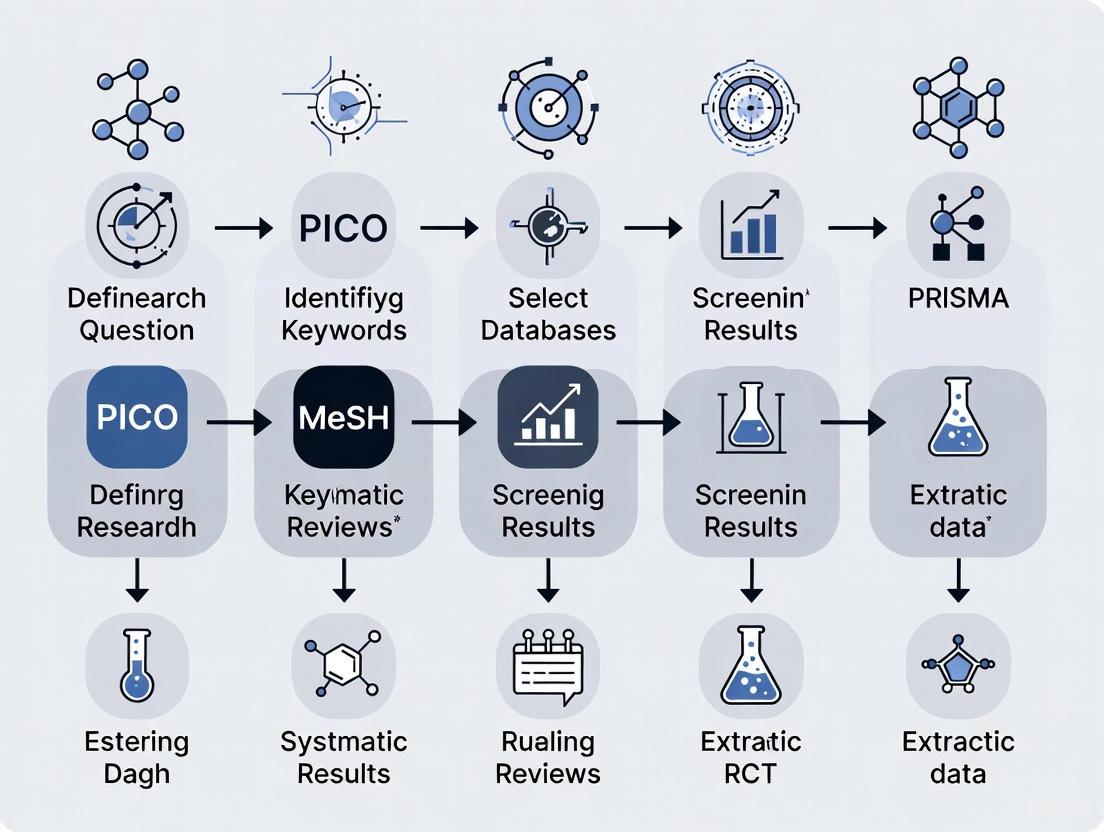
This article provides a comprehensive framework for conducting exhaustive keyword research in systematic reviews for biomedical and clinical research.
Mastering Systematic Review Keyword Research: A Comprehensive Guide for Biomedical Professionals
Abstract
This article provides a comprehensive framework for conducting exhaustive keyword research in systematic reviews for biomedical and clinical research. Covering foundational principles to advanced optimization techniques, it addresses how to identify key concepts, leverage controlled vocabularies like MeSH and Emtree, employ innovative methods such as the WINK technique, troubleshoot common pitfalls, and validate search strategies. Designed for researchers, scientists, and drug development professionals, this guide ensures methodological rigor, enhances search sensitivity and specificity, and ultimately supports the creation of robust, reproducible, and comprehensive systematic reviews.
Understanding the Core Principles of Systematic Search Strategies
The systematic review process represents a cornerstone of evidence-based practice, providing a structured methodology for synthesizing existing research to inform clinical and policy decisions. The foundation of any high-quality systematic review is a precisely formulated research question, which guides every subsequent step from literature search to data synthesis. This protocol details the application of the PICO framework—a mnemonic encompassing Patient, Intervention, Comparison, and Outcome—as a rigorous methodology for developing focused research questions and extracting strategic keywords for comprehensive literature retrieval. We present experimental protocols for translating PICO elements into search strategies, visualization methodologies for representing the systematic review workflow, and reagent solutions for implementing search syntax across major biomedical databases. Proper application of this framework ensures research questions are both clinically relevant and structured to facilitate efficient, reproducible evidence retrieval, thereby establishing a robust foundation for systematic reviews that validly address their intended clinical or scientific inquiries.
The PICO framework is a systematic tool used to formulate focused, answerable clinical questions in evidence-based practice. By deconstructing a clinical scenario into its core components, PICO provides structure for developing research questions that are both directly relevant to patient problems and phrased to direct searches toward precise, relevant evidence [1]. This framework addresses the fundamental challenge that natural language questions often lack the specificity required for efficient literature searching, leading to potentially incomplete or biased evidence retrieval [1]. The modest investment of time required to construct a PICO question yields significant returns through more effective and efficient evidence searches, enabling researchers and clinicians to more rapidly locate the best available evidence to inform clinical decision-making [1].
Originally developed for interventional questions, the PICO framework has evolved to accommodate various types of clinical inquiries, including those related to diagnosis, prognosis, etiology, and prevention [1] [2]. Its utility has been recognized as potentially universal for scientific endeavors beyond clinical settings, with some proponents arguing it can be applied to all research designs and disciplines [2]. This broader application conceptualizes PICO elements as inherent components of all research: the research object (Problem), application of a theory or method (Intervention), alternative theories or methods (Comparison), and knowledge generation (Outcome) [2]. Within systematic reviews specifically, PICO serves dual purposes: framing the clinical question and developing comprehensive literature search strategies [2].
PICO Components and Question Formulation
Core PICO Elements
The PICO framework comprises four core components that systematically define the key elements of a clinical research question. These components provide the structural foundation for developing focused, answerable questions suitable for systematic inquiry:
P (Patient, Problem, or Population): This element refers to the individual or group of patients or the clinical problem being addressed. When defining this component, researchers should consider not only the specific health condition but also relevant demographic factors (age, sex), comorbid conditions, clinical setting, and other characteristics that define the population of interest [1]. A crucial consideration is defining a population that balances clinical specificity with practical research feasibility—while a patient might be a "73-year-old woman with hypertension," the research population would more appropriately be "older adults with hypertension" or "post-menopausal women with hypertension" to align with how study populations are typically defined in clinical research [1].
I (Intervention or Investigated Condition): This component specifies the main intervention, diagnostic test, exposure, or prognostic factor under investigation. The intervention should be described with sufficient detail to enable precise searching, including specifics such as dosage, frequency, duration, or intensity when applicable [1]. For non-interventional questions, this element might encompass exposures, risk factors, prognostic factors, or diagnostic tests depending on the question type [2].
C (Comparison or Control): The comparison element represents the alternative against which the intervention is evaluated. This may be a standard treatment, placebo, different intervention, or even no intervention [1]. In some question types (particularly prognosis or etiology), this component may be less relevant or inapplicable [1]. The comparison provides essential context for interpreting the relative benefits or harms of the intervention.
O (Outcome(s)): Outcomes are the measurable effects, consequences, or endpoints of interest that determine the effectiveness or impact of the intervention. Outcomes should be clinically important rather than surrogate markers whenever possible [1]. Examples include mortality rates, disease incidence, symptom resolution, functional status improvements, or test performance characteristics (sensitivity, specificity) [1]. Defining relevant, patient-centered outcomes enhances the clinical utility of the systematic review.
PICO Variations by Question Type
The application and emphasis of PICO elements vary significantly depending on the type of clinical question being investigated. The table below illustrates how each PICO component is operationalized across major question domains:
Table 1: PICO Elements Across Different Question Types
| Question Type | Patient/Population | Intervention/Investigation | Comparison | Outcomes |
|---|---|---|---|---|
| Therapy | Patient's disease or condition | Therapeutic intervention (drug, surgery, advice) | Standard care, another intervention, or placebo | Mortality, complications, disease recurrence, quality of life |
| Diagnosis | Target disease or condition | Diagnostic test or procedure | Current reference standard test | Test utility (sensitivity, specificity, accuracy) |
| Prognosis | Prognostic factor or clinical problem | Disease, drug, or time exposure | Standard care or no exposure (may be inapplicable) | Survival rates, disease progression, recovery time |
| Etiology/Harm | Risk factors or general health condition | Exposure of interest (including dose and duration) | Absence of exposure or alternative exposure | Disease incidence, rates of disease progression |
| Prevention | Risk factors and general health condition | Preventive measure (medication, lifestyle change) | Absence of preventive measure | Disease incidence, mortality, morbidity rates |
Formulating the Question Statement
After identifying the key PICO elements, researchers synthesize them into a formal question statement. The specific structure and verb tense vary by question type, but all should maintain clarity, focus, and directness. The following examples illustrate properly structured PICO questions:
Therapy: "In [Population], does [Intervention] result in [Outcome] compared with [Comparison]?" Example: "In patients with hypertension and at least one additional cardiovascular disease risk factor, does tight systolic blood pressure control lead to lower rates of myocardial infarction, stroke, heart failure, and cardiovascular mortality compared to conservative control?" [1]
Diagnosis: "In [Population], is [Intervention] as accurate as [Comparison] for diagnosing [Outcome]?" Example: "Among asymptomatic adults at low risk of colon cancer, is fecal immunochemical testing (FIT) as sensitive and specific for diagnosing colon cancer as colonoscopy?" [1]
Prognosis: "In [Population], do those with [Intervention] have different [Outcome] than those without [Intervention]?" Example: "Among adults with pneumonia, do those with chronic kidney disease (CKD) have a higher mortality rate than those without CKD?" [1]
Etiology/Harm: "Are [Population] with [Intervention] at higher risk of [Outcome] than [Comparison]?" Example: "Are women with a history of pelvic inflammatory disease (PID) at higher risk for gynecological cancers than women with no history of PID?" [1]
Prevention: "In [Population], does [Intervention] reduce [Outcome] compared with [Comparison]?" Example: "Among adults with a history of myocardial infarction, does adherence to a Mediterranean diet lower risk of a second myocardial infarction compared to those who do not adopt a Mediterranean diet?" [1]
Experimental Protocol: Translating PICO to Search Strategy
Keyword Extraction and Vocabulary Mapping
The initial phase of transforming a PICO question into an executable search strategy involves systematic keyword extraction and vocabulary mapping. This protocol ensures comprehensive coverage of relevant terminology across biomedical databases:
Deconstruct PICO Elements: List all relevant terms for each PICO component separately. For the population element, include specific diagnoses, demographic terms, clinical settings, and related conditions. For interventions, include generic and brand names, procedure terminology, and technical specifications.
Expand Terminology: Utilize controlled vocabularies such as Medical Subject Headings (MeSH) in MEDLINE or Emtree in Embase to identify standardized terms for each concept. Include synonyms, related terms, acronyms, plural forms, and British/American spelling variations.
Structure Search Blocks: Organize search terms into conceptual blocks corresponding to each PICO element. Combine terms within each block using Boolean OR operators, then combine the conceptual blocks using Boolean AND operators to ensure results address all PICO components.
Implement Syntax and Truncation: Apply appropriate search syntax for each database, including truncation symbols for word stemming, phrase searching with quotation marks, and proximity operators where available to refine retrieval.
Table 2: Search Strategy Development Reagents
| Research Reagent | Function | Implementation Example |
|---|---|---|
| Boolean Operators | Logical connectors that define relationships between search terms | AND: narrows search (hypertension AND diet); OR: broadens search (hypertension OR high blood pressure); NOT: excludes terms (hypertension NOT pulmonary) |
| Controlled Vocabulary | Pre-defined standardized terms used to index database content | MeSH (Medical Subject Headings) in PubMed; Emtree in Embase; CINAHL Headings in CINAHL |
| Truncation Symbols | Wildcards that retrieve variant word endings | * (asterisk) for multiple characters: hypertens* retrieves hypertension, hypertensive; ? (question mark) for single character: wom?n retrieves woman, women |
| Proximity Operators | Specify distance between search terms within documents | NEAR/x in some platforms: (diet NEAR/5 hypertension) finds terms within 5 words of each other |
| Field Codes | Restrict search to specific database fields | [ti] for title; [au] for author; [mh] for MeSH terms; [tw] for text words |
Search Strategy Optimization and Validation
After constructing the initial search strategy, systematic optimization and validation are essential to ensure comprehensive retrieval while maintaining precision:
Pilot Testing: Execute the preliminary search strategy and review initial results for relevance. Analyze the search terms used in highly relevant articles to identify potentially missing terminology.
Recall and Precision Assessment: Calculate preliminary recall (proportion of relevant articles retrieved from a known set) and precision (proportion of relevant articles in search results) using a validated set of key articles identified through known-source searching.
Search Iteration: Refine the search strategy based on pilot results, adding newly identified terms and adjusting syntax to improve retrieval. Document all search iterations with dates and results for transparency and reproducibility.
Peer Review: Utilize the PRESS (Peer Review of Electronic Search Strategies) framework to have an information specialist or subject expert review the search strategy for completeness, syntax errors, and logical structure.
Database Translation: Adapt the refined search strategy for additional databases, accounting for differences in controlled vocabularies, search syntax, and available fields. Maintain conceptual consistency while respecting database-specific requirements.
Data Analysis and Synthesis Methodology
Systematic Review Classification and Approach
Systematic reviews can incorporate qualitative, quantitative, or mixed-method approaches depending on the nature of the included studies and the research question. The decision between these approaches significantly influences the data analysis plan:
Table 3: Systematic Review Classification by Methodology
| Review Type | Research Questions | Data Type | Analysis Methods | Results Presentation |
|---|---|---|---|---|
| Qualitative Systematic Review | Open-ended questions to understand concepts or formulate hypotheses | Words, concepts, themes from observations, interviews, literature | Content analysis, thematic analysis, discourse analysis | Textual summary identifying patterns, themes, meanings |
| Quantitative Systematic Review | Test or confirm existing hypotheses or theories | Numerical data from measurements, counts, ratings | Statistical analysis, meta-analysis | Numbers, graphs, statistical summaries with effect sizes |
| Mixed-Methods Systematic Review | Complex questions requiring both exploratory and confirmatory approaches | Both textual and numerical data | Separate qualitative and quantitative synthesis followed by integration | Integrated presentation explaining how qualitative results contextualize quantitative findings |
Quantitative Synthesis (Meta-Analysis) Protocol
When studies are sufficiently homogeneous in design, quality, and measured outcomes, quantitative synthesis through meta-analysis provides a statistical approach to combining results across studies:
Effect Size Calculation: Extract or calculate appropriate effect sizes from each included study based on outcome type. For continuous outcomes, use mean differences or standardized mean differences; for dichotomous outcomes, use risk ratios, odds ratios, or risk differences [3].
Weighting Strategy: Assign weights to individual studies based on precision, typically using inverse variance weighting where larger studies with smaller standard errors contribute more to the pooled estimate [3].
Model Selection: Choose between fixed-effect models (assuming a single true effect size across studies) and random-effects models (assuming effect sizes vary across studies due to both sampling error and genuine differences) [3]. The choice should be based on clinical and methodological considerations alongside statistical heterogeneity assessment.
Heterogeneity Quantification: Calculate I² statistics and Cochran's Q to quantify between-study heterogeneity, with I² values of 25%, 50%, and 75% typically representing low, moderate, and high heterogeneity respectively [3].
Sensitivity and Subgroup Analyses: Conduct planned sensitivity analyses to assess the robustness of findings to methodological choices, and subgroup analyses to explore potential sources of heterogeneity [3].
Bias Assessment: Evaluate potential for publication bias and small-study effects using funnel plots, Egger's test, or other appropriate statistical methods [3].
For heterogeneous studies where statistical pooling is inappropriate, narrative synthesis following a systematic approach is recommended, collecting major findings by study type and categorizing results as positive, negative, mixed, or inconclusive based on frequency and consistency of findings [4].
Visualization of Systematic Review Workflow
The following diagram illustrates the complete systematic review process from question formulation through evidence synthesis, highlighting the central role of the PICO framework:
Systematic Review Workflow from Question to Synthesis
PICO to Keywords Transformation Protocol
The translation of PICO elements into searchable concepts requires systematic mapping of clinical concepts to database terminology. The following protocol ensures comprehensive keyword development:
Conceptual Expansion: For each PICO element, brainstorm related terms, synonyms, acronyms, and variations in terminology. Consult domain experts, textbooks, and relevant articles to identify additional terminology.
Vocabulary Mapping: Identify controlled vocabulary terms (MeSH, Emtree) for each key concept. Include both broader and narrower terms to ensure appropriate scope.
Syntax Application: Structure the search using Boolean logic, with OR operations within concepts and AND operations between PICO concepts. Apply appropriate truncation and field codes based on database capabilities.
Iterative Refinement: Test search sensitivity and precision using known relevant articles. Modify strategy based on results, adding missing terms and removing non-productive terms.
The following diagram illustrates the transformation of PICO elements into executable search strategies:
PICO Elements to Search Strategy Transformation
Application Example: Therapy Question
To illustrate the complete process from question formulation to search strategy development, consider the following therapy question example:
Clinical Scenario: A clinician seeks evidence regarding the effectiveness of cognitive behavioral therapy versus medication for treating depression in adolescents.
PICO Elements:
- P: Adolescents with major depressive disorder
- I: Cognitive behavioral therapy
- C: Selective serotonin reuptake inhibitors (SSRIs)
- O: Reduction in depressive symptoms, remission rates
PICO Question: "In adolescents with major depressive disorder, does cognitive behavioral therapy result in greater reduction in depressive symptoms and higher remission rates compared to treatment with SSRIs?"
Keyword Development:
Table 4: Search Terms for Depression Therapy Example
| PICO Element | Conceptual Terms | Specific Search Terms | MeSH Terms |
|---|---|---|---|
| Population | Adolescents with depression | teen, adolescent, youth, young person, "major depressive disorder", depression, depressive | "Depressive Disorder", "Adolescent" |
| Intervention | Cognitive behavioral therapy | "cognitive behavioral therapy", CBT, "cognitive therapy", "behavior therapy" | "Cognitive Behavioral Therapy" |
| Comparison | SSRIs | SSRI, "selective serotonin reuptake inhibitor", fluoxetine, sertraline, citalopram, escitalopram | "Serotonin Uptake Inhibitors" |
| Outcome | Symptom reduction, remission | "depressive symptoms", remission, response, "Hamilton Depression Rating Scale", "Beck Depression Inventory", improvement | "Treatment Outcome", "Remission Induction" |
Sample PubMed Search Strategy:
This example demonstrates the systematic translation of a clinical question into an executable search strategy, illustrating the practical application of the PICO framework for evidence retrieval.
The Critical Role of Sensitivity vs. Specificity in Systematic Reviews
In the rigorous process of conducting a systematic review, the development of a search strategy is a foundational step that directly impacts the validity and comprehensiveness of the findings. The principle of evidence synthesis requires that reviewers identify as many relevant studies as possible to minimize bias and provide reliable conclusions [5]. This introduces a fundamental tension in search strategy design: the balance between sensitivity (the ability to identify all relevant records) and precision (the proportion of retrieved records that are relevant) [6]. For systematic reviews, the scale overwhelmingly tips in favor of sensitivity, accepting that a large volume of irrelevant records will be retrieved to ensure that nearly all pertinent studies are captured [6]. This application note delineates detailed protocols for constructing highly sensitive search strategies, framed within the broader context of methodological rigor in systematic reviews.
Theoretical Framework: Sensitivity and Specificity in Retrieval
Defining the Core Concepts
- Sensitivity (Recall): In search terminology, sensitivity refers to the number of relevant records identified divided by the total number of relevant records in existence. A highly sensitive search aims to maximize this proportion.
- Precision: Precision is the number of relevant records identified divided by the total number of records (both relevant and irrelevant) retrieved by the search.
- The Trade-off: In practice, maximizing sensitivity involves broadening search parameters, which invariably decreases precision by retrieving more irrelevant records [6]. This trade-off is an inherent characteristic of information retrieval. For systematic reviews, which aim to be as comprehensive as possible, it is methodologically sound to favor sensitivity [6].
The Role of Keyword Research
Keyword research serves as the primary mechanism for controlling the sensitivity-precision balance. A poorly constructed search strategy risks missing key studies, introducing selection bias and potentially invalidating the review's conclusions [7]. The goal is to create a search strategy that functions as a wide net, capturing the vast majority of relevant literature, with the understanding that subsequent screening phases will filter out irrelevant results [6].
Quantitative Evidence: Impact of Search Strategy Techniques
The following table summarizes empirical findings on the performance of different search strategy approaches, highlighting their impact on sensitivity.
Table 1: Comparative Performance of Search Strategy Techniques
| Technique | Description | Impact on Sensitivity | Key Findings |
|---|---|---|---|
| Conventional Keyword Selection | Relies on a limited set of keywords and controlled vocabulary terms derived from initial subject expert input. | Baseline | Retrieved 74 and 197 articles for two test queries [7]. |
| WINK (Weightage Identified Network of Keywords) Technique | Uses network visualization charts (e.g., VOSviewer) to analyze keyword interconnections, excluding terms with limited networking strength [7]. | Significantly Increased | Yielded 69.81% and 26.23% more articles for the same test queries compared to the conventional approach [7]. |
| Combining Keywords & Controlled Vocabulary | Uses both free-text keywords (for title/abstract) and standardized index terms (e.g., MeSH, Emtree) [6] [8]. | Increased | Index terms find studies based on conceptual relevance, not just word presence, capturing records missed by keywords alone [6]. |
| Systematic Grey Literature Search | Searching beyond bibliographic databases (e.g., trial registries, theses, conference abstracts) [6]. | Increased | Mitigates publication bias by identifying unpublished or non-journal studies that database searches may miss [6]. |
Experimental Protocols for Search Strategy Development
Protocol 1: Foundational Search Strategy Formulation
This protocol outlines the standard methodology for building a comprehensive search strategy.
I. Materials and Reagents
- Bibliographic Databases: Access to relevant databases (e.g., MEDLINE/PubMed, Embase, Cochrane Central Register of Controlled Trials, PsycINFO) [8].
- Grey Literature Sources: Access to clinical trial registries (e.g., ClinicalTrials.gov), institutional repositories, and conference proceedings [6].
- Search Strategy Tools: Reference management software (e.g., EndNote, Covidence) for storing and deduplicating results [6].
II. Methodology
- Define Core Concepts: Deconstruct the research question into its fundamental components using a framework like PICO (Population, Intervention, Comparison, Outcome) [8].
- Generate Synonym List: For each PICO concept, compile an exhaustive list of synonyms, acronyms, spelling variants, and related terms [8].
- Incorporate Controlled Vocabulary: Identify the corresponding controlled vocabulary terms (e.g., MeSH in PubMed, Emtree in Embase) for each concept [6] [8].
- Apply Search Syntax:
- Combine all synonymous terms for a single concept with the Boolean operator
ORto broaden the search [6]. - Use truncation (
*or$) to capture word variations (e.g.,therap*finds therapy, therapies, therapist) [6]. - Use wildcards (
?or#) to account for spelling variations (e.g.,wom#nfinds woman and women) [6]. - Combine the different concepts (P, I, C, O) with the Boolean operator
AND[6].
- Combine all synonymous terms for a single concept with the Boolean operator
- Translate and Test: Translate the search strategy for the syntax requirements of other databases. Test the search performance by verifying if known key studies are retrieved [6] [8].
Protocol 2: Application of the WINK Technique
This advanced protocol utilizes a network analysis approach to objectively refine keyword selection, thereby enhancing sensitivity.
I. Materials and Reagents
- Primary Tool: VOSviewer software for constructing and visualizing bibliometric networks [7].
- Data Source: A preliminary set of relevant articles or a Scopus/PubMed search on the broad topic.
- Validation Database: PubMed (for its robust MeSH indexing) [7].
II. Methodology
- Data Extraction: Extract keywords (author keywords, Index Keywords) from the preliminary article set.
- Network Visualization: Input the keywords into VOSviewer to generate a network visualization chart. This chart maps the interconnections and co-occurrence strength between keywords within the research domain [7].
- Keyword Weightage Analysis: Analyze the network to identify keywords with high "weightage," indicated by strong links to multiple core concepts. Keywords with limited or weak networking strength are candidates for exclusion [7].
- MeSH Term Identification: Utilize the high-weightage keywords and the "MeSH on Demand" tool on PubMed to identify the most relevant and comprehensive set of MeSH terms [7].
- Search String Construction: Build the final search string using the identified MeSH terms and high-weightage keywords, combining them with Boolean operators.
- Performance Validation: Execute the search and compare the yield against a conventionally developed search string to quantify the improvement in sensitivity [7].
The Scientist's Toolkit: Essential Research Reagents
Table 2: Key Resources for Systematic Review Search Strategies
| Item | Function / Application |
|---|---|
| Medical Subject Headings (MeSH) | The NLM's controlled vocabulary thesaurus used for indexing articles in PubMed/MEDLINE. Using MeSH terms ensures studies are found by concept, not just author terminology [7] [6]. |
| Boolean Operators (AND, OR, NOT) | Logical commands used to combine search terms. OR broadens a search (increases sensitivity), while AND narrows it (increases precision) [6]. |
| Truncation and Wildcards | Symbols (e.g., *, ?, #) that account for word variations and plurals, ensuring different spellings and endings of a word are captured [6]. |
| Bibliographic Databases | Multidisciplinary and subject-specific databases (e.g., PubMed, Embase, Scopus, CINAHL, PsycINFO) that must be searched comprehensively to avoid database-specific bias [8]. |
| Grey Literature Sources | Trial registries, dissertations, and conference proceedings. Searching these is critical to minimize publication bias, as they contain studies not published in commercial journals [6]. |
| Covidence | A web-based software platform that facilitates collaboration during the systematic review process, including storing search strategies, screening results, and data extraction [6]. |
| PRISMA-S Checklist | An extension of the PRISMA statement that provides reporting standards for the search process, ensuring transparency and reproducibility [8]. |
The critical role of sensitivity in systematic review search strategies cannot be overstated. A methodologically sound approach prioritizes a comprehensive, sensitive search to capture the breadth of existing evidence, accepting the subsequent burden of a low-precision, high-volume result set. The protocols outlined herein—from the foundational use of controlled vocabulary and Boolean logic to the advanced, data-driven WINK technique—provide researchers with a structured pathway to achieve this goal. By rigorously applying these methods and transparently reporting the process, researchers can fortify the integrity of their systematic reviews, ensuring that their conclusions are built upon the most complete evidence base possible.
In the realm of evidence-based medicine and systematic reviews, comprehensive literature searching is paramount. Controlled vocabularies, also known as subject headings, thesauri, or descriptor terms, provide an organized, standardized approach to classifying knowledge across scientific databases [9]. These pre-defined, carefully selected words and phrases solve two major challenges in literature retrieval: the problem of synonyms, where multiple terms describe the same concept, and ambiguity, where the same term has different meanings across contexts [10].
For researchers, scientists, and drug development professionals conducting systematic reviews, mastering controlled vocabularies is not optional—it is essential for methodological rigor. These vocabularies bring uniformity to how publications are indexed within databases, creating consistency and precision that transcends the variable terminology authors might use [11]. This guide provides detailed application notes and protocols for the three predominant controlled vocabularies in the health sciences: Medical Subject Headings (MeSH), Emtree, and CINAHL Headings, framing their use within a robust keyword research methodology for systematic reviews.
Core Concepts and Definitions
What are Controlled Vocabularies?
Controlled vocabularies are structured, hierarchical lists of terms used by bibliographic databases to tag records based on their subject matter [12] [9]. Indexers, who are often specially trained, read the full text of articles and assign the most relevant terms from the vocabulary to represent the concepts covered [11]. This process transforms diverse natural language into a consistent, searchable language.
- Textwords (Keywords): Terms you choose yourself to search parts of an article's record, such as the title, abstract, and author-provided keywords [10]. This is often called "free-text" searching.
- Subject Headings: The pre-assigned terms from a controlled vocabulary used to label articles by their core concepts [10].
- Hierarchical Structure: Most vocabularies are organized in trees from broader to narrower terms, allowing searchers to explore related concepts [12].
The Imperative for Comprehensive Searching
A comprehensive systematic review search strategy must incorporate both subject headings and textwords for each concept [10]. Relying solely on one method risks missing critical evidence. Subject headings can be missing from records, and new or highly specific concepts may not yet have a dedicated subject heading [12]. Conversely, textword searching alone is vulnerable to synonyms and variations in author terminology [10].
Table 1: Comparison of Search Term Types
| Feature | Subject Headings | Textwords (Keywords) |
|---|---|---|
| Definition | Pre-assigned, standardized terms from a database's controlled vocabulary [10] | Natural language terms chosen by the searcher [10] |
| Consistency | High; uniform across all indexed records [11] | Low; depends on author's word choice |
| Searches | The entire record, regardless of where the concept is discussed | Specific fields (e.g., Title, Abstract) [10] |
| Advantages | Solves synonym and ambiguity problems [10] | Captures new concepts not yet in vocabularies |
| Disadvantages | Requires learning each database's system; indexing may be delayed | Requires guessing all possible term variations |
The Scientist's Toolkit: Database Vocabularies and Research Reagents
Systematic reviewers must be equipped with knowledge of the key "research reagents"—the databases and their associated vocabularies. Each database uses a unique controlled vocabulary tailored to its disciplinary focus [12] [10].
Table 2: Essential Research Reagents: Major Databases and Their Controlled Vocabularies
| Database | Primary Discipline | Controlled Vocabulary | Vocabulary Characteristics |
|---|---|---|---|
| MEDLINE | Biomedicine and Life Sciences | Medical Subject Headings (MeSH) [13] | One of the oldest, best-known health thesauri; hierarchical structure [12] |
| Embase | Pharmacology and Biomedicine | Emtree [14] | Extensive coverage of drugs and medical devices; updated 3 times yearly [14] |
| CINAHL | Nursing and Allied Health | CINAHL Subject Headings [15] | Modeled on MeSH but adapted for nursing and allied health literature [9] |
| APA PsycInfo | Psychology and Behavioral Sciences | APA Thesaurus [11] | Focus on psychological concepts and processes |
| Cochrane Library | Evidence-Based Medicine | MeSH | Uses MeSH for indexing systematic reviews and trials |
Experimental Protocols for Vocabulary-Driven Search Strategy
The following protocols provide a step-by-step methodology for integrating controlled vocabularies into a systematic review search strategy.
Protocol 1: Foundational Search Strategy Development
This protocol outlines the core process of building a search strategy using controlled vocabularies and textwords.
Materials:
- Database Interface: (e.g., Ovid, EBSCOhost, PubMed)
- Thesaurus Browser: MeSH Browser [16], Emtree, CINAHL Headings [15]
- Documentation Tool: Spreadsheet or dedicated systematic review software
Procedure:
- Deconstruct Research Question: Break down your primary research question into discrete core concepts (e.g., for "How do environmental pollutants affect endocrine function?", the concepts are "environmental pollutants" and "endocrine function") [7].
- Identify Keywords (Textwords): For each concept, brainstorm a comprehensive list of synonyms, related terms, and spelling variations. Use truncation (
*or?) and wildcards to account for word variations [15]. - Map to Subject Headings: For each database to be searched, use the built-in thesaurus or term finder tool to identify the corresponding controlled vocabulary terms for your concepts [12] [9].
- Combine Search Sets: Within each concept, combine all identified keywords and subject headings using the Boolean operator
OR. This creates a comprehensive search set for each concept. - Combine Concepts: Combine the different concept search sets using the Boolean operator
ANDto finalize the search strategy. - Test and Refine: Run the search and review a sample of results. Iteratively refine the strategy by adding missing terms or removing sources of noise.
Protocol 2: Advanced Vocabulary Techniques (Explode, Focus, Qualifiers)
This protocol details the application of advanced database features to enhance search precision and recall.
Materials:
- A subject heading identified via Protocol 1.
- Database interface supporting advanced features (Ovid, EBSCOhost).
Procedure:
- 'Explode' a Subject Heading:
'Focus' a Subject Heading (Major Concept):
- Purpose: To restrict results to records where the subject heading is considered a major point of the article, not just a minor mention. This increases search specificity [12].
- When to Use: When a topic has a large body of literature and you need to narrow results to the most relevant, in-depth studies [12].
- Method:
Apply Qualifiers (Subheadings):
- Purpose: To restrict the search to a specific aspect of a subject heading, such as adverse effects, drug therapy, or psychology [12].
- When to Use: To narrow a broad subject heading to a more precise research question aspect.
- Method:
Data Presentation: Comparative Syntax and Functionality
The implementation of advanced features varies significantly across databases and platforms. The following tables synthesize the key syntax differences.
Table 3: Syntax for Exploding and Focusing Subject Headings Across Platforms
| Database | Interface | Explode Syntax (Example) | Focus/Major Syntax (Example) |
|---|---|---|---|
| MEDLINE | Ovid | exp Health education/ [12] |
*Health education/ [12] |
| Embase, Emcare, APA PsycInfo | Ovid | exp Health education/ [12] |
*Health education/ [12] |
| CINAHL | EBSCOhost | MH "Health Education+" [12] |
MM "Health Education" [15] |
| Cochrane Library | Cochrane | MeSH descriptor: [Health Education] explode all trees [12] |
[mh Education[mj]] [12] |
| ERIC | ProQuest | MAINSUBJECT.EXACT.EXPLODE("Patient Education") [12] |
MJMAINSUBJECT.EXACT("Patient Education") [12] |
Table 4: Search Field Codes for Comprehensive Literature Searching
| Database | Interface | Title Field | Abstract Field | Subject Heading Field |
|---|---|---|---|---|
| MEDLINE | Ovid | .ti. |
.ab. |
/ (e.g., Health education/) |
| Embase | Ovid | .ti. |
.ab. |
/ |
| CINAHL | EBSCOhost | TI |
AB |
MH for exact heading, SU for keyword-in-subjects [15] |
| PubMed | --- | [ti] |
[ab] |
[mh] |
Advanced Application: The WINK Technique for Systematic Keyword Selection
The Weightage Identified Network of Keywords (WINK) technique is a modern methodology that integrates computational analysis with expert insight to enhance the keyword selection process for systematic reviews [7].
Objective: To develop a structured framework for keyword identification that improves the thoroughness and precision of evidence synthesis by analyzing the interconnections among keywords within a specific domain [7].
Materials:
- Bibliographic database (e.g., PubMed/MEDLINE)
- Visualization Software: VOSviewer [7]
- Seed keywords from subject experts
Procedure:
- Initial Search: Conduct a preliminary search using seed keywords derived from the research question and subject expert insight [7].
- MeSH Term Extraction: Utilize tools like "MeSH on Demand" to identify relevant MeSH terms from the results of the initial search [7].
- Network Visualization and Weightage Assignment:
- Extract the MeSH terms and keywords from a robust set of relevant articles.
- Input these terms into VOSviewer to generate a network visualization chart.
- Analyze the networking strength between terms related to different concepts (e.g., Q1 and Q2 concepts) [7].
- Keyword Pruning and Selection: Exclude keywords with limited networking strength, prioritizing those with higher weightage and stronger connections within the network [7].
- Search String Construction: Build the final search string using the high-weightage MeSH terms and keywords identified through the WINK process.
- Validation: Comparative studies have shown that search strings built with the WINK technique can retrieve significantly more articles (e.g., 69.81% more for one research question) compared to conventional approaches [7].
Mastering MeSH, Emtree, and CINAHL Headings is a foundational skill for researchers conducting systematic reviews in the health sciences. A protocolized approach that systematically combines controlled vocabulary (to control for synonymy and ambiguity) with a comprehensive textword search (to capture nascent and unindexed concepts) is non-negotiable for achieving high recall and precision. By applying the detailed application notes and experimental protocols outlined in this document—from basic search construction to advanced techniques like exploding and focusing, and even leveraging cutting-edge methods like the WINK technique—researchers and drug development professionals can ensure their literature searches are rigorous, reproducible, and minimize the risk of bias, thereby laying a solid foundation for a high-quality systematic review.
In the realm of evidence-based medicine, systematic reviews are a cornerstone of scientific literature, providing a comprehensive synthesis of existing research on a specific question. The integrity and validity of a systematic review are fundamentally dependent on the completeness of the literature search, which aims to capture as many relevant studies as possible [6]. A critical challenge in constructing a comprehensive search strategy is accounting for the inherent variability in human language. Authors of primary research may describe the same concept using different synonyms, spelling variants (e.g., "behavior" vs. "behaviour"), or acronyms (e.g., "CVA" for "cerebrovascular accident") [17] [18]. Failure to account for these variations can lead to a biased and incomplete set of results, ultimately undermining the review's conclusions. Therefore, the meticulous identification and incorporation of natural language variants, including synonyms, spelling variations, and acronyms, is not merely a technical step but a fundamental principle in conducting rigorous systematic reviews [19] [20].
This document provides detailed application notes and protocols for identifying and handling these language variations within the context of keyword research for systematic reviews. It is structured to guide researchers, scientists, and drug development professionals through practical methodologies, supported by quantitative data and experimental protocols, to enhance the sensitivity and comprehensiveness of their search strategies.
Effective search strategy development relies on understanding the types of language variations and their impact. The primary goal is to maximize sensitivity (retrieving all relevant records) while accepting a trade-off in precision (retrieving only relevant records) to ensure comprehensiveness [6].
Table 1: Types of Natural Language Variations in Search Strategies
| Variation Type | Definition | Impact on Search | Examples |
|---|---|---|---|
| Synonyms & Related Terms | Different words or phrases used to describe the same concept. | High; crucial for recall. | "heart attack" vs. "myocardial infarction"; "kidney failure" vs. "renal failure" [21] [22] |
| Spelling Variants | Differences in spelling based on regional language conventions. | Medium; can cause relevant studies to be missed. | "tumor" vs. "tumour"; "pediatric" vs. "paediatric" [17] |
| Acronyms & Abbreviations | Shortened forms of phrases or words. | High; extremely common and ambiguous in scientific literature. | "CVA" for "cerebrovascular accident" or "costovertebral angle"; "MI" for "myocardial infarction" or "medical illustrator" [23] [18] |
| Subject Headings | Controlled vocabulary terms (e.g., MeSH, Emtree) assigned by database indexers. | High; tag articles by concept, overcoming keyword limitations [6] [21]. | MeSH term "Renal Insufficiency, Chronic" encompasses "chronic kidney disease," "chronic renal failure," "CKD," and "CRF" [21]. |
Table 2: Impact of Structured Keyword Identification Techniques
| Technique | Description | Reported Efficacy |
|---|---|---|
| Conventional Search (Subject Expert Input) | Relies on keywords and MeSH terms identified by domain experts. | Baseline for comparison [7]. |
| WINK Technique | Uses network visualization to assign weightage to MeSH terms, excluding those with limited networking strength [7]. | Retrieved 69.81% and 26.23% more articles for two sample research questions compared to conventional approaches [7]. |
| Combined Distributional Models | Uses ensemble semantic spaces (Random Indexing + Random Permutation) from clinical and journal article corpora for synonym and abbreviation extraction [24]. | Achieved a recall of 0.39 for abbreviations to long forms and 0.47 for synonyms within the top 10 candidate terms [24]. |
| LLM/BERT Disambiguation | Employs large language models (e.g., ChatGPT) or BERT-based models for acronym and symbol sense disambiguation [18]. | BERT-based models achieved over 95% accuracy in disambiguating acronym senses in clinical notes [18]. |
Experimental Protocols for Identifying Language Variations
Protocol: Building a Gold Set and Extracting Terms
Purpose: To create a foundational set of relevant articles ("gold set") to identify the synonyms, acronyms, and spelling variants used in the existing literature on the topic [20] [22].
Materials:
- Access to major bibliographic databases (e.g., PubMed/MEDLINE, Embase).
- Citation tracking tools (e.g., Scopus, Web of Science).
- Reference management software (e.g., EndNote, Zotero).
Methodology:
- Identify Sentinel Articles: Compile a shortlist of 3-6 highly relevant, authoritative papers fundamental to your research topic through preliminary scoping searches and expert consultation [20] [22].
- Forward and Backward Citation Tracking:
- Backward Tracking: Review the reference lists of the sentinel articles to identify prior key studies.
- Forward Tracking: Use citation databases to find newer articles that have cited the sentinel articles.
- Gold Set Compilation: Combine sentinel articles with the most relevant studies identified through citation tracking to form your "gold set."
- Term Extraction:
- Manual Analysis: Read the titles, abstracts, and full texts of gold set articles to manually extract keywords, synonyms, and acronyms.
- Tool-Assisted Analysis: Use tools like the Yale MeSH Analyzer to automatically extract the MeSH terms assigned to each article in your gold set [20]. This helps identify the controlled vocabulary used for key concepts.
- Validation: The final search strategy must be tested to ensure it retrieves all articles in the gold set.
Protocol: Systematic Keyword Mining and Expansion
Purpose: To systematically generate a comprehensive list of free-text keywords and account for spelling and morphological variations.
Materials:
- Bibliographic databases (PubMed, Ovid platforms).
- Text mining tools (e.g., PubMed PubReMiner, WriteWords word frequency counter) [19].
Methodology:
- Seed Term Search: Execute a preliminary search in a database like PubMed using 2-3 core concepts from your research question.
- Text Mining:
- PubMed PubReMiner: Enter a key phrase to query PubMed and analyze the resulting corpus. The tool provides frequency lists of words, MeSH terms, and authors found in the retrieved citations, helping to identify common synonyms and terminology [19].
- Word Frequency Tools: Use tools like WriteWords to analyze the text of multiple gold set article abstracts, generating a list of the most frequent words and phrases.
- Account for Spelling Variants: Proactively include common spelling variations for identified keywords (e.g., "behavior" OR "behaviour") [20].
- Apply Truncation and Wildcards: Use database-specific symbols to account for word stemming and pluralization.
Protocol: Acronym and Abambiguation Disambiguation
Purpose: To identify the expansions of relevant acronyms and resolve their ambiguities for accurate search formulation.
Materials:
- Access to clinical or biomedical text corpora (e.g., CASI dataset) [18].
- NLP tools or pre-trained models (e.g., BERT-based models, UMLS::SenseRelate) [18] [24].
- Medical dictionaries and terminology resources (e.g., Stedman's Medical Abbreviations) [18].
Methodology:
- Acronym Identification: Use heuristic rule-based and statistical methods to identify acronyms and abbreviations composed of capital letters that appear frequently in a target corpus [18].
- Sense Inventory Creation: For each target acronym, compile a list of all possible expansions (senses) using medical dictionaries, textbooks, and ontologies like the UMLS [18].
- Disambiguation:
- Knowledge-Based Method: Use tools like UMLS::SenseRelate, which calculates a score for each potential sense based on its similarity to the surrounding terms in the text, selecting the sense with the highest score [18].
- Supervised Machine Learning: Train a model, such as BioBERT, on an annotated dataset like the Clinical Acronym Sense Inventory (CASI). The model learns to classify the correct sense of an acronym based on its contextual window (e.g., the 12 preceding and subsequent words) [18].
- Search Integration: In the search strategy, include both the acronym and its most common, relevant long forms connected by the Boolean
ORoperator.
Visualization of Workflows
Search Strategy Development Workflow
Search strategy development workflow for systematic reviews
Natural Language Variation Identification
Identifying natural language variations for a core concept
The Scientist's Toolkit: Research Reagent Solutions
Table 3: Essential Tools for Handling Natural Language in Systematic Reviews
| Tool / Resource Name | Type | Primary Function | Application in Protocol |
|---|---|---|---|
| Medical Subject Headings (MeSH) [21] [7] | Controlled Vocabulary | Provides a standardized set of concepts and terms for indexing PubMed/MEDLINE. | Used to tag articles by concept, overcoming limitations of free-text keywords. Essential for comprehensive searching [6]. |
| Yale MeSH Analyzer [20] | Web-based Tool | Extracts and analyzes MeSH terms from a set of PubMed records. | Protocol 3.1: Rapidly identifies controlled vocabulary terms associated with gold set articles. |
| PubMed PubReMiner [19] | Text Mining Tool | Queries PubMed and provides frequency analysis of words and MeSH in results. | Protocol 3.2: Helps identify common synonyms, keywords, and terminology used in the literature on a topic. |
| UMLS::SenseRelate [18] | Knowledge-Based NLP Tool | Disambiguates ambiguous terms in biomedical text by assigning UMLS concepts. | Protocol 3.3: Used for acronym and symbol sense disambiguation based on contextual similarity. |
| BioBERT [18] | Pre-trained Language Model | A BERT-based model pre-trained on large-scale biomedical corpora. | Protocol 3.3: Can be fine-tuned for high-accuracy acronym sense disambiguation tasks using clinical datasets. |
| VOSviewer [7] | Network Visualization Software | Creates, visualizes, and explores maps based on network data of scientific literature. | Used in the WINK technique to generate network charts for analyzing keyword interconnections and assigning weightage [7]. |
| Ovid MEDLINE Field Guide [19] | Database Documentation | Details all searchable fields within the Ovid MEDLINE database. | Critical for constructing precise search syntax (e.g., .ti,ab for Title/Abstract) during search strategy refinement. |
In the realm of evidence-based medicine, the systematic review represents the highest standard for synthesizing research findings. The integrity and comprehensiveness of a systematic review are fundamentally dependent on the effectiveness of the initial literature search, a process fraught with the risk of selection bias and incomplete retrieval. This Application Note addresses this critical stage by detailing a structured methodology for building a "Gold Set" of references. A Gold Set is a curator-validated collection of key publications that serves as the foundational corpus for the subsequent, rigorous process of term discovery. The protocols herein are designed to minimize bias and maximize recall, providing researchers, scientists, and drug development professionals with a reproducible framework for constructing a robust search strategy, which is the cornerstone of any high-quality systematic review [7].
Comparative Analysis of Keyword Identification Techniques
The selection of keywords and indexing terms is a pivotal decision point that can determine the success of a systematic review. The table below summarizes the core characteristics of a traditional expert-driven approach versus the more structured Weightage Identified Network of Keywords (WINK) technique [7].
Table 1: Comparison of Keyword Identification Techniques for Systematic Reviews
| Feature | Traditional Expert-Driven Approach | WINK Technique |
|---|---|---|
| Core Methodology | Relies on subject matter experts (SMEs) to suggest keywords based on domain knowledge [7]. | Integrates computational analysis (network visualization) with SME validation to identify and weight terms [7]. |
| Primary Tools | Database thesauri (e.g., MeSH on Demand), expert consultation [7]. | VOSviewer for network chart generation, PubMed/MeSH for term validation [7]. |
| Key Advantage | Leverages deep domain-specific insight and context. | Systematically maps the semantic landscape of a research field, reducing expert bias [7]. |
| Key Limitation | Potential for selection bias and omission of non-obvious or emerging terminology [7]. | Requires access to and familiarity with bibliometric software and analysis. |
| Quantified Efficacy | Serves as the baseline for comparison. | Demonstrated 69.81% and 26.23% more articles retrieved for two sample research questions compared to the conventional approach [7]. |
| Best Application Context | Initial scoping searches, topics with well-established and stable terminology. | Complex, multi-faceted research questions where keyword relationships are not immediately apparent [7]. |
Experimental Protocols
This section provides step-by-step protocols for implementing the two primary methodologies for building a Gold Set.
Protocol 1: Construction of an Initial Gold Set via Expert Curation
3.1.1 Objective: To assemble a preliminary Gold Set of reference articles using the traditional, expert-driven method to establish a baseline for further refinement.
3.1.2 Materials & Reagents:
- Access to bibliographic databases (e.g., PubMed/MEDLINE, Scopus, Embase).
- Reference management software (e.g., EndNote, Zotero, Mendeley).
3.1.3 Methodology:
- Define Research Question: Formulate a clear, structured research question. For the purposes of this protocol, we will use the example: "What is the relationship between oral and systemic health?" [7].
- Engage Subject Matter Experts (SMEs): Convene a panel of at least 2-3 domain experts.
- Brainstorm Seed Keywords: With the SME panel, brainstorm a list of broad seed keywords and concepts. For the example question, this may include: "oral health," "periodontitis," "systemic health," "diabetes," "cardiovascular disease" [7].
- Identify Controlled Vocabulary: Using database tools like "MeSH on Demand" in PubMed, identify the preferred controlled vocabulary terms (e.g., MeSH terms) for the seed keywords [7].
- Execute Preliminary Search: Construct a basic Boolean search string and execute it in the chosen database(s).
- Example String:
((oral health[MeSH Terms]) OR (periodontitis[Title/Abstract])) AND ((((systemic health[Title/Abstract]) OR (systemic diseases[Title/Abstract])) OR (diabetes[Title/Abstract])) OR (cardiovascular disease[Title/Abstract]))[7].
- Example String:
- Screen and Select: Manually screen the results (typically by title and abstract) to identify a core set of 10-20 highly relevant, seminal papers. This collection forms the Initial Gold Set.
Protocol 2: Enhancement of the Gold Set using the WINK Technique
3.2.1 Objective: To expand and validate the Initial Gold Set by applying a systematic, network analysis-based technique to identify high-weightage keywords, thereby ensuring a more comprehensive literature search.
3.2.2 Materials & Reagents:
- The Initial Gold Set from Protocol 1.
- Bibliometric analysis software (e.g., VOSviewer, an open-access tool) [7].
- Database access (PubMed/MEDLINE).
3.2.3 Methodology:
- Data Export: For the articles in the Initial Gold Set, export their full metadata, including titles, abstracts, and keywords/MeSH terms, from the database.
- Network Visualization:
- Import the metadata into VOSviewer.
- Perform a term co-occurrence analysis, using keywords or MeSH terms as the unit of analysis.
- Generate a network visualization map where nodes represent terms and the links between nodes represent their strength of co-occurrence across the literature [7].
- Identify High-Weightage Keywords: In the network map, identify keywords with high link strength and density, indicating they are central to the research topic. Conversely, note keywords with limited networking strength for potential exclusion [7].
- SME Validation: Present the network map to the SME panel to validate the identified key terms and contextualize the findings.
- Build Enhanced Search String: Construct a new, exhaustive Boolean search string incorporating the validated, high-weightage MeSH terms.
- Example Enhanced String for Oral/Systemic Health: This string would incorporate a wide array of systemic health MeSH terms (e.g.,
cardiovascular diseases[MeSH],diabetes mellitus[MeSH],pregnancy[MeSH],obesity[MeSH]) and oral health MeSH terms (e.g.,periodontal diseases[MeSH],chronic periodontitis[MeSH],oral health[MeSH]) [7].
- Example Enhanced String for Oral/Systemic Health: This string would incorporate a wide array of systemic health MeSH terms (e.g.,
- Final Gold Set Assembly: Execute the enhanced search. The resulting, larger set of relevant articles, after screening, constitutes the Final Enhanced Gold Set, ready for use in term discovery for the full systematic review.
Workflow Visualization
The following diagram illustrates the integrated workflow for building the Gold Set, combining both Protocols 1 and 2.
The Scientist's Toolkit: Essential Research Reagents & Solutions
The following table details the key digital tools and platforms required to execute the protocols described in this document.
Table 2: Essential Research Reagents & Digital Solutions for Term Discovery
| Item | Function & Application in Protocol | Example/Source |
|---|---|---|
| Bibliographic Database | Primary source for literature retrieval and metadata export. Essential for both Protocols 1 and 2. | PubMed/MEDLINE [7], Scopus, Embase |
| Reference Management Software | Organizes the Gold Set references, manages citations, and deduplicates results from multiple database searches. | EndNote, Zotero, Mendeley |
| Controlled Vocabulary Tool | Identifies standardized indexing terms (e.g., MeSH) to improve search precision. Used in Protocol 1, Step 4. | MeSH on Demand [7] |
| Bibliometric Analysis Software | Generates network visualization charts to analyze keyword co-occurrence and strength. Core tool for Protocol 2, Step 2. | VOSviewer [7] |
| Boolean Search Interface | The platform within a database where structured search strings are built and executed. Used throughout all protocols. | PubMed Advanced Search Builder |
Building and Executing a Comprehensive Search Strategy
A Step-by-Step Method for Systematic Search Strategy Development
A meticulously developed search strategy is the cornerstone of any high-quality systematic review, serving as the primary determinant of the review's comprehensiveness, reliability, and freedom from bias. A robust strategy ensures the identification of all relevant literature on a specific research question, forming a solid evidence base for subsequent synthesis and conclusion. This document provides detailed Application Notes and Protocols for developing a systematic search strategy, framed within the broader context of conducting rigorous keyword research for systematic reviews. The guidance is tailored for researchers, scientists, and drug development professionals, with the goal of standardizing this critical process and enhancing the methodological quality of reviews.
Key Principles of a Systematic Search
The development of a search strategy is guided by several core principles essential for mitigating bias and ensuring the review's validity.
- Sensitivity vs. Precision: A systematic review search must favor sensitivity (the ability to identify all relevant records) over precision (the ability to exclude irrelevant records). Capturing a proportion of irrelevant records is necessary to ensure comprehensiveness [6].
- Reproducibility: Every step of the search strategy, from the initial terms to the final syntax, must be documented with sufficient detail to allow exact replication by other researchers [6].
- Pre-Specified Protocol: The search strategy should be developed as part of a pre-defined review protocol, which outlines the study methodology, including background, research question, and inclusion/exclusion criteria [25]. Registering this protocol on a platform like PROSPERO reduces the risk of bias and guards against duplicate efforts [25].
Preliminary Steps: Scoping and Question Formulation
Before constructing the search string, foundational work is required to define the review's scope and boundaries clearly.
Formulating a Research Question Using Frameworks
A well-defined, structured research question is the critical first step, as it guides every subsequent stage of the review process [26]. Using a formal framework helps in creating a clear, focused, and answerable question.
Table 1: Common Frameworks for Structuring Research Questions
| Framework | Components | Best Suited For |
|---|---|---|
| PICO [25] [26] | Population, Intervention, Comparator, Outcome | Therapy-related questions; can be adapted for diagnosis and prognosis. |
| PICOTTS [26] | Population, Intervention, Comparator, Outcome, Time, Type of Study, Setting | A more detailed extension of PICO. |
| SPIDER [25] [26] | Sample, Phenomenon of Interest, Design, Evaluation, Research Type | Qualitative and mixed-methods research. |
| PECO [25] | Population, Environment, Comparison, Outcome | Questions about the effect of an exposure. |
| SPICE [25] [26] | Setting, Perspective, Intervention/Exposure/Interest, Comparison, Evaluation | Evaluating services or projects from a specific perspective. |
| ECLIPSE [25] [26] | Expectation, Client group, Location, Impact, Professionals, SErvice | Health policy and management searches. |
Conducting Scoping Searches
Once a preliminary question is formed, conducting scoping searches in relevant databases is recommended [25]. These initial searches help to:
- Identify key papers and seminal works in the field.
- Boost understanding of the topic's terminology and scope.
- Provide a feel for the volume of existing literature, allowing for refinement of the question if it is too broad or too narrow [25].
- Build a "gold set" of relevant references, which can be used to test the performance of the final search strategy [20].
Core Methodology: Developing the Search Strategy
This section outlines the protocol for translating the research question into a formal, executable search strategy.
Identifying Search Terms
Search terms are derived directly from the key concepts within the chosen research framework (e.g., PICO). A comprehensive approach involves identifying two types of terms for each concept.
- Keywords: These are free-text words and phrases that authors might use in a study's title or abstract. Strategies for capturing variants include:
- Index Terms: Also known as subject headings, these are standardized terms from a controlled vocabulary assigned by professional indexers to describe the content of articles (e.g., MeSH in MEDLINE, Emtree in Embase) [6]. Using these terms is crucial because they allow retrieval of relevant articles that may not contain your specific keywords in the title or abstract.
A robust search strategy must include both keywords and index terms for each concept to ensure high sensitivity [6]. Relying solely on one type risks missing relevant studies.
Combining Terms with Boolean Operators
Boolean logic is used to combine the identified terms into a coherent search string.
- OR: Used to combine synonyms, related terms, and both keyword and index terms within the same concept. This broadens the search and increases sensitivity.
- AND: Used to combine different concepts (e.g., Population AND Intervention). This narrows the search to records that contain all specified concepts.
- NOT: Used to exclude specific records (e.g., exclude animal studies). This should be used cautiously as it can inadvertently exclude relevant studies [6].
The following diagram illustrates the logical workflow for building a systematic search strategy.
To minimize database-specific bias, it is essential to search multiple bibliographic databases. A minimum of two databases is recommended, though the exact choice should be based on the research topic [26].
Table 2: Key Bibliographic Databases and Specialist Tools
| Resource Name | Type | Primary Function & Characteristics |
|---|---|---|
| MEDLINE (via PubMed/Ovid) [26] | Bibliographic Database | Life sciences and biomedical database using MeSH terms; maintained by the U.S. NLM. |
| Embase [26] | Bibliographic Database | Comprehensive biomedical and pharmacological database with strong coverage of drug studies. |
| Cochrane Central [6] | Bibliographic Database | Specialized register of controlled trials, a key source for interventional reviews. |
| Google Scholar [26] | Search Engine | Provides broad search of scholarly literature but lacks transparency and precision for systematic reviews. |
| Covidence [6] [26] | Review Management Tool | Streamlines the screening, data extraction, and quality assessment phases of a review. |
| Rayyan [26] | Review Management Tool | Aids in the screening phase by allowing collaborative blinding and inclusion/exclusion decisions. |
Searching for Grey Literature
An over-reliance on published literature introduces publication bias, as studies with positive or significant results are more likely to be published [6]. A comprehensive search must therefore include grey literature, which includes:
- Clinical trial registers (e.g., ClinicalTrials.gov)
- Ongoing studies
- Theses and dissertations
- Conference abstracts and proceedings
- Reports from government agencies and institutional repositories [6]
This section details key reagents and software solutions essential for executing a systematic search strategy efficiently and accurately.
Table 3: Research Reagent Solutions for Systematic Searching
| Tool / Resource | Category | Function & Application |
|---|---|---|
| PubMed / MEDLINE [26] | Primary Database | Foundational database for biomedical reviews; uses MeSH for indexing. |
| Embase [26] | Primary Database | Critical for drug development reviews due to extensive pharmacological coverage. |
| EndNote, Zotero, Mendeley [26] | Reference Manager | Import, deduplicate, and manage thousands of search results; essential for organization. |
| Covidence, Rayyan [26] | Screening Tool | Facilitate blinded title/abstract and full-text screening by multiple reviewers. |
| Inciteful.xyz [27] | Scoping Tool | Captures relevant systematic review citations to create a seed set for testing strategy retrieval. |
| PubReMiner [27] | Keyword Identification Tool | Identifies common keywords and MeSH terms from a set of PubMed records. |
| Yale MeSH Analyzer [20] | MeSH Analysis Tool | Extracts and analyzes MeSH terms from a "gold set" of key papers to inform search strategy. |
| 2Dsearch [27] | Grey Literature Tool | Saves search strings for multiple grey literature sites with rudimentary search capabilities. |
Search Strategy Experimental Protocol
Objective
To construct, execute, and validate a sensitive and reproducible search strategy for a systematic review.
Materials
- Computer with internet access.
- Access to selected bibliographic databases (see Table 2).
- Reference management software (e.g., EndNote, Zotero).
- Screening tool (e.g., Covidence, Rayyan) - optional but recommended.
Step-by-Step Procedure
- Protocol Finalization: Confirm the finalized research question, inclusion criteria, and exclusion criteria as per the pre-registered protocol [25].
- Term Generation: For each PICO (or other framework) concept:
- a. List all relevant keywords from scoping searches, including spelling variants, synonyms, and plural forms.
- b. Identify corresponding controlled vocabulary terms (MeSH, Emtree) for each concept using database thesauri or tools like the Yale MeSH Analyzer [20].
- Strategy Assembly (in a test database):
- a. Create concept groups by combining all synonyms (keywords and index terms) for a single concept with the Boolean
OR. - b. Combine the resulting concept groups with the Boolean
AND. - c. Apply necessary search filters (e.g., language, date, study type) with caution.
- a. Create concept groups by combining all synonyms (keywords and index terms) for a single concept with the Boolean
- Strategy Validation:
- a. Run the assembled search strategy.
- b. Check if the "gold set" of known relevant articles is successfully retrieved [20].
- c. If key articles are missing, analyze the reason: Are missing terms, spelling variations, or alternative index terms needed? Refine the strategy accordingly.
- Search Translation and Execution:
- a. Translate the finalized search strategy for each additional database, adapting the syntax and controlled vocabulary terms as needed [27]. Note that automated translation tools primarily help with syntax, not subject term translation [27].
- b. Run the final search in all selected databases and grey literature sources.
- Results Management:
- a. Export all records from each database into your reference manager.
- b. Perform deduplication using the reference manager's functionality or a dedicated tool.
- c. Export the deduplicated results into a screening tool or spreadsheet for the title/abstract screening phase.
- Documentation:
A rigorous, systematic search strategy is a methodical process that requires careful planning, iterative testing, and meticulous documentation. By adhering to the principles and protocols outlined in this document—formulating a structured question, combining keywords and index terms using Boolean logic, searching multiple databases and grey literature, and validating the strategy—researchers can create a foundation for a systematic review that is comprehensive, unbiased, and reproducible. This methodological rigor is paramount for generating reliable evidence to inform scientific discourse and drug development decision-making.
The precision and comprehensiveness of a systematic review are fundamentally dependent on the strategy employed for literature retrieval. A core pillar of this strategy is the selection of appropriate bibliographic databases. Within evidence-based medicine, systematic reviews are a cornerstone, synthesizing scientific evidence to inform clinical practice, guide healthcare policies, and direct future research [28] [7]. An ineffective search that fails to capture a substantial proportion of relevant studies introduces bias and compromises the review's validity and reliability. Consequently, understanding the coverage, strengths, and weaknesses of major databases is not merely a preliminary step but a critical methodological decision. This article provides detailed application notes and protocols for selecting and utilizing databases, framed within the broader context of conducting rigorous keyword research for systematic reviews. The guidance is tailored for researchers, scientists, and drug development professionals who require methodologically sound and efficient approaches to evidence synthesis.
Database Performance and Coverage: A Quantitative Analysis
Choosing databases is not a one-size-fits-all process; it requires an understanding of their relative contributions to finding unique, relevant studies. Relying solely on one or two major databases can lead to missing a significant number of included studies.
Table 1: Unique Contribution of Major Databases to Systematic Reviews
| Database | Percentage of Unique Included References Retrieved | Key Characteristics |
|---|---|---|
| Embase | 7.6% (132 of 1746) [29] | Strong coverage of European and Asian literature, particularly for pharmacology and drug research. |
| MEDLINE | Not specified as highest, but essential [29] | Premier biomedical database from the U.S. National Library of Medicine, uses MeSH thesaurus. |
| Web of Science Core Collection | Contributed unique references [29] | Multidisciplinary, includes conference proceedings, strong citation tracking. |
| Google Scholar | Contributed unique references [29] | Broad coverage of grey literature and open-access sources, requires careful searching. |
| Cochrane Library | Increased coverage beyond PubMed/Embase [30] | Essential for controlled trials and Cochrane reviews. |
| PubMed | Provides substantial coverage, but not alone [30] | Interface for searching MEDLINE, includes publisher-supplied and in-process citations. |
A prospective study analyzing 58 published systematic reviews found that 16% of all included references were found in only a single database, with Embase being the most prolific source of these unique references [29]. This underscores the risk of relying on a single data source. The performance of database combinations can be quantified by their recall—the proportion of all relevant references that the search manages to retrieve.
Table 2: Performance of Database Combinations
| Database Combination | Overall Recall | Reviews with 100% Recall | Key Findings |
|---|---|---|---|
| Embase + MEDLINE + Web of Science + Google Scholar | 98.3% | 72% | Recommended minimum combination for adequate coverage [29]. |
| PubMed + Embase (across four specialties) | 71.5% (average) | Not specified | An average of 28.5% of relevant publications were missed [30]. |
| PubMed + Embase + Cochrane + PsycINFO + CINAHL, etc. | >95% (potential) | Varies by topic | Supplementary databases are essential for comprehensive coverage [30]. |
The evidence suggests that searching only PubMed and Embase may miss, on average, over a quarter of relevant publications, and an estimated 60% of published systematic reviews fail to retrieve 95% of all available relevant references because they do not search an adequate number of databases [29] [30].
Experimental Protocol: Testing Database Coverage for a Specific Review Topic
Objective: To empirically determine the optimal combination of databases for a systematic review on a specific topic, minimizing the risk of missing relevant studies while managing screening workload.
Methodology:
- Define a Gold Standard: Create a small, representative set of 20-30 known relevant studies for the review topic. These can be identified through preliminary scoping searches or expert consultation.
- Develop a Preliminary Search Strategy: Formulate a basic search strategy using the key concepts of the review topic. This strategy should be kept constant to isolate the effect of the database.
- Execute Searches Across Databases: Run the identical search strategy in multiple candidate databases (e.g., MEDLINE, Embase, Cochrane Central, Web of Science, Scopus, PsycINFO, CINAHL).
- Measure Retrieval and Deduplication: For each database, record the total number of results and then identify how many of the gold-standard references are retrieved. Use citation management software to perform deduplication against a reference database containing all records from all tested databases.
- Calculate Performance Metrics:
- Recall: (Number of gold-standard records found in the database / Total number of gold-standard records) x 100.
- Unique Contribution: Number of gold-standard records found only in that database.
- Number Needed to Read (NNR): Total records from the database after deduplication / Number of gold-standard records found; this estimates the screening burden per relevant study found [28].
Expected Outcome: This protocol yields a quantitative basis for selecting the most efficient database combination for a specific review topic, balancing high recall with a manageable screening load.
A Protocol for Systematic Database Selection and Search Execution
Workflow for Database Selection and Keyword Deployment
The following diagram visualizes the logical workflow for selecting databases and developing a comprehensive search strategy, integrating both keyword and index term searching.
Detailed Application Notes for the Protocol
1. Define the Research Question and Key Concepts: Begin with a clear, focused question. Use a framework like PICO (Patient, Intervention, Comparison, Outcome) to identify the core elements, though not all elements may be used in the search strategy to maximize sensitivity [31].
2. Select the Core Database Combination: Based on empirical evidence, a minimum combination should include Embase, MEDLINE, Web of Science Core Collection, and Google Scholar [29]. The Cochrane Library is indispensable for reviews of interventions. Consider supplementary databases based on the review topic:
- PsycINFO: For behavioral and psychological aspects.
- CINAHL: For nursing and allied health literature.
- Scopus: A large multidisciplinary abstract and citation database.
3. Initiate Search Strategy Development: Start the search in a database with a robust thesaurus. Embase is often recommended due to its extensive Emtree vocabulary, which contains more specific terms and synonyms than MEDLINE's MeSH, facilitating the translation to other databases [31]. Document the entire search strategy in a log document (e.g., a text file) to ensure accountability and reproducibility, rather than building it directly in the database interface [31].
4. Identify Thesaurus Terms (Index Terms): In the chosen database, search the thesaurus (MeSH in MEDLINE, Emtree in Embase) for controlled vocabulary terms that describe each key concept. Use the "explode" feature to include narrower terms. This helps find articles that are about the concept, even if the author's chosen words differ [6].
5. Identify Keywords and Free-text Synonyms: For each key concept, compile a comprehensive list of free-text words and phrases. These will be searched in the title and abstract fields.
- Sources for Keywords: Author synonyms found in the thesaurus, terms from known relevant articles, and jargon used in the field.
- Techniques: Use truncation (
therap*for therapy, therapies, therapist) and wildcards (wom#nfor woman, women) to account for spelling variations and plurals [6] [19]. Tools like PubMed PubReMiner can help identify frequently used terms [19].
6. Combine Terms and Optimize: Structure the search using Boolean operators:
- Use OR to combine all synonyms (both thesaurus and keywords) for a single concept. This broadens the search and increases sensitivity.
- Use AND to combine the different concepts of your research question. This narrows the search results. Example: (("endocrine disruptors"[MeSH Terms] OR "environmental pollutants"[MeSH Terms] OR "pesticides"[MeSH Terms]) AND ("thyroid hormones"[MeSH Terms] OR "estrogens"[MeSH Terms])) [7]
- Optimize: Test the search strategy to ensure it finds known key studies. A novel technique like the Weightage Identified Network of Keywords (WINK) can use network visualization charts to analyze keyword interconnections, helping to exclude terms with limited relevance and systematically identify high-weightage MeSH terms, significantly increasing article yield [7].
7. Translate and Execute Across Databases: Manually translate the finalized search strategy for the syntax and thesaurus of each additional database. Use macros or careful editing to adapt field codes, truncation symbols, and controlled vocabulary [31]. Record the exact search strategy for each database for inclusion in the review's appendix.
8. Manage Results and Document the Process: Export results from all databases into a reference manager. Remove duplicate records. The entire process, including the number of records retrieved from each source, should be documented and presented using a PRISMA flow diagram [6].
The Scientist's Toolkit: Essential Reagents for Systematic Searching
Table 3: Key Research Reagent Solutions for Literature Retrieval
| Item | Function & Application |
|---|---|
| Boolean Operators (AND, OR, NOT) | Logical commands used to combine search terms to broaden or narrow results. OR gathers synonyms; AND links different concepts [6]. |
| Thesaurus Terms (MeSH, Emtree) | Controlled vocabulary assigned by indexers to describe content. Using them ensures finding studies centrally about a topic, beyond just word matching [6] [31]. |
| Field Codes (e.g., .ti, .ab, .tw, [MeSH]) | Directs the database to search for terms in specific fields (e.g., Title, Abstract, Author Keywords), improving precision [19]. |
| Truncation (*) and Wildcards (#, ?) | Symbols that replace characters to find variant spellings and endings, ensuring comprehensiveness (e.g., therap* for therapy/therapies; wom#n for woman/women) [6] [19]. |
| Proximity Operators (e.g., ADJ, N) | Commands that find terms near each other and in a specified order, offering a balance between sensitivity and precision (syntax is database-specific). |
| Reference Management Software | Tools (e.g., EndNote, Covidence) to import, store, deduplicate, and screen search results from multiple databases efficiently [6]. |
| Protocol Registries (PROSPERO, OSF) | Platforms to publicly register the systematic review protocol, enhancing transparency and reducing duplication of effort [32]. |
Advanced Keyword Research Protocol: The WINK Technique
Objective: To employ a systematic, data-driven method for selecting and utilizing keywords to maximize the comprehensiveness and accuracy of a systematic review search [7].
Methodology:
- Initial Search: Conduct a preliminary search using keywords suggested by subject experts and tools like "MeSH on Demand."
- Data Extraction and Network Visualization: Export the keywords or MeSH terms from the resulting articles. Use a tool like VOSviewer to generate network visualization charts that map the interconnections and co-occurrence of keywords within the domain.
- Analyze Networking Strength: Analyze the charts to identify keywords with strong links to the core concepts of the research question (Q1 and Q2). Keywords with limited or no networking strength are candidates for exclusion.
- Assign Weightage and Finalize Terms: Prioritize keywords with higher weightage (i.e., stronger connections and frequency). This list, validated by subject experts, forms the final set of terms for the search string.
- Build and Execute Search: Construct the formal search string using the identified MeSH terms and keywords with Boolean operators.
Expected Outcome: This technique has been shown to yield significantly more articles (e.g., 69.81% and 26.23% more for different topics) compared to conventional keyword approaches, ensuring a more comprehensive evidence synthesis [7].
The selection of databases is a critical, evidence-based decision that directly impacts the validity of a systematic review. Relying on a single database or a limited combination like PubMed and Embase alone is insufficient for comprehensive coverage, as a significant proportion of relevant studies will be missed. A protocol-driven approach—starting with a core combination of Embase, MEDLINE, Web of Science, and Google Scholar, then supplementing with topic-specific databases—provides the best foundation. This must be coupled with a rigorous, documented search strategy that leverages both controlled vocabulary (thesaurus terms) and a comprehensive set of free-text keywords, developed using systematic methods like the WINK technique. For researchers in drug development and other high-stakes fields, adhering to this structured protocol for database selection and keyword research is not merely a recommendation but a fundamental requirement for producing a definitive and unbiased synthesis of the evidence.
The foundation of a rigorous systematic review is a comprehensive and precise literature search. In an era of exponentially growing scientific literature, the ability to retrieve all relevant studies while minimizing irrelevant results is paramount [7]. Effective keyword selection and advanced search syntax are not merely preliminary steps; they are critical methodological components that directly impact the validity and reproducibility of the evidence synthesis [7]. This document provides detailed application notes and protocols for mastering Boolean operators, field codes, and proximity searching, framing these techniques within the broader thesis of conducting thorough keyword research for systematic reviews. The guidance is tailored for researchers, scientists, and drug development professionals who require the highest level of precision in their evidence gathering.
Core Search Syntax: Operators and Protocols
Advanced search syntax allows researchers to translate a complex research question into a structured query that a database can efficiently execute. The core operators form the building blocks of these queries.
Boolean Operators Protocol
Purpose: To logically combine concepts to broaden or narrow a search set. Methodology: Boolean operators are used to define the relationships between individual search terms or groups of terms. They are fundamental to constructing a systematic review search strategy.
Table 1: Boolean Operators and Their Functions
| Operator | Function | Use Case Example | Effect on Search Results |
|---|---|---|---|
| AND | Narrows the search by requiring all connected terms to be present. | semaglutide AND diabetes |
Retrieves only records containing both "semaglutide" and "diabetes" [33]. |
| OR | Broadens the search by requiring any of the connected terms to be present. | (diabetes OR hyperglycemia) |
Retrieves records containing either "diabetes" or "hyperglycemia" or both [33]. Essential for including synonyms and variant terminology. |
| NOT | Narrows the search by excluding records containing a specific term. | cholesterol NOT HDL |
Retrieves records containing "cholesterol" but excludes those that also mention "HDL" [33]. Use with caution to avoid inadvertently excluding relevant studies. |
Application Notes:
- Grouping with Parentheses: Always use parentheses
()to group terms connected with OR when they are part of a larger query. This controls the logic and ensures the query is processed correctly. For example,(diabetes OR hyperglycemia) AND (semaglutide OR ozempic)ensures the search finds papers about either diabetes condition and either drug name [33] [34]. - Order of Operations: Databases typically process Boolean operators in the order: NOT, AND, OR. Using parentheses overrides this inherent order and is considered a best practice for clarity and precision.
Field Codes and Truncation Protocol
Purpose: To limit searches to specific parts of a document (e.g., title, abstract) and to retrieve variant endings of a word root.
Methodology A: Field Code Searching Field codes restrict the search for a term to a specific metadata field within a database record, increasing relevance.
Table 2: Common Field Codes in Bibliographic Databases
| Database/Platform | Field Code Syntax | Application |
|---|---|---|
| PubMed | "term"[tiab] OR "term"[Title/Abstract] |
Searches for the term in the title or abstract fields [35]. |
| PubMed | "term"[Mesh] |
Searches for the term as a controlled Medical Subject Heading [7]. |
| Ovid (Medline, Embase) | term.ti,ab. |
Searches for the term in the title or abstract fields. |
| Elicit | title:semaglutide |
Searches for the term specifically in the title field [33]. |
Methodology B: Truncation
Truncation uses a symbol (most commonly the asterisk *) to replace zero or more characters at the end of a word root.
- Protocol: Identify the root of a keyword and append the truncation symbol to find all its variants.
- Example: The search
therap*will retrieve records containing "therapy," "therapies," "therapeutic," and "therapist" [36]. - Considerations: Truncation must be used judiciously. A search for
therap*may retrieve irrelevant terms like "therapist" when looking for "therapies." It is recommended to first map a term to its relevant Subject Headings before applying truncation to free-text keywords [36].
Proximity Searching Protocol
Purpose: To find records where two or more search terms appear within a specified distance of each other, ensuring the concepts are discussed in relation to one another without requiring an exact phrase.
Methodology: Proximity operators are used when a Boolean AND search is too broad, returning records where the terms are mentioned but not necessarily linked. The specific operator and syntax vary by database [37] [35].
Table 3: Proximity Operators Across Major Databases
| Database/Platform | Proximity Operator | Function and Example |
|---|---|---|
| EBSCO (CINAHL) | Nn |
Finds terms within n words of each other, in any order. E.g., "middle ear" N3 infect* [36]. |
| EBSCO | Wn |
Finds terms within n words of each other, in the specified order. E.g., kidney W3 failure finds "kidney failure" but not "failure of the kidneys" [36]. |
| Ovid (Medline, Embase) | ADJn |
Finds terms within n words of each other, in any order. E.g., "middle ear" adj4 infect* [36]. |
| ProQuest | NEAR/n |
Finds terms within n words of each other, in any order. E.g., climate NEAR/5 change [37]. |
| Web of Science | NEAR/n |
Finds terms within n words of each other, in any order. E.g., "middle ear" NEAR/3 infect* [36]. |
| Scopus | W/n |
Finds terms within n words of each other, in any order. E.g., pain W/5 morphine [36]. |
| PubMed | "term term"[~n] |
Title/Abstract search only. Finds the quoted phrase and its variations within n words. E.g., "physical therapy"[Title/Abstract:~3] [35]. |
Application Notes:
- A lower number (e.g., N3) creates a narrower, more precise search than a higher number (e.g., N8) [37] [35].
- Proximity searching is less precise than a phrase search (using quotation marks) but more precise than a simple AND, increasing the likelihood that the retrieved documents discuss the linked concepts [37].
Diagram 1: Search strategy development workflow.
Experimental Protocol: The WINK Technique for Systematic Keyword Selection
The Weightage Identified Network of Keywords (WINK) technique is a structured, evidence-based methodology for selecting keywords to enhance the comprehensiveness of systematic review searches [7].
Objective and Principle
- Objective: To develop a more rigorous and comprehensive search strategy by quantitatively analyzing the interconnections among keywords within a specific research domain, thereby minimizing expert selection bias [7].
- Principle: The technique uses network visualization charts (e.g., via VOSviewer) to analyze the co-occurrence and networking strength of Medical Subject Headings (MeSH) terms. Keywords with limited networking strength in the context of the research question are excluded, while those with higher weightage are prioritized [7].
Materials and Reagents
Table 4: Research Reagent Solutions for the WINK Protocol
| Item | Function / Explanation |
|---|---|
| PubMed/MEDLINE Database | Primary database for biomedical literature and MeSH terminology [7]. |
| MeSH on Demand Tool | Tool to automatically identify relevant MeSH terms from text, aiding in initial list generation [7]. |
| VOSviewer Software | Open-access software for constructing and visualizing bibliometric networks, used to create keyword network maps [7]. |
| Yale MeSH Analyzer | Online tool that generates a grid of MeSH terms assigned to a set of known relevant articles (via PMIDs), helping to identify missing keywords [36]. |
Step-by-Step Methodology
- Define the Research Question (PICO): Formulate a clear and structured research question. For example: "How do environmental pollutants affect endocrine function?" (Q1) or "What is the relationship between oral and systemic health?" (Q2) [7].
- Generate Initial Keyword List: Create a preliminary list of MeSH terms and free-text keywords using subject expert knowledge and tools like "MeSH on Demand" [7].
- Construct and Execute a Conventional Search: Build a search string using the initial keyword list with Boolean operators. Execute this search in a database like PubMed, applying relevant filters (e.g., publication year, study type). Record the number of results. For Q1, a conventional search might yield 74 articles [7].
- Apply the WINK Network Analysis:
- Input the initial keyword list into VOSviewer to generate a network visualization chart.
- Analyze the chart to identify keywords with strong co-occurrence and networking strength related to the research question.
- Exclude keywords with limited networking strength and prioritize those with higher weightage for the final search string [7].
- Construct and Execute the WINK Search: Build a new, expanded search string incorporating the high-weightage MeSH terms identified from the network analysis. For Q1, this might include terms like "particulate matter," "environmental exposure," "pesticides," and "water pollutants, chemical" in addition to the original terms [7].
- Compare and Validate Results: Execute the WINK search string. The application of the WINK technique has been shown to yield significantly more articles (e.g., 69.81% more for Q1) compared to conventional approaches, demonstrating superior comprehensiveness [7].
Diagram 2: WINK technique workflow for keyword selection.
Integrated Search Strategy Development and Peer Review
Assembling a Comprehensive Search Strategy
A robust search strategy for a systematic review integrates all previously described syntax and techniques. The following workflow should be adopted:
- Break Down the Research Question: Divide the question into distinct core concepts (e.g., Population, Intervention, Comparison, Outcome - PICO).
- Develop Search Strings for Each Concept: For each concept, build a block of search terms using the following protocol:
- Identify all relevant MeSH terms.
- Identify free-text keywords and synonyms.
- Combine all synonyms for a single concept using the Boolean OR operator within parentheses (e.g.,
(diabetes OR hyperglycemia)). - Apply truncation to free-text keywords where appropriate (e.g.,
therap*).
- Combine Concept Blocks: Combine the different concept blocks using the Boolean AND operator (e.g.,
(Concept A) AND (Concept B) AND (Concept C)). - Apply Precision Refinements: Within concept blocks, consider using proximity operators to ensure terms are discussed in relation to one another, especially for multi-word concepts.
Protocol for Peer Review of Search Strategies (PRESS)
The peer review of electronic search strategies is a critical step to ensure the accuracy and completeness of a systematic review search.
- Objective: To identify errors and omissions in the search strategy before the final execution, thereby reducing the risk of bias [36].
- Methodology: Use the evidence-based PRESS (Peer Review of Electronic Search Strategies) Checklist [36].
- Procedure:
- The search strategist finalizes the draft search strategy for one database (e.g., Ovid Medline).
- The strategy is shared with a peer reviewer (a librarian or information specialist with expertise in systematic reviews) along with the PRESS guideline and assessment form.
- The reviewer critically appraises the strategy against the PRESS checklist, examining elements such as the translation of the research question, Boolean and proximity operators, spelling, syntax, and overall structure [36].
- The reviewer provides feedback, and the strategist revises the search accordingly. This process is iterative until the strategy is deemed optimal.
Mastering advanced search syntax and systematic keyword selection methodologies is non-negotiable for conducting high-quality systematic reviews in the biomedical sciences. The disciplined application of Boolean logic, field codes, and proximity operators, as detailed in these protocols, provides the necessary precision. When combined with a rigorous keyword development technique like WINK and a validation step like PRESS peer review, researchers can ensure their literature searches are both comprehensive and accurate. This rigorous approach directly supports the integrity of the subsequent evidence synthesis, ultimately leading to more reliable findings that can confidently inform clinical practice and drug development.
Combining Controlled Vocabulary (MeSH) and Free-Text Keywords Effectively
In the realm of evidence-based medicine and systematic reviews, conducting comprehensive literature searches is a foundational skill. The effectiveness of a review is contingent upon its ability to identify all relevant evidence while efficiently excluding irrelevant material. This process relies heavily on two primary search strategies: using controlled vocabularies, such as Medical Subject Headings (MeSH), and free-text keywords. Research demonstrates that a MeSH-term search strategy can achieve a 75% recall and 47.7% precision, outperforming a text-word strategy with 54% recall and 34.4% precision [38]. This application note provides detailed protocols for integrating these strategies to optimize search quality for systematic reviews, framed within the broader context of rigorous keyword research.
Quantitative Comparison of Search Strategies
The following table summarizes performance metrics for MeSH-term and text-word search strategies, based on an empirical study evaluating searches for psychosocial factors in adolescents with type 1 diabetes [38].
Table 1: Performance Metrics of MeSH vs. Text-Word Searching
| Search Strategy | Recall (Sensitivity) | Precision | Complexity |
|---|---|---|---|
| MeSH-Term Strategy | 75% | 47.7% | More complicated in design and usage |
| Text-Word Strategy | 54% | 34.4% | Less complicated |
Experimental Protocol for Search Strategy Development
This protocol outlines a systematic method for developing a comprehensive search strategy that integrates controlled vocabulary and free-text terms.
Materials and Reagents
Table 2: Research Reagent Solutions for Search Strategy Development
| Item | Function/Description | Example Sources |
|---|---|---|
| Gold Standard Articles | A set of known, highly relevant articles used to validate search strategy performance. | Found via preliminary scanning, expert recommendation, or existing reviews. |
| MeSH Database | The National Library of Medicine's controlled vocabulary thesaurus; used to identify standardized subject terms. | PubMed MeSH Database |
| Yale MeSH Analyzer | A web tool that dissects the MeSH terms, keywords, and other metadata from a set of PubMed IDs, aiding in term harvesting. | Yale MeSH Analyzer |
| Text Mining Tools | Automation tools that perform frequency analysis on text to identify commonly appearing words and phrases. | PubMed PubReMiner, TERA WordFreq [39] |
| Search Hedge/Filters | Pre-tested search strings designed to retrieve specific study types or topics. | ISSG Search Filters Resource, McMaster Hedges Project [40] |
Methodology
Step 1: Identify Key Concepts and Gather Gold Standard Articles
- Extract the primary concepts from the research question (e.g., using PICO—Patient, Intervention, Comparator, Outcome).
- Assemble a "gold standard" set of 5-10 articles that are unequivocally relevant to the topic. These will be used to test and validate the search strategy [41].
Step 2: Subject Heading (MeSH) Analysis
- Input the PubMed IDs (PMIDs) of the gold standard articles into the Yale MeSH Analyzer [40] [41].
- Export and analyze the results to identify which MeSH terms are frequently assigned to the relevant articles. Note the MeSH terms, subheadings, and whether terms are marked as major topics [41].
Step 3: Free-Text Term Harvesting
- Brainstorm a wide range of free-text terms (keywords) for each key concept. Sources for these terms include [39] [40] [42]:
- Titles and Abstracts: Scan the titles and abstracts of gold standard articles and other relevant papers from preliminary searches.
- MeSH Entry Terms: In the MeSH database record, review the "Entry Terms" listed for your target MeSH terms, as these are synonyms that are automatically mapped to the subject heading and are excellent candidates for free-text terms [40] [42].
- Synonyms and Variations: Consider acronyms, abbreviations, singular/plural forms, British vs. American spelling (e.g., tumor vs. tumour), professional jargon, and layman's terms [40].
- Text Mining: Use tools like PubMed PubReMiner or TERA WordFreq to analyze a set of relevant search results and identify high-frequency words and phrases [39].
Step 4: Create a Concept Table
- Organize all identified terms into a concept table. This ensures all variants for each concept are captured and logically grouped. Example Concept Table for "Animal-assisted therapy for dementia" [39]:
Table 3: Example Concept Table for Search Term Organization
| Concept 1: Dementia | Concept 2: Animal Therapy | Concept 3: Behavior |
|---|---|---|
| Dementia[Mesh] | Animal-assisted therapy[Mesh] | Aggression |
| Alzheimer | Animal-assisted activities | Neuropsychiatric |
| Huntington | Pet therapy | Apathy inventory |
| Lewy | Dog therapy | Cohen Mansfield |
| Canine-assisted therapy | Behavior (UK: Behaviour) |
Step 5: Construct and Test the Boolean Search String
- Formatting: Combine terms within the same concept using the Boolean operator
OR. Link different concepts usingAND[42] [41]. - Controlled Vocabulary: Use the appropriate field tags for your database (e.g.,
[Mesh]in PubMed). "Explode" MeSH terms to include all narrower terms in the hierarchy, unless there is a specific reason not to [42]. - Free-Text Terms: Search free-text terms in title and abstract fields using field tags like
[tiab]in PubMed [42]. - Syntax Elements: Use truncation (
*) to find multiple word endings (e.g.,mobili*finds mobility, mobilization) and phrase searching with quotes (e.g.,"hospital acquired infection") [42]. - Validation Test: Execute the search string in a database like PubMed. Check if all gold standard articles are retrieved. If any are missing, analyze why (e.g., missing synonym, incorrect MeSH term) and refine the strategy accordingly [41].
Step 6: Translate the Search Strategy
- A comprehensive systematic review searches multiple databases. Translate the finalized search strategy from one database (e.g., PubMed/MEDLINE) to others (e.g., Embase, CINAHL, PsycInfo) [41].
- Adjustments Required:
- Controlled Vocabulary: Replace MeSH terms with the appropriate thesaurus for the target database (e.g., Emtree for Embase, CINAHL Headings for CINAHL) [43] [40].
- Field Tags: Adjust field tags to match the target database's syntax.
- Truncation & Proximity: Adjust truncation symbols and, if used, proximity operators, as these vary by database. Note that PubMed does not support proximity searching [41].
Workflow Visualization
The following diagram illustrates the logical workflow for developing a comprehensive search strategy, integrating both MeSH and free-text terms.
Database-Specific Controlled Vocabulary
Different databases utilize unique controlled vocabulary systems. The table below provides a concise reference for major health sciences databases.
Table 4: Controlled Vocabulary Systems Across Major Databases
| Database | Controlled Vocabulary Name | Field Tag Example |
|---|---|---|
| PubMed (MEDLINE) | Medical Subject Headings (MeSH) | "Neoplasms"[Mesh] [43] [40] |
| Embase | Emtree | 'neoplasm'/exp [43] [40] |
| CINAHL | CINAHL Headings | (MH "Neoplasms+") [43] |
| PsycInfo | APA Thesaurus of Psychological Index Terms | DE "Chronic Illness" [40] |
| Cochrane Library | MeSH | "Neoplasms"[Mesh] [43] |
| Scopus | None (Free-text only) | N/A [43] |
| Web of Science | None (Free-text only) | N/A [43] |
The foundation of a rigorous systematic review is a comprehensive literature search that minimizes bias and maximizes retrieval of all relevant studies [6]. The precision and sensitivity of this search are paramount, as an incomplete search can compromise the validity of the entire review [7]. Effective literature retrieval hinges on the strategic selection of search terms, a process that must account for the natural language used by authors (keywords) and the standardized vocabulary (subject headings) applied by database indexers [6] [19]. Relying solely on the initial keywords from a research team can introduce selection bias and overlook critical synonyms, spelling variants, and related concepts [7].
This application note details the integrated use of two powerful, free tools—MeSH on Demand and PubMed PubReMiner—to create a systematic, evidence-based methodology for term discovery. By integrating these tools into the search development workflow, researchers can transform a nascent research question into a robust, documented search strategy, ensuring the comprehensiveness required for a high-quality systematic review.
MeSH on Demand, developed by the National Library of Medicine (NLM), utilizes natural language processing and the NLM Medical Text Indexer to automatically identify relevant Medical Subject Headings (MeSH) from user-provided text, such as an abstract or grant summary [44] [45]. It provides a rapid, automated starting point for identifying controlled vocabulary.
PubMed PubReMiner is a web-based tool that performs a frequency analysis on the results of a PubMed query. It generates tables ranking the most frequent journals, authors, words in titles and abstracts, and MeSH terms associated with the retrieved articles [46]. This allows for a data-driven, iterative process of search refinement.
The table below provides a direct comparison of these two complementary tools.
Table 1: Comparative Analysis of MeSH on Demand and PubMed PubReMiner
| Feature | MeSH on Demand | PubMed PubReMiner |
|---|---|---|
| Primary Function | Automatic MeSH term identification from submitted text [44] | Frequency analysis and mining of PubMed search results [46] |
| Core Mechanism | Natural Language Processing (NLP) & NLM Medical Text Indexer [45] | Text mining and statistical frequency analysis [46] |
| Key Input | Block of text (e.g., project abstract, specific aims) | A preliminary PubMed query (keywords, authors, journals) |
| Key Output | List of suggested MeSH terms [44] | Ranked lists of: MeSH terms, keywords, authors, journals, publication years [46] |
| Best Use Case | Initial controlled vocabulary discovery for a new project | Iterative search refinement and "drill-down" analysis of a literature set [46] |
| Major Strength | Speed and simplicity for getting started | Data-driven insight into the literature landscape; identifies expert authors and relevant journals [46] |
Integrated Experimental Protocol for Term Discovery
This section outlines a step-by-step methodology for leveraging MeSH on Demand and PubReMiner to build a systematic review search strategy.
Protocol: Building a Search Strategy Using MeSH on Demand and PubReMiner
Objective: To develop a sensitive and specific search strategy for a systematic review by systematically identifying relevant keywords and MeSH terms.
Materials and Reagents:
- Research Question: A clearly defined PICO (Population, Intervention, Comparison, Outcome) or research question.
- Draft Abstract: A paragraph summarizing the core concepts of the systematic review.
- Computer with Internet Access
- MeSH on Demand: https://meshb.nlm.nih.gov/MeSHonDemand [44]
- PubMed PubReMiner: https://hgserver2.amc.nl/cgi-bin/miner/miner2.cgi [46]
- Reference Management Software: (e.g., Covidence [6]) for recording and deduplication.
Procedure:
- Initial Concept Identification: Break down your research question into key concepts. For example, for the question "What is the relationship between oral and systemic health?", the key concepts are "oral health" and "systemic health" [7].
- MeSH on Demand Analysis:
- Navigate to the MeSH on Demand website.
- Copy and paste your draft abstract into the text input box.
- Execute the analysis. The tool will return a list of suggested MeSH terms relevant to your text [44].
- Record all suggested MeSH terms for each key concept in a separate list.
- Preliminary Keyword Search:
- Using one or two core keywords from a single concept (e.g., "oral health"), perform a broad search in PubMed.
- Identify 2-3 key studies that are highly relevant to your review. Record their PubMed IDs (PMID) [47].
- PubMed PubReMiner Analysis:
- Navigate to the PubMed PubReMiner website.
- Input your preliminary keyword search OR the PMIDs of your key studies into the "Enter your PubMed Query" field [46].
- Execute the query. PubReMiner will process the results and generate several frequency tables.
- Analyze the output tables:
- "MESH headers" table: This provides a ranked list of MeSH terms assigned to the articles in your result set. Add new, relevant terms to your growing list [46].
- "Words in Title" and "Words in Abstract" tables: These tables reveal the most frequently used author keywords. Identify synonyms, acronyms, and alternative phrasings for your concepts [19]. Pay attention to truncation points (e.g., "periodont*" for periodontitis, periodontal).
- "Authors" and "Journals" tables: Useful for identifying experts and high-impact journals in the field, which can be used for supplementary searching [46].
- Iterative Refinement:
- Use the "add to query" function in PubReMiner to combine identified MeSH terms and keywords logically with Boolean OR. Re-run the analysis within PubReMiner to see how the literature landscape changes with your refined query [46].
- Repeat steps 2-4 for each key concept in your research question.
- Final Search Strategy Assembly:
- Combine the finalized lists of terms for each concept using Boolean AND [6] [47].
- Incorporate search syntax such as truncation (
*) and field codes (e.g.,[tiab],[mesh]) as required by the target database [6] [19]. - Test the final search strategy by confirming it retrieves the key studies identified in Step 3.
The following workflow diagram visualizes this iterative protocol.
Results and Data Interpretation: A Practical Example
Applying the protocol to a sample research question, "What is the relationship between oral and systemic health?", yields structured term lists. The power of this approach is demonstrated by a study that used a similar systematic method (the WINK technique), which incorporated MeSH term analysis and resulted in retrieving 26.23% more articles for the oral/systemic health question compared to a conventional, expert-suggestion-only approach [7].
Table 2: Exemplar Output of Discovered Terms for the Concept "Oral Health"
| Term Type | Discovered Terms | Source Tool | Notes / Function |
|---|---|---|---|
| MeSH Terms | Oral Health [7] Mouth Diseases [7] Periodontal Diseases [7] Chronic Periodontitis [7] |
MeSH on Demand, PubReMiner | Controlled vocabulary for searching MEDLINE/PubMed; ensures retrieval of indexed studies. |
| Keywords | periodontitis gingivitis dental caries oral hygiene |
PubReMiner (Words in Title/Abstract) | Free-text terms to find studies not yet indexed or using author-specific language. |
| Truncated Terms | periodont* (captures periodontal, periodontitis) gingiv* (captures gingival, gingivitis) |
Derived from Keywords | Expands search to include various word endings, improving sensitivity [47]. |
| Spelling Variants | tumor / tumour pediatric / paediatric |
Implied from methodology | Requires manual consideration; can be searched with wildcards if supported (e.g., p?ediatric). |
The Scientist's Toolkit: Essential Research Reagents for Search Strategy Development
The following table details the key "research reagents" – the core tools and concepts – essential for conducting effective term discovery and search strategy development.
Table 3: Essential Research Reagents for Systematic Search Development
| Research Reagent | Function / Application in Term Discovery |
|---|---|
| MeSH on Demand | The primary reagent for initial automated extraction of controlled vocabulary from a textual summary of your research [44] [45]. |
| PubMed PubReMiner | The key reagent for data-driven analysis of the literature landscape, enabling iterative query refinement and discovery of keywords, experts, and journals [46]. |
| Boolean Operators (AND, OR, NOT) | Logical connectors used to combine search terms. OR broadens search (synonyms), AND narrows (combines concepts), NOT excludes [6] [47]. |
| Truncation (*) | A symbol (asterisk) used to search for a word root and all its variants. For example, therap* finds therapy, therapies, therapist [6]. |
| Field Codes (e.g., [tiab], [mesh]) | Directs the database to search for terms only in specific fields (e.g., Title/Abstract, MeSH), improving precision [19]. |
| PubMed ID (PMID) | A unique numeric identifier for a citation in PubMed. Used in PubReMiner to analyze the metadata of known key papers [47] [46]. |
Systematic term discovery is a non-negotiable component of a methodologically sound systematic review. Moving beyond ad-hoc keyword selection requires leveraging specialized tools. MeSH on Demand provides an efficient entry point into the structured world of controlled vocabulary, while PubMed PubReMiner offers a powerful, data-driven platform for iterative exploration and refinement of the scientific literature. When used in tandem within a structured protocol, these tools empower researchers to construct comprehensive, transparent, and reproducible search strategies. This rigorous approach mitigates selection bias and helps ensure that the subsequent systematic review is built upon a foundation of all available relevant evidence.
The Weightage Identified Network of Keywords (WINK) technique represents a significant methodological advancement in the construction of search strategies for systematic reviews. In biomedical research, the impact of systematic reviews is profound and far-reaching, revolutionizing the landscape of evidence-based medicine by providing critical insights into the efficacy, safety, and effectiveness of healthcare interventions [7]. The process begins with the meticulous identification of relevant articles using carefully selected, topic-specific keywords. The importance of precise keyword selection cannot be overstated, as it ensures the retrieval of highly relevant studies while minimizing the risk of overlooking critical evidence [7].
Traditional approaches to keyword selection have often relied heavily on subject expert insights, which, while valuable, may introduce selection bias and potentially limit the comprehensiveness of the review [7]. The WINK technique addresses this limitation by integrating computational analysis with domain expertise through network visualization charts. This structured framework analyzes the interconnections among keywords within a specific domain, assigning weightages to Medical Subject Headings (MeSH) terms to create a scientifically robust and efficient method for searching medical literature via PubMed and other databases [7]. This methodology enhances both the rigor and breadth of the literature base for systematic reviews, ensuring more comprehensive evidence synthesis.
Theoretical Foundation and Principles
The WINK technique operates on the fundamental principle that keywords within a research domain exhibit varying degrees of interconnectedness and importance. By mapping these relationships through network analysis, researchers can identify which terms possess sufficient "weightage" to warrant inclusion in search strategies. This approach moves beyond traditional keyword selection methods by providing a systematic, data-driven framework for search string development.
Network visualization serves as the core analytical component of the WINK methodology. This process utilizes tools like VOSviewer, an open-access platform for scientific data visualization and trend analysis, to extract and organize keywords from large datasets [7]. The technique is particularly valuable for analyzing the networking strength between different conceptual contexts within a research question. Keywords with limited networking strength can be systematically excluded, while those with stronger connections receive higher priority in the search strategy [7].
The methodology incorporates both computational analysis and subject expert insights to enhance the accuracy and relevance of the findings. This hybrid approach leverages the scalability of computational methods while maintaining the contextual understanding that domain experts provide. The result is a more objective and comprehensive keyword selection process that mitigates the potential biases inherent in purely expert-driven approaches [7].
Experimental Protocols and Methodologies
Step-by-Step WINK Protocol
Step 1: Research Question Formulation
- Define clear, structured research questions using the PICO framework (Population, Intervention, Comparison, Outcome)
- Example from research: Q1: "How do environmental pollutants affect endocrine function?" Q2: "What is the relationship between oral and systemic health?" [7]
Step 2: Initial Keyword Identification
- Conduct preliminary literature review to identify potential search terms
- Consult subject matter experts to generate initial keyword lists
- Identify relevant MeSH terms using PubMed's "MeSH on Demand" tool [7]
Step 3: Network Visualization and Analysis
- Input initial keyword sets into VOSviewer or similar network analysis software
- Generate network visualization charts to analyze interconnections among keywords
- Examine networking strength between different contextual domains within the research question
- Exclusion Criterion: Remove keywords with limited networking strength from the final search strategy [7]
Step 4: Search String Construction
- Incorporate high-weightage keywords into Boolean search strings
- Utilize MeSH terms identified through the WINK analysis
- Combine terms using appropriate Boolean operators (AND, OR, NOT)
- Apply relevant search filters (e.g., "systematic review" filter, publication date ranges) [7]
Step 5: Validation and Refinement
- Execute search strategy in target databases (e.g., MEDLINE via PubMed)
- Compare yield with conventional search strategies
- Analyze retrieved articles for relevance to research question
- Iteratively refine search strings based on preliminary results
Experimental Validation Methodology
The WINK technique's effectiveness was validated through comparative studies measuring article retrieval rates against conventional search strategies. In one study, researchers applied both WINK and conventional approaches to two distinct research questions and quantified the differences in retrieved articles [7].
Table 1: Search Strategy Results Comparison
| Research Question | Search Strategy | Number of Retrieved Articles | Percentage Increase with WINK |
|---|---|---|---|
| Q1: Environmental pollutants and endocrine function | Conventional | 74 | 69.81% |
| WINK | 106 | ||
| Q2: Oral and systemic health relationship | Conventional | 197 | 26.23% |
| WINK | 229 |
The experimental protocol involved restricting study types to "systematic reviews" and limiting publication years from 2000 to 2024 to ensure consistency in comparison. The significant increase in retrieved articles demonstrates WINK's effectiveness in identifying relevant studies and ensuring comprehensive evidence synthesis [7].
Data Presentation and Analysis
Comparative Performance Metrics
The application of the WINK technique demonstrates substantial improvements in search sensitivity compared to conventional approaches. The methodology's ability to identify a more comprehensive set of relevant MeSH terms directly translates to enhanced retrieval rates.
Table 2: Detailed Search String Composition and Results
| Research Question | Search Strategy | MeSH Terms in Search String | Article Yield | Additional Articles Retrieved |
|---|---|---|---|---|
| Q1: Environmental pollutants and endocrine function | Conventional | 6 MeSH terms | 74 | Baseline |
| WINK | 13 MeSH terms | 106 | 32 (69.81% increase) | |
| Q2: Oral and systemic health relationship | Conventional | 4 MeSH terms | 197 | Baseline |
| WINK | 31 MeSH terms | 229 | 32 (26.23% increase) |
The data reveal a clear correlation between the number of relevant MeSH terms incorporated through the WINK analysis and the comprehensiveness of search results. For Q1, the WINK technique identified 13 MeSH terms compared to 6 in the conventional approach, resulting in 69.81% more articles. Similarly, for Q2, the WINK method incorporated 31 MeSH terms versus only 4 in the conventional search, yielding 26.23% more articles [7].
Workflow Visualization
The following diagram illustrates the logical workflow and sequential stages of the WINK methodology:
The Scientist's Toolkit: Essential Research Reagents and Solutions
Successful implementation of the WINK methodology requires specific tools and resources that facilitate the network analysis and search construction processes.
Table 3: Essential Research Reagent Solutions for WINK Implementation
| Tool/Resource | Function in WINK Protocol | Access Method |
|---|---|---|
| VOSviewer | Open-access software for constructing and visualizing keyword network maps | Download from vosviewer.com |
| PubMed/MEDLINE | Primary database for biomedical literature retrieval and MeSH term identification | Access via ncbi.nlm.nih.gov/pubmed |
| MeSH on Demand | Automated MeSH term identification tool for input text or abstracts | Integrated within PubMed |
| Boolean Operators | Logical connectors (AND, OR, NOT) for combining search terms | Standard database syntax |
| MeSH Database | Controlled vocabulary thesaurus for precise index term selection | Access via ncbi.nlm.nih.gov/mesh |
These tools collectively enable researchers to implement the complete WINK workflow, from initial keyword identification through network analysis to final search string execution. The integration of computational analysis (VOSviewer) with standardized biomedical vocabulary (MeSH) creates a powerful synergy that enhances both the sensitivity and specificity of literature searches [7].
Implementation Considerations and Technical Notes
Accessibility in Visualization
When implementing the WINK technique and creating network visualizations, researchers should adhere to accessibility guidelines for color coding. Color should not be used as the only visual means of conveying information, indicating an action, prompting a response, or distinguishing a visual element [48]. This is particularly crucial for accommodating users with color vision deficiencies.
For network diagrams and keyword categorization, supplement color differentiation with:
- Variations in shape or texture
- Direct text labels
- Patterns or fill styles
- Adequate contrast between foreground and background elements [48]
A particularly problematic combination is red vs. green color coding due to the high prevalence of red-green color vision deficiency. Consider using blue-red combinations or incorporating symbolic differentiation (e.g., +/× symbols) to ensure accessibility for all users [48].
Methodological Rigor and Reproducibility
The absence of standardized guidelines for describing and reporting information retrieval methods in systematic reviews poses a significant challenge in evidence synthesis. The WINK technique addresses this issue by providing a structured, transparent framework that enhances both the reproducibility and comprehensiveness of literature searches [7].
Researchers should document each stage of the WINK process thoroughly, including:
- Initial keyword sources and selection criteria
- Network analysis parameters and strength thresholds
- Rationale for keyword inclusion/exclusion decisions
- Complete search strings with all Boolean operators
This documentation ensures the methodological transparency necessary for reproducible systematic reviews and facilitates peer review of the search strategy.
The WINK technique represents a significant advancement in systematic review methodology by providing a structured, evidence-based approach to keyword selection. Through the integration of network analysis and domain expertise, this method enhances the comprehensiveness of literature searches while maintaining precision. The documented increases in article retrieval rates—69.81% for environmental pollutants and endocrine function, and 26.23% for oral-systemic health relationships—demonstrate the technique's efficacy in overcoming the limitations of conventional search strategies [7].
As systematic reviews continue to play a pivotal role in evidence-based medicine, methodologies like WINK that enhance the rigor, transparency, and comprehensiveness of literature searches will become increasingly valuable. The technique's structured framework offers researchers a powerful tool for navigating the exponentially growing volume of biomedical literature, ensuring that systematic reviews can fulfill their role as reliable sources of evidence for clinical practice guidelines and healthcare policies [7].
Translating Search Strategies Across Different Database Platforms
In the context of a broader thesis on conducting keyword research for systematic reviews, the translation of search strategies across database platforms emerges as a critical, technically complex step. A systematic review's validity hinges on the comprehensive retrieval of all relevant literature, which necessitates searching multiple databases to overcome the limitations and biases inherent in any single source [49]. However, this process is complicated by a fundamental challenge: database syntax heterogeneity. Each electronic database employs unique search syntax, controlled vocabularies, and operational rules, meaning a perfectly constructed search in one platform will likely fail or return incomplete results in another if not properly translated [50] [51]. This application note provides detailed protocols for accurately translating search strategies, thereby ensuring the methodological rigor, reproducibility, and completeness required for high-impact systematic reviews in scientific and drug development research.
Fundamental Concepts and Syntax Variations
Successful translation requires understanding the key technical differences between database platforms. The core components of a search strategy—Boolean operators, field codes, phrase searching, truncation, and wildcards—are universally recognized but implemented with distinct syntax rules.
Table 1: Core Search Syntax Variations Across Major Platforms
| Component | Function | PubMed/MEDLINE | Ovid Platforms | Web of Science | Scopus | CINAHL (EBSCO) |
|---|---|---|---|---|---|---|
| Field Codes | Limits search to specific record fields | [tiab], [MeSH] |
.ti,ab., / (for MeSH) |
TS= (Topic) |
TITLE-ABS-KEY() |
TX (All Text), MH (Subject Headings) |
| Phrase Searching | Searches for exact word sequence | "systematic review" [50] |
"systematic review" [50] |
"systematic review" [50] |
{"systematic review"} or "systematic review" [50] |
"systematic review" |
| Truncation | Finds all word endings | obes* (finds obese, obesity) [50] |
obes* [50] |
obes* [50] |
obes* [50] |
obes* |
| Wildcards | Replaces a single character | Not available in PubMed [50] | an?emi* (finds anaemia, anemia) [50] |
an$emi* (finds multiple spellings) [50] |
an*emi* [50] |
an*emi* [50] |
| Subject Headings | Pre-defined controlled vocabulary | MeSH ([MeSH]) [50] |
MeSH (/) [52] |
No controlled vocabulary [50] | No controlled vocabulary [50] | CINAHL Headings (MH) [50] |
A particularly critical technicality involves quotation mark types. Some databases and search engines (e.g., Ovid) only function correctly with straight quotation marks (" "). Programs like Microsoft Word automatically convert these to ‘smart' or curly quotes (“ ”), which can cause search failures [50] [52]. Searchers must manually disable this auto-formatting feature or use a plain text editor to ensure compatibility.
Experimental Protocol: A Step-by-Step Translation Workflow
The following protocol outlines a systematic method for translating a "master" search strategy developed in Ovid MEDLINE to other databases, such as Embase, Scopus, and Web of Science. This process minimizes errors and ensures conceptual consistency.
Protocol: Systematic Search Strategy Translation
Objective: To accurately adapt a finalized Ovid MEDLINE search strategy to multiple other databases while maintaining the original search concept's scope and sensitivity. Primary Application: The preparatory phase of literature searching for systematic reviews and meta-analyses. Reagents & Materials:
- Finalized search strategy for Ovid MEDLINE.
- Spreadsheet software (e.g., Excel, Google Sheets).
- Plain text editor (e.g., Notepad, TextEdit).
- Access to target database platforms (e.g., Embase, Scopus, Web of Science).
Procedure:
Preparation and Documentation
- Run and finalize your search in Ovid MEDLINE. This becomes your "master" strategy [52].
- Create a Translation Spreadsheet: Set up a spreadsheet with columns for each key concept of your search. Include columns for: Ovid MEDLINE (MeSH), Keywords, Embase (Emtree), Scopus, Web of Science, and Notes [52]. This provides a central overview of the mapping process.
- Extract Keywords: Copy all keyword lines (those using
.ti,ab.or.mp.field codes) from your Ovid search history and save them into a plain text editor. This creates a master keyword file to be used across all databases [52].
Mapping Controlled Vocabulary
- For each database that uses a proprietary thesaurus (e.g., Embase with Emtree, CINAHL with its Subject Headings), you must remap the MeSH terms from your MEDLINE strategy.
- Log into the target database (e.g., Embase via Ovid) and use its thesaurus tool to search for each original MeSH term.
- Document the Equivalents: In your translation spreadsheet, note the corresponding subject heading in the new database. The mapping can have several outcomes [52]:
- Direct Equivalent: The term is the same or highly similar (e.g.,
Weight Gain/in MeSH maps toWeight Gain/in Emtree). - Conceptual Synonym: A different term covers the same concept.
- No Equivalent: No suitable controlled vocabulary exists. In this case, rely solely on your keyword lines for that concept in the target database.
- Direct Equivalent: The term is the same or highly similar (e.g.,
- Caution: Beware that "exploding" a subject heading may include a different set of narrower terms in a new database's thesaurus hierarchy [52].
Adapting Search Syntax
- Database-Specific Syntax: Reformulate your master strategy using the syntax rules of the target database (refer to Table 1).
- Boolean Logic and Nesting: The underlying logic (using
AND/ORand parentheses) should remain unchanged. Only the syntax wrapping the terms is modified.
Iterative Refinement and Validation
- Integrate New Terms: If you discover new relevant keywords or subject headings while searching in a subsequent database, add them to your master keyword file and then retrospectively incorporate them into all previous database strategies to maintain consistency and comprehensiveness [51] [52].
- Run and Validate: Execute the translated search in the target database. Review a sample of results to ensure they are relevant and comparable to those from your master search. Be prepared to make minor adjustments to correct mapping errors or refine term selection.
Figure 1: Workflow for translating a systematic review search strategy across database platforms.
Table 2: Key Research Reagent Solutions for Search Strategy Translation
| Tool / Resource Name | Type | Primary Function | Key Considerations |
|---|---|---|---|
| Polyglot Search Tool [50] [53] | Syntax Translator | Automatically translates search syntax between major databases (e.g., PubMed to Ovid, CINAHL, Scopus). | Does not map subject headings; only converts syntax. Requires manual validation and correction of vocabulary [53]. |
| MEDLINE Transpose [50] [53] | Syntax Translator | Specifically converts search strings between PubMed and Ovid MEDLINE formats. | A focused tool for a common translation task. Useful for teams using different MEDLINE interfaces. |
| litsearchr [53] | R Package | Identifies potential search terms from a set of known relevant articles, aiding in keyword discovery. | Requires some technical proficiency with R. Helps create more objective, evidence-based search strategies. |
| Yale MeSH Analyzer [53] | Vocabulary Analysis | Upload PMIDs of key articles to visualize and extract the MeSH terms assigned to them. | Excellent for identifying relevant controlled vocabulary from a gold standard set of papers. |
| Plain Text Editor (e.g., Notepad++) | Software | Used to store and manipulate search strategies with straight quotes, avoiding formatting issues. | Critical for preventing errors caused by "smart quotes" and for batch find/replace operations [52]. |
| Translation Spreadsheet | Documentation | A custom-built spreadsheet to track keywords, subject headings, and syntax across all target databases. | The single most important tool for ensuring a systematic, transparent, and reproducible process [52]. |
Advanced and Semi-Automated Translation Techniques
For complex or frequent systematic reviewing, advanced semi-automated techniques can improve efficiency. Text-mining tools like VOSviewer or AntConc can analyze a corpus of relevant literature (e.g., included studies from prior reviews) to identify high-frequency keywords and term co-occurrences, objectively informing the development of robust keyword lines [53]. Furthermore, the Ovid platform's "Change" feature offers a hybrid approach: after running a search in MEDLINE, you can select a different Ovid database (e.g., Embase) to automatically rerun the same search. However, this is only a starting point; you must manually check and correct the mapping of every subject heading line, as the system may map MeSH to incorrect or non-equivalent Emtree terms [52].
When translating searches for grey literature or regional databases, which often cannot handle complex syntax, the strategy must be distilled. The recommended method is to combine the most critical few terms from each key concept of your research question into a simpler Boolean search [50]. This balances comprehensiveness with the technical limitations of these sources.
Translating search strategies is a foundational component of the keyword research process for systematic reviews. It is not a mechanical task but a conceptual one that demands meticulous attention to the syntactic and lexical particulars of each database platform. By adhering to the detailed protocols and utilizing the tools outlined in this application note, researchers and drug development professionals can ensure their literature searches are both comprehensive and reproducible, thereby solidifying the integrity of their evidence synthesis and the validity of their conclusions.
Refining Your Search: Overcoming Pitfalls and Enhancing Results
Iterative Search Testing and Validation Using Known Relevant Studies
Systematic reviews require comprehensive literature identification, yet traditional single-pass search strategies often miss relevant studies. Iterative search testing and validation addresses this through a cyclical process of developing, testing, and refining search strategies against a pre-identified set of known relevant studies, known as a "gold standard". This methodology significantly enhances search accuracy and completeness compared to conventional approaches.
The fundamental principle involves using known relevant articles as validation benchmarks throughout search development. By repeatedly testing search iterations against this gold standard, researchers can identify gaps in terminology, syntax, and database selection, enabling precise refinements that maximize retrieval of all pertinent literature while minimizing irrelevant results [54]. This approach is particularly valuable in biomedical and drug development research where comprehensive evidence synthesis directly impacts clinical decisions and policy-making.
Theoretical Foundation and Key Concepts
The Validation Framework: Precision and Recall
Iterative search validation employs two core metrics from information retrieval science: precision and recall. These quantitative measures provide objective criteria for evaluating search strategy performance at each iteration [55].
Recall (or sensitivity) measures completeness - the proportion of all relevant documents in the collection that were successfully retrieved. It is calculated as:
High recall indicates a comprehensive search that misses few relevant studies, which is critical for systematic reviews where omitted evidence could bias conclusions [55].
Precision measures efficiency - the proportion of retrieved documents that are actually relevant. It is calculated as:
High precision indicates a focused search that minimizes time spent screening irrelevant results [55].
The relationship between these metrics involves trade-offs; strategies maximizing recall often decrease precision, and vice versa. Iterative testing aims to optimize both through controlled refinements.
The Gold Standard Article Set
The foundation of iterative validation is a gold standard article set - a collection of publications known to be relevant to the research question. This set functions as a reference for measuring search performance [54].
Ideal gold standard articles should:
- Represent all main concepts in the research question
- Include diverse terminology and conceptual expressions
- Span various publication dates and journals
- Be identified through methods independent of the database searches being tested (e.g., reference list checking, expert nomination, prior known studies)
The validation process tests how many gold standard articles each search iteration retrieves, providing a quantitative performance baseline for systematic refinement [54].
Experimental Protocols
Protocol 1: Establishing the Validation Framework
Objective: Create a robust gold standard and baseline metrics for iterative search testing.
Materials: Reference management software (e.g., EndNote, Zotero), spreadsheet application, database access (e.g., PubMed, Embase, Scopus)
Methodology:
- Gold Standard Development:
- Identify 10-20 key publications through expert consultation, seminal author searches, and reference list scanning
- Ensure coverage of all research question concepts and terminology variations
- Document complete bibliographic information and concept mapping for each article
Initial Search Strategy Formulation:
- Define research concepts using PICO or alternative frameworks
- For each concept, compile comprehensive term lists including:
- Controlled vocabulary (MeSH, Emtree)
- Keyword synonyms, abbreviations, plural forms
- British/American spelling variations
- Historical and contemporary terminology
- Structure search syntax using Boolean operators, field tags, and proximity operators
Baseline Performance Assessment:
- Execute initial search across selected databases
- Record total results and identify gold standard articles retrieved
- Calculate initial recall: (Gold standard articles retrieved)/(Total gold standard)
- Sample ~100 results to estimate precision: (Relevant from sample)/(Total sampled)
Table 1: Gold Standard Article Characteristics
| Article ID | Primary Concept Representation | Terminology Variants Present | Publication Date | Database Availability |
|---|---|---|---|---|
| GS-01 | Intervention & Outcome | Standardized and colloquial | 2020 | PubMed, Embase, Scopus |
| GS-02 | Population & Context | Evolving terminology | 2018 | PubMed, Embase |
| GS-03 | All major concepts | Limited vocabulary | 2021 | PubMed only |
| GS-04 | Intervention & Comparator | Technical jargon | 2019 | Embase, Scopus |
Protocol 2: Iterative Search Refinement Process
Objective: Systematically improve search strategy performance through measured iterations.
Materials: Database interfaces, PRESS checklist [54], statistical calculator
Methodology:
- Initial Execution and Gap Analysis:
- Run search strategy across all selected databases
- Identify which gold standard articles were not retrieved (missed articles)
- Analyze missed articles for missing terminology or syntax issues
Strategy Refinement:
- For missed articles, identify potentially effective search terms
- Add relevant controlled vocabulary and keywords to strategy
- Adjust Boolean logic, field tags, and proximity operators
- Consult terminology resources (MeSH on Demand [7], thesauri)
Validation Iteration:
- Execute refined search strategy
- Measure recall improvement using gold standard
- Sample results to assess precision impact
- Continue until recall plateaus or target (typically >90%) achieved
Documentation:
- Record all strategy versions with performance metrics
- Document rationale for each modification
- Note trade-offs between recall and precision
Diagram 1: Iterative Search Validation Workflow (64 characters)
Protocol 3: Multi-Database Validation and Translation
Objective: Ensure search strategy effectiveness across all relevant bibliographic databases.
Materials: Multiple database interfaces, syntax translation guides, citation management software
Methodology:
- Database-Specific Optimization:
- Identify controlled vocabulary specific to each database (MeSH for PubMed, Emtree for Embase)
- Adapt syntax to database-specific field tags and operators
- Test strategy in each database with gold standard validation
Cross-Database Performance Assessment:
- Measure recall and precision in each database
- Identify database-specific terminology gaps
- Refine strategies to address database-specific limitations
Search Strategy Translation:
- Maintain conceptual equivalence while adapting syntax
- Validate translated strategies against gold standard
- Document all database-specific versions
Table 2: Iterative Search Performance Tracking
| Iteration | Search Strategy Modifications | Recall (%) | Precision (Est.) | Gold Standard Articles Retrieved | Total Results |
|---|---|---|---|---|---|
| Initial | Basic MeSH + keywords | 65.2 | 12.5 | 15/23 | 4,521 |
| 1 | Added missing MeSH terms | 73.9 | 11.8 | 17/23 | 5,127 |
| 2 | Included text word variants | 82.6 | 10.3 | 19/23 | 6,458 |
| 3 | Added historical terminology | 91.3 | 9.1 | 21/23 | 7,892 |
| 4 | Optimized proximity operators | 95.7 | 8.7 | 22/23 | 8,415 |
Application of the WINK Technique
The Weightage Identified Network of Keywords (WINK) technique provides a structured approach to keyword selection that complements iterative validation [7]. This methodology uses network visualization to analyze keyword interconnections within a specific domain.
Implementation Steps:
- Keyword Network Analysis:
- Extract keywords and controlled vocabulary from seminal articles
- Generate network visualization charts using tools like VOSviewer
- Analyze interconnection strength between key concepts
Term Weightage Assessment:
- Prioritize keywords with higher connectivity in the network
- Exclude terms with limited networking strength
- Integrate computational analysis with subject expert insights
Search Strategy Enhancement:
- Incorporate high-weightage terms into search strategies
- Validate enhanced strategy using gold standard articles
- Refine based on performance metrics
In comparative studies, the WINK technique yielded 69.81% more articles for a search on environmental pollutants and endocrine function, and 26.23% more articles for oral-systemic health research compared to conventional approaches [7]. This demonstrates its significant advantage for comprehensive evidence synthesis.
The Scientist's Toolkit: Research Reagent Solutions
Table 3: Essential Resources for Iterative Search Validation
| Tool/Resource | Function | Application in Iterative Testing | Access |
|---|---|---|---|
| Gold Standard Articles | Reference set for validation | Benchmark for measuring recall | Manually curated by research team |
| Medical Subject Headings (MeSH) | Controlled vocabulary thesaurus | Standardized terminology for PubMed/MEDLINE | https://meshb.nlm.nih.gov/ |
| Emtree | EMBASE's controlled vocabulary | Comprehensive biomedical terminology mapping | Via Embase database interface |
| VOSviewer | Network visualization software | Keyword mapping and weightage analysis (WINK technique) | https://www.vosviewer.com/ |
| PRESS Checklist | Peer review framework | Quality assessment of search strategies | https://www.cadth.ca/resources/finding-evidence/press |
| MeSH on Demand | Automated MeSH term identification | Terminology discovery from relevant text | https://meshb.nlm.nih.gov/MeSHonDemand |
| PRISMA-S | Reporting standards for searches | Documentation protocol for reproducible searches | http://prisma-statement.org/ |
Analysis and Validation Methodologies
Frequency Analysis for Search Optimization
Frequency analysis evaluates search term effectiveness by analyzing proportionate counts of returned items [55]. This method helps identify:
- Overly broad terms that retrieve predominantly irrelevant results
- Non-discriminating criteria that fail to improve relevance
- Term combinations with optimal specificity
Implementation involves:
- Reviewing term frequency distributions across results
- Sampling high-frequency terms to assess relevance
- Removing or qualifying non-discriminatory terms
- Testing impact on precision and recall metrics
Dropped Item and Non-Hit Validation
These critical methodologies address search completeness by analyzing documents excluded during iterative refinement [55].
Dropped Item Validation:
- Sample documents retrieved in previous iterations but excluded in current strategy
- Assess retained relevance to identify problematic exclusions
- Modify strategy to preserve relevant results while reducing noise
Non-Hit Validation:
- Sample documents that never matched any search iteration
- Identify relevant articles missing from all results
- Discover entirely new terminology or conceptual approaches
- Address potential biases in gold standard composition
Diagram 2: Search Validation Sampling Methods (53 characters)
Performance Metrics and Benchmarking
Effective iterative search testing requires systematic performance measurement across multiple dimensions. The following metrics provide comprehensive assessment:
Primary Performance Indicators:
- Recall Rate: Percentage of gold standard articles successfully retrieved
- Estimated Precision: Proportion of relevant results in overall retrieval
- Total Yield: Number of total results requiring screening
- Database Coverage: Distribution of relevant results across sources
Benchmarking Standards:
- Target Recall: >90% of gold standard articles retrieved
- Precision Threshold: Balance based on screening capacity
- Statistical Significance: 95% confidence level for performance claims [56]
Table 4: Validation Methodology Applications
| Validation Method | Primary Application | Impact on Search Quality | Resource Requirements |
|---|---|---|---|
| Gold Standard Testing | Overall strategy assessment | Measures fundamental completeness | Moderate (initial curation) |
| Frequency Analysis | Term-level optimization | Improves precision and efficiency | Low (automation possible) |
| Dropped Item Validation | Iteration refinement safety | Prevents loss of relevant content | Moderate (sampling needed) |
| Non-Hit Validation | Comprehensive gap identification | Discovers new terminology and concepts | High (extensive sampling) |
| Peer Review (PRESS) | Methodological quality | Ensures technical correctness and completeness | Low to moderate |
Implementation in Systematic Review Practice
Integrating iterative search testing requires methodological rigor but provides substantial benefits for systematic reviews, particularly in drug development and clinical research.
Workflow Integration:
- Protocol Development Stage:
- Identify gold standard articles during scoping searches
- Document inclusion criteria with explicit terminology
- Pre-register search strategy development methods
Search Development Phase:
- Allocate sufficient time for multiple iterations (typically 3-5 cycles)
- Document each iteration with performance metrics
- Incorporate peer feedback using PRESS checklist [54]
Reporting and Documentation:
- Include all search iterations in supplementary materials
- Report recall rates for gold standard articles
- Justify final strategy based on performance data
Advantages for Drug Development Research:
- Enhanced identification of clinical trial reports across registries
- Comprehensive adverse event evidence synthesis
- Improved systematic review reliability for regulatory submissions
- Reproducible literature surveillance for drug safety monitoring
The iterative approach transforms search development from an art to a science, providing measurable quality assurance for the fundamental first step in evidence synthesis - ensuring that conclusions rest upon a comprehensive foundation of all relevant literature.
Application Note: Core Principles for Bias-Aware Search Development
In systematic reviews, the strategic selection of search elements and the responsible handling of outdated terminology are critical to minimizing bias and ensuring comprehensive evidence retrieval. Biases introduced at the search stage can fundamentally compromise the validity and reliability of a review's conclusions. This document provides application notes and detailed protocols for researchers to identify, manage, and mitigate these biases within the context of keyword research for systematic reviews.
The integrity of a systematic review is heavily dependent on the search strategy's ability to capture all relevant evidence without introducing systematic error. Bias can occur through the omission of key concepts (element selection bias) or the incomplete retrieval of historical literature due to evolving terminology (terminology bias). Addressing these requires a deliberate, documented methodology that prioritizes sensitivity while being ethically aware of the potential harm caused by certain search terms [57] [58]. The following protocols provide a structured approach to achieving this balance.
The tables below summarize key quantitative findings and conceptual frameworks related to bias in evidence synthesis, providing a foundation for understanding the scope of the problem.
Table 1: Documented Impact of Systematic Bias and Methodological Gaps
| Bias / Methodological Issue | Documented Impact or Prevalence | Context |
|---|---|---|
| Publication Lag in Overviews | Mean publication lag of >5 years; 36% of included reviews were >6 years old [59]. | Systematic review of overviews, indicating a neglect of up-to-dateness. |
| Time Cost of Traditional Methods | Requires up to 100 hours or more [31]. | Development of systematic search strategies for reviews. |
| Impact of Poorly Designed Research | 25-fold increase in measles cases following a biased, later-retracted study [60]. | Illustrates the real-world consequence of biased research on public health. |
Table 2: Categorization and Management of Problematic Terminology
| Term Category | Description | Example Handling Strategy |
|---|---|---|
| Antiquated Terms | Terms that were once standard but are now outdated. | Include in search strategy to retrieve historical literature; justify use in methods section [58]. |
| Exclusionary Terms | Language that marginalizes or excludes populations. | Consult with experts and community members; acknowledge potential harm [57]. |
| Offensive Terms | Language that is pejorative and causes harm. | Decision to include must balance comprehensiveness with potential for trauma; transparent reporting is essential [57] [58]. |
Experimental Protocols
Protocol 1: Optimizing Element Selection to Minimize Bias
Purpose: To structure the selection of key concepts for a search strategy in a way that maximizes sensitivity and minimizes the introduction of selection bias.
Workflow:
- Determine Key Concepts: Break down the research question into its fundamental components (e.g., population, intervention, outcome).
- Plot Elements by Specificity & Importance: Assess the specificity of each element by the number of hits a key term for that element retrieves in a primary database like Embase. Simultaneously, judge its importance based on whether known relevant articles would contain that element [31].
- Prioritize Core Elements: Begin the search strategy with the most important and specific elements. Progressively add more general and important elements only until the search result set becomes manageable for screening [31].
- Identify and Exclude Biased Elements: Critically evaluate elements for two types of bias:
- Bias from Over-Specificity: Avoid elements that use terminology often associated only with positive outcomes, as this can skew results [31].
- Bias from Overlapping Elements: Eliminate redundant elements where one concept is inherently defined by another (e.g., a specific surgical technique for a specific condition) [31].
The following workflow diagram illustrates the strategic process for element selection, from concept identification to building the final search strategy.
Protocol 2: A Systematic Method for Handling Outdated and Problematic Terminology
Purpose: To construct a sensitive and comprehensive search strategy that accounts for historical and potentially offensive terminology, while ethically acknowledging the use of such terms.
Workflow:
- Terminology Scoping & Team Consultation:
- Conduct preliminary scoping searches to identify variant terminology.
- Proactively discuss the potential presence of "tough terms" (antiquated, non-standard, exclusionary, offensive) with the review team. Acknowledge the potential for harm and trauma [57].
- Identify Terminology Across Sources:
- Database Thesauri: Identify preferred subject headings (e.g., MeSH, Emtree) and their entry terms, which include synonyms and often historical terminology [31].
- Free-Text Synonyms: Extract keywords and free-text synonyms from relevant known articles and preliminary searches. Use natural language processing (NLP) tools on article titles and abstracts to systematically identify candidate search terms [31] [61].
- Decision Matrix for Inclusion:
- Justification: Include tough terms only when they are necessary for a sensitive and comprehensive search. Their use must be justified by their presence in the published literature [57] [58].
- Consultation: When possible, consult with domain experts, community stakeholders, or relevant caucuses to inform decisions [57].
- Documentation: Maintain a log of all considered terms and the rationale for their inclusion or exclusion.
- Strategy Assembly & Transparency:
- Combine thesaurus terms and free-text keywords using appropriate Boolean operators and syntax in a text document outside the database to ensure reproducibility [31].
- In the final manuscript, explicitly state the use of outdated or offensive terms in the search strategy and justify their inclusion for the purpose of search sensitivity. Provide a rationale for the approach taken [58].
The protocol for handling sensitive terminology involves careful scoping, team consultation, and transparent decision-making to ensure comprehensive yet ethical search strategies.
Protocol 3: Quantitative Bias Analysis (QBA) for Search Validation
Purpose: To quantitatively estimate the potential direction and magnitude of systematic error, such as unmeasured confounding or selection bias, that might affect the interpretation of evidence gathered by a systematic review. This protocol is adapted from epidemiological research for application in validating evidence synthesis [62].
Workflow:
- Determine the Need for QBA:
- QBA is particularly valuable when a study's findings are not aligned with prior literature or when there are specific, identified concerns about systematic error (e.g., a known unmeasured confounder) [62].
- Use a Directed Acyclic Graph (DAG) to visually map the hypothesized structure of the bias, identifying potential sources of confounding, selection bias, and information bias [62].
- Select a QBA Method: Choose a method based on computational complexity and availability of bias parameter data.
- Simple Bias Analysis: Uses a single value for each bias parameter. Best for initial, simple assessments [62].
- Multidimensional Bias Analysis: Uses multiple sets of bias parameters to account for some uncertainty. A series of simple bias analyses [62].
- Probabilistic Bias Analysis (PBA): Incorporates the most uncertainty by specifying probability distributions for bias parameters. Results in a simulated distribution of bias-adjusted estimates [62].
- Identify Bias Parameters: Gather quantitative estimates for the bias parameters from internal validation studies, external literature, or expert opinion. Key parameters include:
- Information Bias: Sensitivity and specificity of exposure, outcome, or confounder measurement [62].
- Selection Bias: Participation probabilities across exposure and outcome groups [62].
- Unmeasured Confounding: Prevalence of the confounder among exposed/unexposed groups and the confounder-outcome association strength [62].
- Implement the Analysis and Interpret Results:
- Apply the chosen model and bias parameters to the observed data to generate a bias-adjusted estimate.
- Compare the adjusted and observed estimates. The analysis does not provide a "corrected" estimate but rather quantifies how susceptible the observed result is to the specified biases [62].
The Scientist's Toolkit: Research Reagent Solutions
This table details key methodological tools and resources essential for implementing bias-aware search strategies and quantitative bias analysis.
Table 4: Essential Reagents for Bias-Aware Systematic Research
| Tool / Resource | Type | Function in Addressing Bias |
|---|---|---|
| Directed Acyclic Graph (DAG) | Conceptual Model | Visually maps causal relationships and hypothesized biases (e.g., confounding, selection bias) to inform both search strategy and QBA [62]. |
| Text Document Search Log | Documentation Tool | Ensures search strategy development is accountable, reproducible, and allows for peer review, mitigating ad-hoc introduction of bias [31]. |
| NLP Pipeline (e.g., spaCy) | Software Tool | Automates keyword extraction from titles/abstracts using lemmatization and part-of-speech tagging, reducing subjectivity in term selection [61]. |
| Bias Parameter Estimates | Quantitative Data | Informs QBA models; sourced from validation studies or external literature to quantify potential impact of systematic error [62]. |
| Community & Expert Consultation | Collaborative Process | Informs decisions on including/excluding "tough terms," providing critical perspective on potential harm and terminology completeness [57]. |
In the context of systematic reviews, where the objective is to identify all relevant literature on a given topic, optimizing search strategies for recall is paramount [63]. A key to the success of any review is the search strategy used to identify relevant literature, yet the traditional Boolean methods employed are often complex, time-consuming, and error-prone [63]. This application note provides a structured framework for researchers and scientists to formulate and refine search strategies. We present quantitative metrics for evaluating search performance, detailed protocols for iterative search refinement, and visual workflows to guide the decision of when to expand or narrow search terms to maximize recall while managing resource constraints.
Systematic literature reviews play a vital role in identifying the best available evidence for health, social care, and scientific research [63]. The fundamental goal of the search phase in a systematic review is to achieve high recall—the proportion of all relevant studies in the world that are successfully retrieved by the search. Failing to identify relevant studies (low recall) can introduce bias and invalidate the review's conclusions [63]. However, blindly maximizing recall can result in an unmanageably large number of irrelevant records, straining time and resources. Therefore, the search process is a deliberate balancing act between recall and precision. This document provides a practical framework for making the critical decisions involved in expanding or narrowing a search to optimize for recall within the practical limits of a research project.
Quantitative Framework: Metrics for Search Strategy Evaluation
To make informed decisions, researchers must quantify search performance. The following table defines key metrics used to evaluate a search strategy. These metrics should be calculated on a small, hand-screened sample of records before being applied to the entire dataset.
Table 1: Key Metrics for Evaluating Search Performance
| Metric | Definition | Calculation | Interpretation in Systematic Reviews |
|---|---|---|---|
| Recall | The proportion of all known relevant studies that the search successfully retrieves. | (Number of relevant studies retrieved) / (Total number of known relevant studies) |
The primary target for optimization. A higher value is better, with the ideal being 1.0 (100%). |
| Precision | The proportion of retrieved studies that are relevant. | (Number of relevant studies retrieved) / (Total number of studies retrieved) |
Indicates search efficiency. A higher value means less time spent screening irrelevant records. |
| Number of Results to Screen | The total volume of records returned by the search strategy. | N/A | A practical constraint. An overly large number may be infeasible to screen within project resources. |
The relationship between these metrics is often a trade-off. Strategies with very high recall often suffer from low precision, and vice-versa. The following table outlines the quantitative triggers that should prompt consideration of expanding or narrowing a search.
Table 2: Decision Triggers for Search Strategy Refinement
| Scenario | Quantitative Trigger | Recommended Action |
|---|---|---|
| Recall is too low | Recall < 90% (or project-specific threshold) based on a test set of known relevant articles. | Expand the Search |
| Precision is too low | Precision is very low (e.g., <1-5%), resulting in an unmanageably high number of results to screen. | Narrow the Search |
| Search yield is unmanageable | The total number of records exceeds the project's screening capacity (e.g., >10,000 records with limited reviewers). | Narrow the Search |
| Search yield is suspiciously low | The total number of records is very low (e.g., <100) for a broad topic, suggesting missed relevant literature. | Expand the Search |
Experimental Protocols for Search Strategy Formulation
The following protocols provide a step-by-step methodology for developing and refining a search strategy. It is strongly recommended that at least two reviewers are involved in this process to reduce errors [64].
Protocol 1: Establishing a Benchmark Test Set
Objective: To create a gold-standard set of known relevant and known irrelevant studies against which to measure the recall and precision of candidate search strategies.
Materials:
- Bibliographic database access (e.g., PubMed, Embase, Scopus)
- Reference management software (e.g., Covidence, Rayyan, Excel)
Methodology:
- Identify Known Relevant Studies: Manually assemble a collection of 20-30 studies that are definitively relevant to the review's inclusion criteria. Sources can include key papers from subject experts, seminal works in the field, or studies identified through a preliminary scoping search [65].
- Identify Known Irrelevant Studies: Randomly select or manually identify a similar-sized sample of studies that are definitively irrelevant to the review question. This helps validate the specificity of the search strategy.
- Compile the Test Set: Combine the relevant and irrelevant studies into a single benchmark list. The total number of known relevant studies in this set is the denominator for the recall calculation in subsequent protocols.
Protocol 2: Iterative Search Testing and Refinement
Objective: To develop a final search strategy by iteratively testing and refining search queries against the benchmark test set.
Materials:
- Benchmark Test Set (from Protocol 1)
- Bibliographic database(s)
- A tool for documenting search strategies and results (e.g., systematic review software, spreadsheet)
Methodology:
- Run Initial Search: Execute a preliminary search strategy using core keywords and Boolean logic (AND, OR) [63].
- Measure Initial Performance: Screen the results of the initial search against the benchmark test set. Calculate the initial Recall and Precision (see Table 1).
- Refine the Strategy:
- IF RECALL IS TOO LOW (Expand the Search):
- Add synonyms and related terms for key concepts, connecting them with the Boolean
OR[66]. - Use truncation (e.g.,
pharmac*to retrieve pharmacology, pharmacist, pharmaceutical) and wildcards. - Remove the least impactful search concepts, particularly those that are overly restrictive.
- Search in additional fields (e.g., title, abstract, keywords, full text) or databases.
- Add synonyms and related terms for key concepts, connecting them with the Boolean
- IF PRECISION IS TOO LOW (Narrow the Search):
- Add more specific search terms or use
NOTto exclude clearly irrelevant, major concepts (use with extreme caution). - Add limiting filters where appropriate (e.g., by publication type, language, date range).
- Introduce more
ANDBoolean operators to require the co-occurrence of concepts.
- Add more specific search terms or use
- IF RECALL IS TOO LOW (Expand the Search):
- Re-test and Document: Run the refined search strategy. Re-calculate recall and precision. Repeat steps 3 and 4 until a satisfactory balance between recall and feasibility is achieved. Document every iteration of the search strategy for full transparency and replicability [63].
The following workflow diagram visualizes this iterative decision process.
Diagram 1: Workflow for iterative search strategy refinement.
The Scientist's Toolkit: Research Reagent Solutions
Successful systematic review searching relies on a combination of software tools and methodological rigor. The following table details essential "research reagents" for this process.
Table 3: Essential Tools for Systematic Review Search Optimization
| Tool / Resource | Function / Application | Key Features for Recall |
|---|---|---|
| Bibliographic Databases (e.g., PubMed, Embase, Scopus, Web of Science) | Primary interfaces for executing structured literature searches. | Comprehensive coverage of journal literature; advanced syntax (Boolean, proximity); field-specific searching (title, abstract, MeSH). |
| Systematic Review Software (e.g., Covidence, Rayyan) | Platforms for managing the review process, including screening. | Dedicated interfaces for importing search results, deduplication, and blinded dual-reviewer screening; automatically highlights discrepancies. |
| Text Mining Tools (e.g., PubMed's "Find related data") | Assist in discovering semantically similar articles and identifying new keywords. | Can help identify synonyms or related concepts based on word frequency or co-occurrence in relevant articles, aiding search expansion. |
| Reference Management Software (e.g., EndNote, Zotero) | Organizes and stores bibliographic records. | Manages large volumes of search results; facilitates deduplication; integrates with word processors for citation. |
| PICO Framework | A structured method for defining the research question. | Guides the breakdown of a research question into key concepts (Population, Intervention, Comparator, Outcome) to ensure all elements are captured in the search, optimizing recall. |
Advanced Techniques: Beyond Boolean Logic
While Boolean logic is dominant in search strategy formulation, it is complex and resource-intensive [63]. The following diagram and protocol describe an advanced, concept-based approach that can supplement traditional methods.
Diagram 2: A concept-based approach to search formulation.
Protocol 3: Concept-Based Search Formulation
Objective: To build a robust search strategy by systematically identifying all possible terms for each core concept in the research question.
Materials:
- PICO framework breakdown of the research question.
- Database thesauri (e.g., Medical Subject Headings - MeSH).
- Text mining or term extraction tools.
Methodology:
- Deconstruct the Question: Break down the research question into its core concepts (e.g., using PICO: Population, Intervention, Comparison, Outcome).
- Build Synonym Sets for Each Concept: For each core concept, build a comprehensive set of search terms.
- Database Thesauri: Identify the controlled vocabulary terms (e.g., MeSH) for each concept and include their entry terms [64].
- Text Mining: Analyze the title, abstract, and keywords of known relevant papers to identify additional free-text synonyms and jargon.
- Implicit Query Reformulation: Analyze search session logs, if available, to see how users reformulate queries to find relevant results, which can reveal related terms [67].
- Combine with Boolean Logic: Create the final search strategy by combining the comprehensive synonym sets for each concept with
ORwithin concepts, and then combining the different concepts withAND.
Optimizing search strategies for recall is a critical, iterative process that balances comprehensiveness with feasibility. By applying the quantitative metrics, experimental protocols, and visual workflows outlined in this document, researchers and drug development professionals can formulate transparent, reproducible, and highly sensitive search strategies. This rigorous approach ensures that systematic reviews and other evidence syntheses are built upon a firm foundation of comprehensively identified literature, thereby strengthening the validity and impact of their conclusions.
Common Search Strategy Errors and How to Correct Them
A well-constructed search strategy is the methodological foundation of any rigorous systematic review, serving as the primary mechanism for identifying all relevant evidence while minimizing bias. The quality of this search directly determines the validity and comprehensiveness of the review's conclusions. Research demonstrates that over 90% of published systematic reviews contain significant search strategy errors that potentially compromise their findings [68] [69]. Within the broader context of keyword research methodology, strategic search construction represents the critical implementation phase where conceptual frameworks are translated into executable database queries. This process requires meticulous attention to syntax, vocabulary selection, and logical structure to ensure optimal recall (sensitivity) while maintaining reasonable precision.
Quantitative Analysis of Common Search Errors
Empirical studies examining search strategies in major systematic review repositories reveal a concerning prevalence of methodological errors. A comprehensive evaluation of 137 systematic reviews published in 2018 found that 92.7% contained at least one search error, with 78.1% exhibiting errors that directly impaired retrieval of relevant studies [68]. Similarly, an analysis of Cochrane Library reviews identified errors in 90.5% of search strategies, with a median of 2 errors per strategy [69]. The distribution of these errors follows consistent patterns across different review platforms and disciplines.
Table 1: Frequency and Impact of Common Search Strategy Errors
| Error Category | Specific Error Type | Frequency (%) | Primary Effect |
|---|---|---|---|
| Terminology Errors | Missing morphological variations | 49.6% | Reduced recall |
| Missing Medical Subject Headings (MeSH) | 21.9% | Reduced recall | |
| Missing synonyms | 22.6% | Reduced recall | |
| Irrelevant MeSH or free-text terms | 28.6% | Reduced precision | |
| MeSH Application Errors | No explosion of MeSH terms | 15.3% | Reduced recall |
| MeSH terms not searched in [mesh] field | 10.2% | Reduced precision | |
| Unwarranted explosion of MeSH terms | 38.1% | Reduced precision | |
| Syntax & Structure Errors | Incorrect Boolean operators | 19.0% | Variable effect |
| Missing parentheses | 17.5% | Altered logic | |
| Truncation syntax errors | 5.1% | Reduced recall |
Error-Specific Correction Protocols
Terminology and Vocabulary Deficiencies
Protocol 3.1.1: Comprehensive Term Identification Missing synonyms and morphological variations represent the most prevalent error category, affecting nearly half of all systematic review searches [68]. To address this deficiency, implement a structured terminology discovery protocol:
- Concept Mapping: Deconstruct the research question into discrete searchable concepts using established frameworks (PICO, SPIDER, etc.) [8].
- Gold Standard Validation: Create a "gold set" of 10-15 known relevant publications and analyze their titles, abstracts, and keywords to identify terminology [20].
- Controlled Vocabulary Integration: For each concept, identify appropriate controlled vocabulary (MeSH for PubMed, Emtree for Embase, CINAHL Headings for CINAHL) using database thesauri [8].
- Synonym Expansion: Systematically expand term lists using specialized resources including the MeSH database, PubMed PubReMiner, and text-mining tools such as LitsearchR [70].
- Terminology Timeline Analysis: Account for historical terminology changes, particularly for population terms or emerging technologies, to ensure comprehensive historical coverage [71].
Application Note: The WINK (Weightage Identified Network of Keywords) technique provides a systematic methodology for prioritizing terminology through network visualization charts that analyze interconnections among keywords within a specific domain [7]. This approach integrates computational analysis with subject expert insights to exclude keywords with limited networking strength, resulting in 26-70% improvement in article retrieval compared to conventional approaches [7].
MeSH and Controlled Vocabulary Misapplication
Protocol 3.2.1: Optimized MeSH Deployment Errors in Medical Subject Headings application constitute the second most frequent error category, with potentially severe consequences for recall:
- Strategic Explosion: Default to exploded MeSH searches to automatically include more specific terms in the hierarchy, unless specifically seeking broad concepts [68].
- Dual-Pathway Searching: Always combine MeSH terms with free-text keywords to capture both indexed content and recent publications not yet fully indexed [6].
- Field-Specific Tagging: Apply appropriate field tags ([mesh] in PubMed) to ensure controlled vocabulary is searched in the designated subject heading field [68].
- Entry Term Utilization: Incorporate "entry terms" listed in MeSH records, which represent synonyms and alternative phrasings that map to the primary heading [68].
Table 2: MeSH Application Standards Across Major Databases
| Database | Controlled Vocabulary | Field Tag | Explosion Syntax |
|---|---|---|---|
| PubMed/MEDLINE | Medical Subject Headings (MeSH) | [Mesh] | Automatic (default) |
| Embase | Emtree | /exp | Automatic (default) |
| CINAHL | CINAHL Headings | MH (major) or MM (minor) | No automatic explosion |
| PsycINFO | APA Thesaurus | DE | No automatic explosion |
Application Note: MeSH indexing demonstrates a timeliness limitation, with new publications experiencing delayed controlled vocabulary application and historical publications retaining outdated terminology. Always supplement controlled vocabulary with current and historical free-text terms to bridge these temporal gaps [72].
Structural and Syntax Deficiencies
Protocol 3.3.1: Boolean Logic and Nesting Correction Incorrect application of Boolean operators and parentheses represents the third major error category, with potential to dramatically alter search logic:
- Parentheses Balancing: Verify that all opening parentheses have corresponding closing parentheses, as unbalanced parentheses constitute one of the most common structural errors [71].
- OR-AND Sequencing: Group synonymous terms with OR within concepts, then combine concepts with AND to maximize recall before applying precision filters [73].
- NOT Operator Minimization: Avoid NOT operators except for explicit exclusion criteria, as they frequently eliminate relevant records through unintended semantic associations [71].
- Proximity Operator Utilization: When available, employ proximity operators (NEAR, ADJ) instead of AND for phrase-like concepts without the rigidity of phrase searching [73].
Figure 1: Optimal search strategy development workflow with quality control checkpoints.
Advanced Keyword Research Methodology
Systematic Terminology Identification
Beyond basic error correction, sophisticated keyword research methodologies significantly enhance search strategy quality. The WINK technique exemplifies this approach through its structured weighting system that prioritizes keywords based on their network connectivity within a domain [7]. Implementation requires four distinct phases:
- Domain Mapping: Identify the complete universe of relevant terminology through computational analysis of domain literature.
- Network Visualization: Generate keyword co-occurrence networks using tools like VOSviewer to identify central and peripheral terms [7].
- Weight Assignment: Calculate connection strength between terms, excluding those with limited networking capability.
- Search String Construction: Incorporate high-weight terms into structured search syntax using appropriate Boolean relationships.
Application Note: When researching historical topics or socially sensitive domains, acknowledge that database indexing may retain outdated or potentially offensive terminology. Include these terms exclusively in database searches while using contemporary language in the review itself [8] [71].
Database-Specific Translation Protocol
Protocol 4.2.1: Cross-Platform Search Optimization Even error-free search strategies require careful translation across database platforms, as controlled vocabulary and syntax features vary significantly:
- Controlled Vocabulary Mapping: Identify equivalent subject headings across databases (e.g., MeSH to Emtree) using database thesauri and cross-walk tools [8].
- Syntax Adaptation: Adjust field tags, truncation symbols, and proximity operators to match each database's specific requirements [20].
- Platform-Specific Validation: Test searches in each database to ensure equivalent functionality, particularly for complex nested queries.
- Search Strategy Documentation: Record the exact syntax for each database to ensure reproducibility and future updating [6].
Quality Assurance and Validation Framework
Peer Review Protocol
Protocol 5.1.1: Structured Search Strategy Evaluation Formal peer review represents the most effective mechanism for identifying and correcting search strategy errors before execution:
- PRESS Implementation: Utilize the Peer Review of Electronic Search Strategies (PRESS) checklist, which provides structured evaluation criteria for search strategies [68].
- Librarian Consultation: Engage information specialists or librarians with systematic review expertise, as their involvement correlates with significantly higher search quality [68] [6].
- Multi-Perspective Validation: Incorporate subject, methodology, and database expertise in the review process to address different error categories.
- Gold Standard Testing: Verify that the search strategy retrieves all references in a pre-identified "gold set" of known relevant publications [20].
Search Strategy Documentation Standards
Comprehensive documentation enables both reproducibility and quality assessment while facilitating future updates:
- Full Syntax Reporting: Include complete search strategies for all databases as appendices or supplementary materials, preserving original syntax [6].
- Database and Platform Specification: Record specific database versions and hosting platforms (Ovid, EBSCO, etc.), as functionality differs across interfaces [8].
- Date and Filter Transparency: Document search dates precisely and report all applied limits or filters [72].
- Result Management: Maintain precise records of record counts from each database and deduplication results, ideally using PRISMA flow diagrams [6].
Figure 2: Multi-stage validation framework for search strategy quality assurance.
Research Reagent Solutions
Table 3: Essential Tools for Search Strategy Development and Validation
| Tool Category | Specific Tools | Primary Function | Application Context |
|---|---|---|---|
| Terminology Discovery | MeSH on Demand, PubMed PubReMiner, Yale MeSH Analyzer | Identify controlled vocabulary and free-text terms | Initial strategy development and validation |
| Search Translation | Polyglot Search Translator (SR Accelerator) | Translate syntax between database platforms | Cross-database search implementation |
| Validation & Testing | PRESS Checklist, Gold Standard Reference Set | Quality assessment of search strategies | Pre-execution peer review |
| Result Management | Covidence, Rayyan, EndNote | Deduplication and screening workflow management | Post-search processing |
| Network Analysis | VOSviewer, LitsearchR | Keyword relationship mapping and analysis | Comprehensive terminology identification |
The high prevalence of search strategy errors in published systematic reviews underscores the critical need for methodological rigor in search design and execution. By implementing the structured protocols and correction methodologies outlined in this document, researchers can significantly enhance search quality, thereby improving the validity and reliability of systematic review conclusions. The integration of sophisticated keyword research techniques like the WINK method, combined with rigorous validation frameworks and comprehensive documentation, represents a substantive advancement in systematic review methodology. As the evidence synthesis landscape continues to evolve, maintaining focus on search strategy optimization remains fundamental to producing reviews that accurately represent the complete evidence base.
Using Text Frequency Analysis and Macro Tools for Efficiency
In the realm of evidence-based medicine, systematic reviews are paramount for synthesizing scientific knowledge to guide clinical practice and policy. The foundation of a robust systematic review is a comprehensive literature search that identifies all relevant studies while minimizing bias. Traditional search strategies, often reliant on the domain knowledge of subject experts, can introduce selection bias and risk overlooking critical evidence [7]. This application note details a structured methodology that enhances the efficiency and thoroughness of keyword selection for systematic reviews. By integrating computational text frequency analysis with macro-level automation tools, researchers in drug development and biomedical science can achieve a more precise, reproducible, and comprehensive evidence synthesis.
Core Concepts and Key Terminology
Text Frequency Analysis in this context refers to the process of identifying and quantifying the occurrence of specific terms—such as Medical Subject Headings (MeSH)—within a corpus of scientific literature to inform search strategy development [7] [74]. Macro Tools are software applications or scripts that automate repetitive tasks involved in the research process, such as literature search, data extraction, and reference management, thereby boosting productivity [75].
The Weightage Identified Network of Keywords (WINK) technique is a novel methodology that assigns a weightage to MeSH terms based on their networking strength within a specific research domain, facilitating a more rigorous approach to keyword selection [7].
Experimental Protocols and Methodologies
The WINK Technique for Keyword Selection
The WINK technique provides a systematic, step-by-step protocol for building a sensitive and specific search string [7].
Step-by-Step Protocol:
- Define the Research Question: Frame the research question clearly. The example used herein is: "How do environmental pollutants affect endocrine function?" [7].
- Identify Initial MeSH Terms: Use domain expertise and PubMed's "MeSH on Demand" tool to generate an initial set of keywords and MeSH terms related to all facets of the research question [7].
- Generate a Network Visualization Chart: Input the initial set of MeSH terms into a scientific data visualization tool like VOSviewer. This software generates a network graph where terms are nodes, and the connections (edges) between them represent co-occurrence or conceptual relationships [7].
- Analyze Networking Strength: Analyze the visualization to identify keywords with strong interconnections (high weightage) and those with limited networking strength. Keywords with weak connections to the core concepts are candidates for exclusion [7].
- Build the Final Search String: Construct the search string using Boolean operators (AND, OR, NOT) to combine the high-weightage MeSH terms and keywords. The search should be run in multiple relevant databases (e.g., MEDLINE, Embase, CENTRAL) with strategies tailored to each [7] [6].
Search Strategy Implementation and Management
A comprehensive search strategy extends beyond keyword selection to include where to search and how to manage the results [6].
- Deciding Where to Search: A thorough search should include multiple bibliographic databases (e.g., MEDLINE via PubMed, Embase, Cochrane Central Register of Controlled Trials (CENTRAL)) and sources of grey literature (e.g., clinical trial registries, dissertations, conference abstracts) to mitigate publication bias [6].
- Combining Index Terms and Keywords: An effective search string uses a combination of MeSH (or other controlled vocabulary) and free-text keywords searched in titles and abstracts. This approach balances sensitivity and precision [6].
- Iterative Refinement: Test the search strategy by verifying if it retrieves a set of known key studies. If it does not, refine the terms and Boolean logic iteratively [6].
- Recording and Reporting: Precisely record the full search strategy for each database. The reporting should follow PRISMA guidelines, and the strategies are often included as an appendix to the published review to ensure reproducibility [6].
Data Presentation and Analysis
Quantitative Effectiveness of the WINK Technique
The application of the WINK technique has demonstrated a significant increase in the retrieval of relevant articles compared to conventional keyword selection methods.
Table 1: Comparison of Search Results Using Conventional vs. WINK Methodology [7]
| Research Question | Search Strategy | Number of Articles Retrieved | Percentage Increase with WINK |
|---|---|---|---|
| Q1: Environmental pollutants and endocrine function | Conventional | 74 | 69.81% |
| WINK | 106 | ||
| Q2: Oral and systemic health relationship | Conventional | 197 | 26.23% |
| WINK | 249 |
The Scientist's Toolkit: Essential Research Reagents and Solutions
This table outlines key digital tools that function as "research reagents" to enhance efficiency in the systematic review process.
Table 2: Essential Digital Tools for Efficient Systematic Review Research
| Tool / Solution | Category | Primary Function in Systematic Reviews |
|---|---|---|
| PubMed / MEDLINE | Database | Primary database for biomedical literature using MeSH indexing [7]. |
| VOSviewer | Analysis & Visualization | Open-access tool for creating network visualization charts of keyword interconnections (used in the WINK technique) [7]. |
| Covidence | Workflow Management | Online platform for managing screening, full-text review, and data extraction in a collaborative workflow [6]. |
| Trint | Productivity | AI-powered tool to automatically transcribe audio from qualitative interviews, saving time and facilitating analysis [75]. |
| Mendeley | Reference Management | Software to store, manage, and cite references, building a library of research as the review progresses [75]. |
| Asana / Trello | Project Management | Platforms to assign tasks, set deadlines, and track progress for the entire review team, ensuring accountability [75]. |
Workflow Visualization
The following diagram illustrates the complete integrated workflow, from defining the research question to the final article retrieval, incorporating both the WINK methodology and macro tools.
The rigorous application of text frequency analysis, as exemplified by the WINK technique, combined with the strategic use of macro tools for automation, presents a significant advancement in the methodology for systematic reviews. This integrated approach moves beyond reliance on expert opinion alone, providing a structured, data-driven framework for keyword selection. For researchers and drug development professionals, this translates to more efficient workflows, more comprehensive literature retrieval, and ultimately, more reliable and defensible evidence synthesis that can robustly inform critical decisions in medicine and public health.
Evaluating and Documenting Your Search for Peer Review
The integrity of any systematic review is fundamentally dependent on the quality and comprehensiveness of its literature search. A poorly constructed search strategy can introduce significant bias by failing to identify all relevant studies, potentially compromising the review's conclusions and clinical implications. The Peer Review of Electronic Search Strategies (PRESS) framework was developed specifically to address this vulnerability by providing a structured process for evaluating search strategies before execution. Concurrently, the PRISMA-S (Preferred Reporting Items for Systematic reviews and Meta-Analyses literature search extension) guideline provides a reporting standard that ensures complete transparency and reproducibility of the search process [76] [77]. For researchers conducting keyword research for systematic reviews, understanding the symbiotic relationship between PRESS and PRISMA-S is critical—the former ensures the search is methodologically sound during development, while the latter ensures it is completely documented for reporting.
The need for such standards is well-documented in the literature. Even among systematic reviews that include librarians as authors, reproducible searches are implemented only approximately 64% of the time [76]. Furthermore, compliance with previous PRISMA statement items regarding literature search reporting has remained low, with only slight, statistically non-significant evidence of improved reporting in studies explicitly referencing PRISMA [76]. This persistent gap in search methodology reporting underscores the importance of both the rigorous peer review process enabled by PRESS and the comprehensive reporting facilitated by PRISMA-S.
The PRISMA-S Standard: A Comprehensive Framework
PRISMA-S is an official extension to the PRISMA Statement, developed specifically to enhance the reporting of literature searches in systematic reviews [76] [78]. Developed through a rigorous 3-stage Delphi survey process followed by a consensus conference and public review, the final PRISMA-S checklist includes 16 reporting items that provide detailed guidance for documenting each component of a search strategy [76]. The primary goal of PRISMA-S is to provide "extensive guidance on reporting the literature search components of a systematic review" and to "create a checklist that could be used by authors, editors, and peer reviewers to verify that each component of a search was completely reported and therefore reproducible" [76].
Unlike generic reporting guidelines, PRISMA-S offers interdisciplinary applicability across all fields and disciplines conducting evidence syntheses, including but not limited to scoping reviews, rapid reviews, realist reviews, and evidence maps [76]. The guideline intentionally uses the term "systematic reviews" throughout as a representative for the entire family of evidence syntheses, recognizing the fundamental importance of robust literature searching across all method-driven review types [76].
Table 1: Key PRISMA-S Reporting Requirements
| Reporting Category | Specific Requirements | PRISMA-S Item Reference |
|---|---|---|
| Information Sources | List all databases, platforms, registries, and other sources with date coverage and search dates | Item 1-3 |
| Search Strategy | Present full electronic search strategy for at least one database, including limits used | Item 4-6 |
| Search Methodology | Document query qualification, subject filters, and limits | Item 7-9 |
| Supplemental Approaches | Report citation searching, hand searching, and contact with experts | Item 10-12 |
| Peer Review | Document the peer review process for search strategies | Item 13 |
| Results Management | Report deduplication methods and total numbers of records | Item 14-16 |
The Librarian's Role in Search Strategy Peer Review
Librarians and information specialists bring specialized expertise to the systematic review process that significantly enhances search quality and reproducibility. Research indicates that librarian or information specialist involvement is correlated with reproducibility of searches, likely due to their expertise surrounding search development and documentation [76]. The PRISMA-S guideline explicitly recognizes this expertise by including Item 13, which mandates reporting of any peer review process for search strategies [76] [77].
The librarian's role in search strategy peer review encompasses multiple critical functions:
- Terminology Validation: Ensuring appropriate selection and combination of controlled vocabulary (e.g., MeSH, Emtree) and keywords for each database
- Syntax Verification: Checking for correct use of Boolean operators, proximity operators, truncation, and field codes across different database interfaces
- Search Translation: Adapting search strategies appropriately across multiple databases while maintaining conceptual consistency
- Recall-Precision Optimization: Balancing search sensitivity (comprehensiveness) with specificity (relevance) to minimize both false negatives and false positives
- Methodological Alignment: Ensuring search strategies align with review protocols and research questions
The Becker Medical Library guide explicitly notes that "Becker librarians adhere to guidelines and recommended best practices when creating systematic review literature searches" and specifically mention using "PRESS (Peer Review of Electronic Search Strategies) is used by librarian to review systematic review searches" both for self-assessment and formal peer review [77].
Integrated Application Protocol: Implementing PRESS and PRISMA-S
Pre-Search Preparation Protocol
- Research Question Refinement: Collaborate with the research team to develop and refine the review question using appropriate frameworks (PICO, PCC, etc.)
- Protocol Registration: Register the systematic review protocol in PROSPERO or similar registry, including the planned search strategy
- Database Selection: Identify all relevant databases and other sources based on subject coverage, with justification for each source selected
- Vocabulary Mapping: Identify controlled vocabulary and keywords for each concept, documenting synonyms, related terms, and spelling variations
Search Strategy Development and Peer Review Protocol
- Preliminary Strategy Development: Create initial search strategies for each database using appropriate syntax and vocabulary
- PRESS Checklist Application: Systematically apply the PRESS checklist elements through self-review
- Formal Peer Review: Submit the search strategy to an information specialist or librarian for formal peer review using the structured PRESS framework
- Strategy Revision: Revise the search strategy based on peer review feedback, documenting all changes made
- Final Validation: Execute preliminary searches and validate results against known key papers to test recall
Figure 1: Search Strategy Development and Peer Review Workflow
Documentation and Reporting Protocol
- PRISMA-S Checklist Implementation: Complete all 16 items of the PRISMA-S checklist during documentation
- Search Strategy Archiving: Save final search strategies in both native and translated formats for all databases
- Results Tracking: Implement a systematic approach to tracking results at each stage of the screening process
- PRISMA Flow Diagram: Complete the appropriate PRISMA flow diagram template to visualize the study selection process [79] [80]
Table 2: PRISMA-S Documentation Requirements for Keyword Research
| Documentation Element | Specific Requirements | Reporting Location |
|---|---|---|
| Database Search Strategies | Complete reproducible strategies for all databases with dates of search | Supplementary materials |
| Search Vocabulary | All controlled vocabulary terms, keywords, and synonyms used | Methods section |
| Search Limits | Any limits applied (date, language, study design) with justification | Methods section |
| Peer Review Process | Description of PRESS-based peer review and revisions made | Search methods description |
| Results Management | Numbers of records identified, screened, and included | PRISMA flow diagram & results |
Research Reagents and Tools for Search Strategy Development
Table 3: Essential Research Reagents for Systematic Review Search Development
| Tool Category | Specific Examples | Function in Search Development |
|---|---|---|
| Reporting Guidelines | PRISMA-S Checklist [76], PRISMA 2020 Statement [81] | Ensure complete reporting and reproducibility of search methods |
| Peer Review Framework | PRESS Checklist [77] | Structured evaluation of search strategy quality |
| Flow Diagram Tools | PRISMA 2020 Flow Diagram Templates [79], Shiny App [79] | Visualize study selection process and results |
| Database Interfaces | Ovid, EBSCOhost, Embase.com, Cochrane CENTRAL | Platform-specific search syntax and vocabulary |
| Citation Management | EndNote, Zotero, Mendeley, Covidence | Deduplication and screening management |
The integration of rigorous peer review using the PRESS framework with complete reporting via PRISMA-S standards represents a critical advancement in systematic review methodology. For researchers conducting keyword research for systematic reviews, this integrated approach ensures both the methodological quality of the search process and its transparent reporting. Librarians and information specialists play an indispensable role in this process, bringing specialized expertise in search strategy development and evaluation that significantly enhances the validity and reliability of systematic review results. As the field of evidence synthesis continues to evolve, adherence to these standards will become increasingly important for producing reviews that are truly comprehensive, reproducible, and trustworthy for informing clinical and policy decisions.
Comparative Analysis of Search Performance Across Databases
Systematic reviews occupy the highest echelon of the hierarchy of evidence for healthcare decision-makers, necessitating exhaustive and unbiased literature retrieval [82]. The foundational element of a rigorous systematic review is a comprehensive search strategy that maximizes sensitivity (recall) while maintaining acceptable precision across multiple bibliographic databases [8] [6]. These databases, each with unique indexing structures, controlled vocabularies, and search interfaces, present significant challenges for consistent retrieval performance [31]. This application note provides a detailed comparative analysis of search performance across major databases and offers validated experimental protocols for developing, executing, and validating search strategies within the context of systematic review methodology. The principles outlined are essential for researchers, scientists, and drug development professionals who rely on complete evidence synthesis.
Search Performance Metrics and Database Characteristics
Effective literature retrieval requires understanding key performance metrics and the specialized characteristics of major research databases.
Key Search Performance Metrics
- Sensitivity (Recall): The proportion of relevant records successfully retrieved by the search strategy from the total relevant records in the database. High sensitivity minimizes false negatives and is paramount for systematic reviews [82] [6].
- Specificity: The proportion of irrelevant records correctly excluded by the search strategy. High specificity reduces the screening burden [82].
- Precision: The proportion of retrieved records that are actually relevant. Systematic review searches often sacrifice precision for high sensitivity [82] [6].
- Number Needed to Read (NNR): The number of records that need to be screened to find one additional relevant record. A lower NNR indicates higher efficiency [82].
Characteristics of Major Biomedical Databases
Table 1: Key Biomedical Databases for Systematic Reviews
| Database | Scope and Coverage | Controlled Vocabulary | Access |
|---|---|---|---|
| PubMed/MEDLINE | Biomedical and life sciences literature; includes MEDLINE, PubMed Central manuscripts, and e-books [8]. | Medical Subject Headings (MeSH) [8] | Publicly available [8] |
| Embase | Large biomedical research database with a focus on pharmaceuticals and medical devices; includes MEDLINE and conference proceedings [8]. | Emtree [8] | Subscription required [8] |
| Scopus | Multidisciplinary database covering 240 disciplines including medicine, science, and psychology; includes cited references and MEDLINE [8]. | N/A | Subscription required [8] |
| CINAHL | Nursing and allied health sciences literature, including 17 allied health disciplines [8]. | CINAHL Headings [8] | Subscription required [8] |
| PsycInfo | Psychological, behavioral, and mental health literature [8]. | APA Thesaurus [8] | Subscription required [8] |
| Global Index Medicus | Biomedical and public health literature from low- and middle-income countries [8]. | N/A | Publicly available [8] |
| CENTRAL | Cochrane Central Register of Controlled Trials, specializes in randomized trials for systematic reviews [6]. | N/A | Available via Cochrane Library |
Quantitative Performance Comparison
Empirical studies demonstrate significant variation in the performance of different search filters and resources.
Filter Performance in PubMed
A 2022 study compared the Systematic Review publication type filter (SR[pt]) against a sensitive Clinical Query filter for systematic reviews (CQrs) in PubMed for articles published in early 2020 [82].
Table 2: Performance Comparison of Systematic Review Search Filters in PubMed
| Search Filter / Combination | Total Articles Retrieved | Valid Systematic Reviews in Sample (%) | Number Needed to Read (NNR) |
|---|---|---|---|
SR[pt] NOT CQrs |
1,028 | 79% | 1.27 |
CQrs NOT SR[pt] |
253,613 | 8% | 12.5 |
CQrs AND SR[pt] |
8,309 | 92% | 1.09 |
The study concluded that SR[pt] had high precision and specificity but low recall, whereas CQrs had much higher recall but lower precision. For exhaustive searches, combining both filters (SR[pt] OR CQrs) adds valid systematic reviews at a low cost [82].
Clinical Trials Registries Performance
A 2014 study assessed the adequacy of using only clinical trials registries to locate studies for systematic reviews. The research searched ClinicalTrials.gov and the WHO International Clinical Trials Registry Platform (ICTRP) for studies included in eight Cochrane systematic reviews [83].
Table 3: Retrieval Rates of Included Studies from Clinical Trials Registries
| Systematic Review Topic | Total Included Studies | Studies Found in ClinicalTrials.gov | Studies Found in ICTRP |
|---|---|---|---|
| Anti-fibrinolytics for blood transfusion [83] | 252 | 4 (1.59%) | 8 (3.17%) |
| Parenteral vs. oral iron for chronic kidney disease [83] | 22 | 2 (9.09%) | 3 (13.64%) |
| Intravesical gemcitabine for bladder cancer [83] | 7 | 8* (36.36%) | 5* (71.43%) |
| Average across 8 reviews | - | - | ~16% |
Note: Discrepancies in counts for some reviews are present in the original study, which noted that some included studies were split into multiple trial records or linked from other registries [83].
The study found that, on average, 84% of studies included in the systematic reviews were not listed in either trials registry. It concluded that trials registers cannot yet be relied upon as the sole source for locating trials and must be searched in addition to major bibliographic databases [83].
Experimental Protocols for Search Strategy Development and Testing
Protocol: Systematic Search Strategy Development
This protocol provides a step-by-step methodology for creating a comprehensive, systematic search strategy, adapted from the Erasmus University Medical Center method [31].
1. Define the Question and Hypothetical Articles: Determine a clear, focused research question. Hypothesize the characteristics of articles that could answer this question, as these will guide search term selection [31].
2. Identify and Select Key Concepts: Identify the main concepts (e.g., population, intervention, outcome). Use a framework like PICO for clinical questions. Plot these concepts by their specificity and importance, prioritizing the most specific and important concepts to form the initial search elements to keep the strategy focused [31].
3. Choose a Primary Database and Interface: Begin with a comprehensive database that features a robust thesaurus. Embase is often recommended for biomedical topics due to its broad coverage and detailed Emtree thesaurus [31].
4. Document the Search Process: Develop the entire search strategy in a log document (e.g., a text file) to ensure accountability, reproducibility, and easy modification [31].
5. Identify Controlled Vocabulary Terms: For each key concept, search the database's thesaurus (e.g., MeSH in PubMed, Emtree in Embase) for relevant index terms. Start with the most specific and relevant terms [8] [31].
6. Identify Synonyms and Keyword Variations: Collect free-text synonyms from the thesaurus's entry terms. Expand the list by considering spelling variants, acronyms, plural forms, and related terms. Use truncation (* or ?) and wildcards where supported [8] [6].
7. Construct the Search Strategy with Syntax: Combine terms using Boolean operators:
- Use OR to combine synonyms and variations within the same concept to broaden the search [8] [6].
- Use AND to combine different concepts to narrow the results [8] [6].
- Use field tags (e.g., [tiab], [Mesh]) to specify where the database should search for terms [8].
- Use parentheses to nest terms and control the order of execution [8].
8. Optimize the Search Strategy: Validate the strategy by checking if it retrieves known key studies. A novel optimization technique involves comparing results retrieved by thesaurus terms with those from free-text words to identify missing candidate terms for inclusion [31].
9. Translate and Test in Other Databases: Translate the search strategy to the syntax and controlled vocabulary of other databases. Test the translated strategies to ensure they perform consistently [8] [31].
Figure 1: Workflow for Systematic Search Strategy Development
Protocol: Testing Search Performance and Yield
This protocol outlines a method for comparing the performance of different search strategies or filters, based on empirical study methodologies [82] [83].
The Scientist's Toolkit: Research Reagent Solutions
In the context of information science and systematic reviews, "research reagents" are the essential databases, tools, and registries required for comprehensive evidence retrieval.
Table 4: Essential Research Reagents for Systematic Review Searching
| Reagent / Resource | Function / Application | Key Considerations |
|---|---|---|
| Bibliographic Databases (Embase, MEDLINE, etc.) | Primary sources for published journal articles and conference abstracts. | Search multiple databases for comprehensive coverage; use both controlled vocabulary and keywords [8] [6]. |
| Clinical Trials Registries (ClinicalTrials.gov, ICTRP) | Identify ongoing, completed, or unpublished trials to mitigate publication bias [6]. | Cannot be used as a sole source; search using sensitive approaches; lag behind bibliographic databases in search functionality [83]. |
| Thesauri (MeSH, Emtree) | Controlled vocabularies that index articles by content, improving search precision and recall. | Terms are database-specific; indexer application can be inconsistent; there is a time lag between publication and indexing [8] [82]. |
| Systematic Review Software (Covidence, RevMan) | Platforms for managing search results, screening studies, data extraction, and quality assessment. | Import search results from multiple databases; facilitate collaborative screening and decision tracking [6]. |
| Automated Search Validation Tools | Macros and scripts (e.g., in Microsoft Word) to assist in translating search syntax between databases. | Improves efficiency and reduces errors in multi-database search strategy translation [31]. |
| Grey Literature Sources (Theses, Conference Proceedings) | Identify studies not published in commercial academic journals. | Reduces publication bias; includes trial registries, dissertations, and ongoing studies [6]. |
Figure 2: Information Retrieval Workflow for Evidence Synthesis
For researchers, scientists, and drug development professionals, the integrity of a systematic review hinges on the performance of its literature search. A poorly constructed search strategy can lead to missing key studies, introducing bias and invalidating the review's conclusions. This application note provides detailed protocols for validating search strategies to ensure they achieve two critical objectives: retrieving a predefined set of key papers and providing comprehensive coverage of the available literature. Framed within the broader context of systematic review methodology, these procedures are essential for producing reliable, reproducible, and high-quality evidence syntheses.
Key Performance Metrics for Search Strategies
A search strategy's success can be quantitatively and qualitatively assessed using several key metrics. The table below summarizes the core indicators of a high-performing search.
Table 1: Key Metrics for Evaluating Search Strategy Performance
| Metric | Description | Interpretation & Target |
|---|---|---|
| Sensitivity (Recall) | The proportion of known relevant records in the database that are retrieved by the search [8]. | A high value is critical for systematic reviews to minimize omission bias. |
| Specificity | The proportion of known irrelevant records that are correctly excluded by the search. | A higher value reduces the screening burden but is secondary to sensitivity. |
| Precision | The proportion of retrieved records that are relevant. | Often low in systematic searches by design, as sensitivity is prioritized [8]. |
| Key Paper Retrieval | The percentage of a predefined "gold set" of seminal papers successfully retrieved. | A direct measure of effectiveness; the target is 100% retrieval. |
The relationship between these metrics is often a trade-off. Systematic reviews prioritize high sensitivity to ensure all relevant studies are captured, even at the cost of lower precision and a higher initial screening load [8]. The most direct and practical test of a search strategy is its ability to retrieve a benchmark set of key publications.
Experimental Protocols for Search Validation
The following protocols provide a step-by-step methodology for validating and refining your systematic review search strategy.
Protocol 1: Creation and Use of a Benchmark Paper Set
Objective: To create a representative sample of key literature against which the search strategy's retrieval performance can be measured.
Materials:
- Citation databases (e.g., Scopus, Web of Science).
- Reference management software (e.g., EndNote, Zotero).
- A pre-defined review protocol with explicit inclusion/exclusion criteria.
Methodology:
- Identify Key Papers: Assemble a "gold standard" set of 20-30 publications known to be relevant to your research question.
- Sources: Include seminal studies identified from preliminary scoping searches, known landmark papers in the field, and studies included in related prior systematic reviews [84].
- Documentation: Record the full citation and DOI for each paper in a master list.
- Test Search Execution: Run the draft search strategy across all selected databases (e.g., PubMed, Embase, Cochrane Central) [8].
- Check for Retrieval: Manually check the combined results from all databases against the benchmark list. Tally the number of key papers successfully retrieved.
- Calculate Retrieval Rate: Determine the percentage of the benchmark set successfully retrieved (e.g., 25/30 papers = 83% retrieval).
- Iterative Refinement:
- For any missing key paper, analyze its title, abstract, and keywords.
- Identify potential synonyms, alternative spellings, or subject headings that describe its content but are missing from the current search strategy [19].
- Modify the search strategy by incorporating these new terms and re-test until the retrieval rate is maximized, ideally reaching 100%.
Protocol 2: Peer Review of the Electronic Search Strategy (PRESS)
Objective: To subject the search strategy to formal peer review, identifying errors and suggesting improvements before final execution.
Materials:
- A drafted search strategy for at least one major database (e.g., MEDLINE via Ovid).
- The PRESS Guideline checklist [84].
- A librarian or colleague with expertise in information science and systematic reviews [8].
Methodology:
- Document Preparation: Present the full search strategy, including the research question and PICO/S framework, to the reviewer [8] [84].
- Structured Review: The reviewer evaluates the strategy using the PRESS framework, focusing on:
- Translation: Are the concepts and Boolean operators correctly translated for each database?
- Boolean Operators: Is the logic (AND, OR, NOT) used correctly to combine concepts and terms? [8] [19]
- Spelling & Syntax: Are there spelling errors or syntax mistakes specific to the database?
- Subject Headings: Are relevant controlled vocabularies (e.g., MeSH, Emtree) used and combined appropriately with free-text keywords? [8]
- Line-by-Line Term Selection: Is the list of keywords and synonyms for each concept comprehensive? [19]
- Incorporate Feedback: Revise the search strategy based on the PRESS feedback and document all changes made.
The following workflow diagram illustrates the iterative process of developing and validating a systematic review search strategy, integrating both protocols.
The Scientist's Toolkit: Essential Research Reagent Solutions
Beyond the methodological framework, successful search strategy development relies on a set of essential "research reagents"—specialized tools and resources that enable comprehensive and precise literature retrieval.
Table 2: Essential Toolkit for Systematic Review Keyword Research
| Tool / Resource | Category | Function & Application |
|---|---|---|
| PICO Framework | Conceptual Framework | Structures the research question into searchable concepts (Population, Intervention, Comparison, Outcome), providing the foundation for the search strategy [84]. |
| Medical Subject Headings (MeSH) | Controlled Vocabulary | The NIH's NLM-controlled vocabulary thesaurus used for indexing articles in PubMed/MEDLINE. Searching with MeSH ensures articles are found regardless of the author's chosen terminology [8]. |
| Boolean Operators (AND, OR, NOT) | Search Logic | Used to combine search terms logically. OR broadens search (synonyms), AND narrows it (different concepts), NOT excludes terms [8] [19]. |
| Truncation (*) & Wildcards (?) | Search Syntax | Truncation finds multiple word endings (e.g., pharm* retrieves pharmacy, pharmacist, pharmaceutical). Wildcards replace a single character within a word (e.g., wom?n finds woman, women) [19]. |
| Field Codes (e.g., .ti, .ab, .tw) | Search Syntax | In platforms like Ovid, these codes limit searches to specific parts of the record (e.g., .ti,ab searches only Title and Abstract), improving precision [19]. |
| PubMed PubReMiner | Text Mining Tool | Analyzes PubMed search results to identify frequent MeSH terms, keywords, and authors, helping to identify missing synonyms for search strategy refinement [19]. |
Validating a systematic review search strategy is a non-negotiable step in ensuring the scientific rigor and reliability of the final synthesis. By systematically employing the protocols outlined—using a benchmark set of key papers to measure retrieval and undergoing formal peer review with the PRESS framework—research teams can objectively demonstrate that their search is both sensitive and comprehensive. This rigorous approach to search strategy development minimizes the risk of bias and forms a solid foundation for a trustworthy evidence-based conclusion.
Systematic Comparison of Traditional vs. Novel Methods (e.g., WINK Technique)
Systematic reviews are a cornerstone of evidence-based medicine, informing clinical guidelines and healthcare policies. The foundation of a rigorous systematic review is a comprehensive literature search that identifies all relevant studies on a topic. The methodology for developing search strategies has evolved from relying solely on expert knowledge to incorporating structured, data-driven techniques. This article provides a systematic comparison of traditional keyword selection methods with novel, computational approaches such as the Weightage Identified Network of Keywords (WINK) technique and citation-based methods, offering detailed application notes and protocols for researchers, scientists, and drug development professionals [7] [85].
Comparative Analysis of Traditional and Novel Search Methods
Table 1: Key Characteristics of Traditional and Novel Search Methods
| Feature | Traditional Method | WINK Technique | Citation-Based Methods (e.g., CoCites) |
|---|---|---|---|
| Core Principle | Relies on domain expertise and controlled vocabularies like MeSH [11] [8]. | Uses network analysis of keyword co-occurrence to assign weightage and select terms [7]. | Leverages citation networks between publications to find related articles [85]. |
| Primary Approach | Combination of subject headings and keyword synonyms [11] [86]. | Computational analysis with expert validation of network visualizations [7]. | Identification of co-cited and citing articles from known query articles [85]. |
| Key Tools | PubMed, Embase, Cochrane Library; "MeSH on Demand" [7] [8]. | VOSviewer for network visualization [7]. | Web of Science, Scopus; custom web tools [85] [86]. |
| Dependence on Keywords | High | High | None |
| Major Advantage | Well-established and widely accepted [8]. | Quantitatively improves search comprehensiveness (e.g., 69.81% more articles) [7]. | Efficient and accurate; bypasses challenges of keyword selection [85]. |
| Major Limitation | Potential for expert bias and incomplete synonym coverage [7]. | Requires familiarity with network visualization software [7]. | Requires at least one highly relevant starting article (query article) [85]. |
Table 2: Quantitative Performance Comparison from Validated Studies
| Method | Scenario | Search Results | Performance Gain vs. Traditional |
|---|---|---|---|
| Traditional Method [7] | Q1: Environmental pollutants & endocrine function | 74 articles | Baseline |
| Q2: Oral & systemic health | 197 articles | Baseline | |
| WINK Technique [7] | Q1: Environmental pollutants & endocrine function | 106 articles | 69.81% more articles |
| Q2: Oral & systemic health | 248 articles | 26.23% more articles | |
| CoCites Method [85] | Reproduction of existing meta-analyses | Median 75% of included articles retrieved | Screened fewer titles, especially efficient when original screen >500 titles |
Detailed Protocols
Protocol 1: Traditional Search Strategy Using Controlled Vocabulary and Keywords
This protocol outlines the established method for building a systematic review search strategy, combining controlled vocabulary and keyword searching to maximize recall [8] [86].
Research Reagent Solutions
- Database with Controlled Vocabulary: PubMed (MeSH), Embase (Emtree), CINAHL (CINAHL Headings) [11] [8].
- Boolean Operators: AND, OR to combine and nest search concepts [8] [86].
- Field Tags: e.g.,
[MeSH],[Title/Abstract], to specify where the database should search for terms [7] [8]. - Truncation/Wildcards: *, ?, to account for word variations and spelling differences [86].
Step-by-Step Methodology
- Define Core Concepts: Break down the research question into its main concepts using a framework like PICO (Population, Intervention, Comparison, Outcome) [8].
- Identify Controlled Vocabulary Terms: For each concept, search the database's thesaurus (e.g., MeSH in PubMed) to find the most appropriate controlled vocabulary terms. Use "explode" functions to include more specific terms [11] [8].
- Develop Keyword Synonyms: For each concept, compile a comprehensive list of synonyms, acronyms, alternative spellings, and related terms. Scan preliminary search results to identify additional terms [8].
- Apply Field Tags and Syntax: Construct the search string for each concept by combining the controlled vocabulary terms and keywords with Boolean OR. Then, combine the different concepts with Boolean AND [7] [86].
- Validate and Peer Review: Test the search strategy for performance and have it reviewed by a librarian or another subject expert to minimize bias and errors [8].
Protocol 2: Novel WINK (Weightage Identified Network of Keywords) Technique
The WINK technique is a structured framework that uses network analysis to enhance the selection of Medical Subject Headings (MeSH) terms, leading to more comprehensive search results [7].
Research Reagent Solutions
- VOSviewer Software: An open-access tool for constructing and visualizing bibliometric networks [7].
- PubMed/MEDLINE Database: Primary source for literature and MeSH terms.
- "MeSH on Demand" Tool: Assists in identifying pertinent MeSH terms for a given text or research objective [7].
Step-by-Step Methodology
- Initial Broad Search: Conduct a preliminary search in a database like PubMed using key terms from the research question, suggested by subject experts [7].
- Data Extraction for Network Analysis: Extract the metadata (including keywords and MeSH terms) of the articles from the initial search result set.
- Construct and Analyze Network Visualization: Import the extracted data into VOSviewer. Generate a network visualization map where keywords are nodes and the lines between them represent links (e.g., co-occurrence). Analyze this map to identify clusters of strongly connected terms and keywords with limited networking strength [7].
- Select High-Weightage Keywords: Prioritize MeSH terms that show strong networking strength (high weightage and central position in the network) within the domain of interest. Exclude keywords with limited networking strength [7].
- Build and Execute Final Search String: Use the selected high-weightage MeSH terms to build a comprehensive search string. Combine terms with Boolean operators and appropriate filters (e.g., "systematic review") [7].
CoCites is a citation-based search method that uses the expert knowledge embedded in citation networks to find related articles, requiring no keyword selection [85].
Research Reagent Solutions
- Citation Databases: Web of Science, Scopus, which provide robust citation data [85] [86].
- CoCites Web Tool: A custom-designed web-based tool that automates the co-citation and citation search process [85].
Step-by-Step Methodology
- Identify Query Articles: Select one or more highly relevant articles (e.g., seminal papers, key studies) that perfectly represent the specific topic of your review. Using two or more query articles with high citation counts and topic similarity improves performance [85].
- Execute Co-Citation Search: The tool identifies all articles that are cited together with the query article(s) in the reference lists of other papers. It then ranks these "co-cited" articles in descending order of their co-citation frequency (i.e., how often they are cited together with your query article) [85].
- Screen High-Ranking Co-Cited Articles: Screen the titles and abstracts of articles from the top of the co-citation list, as these are most likely to be on a similar topic. A minimum co-citation threshold can be set to improve efficiency [85].
- Execute Citation Search: The tool also finds all articles that cite or are cited by the query articles. Articles are ranked by the number of query articles they cite or are cited by. This helps retrieve recently published articles that may not yet be highly co-cited [85].
- Iterate if Necessary: Newly identified relevant articles from the previous steps can be added to the query set to run an updated, more powerful search [85].
Integration into Systematic Review Workflow
For a robust systematic review, these methods should not be used in isolation. A recommended integrated workflow is as follows:
- Scoping Phase: Begin with a traditional search to understand the landscape and identify key papers and terminology [8] [87].
- Comprehensive Search Phase: Apply the WINK technique to the initial result set to refine and validate the search strategy, ensuring high comprehensiveness [7].
- Supplementary Search Phase: Use the CoCites method with the key articles identified in previous phases to find highly related studies that may have been missed by keyword-based searches [85] [86].
- Reporting: Document all methods and the full search strategy for each database used, as per PRISMA guidelines, to ensure transparency and reproducibility [8] [87].
Complete Documentation and Reporting for Reproducibility and Publication
In the realm of evidence-based research, particularly in fields such as medicine and drug development, systematic reviews represent the highest standard for synthesizing existing knowledge. The fundamental integrity and comprehensiveness of any systematic review are established during its earliest phase: literature sampling [87]. A meticulously planned and documented keyword search strategy is paramount for ensuring that the review is reproducible, transparent, and unbiased, thereby upholding the scientific rigor that researchers, scientists, and drug development professionals rely upon for critical decision-making [26] [32]. Inadequate search strategies can lead to incomplete evidence synthesis, which potentially skews results and compromises the validity of the review's conclusions [87]. This application note provides a detailed protocol for developing, executing, and reporting keyword search strategies to meet the high standards required for publication and reproducibility in scientific research.
Essential Tools and Reagents for Keyword Strategy Development
The process of building a robust search strategy requires a set of specialized tools and resources. The following table catalogs the key "research reagents" — databases and software — essential for this task, along with their primary functions in the context of systematic review methodology.
Table 1: Research Reagent Solutions for Systematic Review Literature Search
| Tool/Reagent Name | Type | Primary Function in Keyword Research |
|---|---|---|
| PubMed/MEDLINE [26] | Bibliographic Database | Provides access to life sciences and biomedical literature, allowing the use of Medical Subject Headings (MeSH) and Boolean operators for comprehensive searching. |
| EMBASE [26] | Bibliographic Database | Offers extensive coverage of biomedical and pharmacological literature, often used alongside MEDLINE to ensure search completeness. |
| Cochrane Library [26] | Bibliographic Database | A source of published systematic reviews and clinical trials, useful for identifying existing reviews and benchmarking search strategies. |
| Systematic Review Toolbox [88] | Software Repository | A curated collection of software tools designed to support various steps of the systematic review process, including search strategy design. |
| Covidence [64] | Systematic Review Software | A platform that streamlines screening, quality assessment, and data extraction; it can also assist in managing the search and screening process. |
| Rayyan [26] | Systematic Review Software | A tool that aids in the blinding and collaboration during the study screening phase, helping to manage search results efficiently. |
Beyond the tools listed, a comprehensive search should also incorporate other databases such as Web of Science and Google Scholar, and consider grey literature sources to mitigate publication bias [26]. The choice of databases should be justified in the review protocol based on the specific research topic.
Experimental Protocol: A Step-by-Step Methodology for Keyword Research and Documentation
This protocol outlines a sequential, evidence-based procedure for developing, executing, and documenting a search strategy for a systematic review.
Step 1: Scoping and Strategy Development
- Define the Research Question using a Framework: Begin by formulating a well-defined research question using a structured framework. The PICO (Population, Intervention, Comparator, Outcome) framework is the most prevalent for therapy-related questions in medical research. Extensions like PICOTTS (Population, Intervention, Comparator, Outcome, Time, Type of Study, Setting) can provide additional specificity [26]. For non-intervention research, alternative frameworks like SPIDER (Sample, Phenomenon of Interest, Design, Evaluation, Research Type) may be more appropriate.
- Brainstorm and Map Initial Keywords: Based on the PICO elements, generate a list of seed keywords and their synonyms. Use the PICO structure to systematically explore related terms, acronyms, and lay terminology for each concept [88] [89].
- Identify Relevant Subject Headings: In databases like PubMed, identify the controlled vocabulary terms (e.g., MeSH) for your key concepts. A robust search strategy combines both free-text keywords and subject headings to maximize sensitivity and precision [26].
Step 2: Search Strategy Execution and Validation
- Develop and Test Search Strings: Combine keywords and subject headings using Boolean operators (AND, OR, NOT). Test the preliminary search string in one primary database and review the results. Check the recall of key known, eligible studies and refine the strategy iteratively by adding or removing terms [87].
- Execute Search Across Multiple Databases: Run the final search strategy across all pre-specified databases (e.g., PubMed, EMBASE, Cochrane Central) [26]. Document the exact search string, the database platform, and the date of search for each database.
- Validate Search Effectiveness: Employ validation checks such as ensuring known key studies are retrieved and using funnel plots to assess completeness where appropriate [87]. This step is critical for confirming that the search strategy is performing as intended.
Step 3: Screening and Reporting
- Manage References and Screen Studies: Import all retrieved records into a reference manager (e.g., EndNote, Zotero) or a systematic review platform (e.g., Covidence, Rayyan) to remove duplicates [26]. Subsequently, follow a two-phase screening process: first based on titles and abstracts, and then based on full-text articles, with at least two independent reviewers to minimize error and bias [64].
- Document the Process with a PRISMA Flow Diagram: Record the number of studies identified, included, and excluded at each stage using a PRISMA (Preferred Reporting Items for Systematic Reviews and Meta-Analyses) flow diagram. This provides a transparent account of the study selection process [64] [87].
- Report the Search Strategy Comprehensively: In the final publication, report the search strategy for at least one major database in its entirety, preferably in an appendix. The reporting should be sufficiently detailed to allow for full replication [87].
Workflow Visualization: Keyword Strategy Development and Study Selection
The following diagrams, generated with Graphviz, illustrate the logical workflow for developing a keyword strategy and the subsequent study selection process, as detailed in the protocol.
Keyword Strategy Development Workflow
Study Selection and Documentation Process
A rigorously developed and transparently reported keyword search strategy is the cornerstone of a valid and reproducible systematic review. By adhering to the structured protocol and utilizing the essential tools outlined in this document, researchers can ensure their work meets the highest methodological standards, thereby providing a reliable evidence base for scientific advancement and clinical practice in drug development and beyond.
Conclusion
Effective keyword research is the cornerstone of a methodologically sound systematic review, directly impacting the validity and comprehensiveness of its conclusions. By mastering the interplay between controlled vocabularies and free-text keywords, employing structured methodologies, and rigorously validating search strategies, researchers can mitigate bias and ensure no pivotal study is overlooked. The future of systematic reviewing will likely see greater integration of computational tools and network analysis techniques, like the WINK method, to further enhance the objectivity and efficiency of literature searching. Embracing these rigorous approaches ensures that biomedical and clinical research syntheses provide a reliable evidence base for guiding healthcare decisions and advancing drug development.
References
- 1. Evidence Based Medicine: The PICO Framework [https://libguides.mssm.edu/ebm/ebp_pico]
- 2. PICO process [https://en.wikipedia.org/wiki/PICO_process]
- 3. Quantitative synthesis in systematic reviews - PubMed - NIH [https://pubmed.ncbi.nlm.nih.gov/9382404/]
- 4. Data Analysis - Systematic Review Toolbox [https://hslib.jabsom.hawaii.edu/systematicreview/dataanalysis]
- 5. Understanding different types of review articles: A primer for ... [https://pmc.ncbi.nlm.nih.gov/articles/PMC12118787/]
- 6. How to write a search strategy for your systematic review [https://www.covidence.org/blog/how-to-write-a-search-strategy-for-your-systematic-review/]
- 7. Weightage Identified Network of Keywords Technique - PMC [https://pmc.ncbi.nlm.nih.gov/articles/PMC11854614/]
- 8. Systematic Reviews: Step 3: Conduct Literature Searches [https://guides.lib.unc.edu/systematic-reviews/search]
- 9. Nursing Research: CINAHL/MeSH Headings - ORU Library [https://library.oru.edu/nursingRes/cinahl-medline-headings]
- 10. Comprehensive Literature Searching in the Health Sciences ... [https://uottawa.libguides.com/c.php?g=738667&p=5325888]
- 11. Keyword vs. Subject Searching - Systematic Reviews [https://guides.library.ucdavis.edu/systematic-reviews/controlled-vocabularies]
- 12. Subject headings - Scoping Reviews - Guides [https://guides.library.unisa.edu.au/ScopingReviews/MedicalSubjectHeadings]
- 13. Medical Subject Headings - Home Page [https://www.nlm.nih.gov/mesh/meshhome.html]
- 14. What new terms have been added in the latest Emtree release? [https://www.elsevier.support/embase/answer/what-new-terms-have-been-added-in-the-latest-emtree-release]
- 15. Searching CINAHL - Nursing and Allied Health Subject Guide [https://guides.lib.uconn.edu/c.php?g=606651&p=11052295]
- 16. MeSH Browser [https://meshb.nlm.nih.gov/]
- 17. How to Handle Spelling and Abbreviation Variations in ... [https://www.linkedin.com/advice/3/what-some-strategies-handling-inconsistent-spellings-xm6wc]
- 18. Exploring Large Language Models for Acronym, Symbol ... [https://pmc.ncbi.nlm.nih.gov/articles/PMC11141821/]
- 19. Keywords - Systematic Reviews - Guides [https://guides.library.unisa.edu.au/SystematicReviews/Keywords]
- 20. 4. Search Terms & Strategies - Systematic Reviews - LibGuides [https://libguides.ucmerced.edu/systematic-reviews/search-terms]
- 21. Natural Language and Controlled Vocbulary Searching [https://researchguides.ben.edu/c.php?g=1196526&p=8764909]
- 22. Search Strategy - Evidence Syntheses (Scoping, systematic ... [https://guides.lib.umich.edu/c.php?g=283340&p=2126706]
- 23. Extracting Acronyms through Natural Language Processing [https://tvsnext.com/blog/extracting-acronyms-through-natural-language-processing/]
- 24. Synonym extraction and abbreviation expansion with ... [https://jbiomedsem.biomedcentral.com/articles/10.1186/2041-1480-5-6]
- 25. Doing a systematic review: Step 1: creating a protocol ... [https://libguides.reading.ac.uk/systematic-review/protocol]
- 26. A comprehensive guide to conduct a systematic review and ... [https://pmc.ncbi.nlm.nih.gov/articles/PMC12366998/]
- 27. Discussion - Systematic Review Search Strategy ... - NCBI - NIH [https://www.ncbi.nlm.nih.gov/books/NBK612667/]
- 28. Search strategies (filters) to identify systematic reviews in ... [https://pmc.ncbi.nlm.nih.gov/articles/PMC10485899/]
- 29. Optimal database combinations for literature searches in ... [https://systematicreviewsjournal.biomedcentral.com/articles/10.1186/s13643-017-0644-y]
- 30. Supplementary databases increased literature search ... [https://www.sciencedirect.com/science/article/pii/S089543562500037X]
- 31. an efficient and complete method to develop literature ... [https://pmc.ncbi.nlm.nih.gov/articles/PMC6148622/]
- 32. LibGuides: Systematic Reviews: Step 2: Develop a Protocol [https://guides.lib.unc.edu/systematic-reviews/protocol]
- 33. Keyword search in Systematic Reviews [https://support.elicit.com/en/articles/8270209]
- 34. Using Advanced Search Syntax [https://help.heinonline.org/kb/advanced-search-syntax/]
- 35. LibGuides: Systematic Reviews: Proximity searching [https://libguides.library.drexel.edu/c.php?g=1463369&p=11031888]
- 36. Searching for Systematic Reviews & Evidence Synthesis [https://libguides.kcl.ac.uk/systematicreview/advanced]
- 37. Proximity Operators - Advanced Search Techniques [https://libguides.bc.edu/advancedsearch/proximity]
- 38. MeSH and text-word search strategies: precision, recall, and ... [https://pmc.ncbi.nlm.nih.gov/articles/PMC8830400/]
- 39. 3. Develop Search Terms - Free-Text - Systematic Reviews for ... [https://utas.libguides.com/SystematicReviews/FreeTextTerms]
- 40. Systematic reviews and other evidence synthesis projects ... [https://guides.lib.uw.edu/c.php?g=99207&p=8634112]
- 41. Systematic Reviews for the Health Sciences - Research Guides [https://guides.libraries.uc.edu/c.php?g=1224299&p=8993060]
- 42. PubMed Search Tips - Expert Searching [https://browse.welch.jhmi.edu/searching/pubmed-search-tips]
- 43. Subject Terms and Controlled Vocabulary - Systematic Reviews [https://libguides.library.drexel.edu/c.php?g=1463369&p=11031889]
- 44. MeSH on Demand [https://bond.libguides.com/az/information-tools-apps/mesh-on-demand]
- 45. Suggestions for Finding Author Keywords using MeSH Tools [https://www.nlm.nih.gov/mesh/authors.html]
- 46. : a tool for PubMed query building and literature... PubReMiner PubMed [https://hgserver2.amc.nl/cgi-bin/miner/miner2.cgi]
- 47. guides.library.harvard.edu/c.php?g=310308&p=9009447 [https://guides.library.harvard.edu/c.php?g=310308&p=9009447]
- 48. accessibility.psu.edu/ color /colorcoding [https://accessibility.psu.edu/color/colorcoding/]
- 49. An overview of methodological approaches in systematic ... [https://pmc.ncbi.nlm.nih.gov/articles/PMC9322259/]
- 50. 6. Translate Search Strategies - A Guide to Evidence ... [https://guides.library.cornell.edu/evidence-synthesis/translate]
- 51. Translate your search to other databases - Scoping Reviews [https://guides.library.ontariotechu.ca/c.php?g=723749&p=5200541]
- 52. Run your search on other databases - Systematic Reviews [https://guides.library.unisa.edu.au/SystematicReviews/RunOnOtherDatabases]
- 53. Tools for search strategy development - AI and Text Mining ... [https://libraryguides.mcgill.ca/text-mining/search-tools]
- 54. Expert Searching Tips - Systematic Reviews and Other Expert ... [https://browse.welch.jhmi.edu/sr-methods/searching-tips]
- 55. 9. Validation of Results [https://edrm.net/resources/project-guides/edrm-search-guide/validation-of-results/]
- 56. The marketer's guide to iterative testing in 2025 [https://unbounce.com/conversion-rate-optimization/iterative-testing/]
- 57. Taubman Library Talks: Language matters: Handling tough ... [https://guides.lib.umich.edu/TaubmanTalks/ToughTerms]
- 58. Systematic Review and Evidence Synthesis [https://libguides.umn.edu/c.php?g=1264119&p=9292412]
- 59. Up-to-dateness of reviews is often neglected in overviews [https://www.sciencedirect.com/science/article/pii/S0895435614003400]
- 60. Confronting Bias - Research Guides at University of Arkansas [https://libguides.uark.edu/bias/research]
- 61. A keyword-based approach to analyzing scientific research ... [https://www.nature.com/articles/s41598-025-93423-5]
- 62. Quantitative Assessment of Systematic Bias: A Guide for ... [https://pmc.ncbi.nlm.nih.gov/articles/PMC10714380/]
- 63. Search strategy formulation for systematic reviews: Issues ... [https://www.sciencedirect.com/science/article/pii/S266730532200031X]
- 64. Systematic Reviews: Step 7: Extract Data from Included Studies [https://guides.lib.unc.edu/systematic-reviews/extract-data]
- 65. Systematic Reviews: Types of Reviews Chart Page [https://libguides.uky.edu/systematicreview/reviewtypes]
- 66. ASO keyword research in 2025: How to achieve better ... [https://www.mobileaction.co/blog/aso-keyword-research/]
- 67. Implicit Query Reformulation - Daniel Tunkelang - Medium [https://dtunkelang.medium.com/implicit-query-reformulation-426a246e7a62]
- 68. Errors in search strategies used in systematic reviews and ... [https://pmc.ncbi.nlm.nih.gov/articles/PMC6466507/]
- 69. Errors in search strategies were identified by type and ... [https://www.sciencedirect.com/science/article/abs/pii/S0895435606000436]
- 70. How to Search - Systematic Reviews and Meta-Analyses [https://guides.lib.vt.edu/SRMA/Search-How]
- 71. Systematic Reviews for the Health Sciences: Search Strategies [https://libguides.niu.edu/SR/searchstrategies]
- 72. Updating a search - Systematic Reviews - Guides [https://guides.library.unisa.edu.au/SystematicReviews/UpdateASearch]
- 73. Step 3: Search strategy - Systematic Reviews - Library Guides [https://plymouth.libguides.com/c.php?g=690651&p=5281512]
- 74. Term Frequency - Text Mining & Analysis @ Pitt - Guides at University of Pittsburgh [https://pitt.libguides.com/textmining/termfrequency]
- 75. 10 of the Best Research Tools To Boost Your Productivity [https://trint.com/creator-hub/research-tools-to-boost-productivity]
- 76. PRISMA-S: an extension to the PRISMA Statement for ... [https://systematicreviewsjournal.biomedcentral.com/articles/10.1186/s13643-020-01542-z]
- 77. Library BeckerGuides Systematic Review Guide Guidelines [https://beckerguides.wustl.edu/SystematicReviews/SRguidelines]
- 78. PRISMA - Statement for Reporting Literature Searches in ... [https://www.equator-network.org/reporting-guidelines/prisma-s/]
- 79. PRISMA 2020 flow diagram [https://www.prisma-statement.org/prisma-2020-flow-diagram]
- 80. PRISMA Flow Diagram - Literature Reviews [https://libguides.derby.ac.uk/literature-reviews/prisma-lr]
- 81. PRISMA statement [https://www.prisma-statement.org/]
- 82. Preliminary comparison of the performance of the National ... [https://pmc.ncbi.nlm.nih.gov/articles/PMC8830395/]
- 83. Searching ClinicalTrials.gov and the International Clinical ... [https://pmc.ncbi.nlm.nih.gov/articles/PMC4076126/]
- 84. Systematic Reviews: Search Strategy [https://guides.himmelfarb.gwu.edu/systematic_review/search-strategy]
- 85. Novel citation-based search method for scientific literature [https://bmcmedresmethodol.biomedcentral.com/articles/10.1186/s12874-020-0907-5]
- 86. Systematic Review Search Strategies | Library and ... [https://le.ac.uk/library/research-support/systematic-reviews/search-strategies]
- 87. How to search for literature in systematic reviews and meta ... [https://www.sciencedirect.com/science/article/pii/S0040162524006310]
- 88. Systematic Review Search Strategy Development Tools - NCBI [https://www.ncbi.nlm.nih.gov/books/NBK612666/]
- 89. The Complete Keyword Research Checklist for 2025 [Step- ... [https://lowfruits.io/blog/keyword-research-checklist/]