Mastering MeSH: The Ultimate Guide to Systematic Keyword Research for Biomedical Professionals
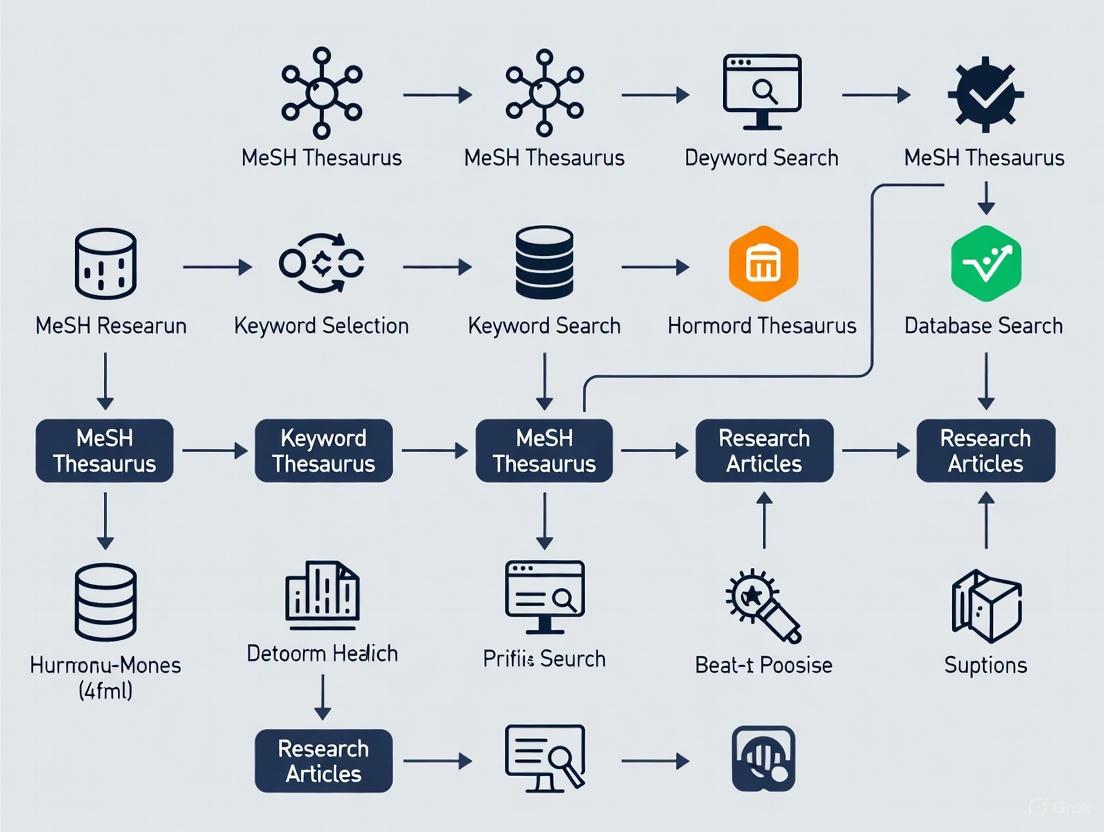
This guide provides a comprehensive framework for researchers, scientists, and drug development professionals to master the Medical Subject Headings (MeSH) thesaurus for effective literature retrieval.
Mastering MeSH: The Ultimate Guide to Systematic Keyword Research for Biomedical Professionals
Abstract
This guide provides a comprehensive framework for researchers, scientists, and drug development professionals to master the Medical Subject Headings (MeSH) thesaurus for effective literature retrieval. It covers foundational concepts, practical application methods, advanced troubleshooting for common search challenges, and validation techniques to ensure search accuracy and completeness. By integrating MeSH terms with keyword strategies, readers will learn to construct robust, systematic searches that account for evolving terminology, maximize recall of relevant studies, and enhance the rigor of evidence-based research and development.
What is MeSH? Building Your Foundational Knowledge for Effective Searching
Medical Subject Headings (MeSH) is a controlled and hierarchically-organized vocabulary thesaurus produced by the National Library of Medicine (NLM) [1]. It serves as a foundational resource for indexing, cataloging, and searching biomedical and health-related information across numerous databases, including MEDLINE/PubMed and the NLM Catalog [1]. By providing a standardized set of terminology, MeSH addresses the challenge of variant terminology in biomedical literature, ensuring that content is discoverable regardless of the specific words used by authors [2]. For instance, a search for the MeSH descriptor "Myocardial Infarction" will systematically retrieve records that use synonymous terms such as "heart attack" or "acute myocardial injury" [2]. This functionality makes MeSH an indispensable tool for rigorous biomedical information retrieval and scientific keyword research.
The Structural Anatomy of MeSH
The MeSH vocabulary is built upon a sophisticated three-tiered structure that exists within a single Descriptor record: Descriptor, Concept, and Term [3]. This structure allows for precise attribution of data elements and establishes clear relationships between different linguistic expressions of the same idea.
The Three-Tiered Structure
- Descriptor: A Descriptor is the top-level category in a MeSH record, representing a distinct biomedical concept and serving as the primary subject heading for indexing and searching. Each record has a single Preferred Concept, whose Preferred Term is also the name of the Descriptor itself [3]. Example: "Cardiomegaly" [3].
- Concept: Within a Descriptor, strictly synonymous terms are grouped into categories called Concepts. Each Concept has its own Preferred Term, which serves as the name for that Concept. A single Descriptor record can consist of multiple Concepts, which may have relationships to one another (e.g., a narrower concept) [3]. Example: Within the "Cardiomegaly" Descriptor, there are "Cardiomegaly" and "Cardiac Hypertrophy" Concepts [3].
- Term: Terms are the individual words or phrases that make up each Concept. These include the Preferred Term for the Concept along with various entry terms (synonyms). All terms within a single Concept are considered strictly synonymous with one another [3]. Example: The "Cardiac Hypertrophy" Concept contains the terms "Cardiac Hypertrophy" (Preferred) and "Heart Hypertrophy."
Table: MeSH Structure Example for "AIDS Dementia Complex" Descriptor
| Descriptor | Concept | Term |
|---|---|---|
| AIDS Dementia Complex | AIDS Dementia Complex (Preferred Concept) | AIDS Dementia Complex (Preferred Term) |
| Acquired-Immune Deficiency Syndrome Dementia Complex | ||
| AIDS-Related Dementia Complex | ||
| HIV Encephalopathy (Narrower Concept) | HIV Encephalopathy (Preferred Term) | |
| AIDS Encephalopathy | ||
| HIV-1-Associated Cognitive Motor Complex (Narrower Concept) | HIV-1-Associated Cognitive Motor Complex (Preferred Term) | |
| HIV-1 Cognitive and Motor Complex |
Hierarchical Organization: The MeSH Tree Structures
Beyond the internal structure of individual records, MeSH organizes Descriptors into broader hierarchical categories known as Tree Structures [3]. This system groups related concepts from broad categories to increasingly specific ones, arranged under 16 main branches such as Anatomy, Diseases, Chemical Compounds, and Analytical Methods [4]. The Tree Structures enable users to explore related concepts and perform comprehensive searches that include all narrower terms in the hierarchy [2].
MeSH in Practice: Applications and Methodologies
Indexing and Searching with MeSH
MeSH terms are applied to citations in MEDLINE/PubMed through an automated indexing process, with human indexers checking the quality of selected sets [2]. Each article is typically indexed with 10-15 MeSH terms [4], which allows for precise information retrieval. Two primary methods exist for finding relevant MeSH terms:
- Using MeSH Terms from a Known Article: When a relevant article is identified in PubMed, its associated MeSH terms are displayed at the bottom of the citation record. These terms can be selected to execute a new search for articles sharing the same indexing [5].
- Searching the MeSH Thesaurus: PubMed's MeSH database allows users to search directly for concepts. The system provides definitions, available subheadings (qualifiers), and shows the term's position in the hierarchical tree structure, enabling identification of broader, narrower, and related terms [2] [5].
NLM updates the MeSH vocabulary annually in response to emerging scientific concepts, taxonomic changes, and ethical considerations [6]. For 2025, one of the most significant expansions involves Artificial Intelligence, with dozens of new MeSH Descriptors added within this conceptual domain [6] [7]. These continuous updates ensure the vocabulary remains current with scientific progress.
Experimental Protocol: MeSH Term Analysis for Research Trend Identification
Research by scholarly analysts has demonstrated that comparative analysis of MeSH term frequencies can reveal evolving scientific trends [4]. The following methodology provides a framework for conducting such analyses.
Objective: To identify MeSH terms that characterize specialized research areas and detect topics with significantly changing publication frequencies over time.
Materials and Reagents:
Table: Research Reagent Solutions for MeSH Trend Analysis
| Item | Function |
|---|---|
| MEDLINE/PubMed Database | Primary source of biomedical literature abstracts and associated MeSH terms [4]. |
| PubMed API (e.g., Scanbious) | Programmatic interface for retrieving publication identifiers (PMIDs) and their associated MeSH terms based on specific queries [4]. |
| Statistical Software (R, Python) | Platform for performing statistical tests, multiple comparison corrections, and data visualization [4]. |
Procedure:
Sample Preparation:
- Define a target sample (
Sample 1) of publications representing a specialized research area (e.g., personalized medicine) using a specific PubMed queryQ(t)[4]. - Define a background control sample (
Sample 2) of publications from a broader field (e.g., general medicine) for comparison [4]. - Use the PubMed API to retrieve lists of PMIDs for both samples and their associated MeSH terms.
- Define a target sample (
Data Processing:
- Calculate the relative frequency of each MeSH term for each sample and year:
PMi/Nc(target sample) andGMi/Nt(control sample), wherePMiandGMiare counts of papers annotated by the term, andNcandNtare total papers in the respective samples for the year [4]. - Form MeSH-term frequency vectors for each sample.
- Calculate the relative frequency of each MeSH term for each sample and year:
Statistical Analysis:
- For each term and year, compare relative frequencies between samples using a proportions test (e.g.,
prop.testin R) [4]. - Apply False Discovery Rate (FDR) correction for multiple comparisons [4].
- Aggregate p-values across years (e.g., 2009-2018) using Fisher's method to obtain a final estimate of significance for differences in term usage [4].
- Calculate the effect size as a log ratio:
logratio = log2(PMi/GMi). A positive value indicates higher frequency in the target sample [4]. - Analyze temporal trends in term frequency using the non-parametric Mann-Kendall test to identify terms with consistently increasing or decreasing usage [4].
- For each term and year, compare relative frequencies between samples using a proportions test (e.g.,
Several specialized tools facilitate effective keyword research using the MeSH vocabulary, each designed for specific use cases from automated term identification to manual vocabulary exploration.
Table: MeSH Research Tools and Resources
| Tool Name | Primary Function | Application in Keyword Research |
|---|---|---|
| MeSH on Demand | Automatically identifies relevant MeSH terms from user-provided text (e.g., an abstract) using natural language processing [8]. | Provides a starting point for identifying potential keywords by analyzing a draft abstract. Results are machine-generated and should be verified [8]. |
| MeSH Browser | Allows direct searching and browsing of the MeSH thesaurus, including Scope Notes, Annotations, Entry Terms, and Tree Structures [1] [8]. | Enables precise lookup of terms, verification of definitions, and exploration of broader/narrower concepts via the hierarchy [8]. |
| Annual MeSH Update Reports | Details all changes (additions, modifications, replacements, deletions) made to the MeSH vocabulary each year [9]. | Critical for maintaining current search strategies and identifying newly available terms for emerging topics (e.g., AI concepts in 2025) [9] [6]. |
Strategic Considerations for Researchers
When incorporating MeSH into keyword research for drug development and scientific investigation, professionals should consider several strategic factors:
Vocabulary Dynamics: MeSH is a living vocabulary that undergoes significant annual updates. The 2025 update introduced approximately 200 new descriptors, with a substantial portion related to Artificial Intelligence, reflecting shifting scientific priorities [6] [7]. Researchers must consult annual update reports to ensure their keyword strategies incorporate newly available terminology.
Retrieval Limitations: When new MeSH terms are introduced, NLM typically does not retroactively re-index existing MEDLINE citations [9] [6]. Consequently, searches limited to a new MeSH term will primarily retrieve citations indexed after its introduction. Comprehensive searches must incorporate previous indexing terms or consider broader terms in the MeSH hierarchy to capture relevant earlier literature [9].
Integration with Related Vocabularies: MeSH exists within a broader ecosystem of biomedical terminologies maintained by NLM. For drug development professionals, RxNorm provides a standardized nomenclature for clinical drugs and supports e-prescribing, formulary development, and medication history applications [1]. The Unified Medical Language System (UMLS) Metathesaurus integrates concepts from over 150 vocabulary sources, including MeSH, facilitating connections across different terminological systems [1].
Medical Subject Headings (MeSH) is a comprehensive controlled vocabulary thesaurus created and updated by the United States National Library of Medicine (NLM) to index journal articles, books, and other resources in the life sciences [10]. For researchers, scientists, and drug development professionals, mastering MeSH's structure is not merely an academic exercise—it is a fundamental skill for conducting precise, reproducible, and comprehensive literature searches. Effective keyword research using MeSH ensures that queries capture all relevant conceptual variations, accounts for hierarchical relationships, and leverages standardized terminology, thereby maximizing retrieval efficiency and minimizing the risk of missing critical scientific evidence. This technical guide deconstructs the core components of MeSH—hierarchies, tree structures, and scope notes—to provide a robust methodological framework for integrating this powerful thesaurus into systematic research practices.
The Architectural Blueprint: Descriptor Hierarchy and Tree Structures
The Hierarchical Organization of Descriptors
At its core, the MeSH vocabulary is organized into a polyhierarchical structure where each descriptor (or subject heading) resides within a set of categories and subcategories [11]. This structure arranges descriptors from the most general to the most specific across up to thirteen hierarchical levels, creating a branching architecture often referred to as "trees" [11]. The hierarchy encompasses sixteen top-level categories, each identified by an alphabetic code, which provide the foundational classification for all subsequent terms (see Table 1: Top-Level MeSH Categories) [10].
Table 1: Top-Level MeSH Categories [10]
| Category Code | Category Title | Description |
|---|---|---|
| A | Anatomy | Organisms, tissues, cells, and subcellular structures |
| B | Organisms | Live entities such as plants, animals, and microorganisms |
| C | Diseases | Pathological conditions and diseases |
| D | Chemicals and Drugs | Chemical substances, drugs, and pharmaceutical agents |
| E | Analytical, Diagnostic and Therapeutic Techniques, and Equipment | Procedures, equipment, and investigative methods |
| F | Psychiatry and Psychology | Mental processes and behaviors |
| G | Phenomena and Processes | Biological, chemical, and physical phenomena |
| H | Disciplines and Occupations | Scientific disciplines and professional fields |
| I | Anthropology, Education, Sociology and Social Phenomena | Social sciences and educational aspects |
| J | Technology, Industry, and Agriculture | Applied sciences, technology, and industrial applications |
| K | Humanities | Arts, history, and philosophy of medicine |
| L | Information Science | Information management, storage, and retrieval |
| M | Named Groups | Specific populations and demographic groups |
| N | Health Care | Healthcare services, facilities, and systems |
| V | Publication Characteristics | Publication types and formats |
| Z | Geographicals | Geographic locations |
Tree Numbers and Polyhierarchy
The position of a MeSH descriptor within the hierarchy is designated by a systematic label known as a tree number [11] [12]. A single descriptor frequently appears in multiple locations within the hierarchical trees—a concept known as polyhierarchy—and therefore can possess multiple tree numbers [10] [12]. For instance, the descriptor "Digestive System Neoplasms" has the tree numbers C06.301 and C04.588.274, locating it within both the "Digestive System Diseases" tree and the "Neoplasms By Site" tree [10]. This multi-parentage allows for complex concepts to be appropriately classified under multiple broader topics, a critical feature for comprehensive retrieval. The tree numbers themselves are subject to change with annual MeSH updates and serve primarily as locators within the structure without intrinsic numerical significance [11].
The following diagram visualizes the hierarchical relationships and polyhierarchical nature of MeSH descriptors using the example of "Eye" and related terms, which belong to multiple parent trees.
Figure 1: MeSH Hierarchical Tree Structure. This diagram illustrates the polyhierarchical placement of "Eye" (A09.371) and its narrower terms, showing how "Eyelids" and "Eyebrows" can be accessed through multiple broader parent trees (A01 and A09).
The Principle of Most Specific Indexing
A fundamental principle in using MeSH for indexing and searching is to select the most specific descriptor available to represent a concept [11]. This practice, known as specificity, ensures that articles are categorized under the most precise relevant term. For example, an article about Streptococcus pneumoniae will be indexed under that specific descriptor rather than the broader term "Streptococcus" [11]. This principle directly impacts search strategy: searchers must consult the trees to identify whether more specific terms exist beneath a broader heading of interest to ensure complete retrieval. PubMed's default search behavior, known as "explode," automatically includes all narrower terms in the hierarchy when a descriptor is searched, but this can be disabled for precision when needed [10] [13].
Defining and Contextualizing Concepts: The Role of Scope Notes
Scope Notes for Descriptors
Qualifiers and Their Scope Notes
Beyond main descriptors, MeSH employs a set of qualifiers (also known as subheadings) that can be appended to descriptors to refine the focus on a particular aspect of the subject [10] [14]. There are 83 such qualifiers, each with its own detailed scope note that provides explicit instructions on its proper application [10] [14]. For instance, the qualifier "/adverse effects" is defined for use "with drugs, chemicals, or biological agents... for adverse effects or complications of... procedures," while "/blood" is used "for the presence or analysis of substances in the blood" [14]. Not all descriptor/qualifier combinations are permitted; the system only allows pairings that are conceptually meaningful [10].
Table 2: Selected MeSH Qualifiers and Scope Notes [14]
| Qualifier Name | Abbreviation | Short Form | Scope Note Summary |
|---|---|---|---|
| Administration & Dosage | AD | ADMIN | Dosage forms, routes, frequency, duration, and effects thereof. |
| Adverse Effects | AE | ADV EFF | Harmful effects of drugs, chemicals, or procedures in normal use. |
| Agonists | AG | AGON | Substances with affinity and intrinsic activity at a receptor. |
| Analysis | AN | ANAL | Identification or quantitative determination of a substance; excludes tissue analysis. |
| Anatomy & Histology | AH | ANAT | Normal descriptive anatomy and histology of organs and tissues. |
| Antagonists & Inhibitors | AI | ANTAG | Substances that counteract the effects of other agents. |
| Biosynthesis | BI | BIOSYN | Anabolic formation of substances in organisms, cells, or subcellular fractions. |
| Chemical Synthesis | CS | CHEM SYN | Chemical preparation of molecules in vitro. |
| Drug Therapy | DT | DRUG THER | Treatment of disease with drugs, chemicals, or antibiotics. |
| Epidemiology | EP | EPIDEMIOL | Disease distribution, causative factors, and attributes in defined populations. |
| Genetics | GE | GENET | Hereditary mechanisms and genetic basis of normal and pathological states. |
| Metabolism | ME | METAB | Biochemical changes and metabolism; includes catabolic changes for chemicals. |
| Pharmacology | PK | PHARMACOKIN | Mechanism, dynamics, and kinetics of substances in the body. |
| Therapy | TH | THER | Therapeutic interventions excluding drug therapy and radiotherapy. |
Methodologies for Leveraging MeSH Structure in Keyword Research and Search Execution
Experimental Protocol: Building a Precise PubMed Search Using the MeSH Database
This methodology outlines the systematic process for constructing a highly targeted PubMed search query using the MeSH database's hierarchical structure and qualifiers.
Step 1: Concept Identification and Initial Terminology Mapping - Begin by deconstructing your research question into core conceptual components. For each concept, enter potential keywords into the PubMed search bar and execute a preliminary search. Immediately navigate to the "Search Details" panel to observe PubMed's Automatic Term Mapping (ATM), which reveals how your natural language terms were translated into official MeSH descriptors and entry terms [10]. This step identifies the primary MeSH terms for your concepts and reveals synonym relationships.
Step 2: Hierarchical Exploration and Specificity Validation - For each identified MeSH descriptor, access the MeSH Database record. Critically examine the "Tree Structures" section (often denoted by section E or F in the database interface) to visualize the term's position in the hierarchy [13]. Determine if the concept is represented by the most specific descriptor available. If more specific (narrower) terms exist in the trees and are relevant to your research, incorporate them into your search strategy to enhance precision.
Step 3: Application of Qualifiers and Search Restrictions - Within the MeSH Database record for each descriptor, review the list of allowable qualifiers (subheadings) [13]. Select qualifiers that best represent the aspect of the concept you are investigating (e.g., "/drug therapy" for a disease, "/therapeutic use" for a drug). Use the scope notes for qualifiers (see Table 2) to ensure correct application [14]. Optionally, apply search restrictions such as "[Majr]" to restrict retrieval to articles where the term is a major topic, or "[Mesh:NoExp]" to prevent automatic explosion of the hierarchy [13].
Step 4: Search Construction and Execution - Use the MeSH Database's "Search Builder" tool to add your refined terms, complete with selected qualifiers and restrictions, to a structured query [13]. Combine multiple concepts using the Boolean operator "AND" to ensure results address all aspects of your research question. Review the final search string in the builder for accuracy before clicking "Search PubMed" to execute the query.
Experimental Protocol: Tracking Vocabulary Changes and Updates
MeSH is a dynamic vocabulary updated annually, necessitating proactive monitoring for sustained search accuracy. This protocol provides a methodology for tracking these changes.
Step 1: Monitor Official NLM Communication Channels - Regularly consult the NLM Technical Bulletin, specifically the "Annual MeSH Processing" article published towards the end of each year, which details the upcoming changes to the vocabulary, including new descriptors, deleted terms, and structural modifications [9]. This is the primary source for authoritative update information.
Step 2: Utilize MeSH Update Reports - Access the structured "MeSH Update" reports provided by NLM, which are available in various formats (CSV, PDF, HTML) and provide detailed, exportable data on additions, deletions, and modifications to descriptors and Supplementary Concept Records (SCRs) [9]. Integrate review of these reports into your pre-search workflow, especially after the annual MeSH release.
Step 3: Account for Retroactive and Non-Retroactive Indexing - Understand NLM's indexing policies. Typically, new MeSH terms are not applied retroactively to older citations [9]. Therefore, a search for a new term will only retrieve articles indexed after its introduction. For comprehensive historical searches, consult the "Previous Indexing" information in the MeSH record to identify the terms previously used for that concept and incorporate them into your search strategy [9] [13].
Table 3: Key Resources for MeSH-Based Research [15] [9] [13]
| Resource Name | Function | Access Point |
|---|---|---|
| MeSH Database | The primary tool for browsing the thesaurus, viewing tree structures, scope notes, and entry terms, and building targeted search queries. | Accessed via the PubMed interface or directly at the NLM MeSH website. |
| NLM Technical Bulletin | Provides official announcements and detailed articles on annual MeSH updates, new features, and changes to indexing policies. | Published online by the National Library of Medicine. |
| MeSH Update Reports | Downloadable, detailed reports (in CSV, JSON, RDF, XML) listing all specific changes (additions, deletions, modifications) made during the annual update cycle. | Found via the NLM Data Discovery catalog or linked from the Technical Bulletin. |
| PubMed Search Details | A feature that displays how a submitted search query was translated by PubMed's Automatic Term Mapping (ATM), revealing the MeSH terms and logic actually used. | Available under the "Search Details" box on the search results page after executing a PubMed query. |
| MeSH Qualifiers with Scope Notes | A complete reference list of all 83 qualifiers alongside their full scope notes, providing essential guidance for their correct application. | Hosted on the NLM website as a dedicated page. |
The Medical Subject Headings (MeSH) thesaurus is a controlled and hierarchically-organized vocabulary produced by the United States National Library of Medicine (NLM). It serves as a critical tool for indexing, cataloging, and searching biomedical and health-related information across databases like MEDLINE/PubMed and the NLM Catalog [1] [10]. A MeSH record structures biomedical concepts into a standardized format, enabling precise information retrieval. For researchers conducting keyword research, understanding the core components of a MeSH record—Entry Terms, Subheadings (Qualifiers), and Tree Numbers—is fundamental to developing effective and comprehensive search strategies. This guide deconstructs these elements within the context of a systematic approach to keyword investigation.
Core Components of a MeSH Record
Entry Terms: The Gateway to Controlled Vocabulary
Entry Terms, also known as "See cross-references," are the synonyms, near-synonyms, alternate forms, and other closely related terms listed within a MeSH record [16]. They function as a bridge between the natural language a researcher might use and the preferred, controlled vocabulary of the MeSH descriptor.
- Function and Role: The primary function of Entry Terms is to enrich the thesaurus, guiding both indexers and searchers to the preferred MeSH heading. They are generally used interchangeably with the preferred descriptor for cataloging, indexing, and retrieval [16] [17].
- Impact on Searching: In PubMed, a search using an entry term automatically triggers the system's Automatic Term Mapping (ATM), which translates the entered phrase into the corresponding MeSH descriptor for the search. This ensures that relevant articles are retrieved even when the searcher does not know the precise MeSH term [15] [10]. For instance, a search for "Heart Arrest" will also map from entry terms like "Arrest, Heart" and "Asystole" [16].
Table: Entry Term Examples for a MeSH Descriptor
| MeSH Descriptor (Preferred Term) | Example Entry Terms |
|---|---|
Heart Arrest |
Arrest, Heart; Cardiac Arrest; Asystole; Cardiorespiratory Arrest [16] |
Independent Living |
Community Dwelling [15] |
Subheadings (Qualifiers): Refining the Focus
Qualifiers, often called Subheadings, are a set of standard terms used in conjunction with MeSH descriptors to narrow the focus of a topic to a specific aspect [17] [10]. There are 78 topical qualifiers available for indexing [17].
- Function and Role: Qualifiers allow for the precise description of an article's content. They afford a convenient means of grouping citations concerned with a particular facet of a subject [17]. For example, while
Liveris a broad descriptor,Liver/drug effectsspecifies that the article is about the effect of drugs on the liver, andLiver/surgeryfocuses on surgical aspects of the liver. - Application in Keyword Research: Using qualifiers in a PubMed search strategy helps filter results to the most relevant sub-topic, significantly increasing the precision of keyword research. Not all descriptor/qualifier combinations are permitted, as some may be semantically meaningless [10].
Table: Common MeSH Subheadings (Qualifiers) and Their Applications
| Subheading | Abbreviation | Application Example |
|---|---|---|
| Adverse effects | AE | Aspirin/adverse effects - Side effects of a drug. |
| Drug therapy | DT | Asthma/drug therapy - Use of drugs to treat a disease. |
| Epidemiology | EP | Influenza, Human/epidemiology - Disease occurrence. |
| Metabolism | ME | Glucose/metabolism - Biochemical transformations. |
| Surgery | SU | Appendicitis/surgery - Surgical procedures. |
Tree Numbers: Mapping the Hierarchical Structure
Tree Numbers are systematic labels that represent a descriptor's location within the MeSH hierarchical tree structures [10]. A single descriptor may appear in multiple locations in the hierarchy, and therefore can have several tree numbers.
- Function and Role: The tree structures organize MeSH descriptors from broader (parent) to narrower (child) concepts across sixteen top-level categories, denoted by letters like A (Anatomy), B (Organisms), C (Diseases), and D (Chemicals & Drugs) [10]. Tree numbers are subject to change as MeSH is updated annually, but each descriptor also carries a unique alphanumerical ID that remains constant [10].
- Application in Keyword Research: The hierarchical structure is leveraged in PubMed through the "Explode" feature. Searching a MeSH term with its children included (exploding) ensures a comprehensive search by automatically including all more specific terms nested beneath it in the tree [10]. This is crucial for ensuring breadth in keyword research.
Figure 1: Logical relationships between core MeSH record components and system functions.
The MeSH thesaurus is dynamically updated to reflect progress in medicine and science. The quantitative data below from the 2025 release provides a snapshot of the scale and evolution of the vocabulary, which directly impacts the comprehensiveness of keyword research [15].
Table: MeSH 2025 Vocabulary Statistics
| Record Type | Total Count | New in 2025 | Notable Changes |
|---|---|---|---|
| Main Headings (Descriptors) | 30,956 | 192 | New terms in Phenomena/Processes (G) and Information Science (L) [15]. |
| Supplementary Concept Records (SCRs) | 323,939 | 1,001 | Includes chemicals, drugs, and rare diseases; updated nightly [15] [17]. |
| Publication Types | Not specified | SCOPING REVIEW added, NETWORK META-ANALYSIS becomes a Publication Type [15]. |
Experimental Protocol: Utilizing MeSH Components for Systematic Keyword Research
This protocol provides a detailed methodology for using MeSH record components to conduct a systematic and reproducible literature search, forming the core of effective keyword research.
Research Reagent Solutions: Essential Tools for MeSH-Based Research
Table: Key Digital Tools for MeSH-Based Keyword Research
| Tool Name | Function in Keyword Research |
|---|---|
| MeSH Database (NLM) | The primary tool for identifying relevant descriptors, their entry terms, tree numbers, and subheadings. |
| PubMed Search Interface | The platform where search strategies are executed, leveraging Automatic Term Mapping and explodes. |
| NLM Technical Bulletin | Source for updates on annual MeSH changes, new terms, and discontinued headings [15]. |
Methodology
Concept Identification and Vocabulary Mining:
- Break down the research topic into core conceptual components.
- For each concept, use the MeSH Database to search for potential main headings. Take note of the Entry Terms listed, as these represent valuable alternative keywords and phrases that will be automatically mapped in PubMed [16].
Hierarchical Exploration and Strategy Formulation:
- For each identified main heading, examine its Tree Numbers and location within the MeSH hierarchy.
- Decide whether an "Explode" search is appropriate. If the concept is broad and should include all specific child terms, use the explode function. If the concept is very specific, a non-exploded search may be more precise [10].
Precision Refinement with Subheadings:
- Determine if any aspect of a concept can be refined using Subheadings. For a question about the drug therapy of a disease, applying the
/drug therapysubheading to the disease descriptor will filter out articles focused on, for instance, the genetics or surgery of that disease [17].
- Determine if any aspect of a concept can be refined using Subheadings. For a question about the drug therapy of a disease, applying the
Search String Assembly and Execution:
- Combine the selected descriptors (exploded or not) with their relevant subheadings using Boolean operators (AND, OR, NOT).
- Execute the search in PubMed.
Validation and Iterative Refinement:
- Check the "Search Details" in PubMed to confirm how your query was translated via Automatic Term Mapping. This reveals which MeSH terms and entry terms were used [10].
- Review the results and refine the search strategy iteratively by adding, removing, or modifying terms based on relevance.
Figure 2: Workflow for building a systematic literature search using MeSH components.
Case Study: Keyword Research on "Aging in Place"
The 2025 MeSH update provides a clear example of how the vocabulary evolves and impacts searching. Previously, the phrase "Aging in Place" was an Entry Term for the main heading Independent Living [15]. A PubMed search for Aging in Place would trigger Automatic Term Mapping and search for the MeSH term Independent Living, yielding approximately 52,498 results [15].
- Post-2025 Update:
Aging in Placehas been promoted to the status of a Main Heading, withCommunity Dwellingas its entry term [15]. - Impact on Search: The same search for
Aging in Placenow triggers the new, more specific MeSH term. Searchers may notice a drop in result count as the search is no longer broadened by the parent termIndependent Living. This change benefits keyword research by enabling more precise retrieval of articles specifically about aging in place [15]. - Research Strategy:
- Pre-2025: A precise search required knowing that
Aging in Placemapped toIndependent Living. - Post-2025: A search for the phrase automatically maps to the specific heading. For comprehensive research, a searcher might now use an "OR" operation to combine the new
Aging in Placeterm with the broaderIndependent Livingterm to capture the full scope of literature. This case highlights the importance of checking the MeSH database for current relationships.
- Pre-2025: A precise search required knowing that
In the complex landscape of biomedical literature retrieval, researchers face significant challenges in navigating the vast and inconsistent terminology of scientific publications. Medical Subject Headings (MeSH), the National Library of Medicine's controlled vocabulary, provides a sophisticated solution to the problem of keyword variability by establishing a standardized framework for information indexing and retrieval. This technical guide examines the structural foundations of MeSH and demonstrates through quantitative analysis how its hierarchical organization and vocabulary control mechanisms enhance search precision and recall compared to traditional text-word strategies. Framed within the context of systematic keyword research methodology, this whitepaper provides drug development professionals and researchers with evidence-based protocols for integrating MeSH into comprehensive literature retrieval workflows, supported by experimental data and practical implementation frameworks.
Biomedical researchers navigating today's literature face a fundamental retrieval problem: the same concepts are described using different terminology across publications. This keyword variability stems from multiple factors including author preferences, disciplinary conventions, and evolving terminology. Without a standardized vocabulary, researchers struggle to comprehensively locate relevant literature, potentially missing critical studies and introducing selection bias into their research. The PubMed database alone contains over 36 million citations with approximately 1 million new additions annually [18], making comprehensive literature retrieval without systematic tools virtually impossible.
MeSH addresses this challenge through its controlled vocabulary of over 27,000 hierarchically-organized terms [18]. This system provides uniformity and consistency to the indexing, cataloging, and searching of biomedical information across NLM databases [19]. For example, a search for the MeSH term "telemedicine" automatically includes synonyms such as "mobile health," "mhealth," "telehealth," and "ehealth" [19], effectively searching for meaning rather than merely matching text strings. This conceptual approach to information retrieval forms the foundation of effective literature searching for evidence-based medicine and systematic reviews.
MeSH Structure and Vocabulary Control Mechanisms
Hierarchical Organization and Semantic Relationships
The MeSH vocabulary is organized hierarchically from broader to narrower terms across 16 main categories, creating a tree structure that enables both specific and comprehensive searching. For instance, the term "Heart Diseases" encompasses narrower terms including "Arrhythmias, Cardiac," which further includes "Atrial Fibrillation" [20]. This arrangement allows searchers to leverage the hierarchy based on their information needs—searching broader terms to capture all relevant literature or narrower terms for precise retrieval.
MeSH incorporates several semantic relationships that enhance retrieval effectiveness:
- Entry Terms: Synonyms and related phrases that direct users to the preferred MeSH term (e.g., "heart attack" maps to "myocardial infarction") [21]
- Scope Notes: Definitions and usage guidelines that clarify a term's meaning and application
- Cross-References: Links to related terms that assist in locating the most appropriate heading
- Subheadings: Qualifiers that allow searching for specific aspects of a subject (e.g., "drug therapy" or "surgery") [20]
Vocabulary Control and Standardization Processes
MeSH employs rigorous vocabulary control mechanisms to maintain consistency. Human indexers assign approximately 5-15 MeSH terms to each article in MEDLINE, describing the primary concepts discussed [21]. When no specific heading exists for a concept, indexers use the closest available general heading, ensuring consistent application across the literature. The National Library of Medicine annually updates MeSH to reflect scientific advancements, with new terms added and existing terms modified or retired based on emerging terminology and user suggestions [1].
Quantitative Analysis: MeSH vs. Text-Word Retrieval Performance
Experimental Protocol and Methodology
A 2022 study compared the effectiveness of MeSH-term versus text-word searching using rigorous bibliometric measurements [22]. Researchers employed the relevant recall method to evaluate search strategies for literature on psychosocial aspects of children and adolescents with type 1 diabetes. The experimental protocol consisted of:
- Gold Standard Development: Identification and evaluation of 3,162 resources to form a validated set of 1,521 relevant articles
- Search Strategy Formulation: Creation of parallel MeSH-term and text-word search strategies for the same research question
- Performance Measurement: Calculation of recall and precision metrics for both strategies
- Statistical Analysis: Comparison of results to determine significant differences in retrieval effectiveness
Recall was defined as the number of relevant citations retrieved divided by the total number of relevant citations, while precision was calculated as the number of relevant citations retrieved divided by the total number of citations retrieved [22].
Comparative Performance Metrics
Table 1: Recall and Precision Comparison of Search Strategies
| Search Strategy | Recall (%) | Precision (%) | Complexity Level |
|---|---|---|---|
| MeSH-term | 75 | 47.7 | High |
| Text-word | 54 | 34.4 | Low |
Table 2: Database Coverage in Systematic Reviews
| Database Metric | Percentage |
|---|---|
| References found in a single database | 16% |
| Recall with multiple databases | 98.3% |
| Systematic reviews with incomplete searches | 60% |
The experimental results demonstrate that the MeSH-term strategy yielded significantly higher recall (75% vs. 54%) and precision (47.7% vs. 34.4%) compared to text-word searching [22]. This performance advantage comes with increased complexity in search design and execution, requiring greater expertise to implement effectively. The data further indicates that searching multiple databases improves comprehensive retrieval, with Embase alone contributing 132 unique references in systematic reviews [18].
Figure 1: MeSH vs. Text-Word Search Performance Comparison
MeSH Implementation Framework: Protocols for Effective Retrieval
MeSH Term Identification and Selection Methodology
Implementing an effective MeSH-based search strategy requires systematic term identification and selection:
- MeSH Database Exploration: Access the MeSH database via PubMed homepage under "Explore" [21]
- Concept Mapping: Input conceptual keywords to identify corresponding MeSH terms and entry terms
- Hierarchy Examination: Review broader and narrower terms in the MeSH tree structure to determine appropriate term specificity [20]
- Subheading Selection: Identify applicable subheadings to focus searches on specific aspects of a topic
- Term Validation: Verify term selection using relevant articles' assigned MeSH terms [19]
For emerging concepts without dedicated MeSH terms, researchers should identify the closest broader terms while supplementing with text-words to ensure comprehensive coverage [19].
Search Strategy Formulation Workflow
Table 3: MeSH Search Formulation Protocol
| Step | Action | Output |
|---|---|---|
| 1 | Conceptual analysis of research question | Defined concepts for searching |
| 2 | MeSH term identification for each concept | Controlled vocabulary terms |
| 3 | Synonym and entry term collection | Supplementary text-words |
| 4 | Boolean logic application | Combined search strategy |
| 5 | Results evaluation and strategy refinement | Optimized search query |
Figure 2: MeSH Search Strategy Development Workflow
MeSH-Enhanced Keyword Research for Drug Development
Domain-Specific Applications
Drug development professionals can leverage MeSH for comprehensive competitor intelligence, clinical trial landscape analysis, and mechanism of action investigations. Specific applications include:
- Drug Profiling: Utilizing MeSH pharmacological action terms to identify literature about drug classes and mechanisms
- Therapeutic Area Mapping: Employing disease hierarchy terms to understand research density across related conditions
- Biomarker Discovery: Applying technique and diagnostic heading combinations to locate validation studies
- Adverse Event Monitoring: Combining drug subheadings with toxicity terms for safety surveillance
The integration of NCBI taxonomy identifiers into MeSH enhances retrieval of organism-specific research relevant to preclinical studies [23]. This integration facilitates precise searching for literature involving specific pathogens, model organisms, or biological materials used in drug development.
Advanced Integration with Research Databases
While PubMed/MedLINE remains the primary MeSH-enabled database with 100% coverage in systematic reviews [18], researchers should implement cross-database searching to minimize bias and maximize retrieval. Key databases include:
- Embase: Particularly strong for pharmacological and European literature, with unique record coverage
- Cochrane Library: Essential for evidence-based medicine and systematic reviews
- Scopus: Multidisciplinary coverage with robust citation analysis tools
- CINAHL: Valuable for nursing and allied health literature
Table 4: Database Integration for Comprehensive Retrieval
| Database | Unique Contribution | MeSH Compatibility |
|---|---|---|
| PubMed/MEDLINE | Foundation for biomedical searching | Full MeSH integration |
| Embase | Drug studies, international coverage | Emtree thesaurus |
| Cochrane Library | Evidence-based medicine resources | MeSH compatible |
| Scopus | Multidisciplinary, citation tracking | Limited vocabulary control |
Research Reagent Solutions: Essential Tools for MeSH-Based Retrieval
Table 5: MeSH Research Toolkit and Resources
| Tool/Resource | Function | Access Point |
|---|---|---|
| MeSH Database | Identify and browse controlled vocabulary | PubMed homepage under "Explore" |
| Yale MeSH Analyzer | Analyze MeSH terms for up to 20 articles | Online tool using PubMed IDs |
| NLM MeSH on Demand | Predict MeSH terms from abstracts/text | NLM web service |
| MeSH Browser | Complete hierarchical browsing | NLM website |
| Automatic Term Mapping | PubMed's query translation system | Built into PubMed search |
MeSH represents an indispensable resource for overcoming the inherent challenges of keyword variability in biomedical literature retrieval. Through its controlled vocabulary and hierarchical structure, MeSH enables researchers to search conceptually rather than lexically, significantly enhancing both recall and precision compared to text-word strategies. The experimental evidence demonstrates clear quantitative advantages: 75% recall for MeSH strategies versus 54% for text-words, with precision advantages of 47.7% versus 34.4% [22]. For drug development professionals and researchers conducting systematic reviews, MeSH provides the methodological foundation for comprehensive, unbiased literature retrieval. The integration of MeSH with supplementary text-words and cross-database searching creates an optimal approach for navigating the increasingly complex landscape of biomedical research, ensuring critical evidence is identified regardless of terminology variations across publications. As biomedical literature continues to expand, mastery of MeSH-based retrieval strategies will remain essential for rigorous scientific investigation and evidence-based decision making.
From Concept to Search Strategy: A Step-by-Step MeSH Methodology
The Medical Subject Headings (MeSH) thesaurus is a controlled and hierarchically-organized vocabulary developed and maintained by the National Library of Medicine (NLM) [2] [19]. Its primary function is to provide uniformity and consistency to the indexing, cataloguing, and searching of biomedical and health-related information within databases like PubMed and MEDLINE [19]. For researchers, scientists, and drug development professionals, mastering MeSH is a critical component of effective keyword research, enabling comprehensive literature retrieval that transcends the limitations of natural language.
When an article is indexed for MEDLINE, human indexers or automated systems assign approximately 10-15 MeSH terms to describe its core content [4] [2]. This structured vocabulary solves a fundamental problem in literature search: the variability of author terminology. For instance, a search for the MeSH term "Myocardial Infarction" will automatically retrieve articles that use author keywords like "heart attack" or "acute myocardial injury," ensuring that relevant studies are not missed due to semantic differences [2]. This guide provides a detailed, technical protocol for discovering relevant MeSH terms, forming the essential first step in a robust, evidence-based keyword research strategy.
Comparative Analysis of Search Strategies: MeSH vs. Textwords
A proficient literature search strategy intentionally combines MeSH terms with textwords (also called keywords) to leverage the strengths of both approaches [19]. Textwords are literal terms searched within specific fields like the title and abstract. The table below summarizes the distinct characteristics and applications of each method.
Table 1: Comparison of MeSH Term and Textword Search Strategies
| Feature | MeSH Term Searching | Textword Searching |
|---|---|---|
| Concept Coverage | Searches for a concept's pre-defined synonyms, acronyms, and alternate spellings [19]. | Searches only for the exact terms and their immediate variants used by the author. |
| Search Precision | High precision for retrieving thematically relevant articles, independent of author wording [2]. | Can be lower precision, as terms may appear in contexts different from the intended concept. |
| Ideal Use Case | Retrieving literature on established, well-defined concepts [19]. | Searching for very new ideas, technologies, or concepts not yet represented in MeSH [19]. |
| Indexing Dependency | Only retrieves records that have been fully indexed with MeSH terms [19]. | Retrieves all records, including those too recent to have been assigned MeSH terms [19]. |
The following workflow diagram maps the logical process for discovering and utilizing MeSH terms, integrating with textword searching to ensure a comprehensive search.
Detailed Methodologies for MeSH Term Discovery
Protocol 1: Direct Query of the MeSH Database
This is the primary method for identifying the controlled vocabulary for a given concept.
- Objective: To authoritatively identify and select the most appropriate MeSH term(s) for a research concept.
- Materials and Tools: Internet access and the NLM's MeSH Database, accessible via the PubMed homepage [2].
- Procedure:
- Access: From the PubMed homepage, select "MeSH" from the search box dropdown menu [2].
- Query: Type your research concept (e.g., "diabetes") into the search box. The database will return a list of suggested MeSH terms [19].
- Evaluate: Click on potential MeSH terms to view their full record, which includes:
- Scope Note: A brief definition of the term [19].
- Entry Terms: Synonyms, acronyms, and alternate spellings that map to this MeSH term (e.g., "telemedicine" includes "mobile health," "mhealth," and "ehealth") [19].
- Tree Hierarchy: A visual representation of broader and narrower (child) terms [2] [19].
- Select and Apply: After choosing the appropriate term(s), you can add them to the PubMed search builder. The search will automatically "explode" the term, meaning it includes all more specific terms in the hierarchy [2].
Protocol 2: Reverse-Engineering from a Known Relevant Article
When a concept is new or a direct MeSH query is unsuccessful, analyzing a known relevant article is an effective alternative.
- Objective: To discover relevant MeSH terms by examining the indexed terms of a pivotal article on your topic.
- Materials and Tools: A PubMed record of a known relevant article.
- Procedure:
- Locate: Find a highly relevant article in PubMed.
- Inspect: In the article's abstract view or full record, locate the "MeSH terms" field [2].
- Extract: Identify and note the MeSH terms that describe the core concepts of your research interest. These terms can be directly used or added to the search builder for a new, broader search [2].
Protocol 3: Advanced Trend Analysis Using MeSH Frequency Vectors
For strategic research planning and scientometric analysis, tracking the temporal dynamics of MeSH terms can reveal emerging trends.
- Objective: To identify research topics for which the number of published works has changed significantly over time [4].
- Materials and Tools: A set of PubMed publications (a target group and a control group) and statistical analysis software. The API Scanbious can be used to retrieve PMIDs and associated MeSH terms [4].
- Experimental Protocol:
- Data Preparation: Form a target sample of papers (e.g., in personalized medicine) and a background/control sample (e.g., general medicine). For each sample, generate a MeSH-terms's frequency vector, which is the relative frequency of each MeSH term's occurrence normalized to the total number of papers in the sample [4].
- Statistical Comparison: For each term and year, compute the relative frequencies in the target ((PMi/Nt)) and control ((GMi/Nc)) samples. Statistical differences between the frequencies (p-value) can be determined using a proportions test (e.g.,
prop.testin R), with correction for multiple comparisons using the False Discovery Rate (FDR) method [4]. - Effect Size Calculation: Calculate a log ratio for each MeSH term using the formula ( \text{logratio} = \log2(PMi/GM_i) ). A positive value indicates the term is more frequent in the target sample. The absolute value indicates the magnitude of the difference [4].
- Trend Analysis: Perform a Mann-Kendall trend test on the frequency of each MeSH term over time (e.g., 2009-2018) to identify terms with consistently increasing or decreasing usage. A p-value ≤ 0.01 is considered indicative of a significant trend [4].
The Researcher's Toolkit for MeSH and Keyword Research
The following table details essential digital tools and resources that facilitate the discovery and application of MeSH terms in scientific keyword research.
Table 2: Essential Digital Tools for MeSH and Keyword Research
| Tool Name | Function | Application in Keyword Research |
|---|---|---|
| NLM MeSH Database | The authoritative source for browsing and searching the entire MeSH thesaurus [2]. | Identifying official terms, definitions, synonyms (Entry Terms), and hierarchical relationships for core concepts. |
| NLM MeSH on Demand | A text analysis tool that predicts MeSH terms based on a submitted abstract or manuscript [19]. | Automatically suggests potential MeSH terms for a specific block of text, aiding in vocabulary discovery. |
| Yale MeSH Analyzer | A utility that groups MeSH headings for up to 20 articles in a table using their PubMed IDs (PMIDs) [19]. | Deconstructing the indexing of multiple key papers to identify recurring and relevant MeSH terms for a search strategy. |
| Automated Term Mapping (ATM) | PubMed's built-in query translation system [15]. | Understanding how untagged search terms are automatically matched to MeSH terms, helping to refine and control searches. |
Updates and Considerations for MeSH in 2025
The MeSH vocabulary is dynamic, with NLM adding, modifying, and occasionally discontinuing terms annually. For 2025, there are 192 new Main Headings [15]. Researchers must be aware of these changes, as they can directly impact search results.
- New Terms: New concepts are continually added. For example,
SCOPING REVIEWis a new Publication Type for 2025, defined as a literature overview that maps available evidence without providing a summary answer, distinct from aSYSTEMATIC REVIEW[15]. Previously, scoping reviews were indexed as "Systematic Review." This change allows for more precise searching, but may alter result counts for existing search filters. - Term Promotions: Entry terms can be promoted to main headings.
AGING IN PLACE, previously an entry term forINDEPENDENT LIVING, is now a main heading itself [15]. A search for the phrase "Aging In Place" will now trigger this new, more specific MeSH term instead of the broader "Independent Living," which may reduce the number of results and increase precision. - Search Strategy Maintenance: Searchers should periodically check their key queries in the MeSH Database to ensure the terms are still current and to identify any new, more specific terms that should be included [15].
Medical Subject Headings (MeSH) is the National Library of Medicine's (NLM) controlled vocabulary thesaurus used for indexing, cataloging, and searching biomedical and health-related information [1]. It features a hierarchically-organized structure that provides consistency and precision in retrieving scientific literature. Within this sophisticated system, entry terms serve as critical access points, functioning as synonyms, near-synonyms, and alternate forms of the preferred MeSH terminology [16].
Understanding and leveraging entry terms is fundamental to constructing comprehensive search strategies. These terms account for variations in scientific language, ensuring researchers can locate all relevant literature regardless of the specific terminology used by authors. This guide provides technical methodologies for systematically exploiting entry terms to build robust synonym lists, thereby enhancing recall and precision in biomedical information retrieval.
The Role and Structure of Entry Terms
Definition and Purpose
Entry terms, sometimes called "See cross-references," are synonyms, near-synonyms, alternate forms, and other closely related terms within a MeSH record [16]. While not always strictly synonymous with the preferred descriptor, they are treated as equivalent for the purposes of cataloging, indexing, and retrieval [16]. This functional equivalence makes them invaluable for search strategy development.
The primary purpose of entry terms is to map natural language to controlled vocabulary. When users search with terms they are familiar with, PubMed's Automatic Term Mapping (ATM) mechanism translates these terms to the appropriate MeSH headings via the entry term mapping system [24]. For example, a search for "Heart Arrest" will also retrieve records containing entry terms such as "Arrest, Heart" and "Asystole" [16].
Relationship to Other MeSH Features
Entry terms represent just one type of cross-reference within the MeSH ecosystem. Other important relationships include:
- See Related: Suggests other descriptor records that may be of interest through associative relationships (e.g., "Factor XIII Deficiency see related Factor XIIIa") [16].
- Consider Also: References other descriptors sharing common linguistic roots, primarily used with anatomical terms (e.g., "Brain consider also terms at CEREBR- and ENCEPHAL-") [16].
- MeSH Tree Structures: Display hierarchical relationships that allow for broader and narrower retrieval through parent-child relationships [16].
Unlike these other relationships, entry terms provide direct semantic equivalence, making them uniquely valuable for synonym generation.
Methodological Framework: Extracting and Utilizing Entry Terms
Locating Entry Terms via the MeSH Database
The MeSH Database provides the primary interface for identifying entry terms associated with a specific concept. The following protocol details the systematic extraction of entry terms:
- Access the MeSH Database: Navigate to the MeSH Database via the PubMed homepage (under "More Resources") [25].
- Concept Search: Enter your key search concept into the query box (e.g., "Heart Arrest").
- Review Results: Examine the returned MeSH records and select the most appropriate descriptor.
- Analyze Full Record: Scroll the full descriptor record to locate the "Entry Terms" section, which lists all synonymous terms [25].
- Document Synonyms: Systematically record all entry terms for inclusion in your search strategy.
Table: Entry Term Extraction Workflow
| Step | Action | Output |
|---|---|---|
| 1 | Access MeSH Database via PubMed | Interface for controlled vocabulary search |
| 2 | Input conceptual search term | List of potential MeSH descriptors |
| 3 | Select relevant MeSH descriptor | Full MeSH record with complete metadata |
| 4 | Locate "Entry Terms" section | Comprehensive list of synonymous terms |
| 5 | Document all entry terms | Raw materials for synonym list construction |
Workflow Visualization
The following diagram illustrates the logical workflow for extracting and implementing entry terms in a comprehensive search strategy:
Categorizing Entry Terms for Strategic Implementation
Entry terms encompass several distinct types of terminology, each with specific strategic value:
- True Synonyms: Scientifically equivalent terms (e.g., "Asystole" for "Heart Arrest") [16]
- Lexical Variations: Inversions, alternate word orders (e.g., "Arrest, Heart") [16]
- British/American Spellings: Variations in spelling conventions
- Abbreviations/Acronyms: Short forms and initialisms
- Common vs. Technical Terms: Lay language versus scientific terminology
- Historical Terminology: Older terms that may appear in legacy literature
Table: Quantitative MeSH Scope (2025 Data) [15] [26]
| MeSH Component | Total Count | New in 2025 |
|---|---|---|
| Main Headings | 30,956 | 192 |
| Supplementary Concept Records (SCRs) | 323,939 | 1,001 |
| Category G (Phenomena and Processes) | Significant growth | Not specified |
| Category L (Information Science) | Significant growth | Not specified |
Experimental Protocol: Building a Comprehensive Synonym List
Materials and Research Reagents
Table: Essential Research Tools for MeSH Search Strategy Development
| Tool/Resource | Function | Access Point |
|---|---|---|
| MeSH Database | Primary interface for identifying MeSH descriptors and entry terms | PubMed homepage > More Resources > MeSH [25] |
| PubMed Advanced Search | Platform for constructing and executing complex Boolean queries | PubMed homepage > Advanced search [24] |
| MeSH Browser | Displays hierarchical tree structures and relationships | NLM MeSH homepage [1] |
| NLM Technical Bulletin | Provides announcements of MeSH updates and changes | NLM website [15] |
| Automatic Term Mapping (ATM) | PubMed's automatic query translation system | Built into PubMed search algorithm [24] |
Step-by-Step Methodology
Phase 1: Conceptual Analysis
- Deconstruct Research Question: Identify core concepts and relationships within your research query.
- List Preliminary Keywords: Brainstorm initial search terms for each concept without consulting controlled vocabulary.
- Identify Potential Ambiguities: Note terms with multiple meanings (e.g., "aids" could refer to Acquired Immunodeficiency Syndrome or assistive devices) [25].
Phase 2: MeSH Database Exploration
- Query Each Concept: Input each preliminary keyword into the MeSH Database.
- Select Appropriate Descriptors: Choose the most relevant MeSH heading for each concept, reviewing scope notes and definitions for accuracy [25].
- Extract Entry Terms: Document all entry terms listed in the full MeSH record.
- Examine Hierarchical Relationships: Review the MeSH tree structure to identify potentially relevant narrower terms [25].
Phase 3: Synonym List Construction
- Compile Entry Terms: Gather all entry terms from relevant MeSH descriptors.
- Supplement with Text Words: Add relevant natural language terms not included as entry terms, including:
- Emerging terminology not yet incorporated into MeSH
- Chemical compounds or gene symbols without dedicated MeSH terms [25]
- Highly specific methodological terms
- Account for Spelling Variations: Include both American and British English spellings.
- Incorporate Abbreviations: Add relevant acronyms and initialisms.
Phase 4: Search Strategy Assembly
- Combine Synonyms with OR: Group all synonymous terms (MeSH headings and text words) for each concept with Boolean OR.
- Apply Search Fields: Tag MeSH terms with
[mesh]and text words with appropriate field tags (e.g.,[tiab]for title/abstract). - Combine Concepts with AND: Link different conceptual groups with Boolean AND.
- Implement Search Limits: Apply methodological filters, date restrictions, or other limits as needed.
Case Study: Myocardial Infarction Search Strategy
To illustrate the practical application of this methodology, consider building a synonym list for "myocardial infarction":
- MeSH Database Query: Searching "myocardial infarction" in the MeSH Database returns the preferred descriptor "Myocardial Infarction" with numerous entry terms including "Heart Attack," "Acute Myocardial Injury," and other variant spellings and plurals [2].
- Entry Term Extraction: The entry terms provide the foundation for the synonym list.
- Synonym List Construction:
- MeSH Terms: "Myocardial Infarction"[mesh]
- Entry Terms: "Heart Attack," "Acute Myocardial Injury," etc.
- Text Words: Additional natural language terms not captured as entry terms
- Search Strategy Assembly:
This approach ensures comprehensive retrieval regardless of the terminology used by authors in their titles or abstracts.
Advanced Technical Applications
Integration with PubMed's Automatic Term Mapping
PubMed's Automatic Term Mapping (ATM) automatically translates search terms to MeSH headings using the entry term mapping system [24]. Understanding this process allows for more sophisticated search strategies:
- Leveraging ATM: Untagged search terms are automatically matched against a translation table that includes MeSH terms and their entry terms [24].
- Bypassing ATM: Using phrase searching (quotation marks) or field tags turns off ATM, requiring explicit synonym management [24].
- Strategic Implications: For comprehensive searching, explicitly including both MeSH terms and text words ensures optimal recall, particularly for newly added terms that may not yet be fully integrated into the translation table.
Managing MeSH Vocabulary Updates
The MeSH vocabulary is updated annually, with new terms added and existing terms modified. These changes directly impact entry terms and search strategies:
- New Descriptors: 192 new main headings were added in the 2025 update [15]. For example, "Aging in Place" was promoted from an entry term of "Independent Living" to a main heading [15] [26].
- Entry Term Promotions: Existing entry terms may be promoted to main headings, changing how searches map to MeSH terms.
- Strategic Adaptation: Regular review of MeSH updates is essential for maintaining search accuracy. The NLM Technical Bulletin provides announcements of these changes [15].
Specialized Search Scenarios
Emerging Concepts and New Terminology
For novel research areas without established MeSH terms, text word searching becomes paramount. However, entry terms of related broader concepts may still provide relevant synonyms. For example, before "Scoping Review" became a publication type in 2025, these articles were indexed under "Systematic Review" [15] [26].
Disambiguation Challenges
Entry terms are particularly valuable for distinguishing between homonyms. For example, searching "aids" without controlled vocabulary retrieves articles on both Acquired Immunodeficiency Syndrome and hearing aids [25]. Using the MeSH term "Acquired Immunodeficiency Syndrome" with its entry terms ensures precise retrieval.
Validation and Optimization Techniques
Recall and Precision Assessment
- Benchmark Testing: Identify key known articles relevant to your research topic and verify they are retrieved by your search strategy.
- Recall Validation: Check if searches using author names or specific title words are captured by your synonym-based strategy.
- Precision Sampling: Randomly sample retrieved results to assess relevance and adjust term inclusion accordingly.
Search Strategy Refinement
- Term Frequency Analysis: Use PubMed's search results to identify frequently occurring terms in relevant articles.
- MeSH Term Explosion Management: By default, PubMed includes more specific terms in a hierarchy (automatic "explode"). This can be disabled with
[mesh:noexp]for greater precision [24]. - Major Topic Restriction: Restricting to MeSH Major Topic (
[majr]) retrieves articles where the subject is a primary focus, improving precision [25].
Documentation and reproducibility
Maintain detailed records of:
- MeSH descriptors utilized
- All entry terms incorporated
- Text words added
- Date of search execution
- Database version (MeSH year)
- Result counts for each iteration
This documentation ensures reproducibility and facilitates strategy updating as MeSH evolves.
Systematic leveraging of MeSH entry terms provides a methodological foundation for comprehensive synonym list construction in biomedical literature searching. By following the protocols outlined in this guide, researchers can develop search strategies that account for terminology variation while maintaining precision. The dynamic nature of the MeSH vocabulary necessitates ongoing attention to updates and modifications, particularly the annual changes that introduce new descriptors and modify existing entry terms. When integrated with text word searching and other advanced PubMed features, entry term analysis forms an essential component of robust, reproducible search methodologies for evidence synthesis and scientific discovery.
Medical Subject Headings (MeSH) represent a critical controlled vocabulary thesaurus produced by the National Library of Medicine (NLM) for the consistent indexing, cataloging, and searching of biomedical and health-related information [1]. Within this hierarchically-organized system, MeSH subheadings (also known as qualifiers) serve as powerful tools that enable researchers to focus their searches on specific aspects or facets of a main subject heading. By attaching a subheading to a main MeSH term, searchers can precisely narrow the scope of their query to target particular research methodologies, anatomical locations, or conceptual themes within a broader topic area. This practice is indispensable for researchers, scientists, and drug development professionals who require high-precision retrieval from vast biomedical databases like MEDLINE/PubMed, particularly when conducting systematic reviews, meta-analyses, or comprehensive landscape analyses of emerging research fields [27] [28].
The strategic application of subheadings transforms generic subject searches into targeted investigations of specific relationships, interventions, or processes. For example, while the MeSH heading "Atrial Fibrillation" alone might retrieve thousands of articles, adding the subheading "/drug therapy" specifically limits results to publications addressing pharmaceutical interventions for this condition [20]. This precision is especially valuable in drug development research, where distinguishing between pharmacological actions, therapeutic uses, adverse effects, and analytical methodologies is essential for efficient knowledge discovery. Proper subheading usage directly addresses the challenges posed by the exponential growth of biomedical literature by filtering out irrelevant results and concentrating on the specific aspect of interest [27].
Table 1: Categories of MeSH Subheadings and Their Research Applications
| Category | Subheading Examples | Primary Research Application |
|---|---|---|
| Therapeutic | /drug therapy, /therapeutic use, /surgery | Investigating treatment modalities and clinical interventions |
| Etiologic | /chemically induced, /etiology, /genetics | Understanding disease causes and risk factors |
| Methodological | /analysis, /diagnosis, /methods | Developing and validating research techniques and tools |
| Physiological | /metabolism, /pharmacokinetics, /physiology | Studying biological processes and mechanisms |
| Descriptive | /classification, /education, /history | Contextualizing knowledge and educational applications |
The Structure and Function of Subheadings
Conceptual Framework of Subheading Organization
MeSH subheadings operate within a carefully structured conceptual framework designed to accommodate the multidimensional nature of biomedical research. The current MeSH thesaurus includes approximately 83 subheadings that can be combined with main headings in semantically meaningful ways, though not all combinations are permitted due to logical constraints [29] [20]. This combinatorial system follows explicit rules where each subheading is specifically designed to qualify particular categories of main headings. For instance, the subheading "/blood" can be attached to terms representing diseases (e.g., "Hypertension/blood") to retrieve articles about blood levels of substances in relation to that disease, or with drug terms (e.g., "Aspirin/blood") to find literature on the pharmacokinetics and concentration monitoring of pharmaceuticals.
The intellectual foundation of this system recognizes that biomedical knowledge exists along multiple axes: anatomical (where), methodological (how), conceptual (what), and temporal (when). Subheadings provide the semantic bridges that connect these dimensions in retrievable ways. The NLM's indexing manual establishes precise guidelines for human indexers regarding which subheading-main heading combinations are valid, ensuring consistency across the MEDLINE database [20]. This systematic approach to knowledge organization directly supports the information retrieval needs of drug development professionals who must navigate complex interdisciplinary relationships between chemical compounds, biological targets, disease processes, and research methodologies.
Subheading-Topic Relationship Mapping
The directed graph above illustrates the fundamental relationship between a MeSH main heading and its applicable subheadings. This logical structure demonstrates how a broad subject heading branches into increasingly specific conceptual facets, enabling precision in information retrieval. The subheading application process follows predetermined compatibility rules maintained by the NLM, which ensures consistent indexing and reliable searching across the biomedical literature [20].
Methodology for Subheading Application
Experimental Protocol for Subheading Identification and Implementation
Objective: To systematically identify and apply relevant MeSH subheadings to focus a literature search on specific aspects of a research topic in PubMed/MEDLINE.
Materials and Equipment:
- Computer with internet access
- PubMed database interface (https://pubmed.ncbi.nlm.nih.gov/)
- MeSH Browser (https://meshb.nlm.nih.gov/)
- Search strategy documentation tool (e.g., spreadsheet or electronic lab notebook)
Table 2: Research Reagent Solutions for MeSH Search Optimization
| Reagent/Resource | Manufacturer/Provider | Primary Function |
|---|---|---|
| MeSH Browser | National Library of Medicine | Browse and identify appropriate MeSH terms and subheadings |
| PubMed Database | NCBI/NLM | Execute subheading-qualified searches against MEDLINE |
| Search Strategy Template | Researcher-developed | Document search methodology for reproducibility |
| Citation Management Software | Various (EndNote, Zotero, Mendeley) | Manage and deduplicate retrieved references |
Step-by-Step Procedure:
Initial Topic Deconstruction: Break down your research question into core conceptual components. For a sample query on "pharmacist interventions in medication adherence for hypertension," identify key concepts: "pharmacists," "medication adherence," and "hypertension" [20].
MeSH Heading Identification: For each core concept, identify the most specific appropriate MeSH heading using the MeSH Browser at https://meshb.nlm.nih.gov/ [29].
- Navigate to the MeSH Browser interface
- Enter potential term candidates into the search box
- Select "Main Heading (Descriptor) Terms" from the "Search in field" dropdown
- Execute search and review results for precise terminology
- Verify hierarchical positioning within the MeSH tree structure
Subheading Compatibility Assessment: For each identified main heading, determine which subheadings are applicable and logically compatible.
- Within the MeSH Browser record for each heading, review the "Allowable Qualifiers" section
- Note which subheadings are designated as frequently used ("FX") for efficient indexing
- Consider which subheading best represents the aspect of your research focus
Search Syntax Construction: Implement subheadings in PubMed using standard syntax conventions.
- Use the bracket syntax: "Hypertension/drug therapy"[Mesh]
- Alternatively, use the colon syntax: "Hypertension/therapy"[Mesh]
- For multiple subheadings, apply separately: "Pharmacists"[Mesh] AND "Medication Adherence"[Mesh] AND "Hypertension/drug therapy"[Mesh]
Search Execution and Results Validation: Execute the constructed search and validate results for relevance.
- Review first 20-30 results for topical relevance to research question
- If precision is too low, consider adding additional subheading qualifications
- If recall is too low, consider removing less critical subheading restrictions
- Iteratively refine search strategy based on results assessment
Search Strategy Documentation: Comprehensively document the final search strategy including all MeSH headings, subheadings, Boolean operators, and field tags for reproducibility and peer review.
Workflow for Systematic Search Using MeSH Subheadings
The workflow diagram above outlines the systematic process for applying MeSH subheadings to focus a literature search. This methodology emphasizes the iterative nature of search development, where results evaluation informs subsequent refinement of the search strategy. The process aligns with established practices for systematic searching while incorporating the specific technical requirements of the MeSH vocabulary system [20].
Analytical Framework for Subheading Utilization
Quantitative Analysis of Subheading Application Patterns
The application of MeSH subheadings follows discernible patterns across different biomedical research domains. A meta-research study examining the use of 'Pharmaceutical Services' MeSH terms revealed significant insights about subheading utilization in specialized literature. The analysis of 2012 primary articles included in 138 meta-analyses on pharmacists' interventions demonstrated that only 36.6% of studies were indexed with at least one MeSH term from the 'Pharmaceutical Services' branch, and in fewer than 20% of cases were these terms designated as 'Major MeSH' [28]. This indicates substantial underutilization of available subheadings in specialized domains, which has direct implications for search recall and precision.
Temporal analysis of MeSH assignment patterns shows a slight positive time-trend in the number of MeSH terms assigned per article (Spearman rho = 0.193; p < 0.001), with a median of 15 [IQR 12-18] MeSH terms per article [28]. However, this increase in overall indexing density has not corresponded with proportional improvements in domain-specific subheading application. Social network analyses further demonstrated weak association between pharmacy-specific and 'Pharmaceutical services' branch MeSH terms, suggesting inconsistent application of available vocabulary even within specialized literature [28].
Table 3: Subheading Application Frequency in Pharmaceutical Research Literature
| MeSH Term Category | Application Frequency | Major Topic Assignment Rate | Search Implications |
|---|---|---|---|
| Pharmaceutical Services Branch | 36.6% | <20% | Potential missed relevant articles |
| Pharmacists Term | 27.8% | Not specified | Reduced search precision |
| Other Pharmacy-Specific Terms | <26 terms collectively <20% | Variable | Limited vocabulary exploitation |
Validation Methods for Subheading Search Strategies
Sensitivity Analysis Protocol: To validate the comprehensiveness of subheading-qualified searches, implement sensitivity analysis using known relevant articles.
- Create a Gold Standard Reference Set: Compile 20-30 known highly relevant articles through expert consultation or prior knowledge.
- Execute Test Searches: Run multiple search variations with different subheading combinations against the reference set.
- Calculate Sensitivity Metrics: Determine what percentage of the gold standard articles are retrieved by each search variant.
- Optimize Strategy: Select the subheading combination that achieves optimal sensitivity while maintaining acceptable precision.
Precision Assessment Protocol: To evaluate the specificity of subheading-qualified searches, manually review random samples of retrieved results.
- Retrieve Results Sample: Execute search strategy and extract random sample of 100 results.
- Relevance Classification: Classify each article in the sample as relevant or irrelevant to the research question.
- Precision Calculation: Calculate precision as percentage of relevant articles in the sample.
- Iterative Refinement: Modify subheading applications to exclude frequent categories of irrelevant articles.
Advanced Applications in Research Domain Analysis
Research Trend Visualization Using MeSH Terms and Subheadings
The strategic application of MeSH subheadings enables sophisticated analysis of research trends and knowledge domains. Advanced implementations combine subheading-qualified searches with visualization techniques to map conceptual relationships within biomedical literature. One methodology extracts MeSH terms from literature retrieved through subheading-focused searches and calculates correlations between them to generate a MeSH network (MeSH Net) based on the Pathfinder Network algorithm [27]. This approach transforms traditional literature searches into structural analyses of research domains, revealing central concepts, emerging relationships, and knowledge gaps.
In a case study applying this methodology to the research area defined by the query "immunotherapy and cancer and 'tumor microenvironment'", the resulting MeSH Net visualization demonstrated strong agreement with actual research activities in the immunotherapy domain [27]. The network structure highlighted core concepts and their interrelationships, providing researchers with an intuitive "guide map" to navigate complex research landscapes. This application is particularly valuable for drug development professionals conducting competitive intelligence, landscape analysis, or identifying emerging research opportunities at the intersection of multiple conceptual domains.
Technical Implementation of MeSH-Based Research Visualization
Data Extraction and Processing Workflow:
Query Formulation: Develop a comprehensive PubMed search query incorporating appropriate MeSH headings and subheadings to define the research domain of interest.
Result Retrieval: Use the Entrez Programming Utility (E-utilities) API provided by NCBI to programmatically retrieve bibliography data for all publications matching the search criteria [27].
MeSH Term Extraction: Parse the retrieved records to extract all MeSH terms assigned to each publication, preserving both main headings and subheadings.
Co-occurrence Analysis: Calculate correlation strengths between MeSH terms based on their frequency of co-assignment to the same publications within the result set.
Network Generation: Apply the Pathfinder Network algorithm to prune weak connections and emphasize strong conceptual relationships, generating a simplified network structure of the most significant MeSH term relationships [27].
Visualization Rendering: Render the resulting network using graph visualization software with appropriate layout algorithms to optimize interpretability.
Interpretation Framework: The resulting MeSH network visualization enables researchers to identify central concepts (highly connected nodes), conceptual clusters (densely connected regions), bridging concepts (nodes connecting multiple clusters), and potential research gaps (underdeveloped conceptual connections). This analytical approach transforms traditional literature searching into a strategic intelligence tool for research planning and domain analysis.
The MeSH Explode function is a powerful automated retrieval feature within PubMed that enhances search comprehensiveness by leveraging the hierarchical structure of the Medical Subject Headings (MeSH) thesaurus. When you search for a broader MeSH descriptor, PubMed automatically includes all the more specific terms listed beneath it in the MeSH Tree Structures [30]. This process ensures a more efficient and complete literature search by capturing articles indexed with both the broad heading and any of its narrower, child terms without requiring the searcher to manually specify each one [31].
This function is fundamental to systematic and comprehensive keyword research, as it directly addresses the challenge of vocabulary variability in scientific literature. By understanding and utilizing the explode function, researchers, scientists, and drug development professionals can ensure they are capturing the full conceptual scope of their topic of interest, a critical step in any rigorous research methodology.
The Hierarchical Structure of MeSH
The explode function's effectiveness is rooted in the controlled and hierarchically-organized vocabulary of MeSH [1]. MeSH descriptors are arranged in a tree structure that moves from least specific (broader terms) to most specific (narrower terms) [31]. Each tree has a root category, and terms become progressively more specialized as you move down the branches.
For example, the term "Pneumoconiosis" sits above a series of more specific types of pneumoconiosis in its hierarchy [30]. The tree structure visually represents this relationship:
- Pneumoconiosis [30]
- Anthracosis
- Asbestosis
- Berylliosis
- Byssinosis
- Caplan Syndrome
- Siderosis
- Silicosis
- Anthracosilicosis
- Silicotuberculosis
When you use the explode function on "Pneumoconiosis," your search will automatically include articles indexed with "Asbestosis," "Silicosis," and all other indented terms listed under it [30]. This hierarchical organization is consistent across all MeSH categories, from diseases to chemicals, and provides the logical framework that makes automatic explosion possible.
Visualizing a MeSH Hierarchy for Explosion
The following diagram illustrates a generic MeSH hierarchy, showing how a search for a broader term automatically "explodes" to include its narrower concepts.
Practical Implementation in PubMed
Default Automatic Explosion
In PubMed, automatic explosion is the default behavior when you search using a MeSH term with the [mh] tag [32]. For instance, a simple search for Asthma[mh] will not only retrieve citations indexed with the descriptor "Asthma" but will also include citations indexed to its narrower terms, such as "Asthma, Exercise-Induced" and "Status Asthmaticus" [30].
This automatic mapping and explosion occur when you enter an unqualified search term that matches a MeSH entry term. PubMed's Automatic Term Mapping (ATM) mechanism translates your search term into the appropriate MeSH descriptor and then explodes it [30]. For example, searching for "bronchial asthma," which is an entry term for "Asthma," will automatically map and explode the search to include the narrower terms [30].
Methodologies for Controlled Explosion and Unexploded Searches
While explosion is usually desirable for comprehensive searches, there are scenarios where you may want to disable it to focus exclusively on the broader concept. The methodology for controlling this function is straightforward.
To perform an unexploded search, you can use the [mh:noexp] tag [30] [31]. For example, searching Pneumoconiosis[mh:noexp] will retrieve only those articles where the major focus is the general concept of pneumoconiosis, excluding articles indexed solely with specific types like asbestosis or silicosis [30].
Other operations that will bypass automatic explosion include [32] [31]:
- Using truncation on an unqualified term (e.g.,
breast neoplasm*) - Putting your search term in quotation marks
- Applying a non-MeSH field tag (e.g.,
[ti]for title,[tw]for text word) - Selecting a term from the "List Terms" display with "All Fields" selected in PubMed's Advanced Search
The table below summarizes the key techniques for controlling the explode function in your searches.
Table 1: Methodologies for Controlling the MeSH Explode Function in PubMed
| Search Goal | Protocol / Search Syntax | Effect on Retrieval |
|---|---|---|
| Default Exploded Search | Asthma[mh] OR simply Asthma (relying on Automatic Term Mapping) |
Retrieves citations indexed with the term "Asthma" AND all citations indexed with any of its narrower terms in the hierarchy [30]. |
| Unexploded Search | Asthma[mh:noexp] |
Retrieves only citations indexed with the term "Asthma," excluding those indexed with its narrower terms [30] [31]. |
| Search Bypassing Explosion | breast neoplasm* (truncation) OR"Myocardial Infarction" (quotes) ORLiver Diseases[tw] (text word tag) |
Bypasses PubMed's translation tables and automatic explosion, searching only for the exact term(s) in the specified field [32] [31]. |
Workflow for Building an Exploded MeSH Search
A robust search strategy often involves identifying the correct MeSH terms and then efficiently applying the explode function. The following workflow diagrams this process.
The Researcher's Toolkit: Essential Elements for MeSH Searching
Table 2: Key "Research Reagent Solutions" for Effective MeSH Search Construction
| Tool or Element | Function in the Search Process |
|---|---|
| MeSH Browser [30] [33] | A dedicated interface for searching the MeSH thesaurus to find appropriate descriptors, view their scope notes, entry terms, and navigate their position in the tree hierarchy. |
| MeSH Tree Structures [30] | The hierarchical display of MeSH descriptors that visually shows broader-narrower term relationships, forming the basis for the explode function. |
| Entry Terms [30] | Synonyms, alternate forms, and other closely related terms for a MeSH descriptor. Using an entry term in a search automatically maps to the preferred MeSH term, increasing access points. |
| Field Tags ([mh], [mh:noexp]) [30] [31] | Codes that precisely control how a term is searched. The [mh] tag ensures a MeSH search, while [mh:noexp] turns off explosion for that term. |
| PubMed's Translation Table [30] | An internal system that maps common keywords and phrases to their corresponding MeSH terms, often activating the explode function automatically even for untagged searches. |
Strategic Considerations for Comprehensive Retrieval
- Balance Comprehensiveness with Precision: The explode function is ideal for broad, systematic searches where capturing all aspects of a concept is paramount [33]. However, for topics where the broader term is well-defined and the narrower terms represent distinct concepts, an unexploded search may be more precise.
- Combine with Text Word Searching: Relying solely on exploded MeSH terms may miss very recent articles that have not yet been indexed with MeSH terms [33]. A comprehensive search strategy should combine exploded MeSH searches with keyword searches using the Boolean "OR" operator [33]. Example:
"Liver Diseases"[MeSH] OR "liver disease" OR "liver dysfunction"[33]. - Verify with PubMed's "Details": Use the "Details" feature in PubMed to see the translated search strategy after automatic mapping and explosion have been applied, ensuring the search executes as intended [30].
A hybrid search strategy, which combines controlled vocabulary from the Medical Subject Headings (MeSH) thesaurus with free-text keywords, represents the gold standard for achieving comprehensive and precise literature retrieval in biomedical databases like PubMed. MeSH, the National Library of Medicine's (NLM) controlled vocabulary thesaurus, is used for indexing articles in PubMed and provides a consistent, hierarchical structure for subject analysis [1]. This methodology directly addresses fundamental search challenges, including linguistic variability (synonyms, acronyms, and spelling differences), evolution of terminology as scientific fields advance, and the inherent indexing latency between article publication and their assignment of MeSH terms. A robust hybrid approach mitigates the risk of missing relevant studies by leveraging the respective strengths of controlled vocabulary and natural language, thereby maximizing both recall (sensitivity) and precision in search results. This step is critical for systematic reviews, meta-analyses, and clinical research, where the completeness of the retrieved literature is paramount.
Conceptual Foundation: MeSH and Textwords
Understanding MeSH Structure and Function
Medical Subject Headings (MeSH) is a controlled and hierarchically-organized vocabulary produced by the NLM specifically for indexing, cataloging, and searching biomedical and health-related information [1]. Its structure is designed to bring consistency to the literature retrieval process.
- MeSH Descriptors/Headings: These are the main terms in the thesaurus. As of the 2025 update, there are 30,956 Main Headings, including 192 new additions [15]. These descriptors are arranged in a hierarchical tree structure, allowing searches to be broadened or narrowed conceptually.
- Tree Structures: MeSH terms are organized in a hierarchy from broader to narrower subjects. When a MeSH Descriptor is used in a PubMed search, the system, by default, automatically includes all narrower terms indented beneath it in the MeSH Tree Structures. This feature, known as "exploding" a heading, ensures comprehensive retrieval of articles indexed with specific child terms [30]. Searchers can disable this function using the tag
[mh:noexp]to search only for the broader term. - Entry Terms: These are synonyms, alternate forms, and other closely related terms listed in a MeSH record. When an entry term is used in a search, PubMed automatically maps it to the preferred MeSH descriptor. For example, "Lung Cancer" and "Pulmonary Cancer" are entry terms that map to the descriptor "Lung Neoplasms" [30]. This feature greatly expands search access points without requiring users to know the exact preferred term.
- Qualifiers (Subheadings): These are used in conjunction with MeSH descriptors to define a specific aspect of a topic, such as
/diagnosis,/drug therapy, or/adverse effects[24]. They allow for more precise searching within a broader subject category.
The Role of Textwords (Keywords)
Textwords, or keywords, are free-text terms searched across specific fields of a citation record, most commonly the title and abstract. Unlike MeSH terms, they are not controlled and do not account for hierarchy or synonyms unless explicitly included by the searcher. Their primary value lies in:
- Capturing the newest literature: There is an inherent time lag, often several weeks or months, between an article's publication and its indexing with MeSH terms. Textword searches are essential for retrieving the most recent, not-yet-indexed publications [24].
- Accounting for searcher terminology: Researchers may use colloquial or outdated terms not present in the MeSH vocabulary. A textword search for "heart attack" will find articles using that phrase, which are indexed with the MeSH term "Myocardial Infarction" [30].
- Targeting specific fields: Using field tags like
[ti](title) or[tiab](title/abstract) allows searchers to focus on areas where key concepts are most likely to be mentioned.
Table: Core Components of MeSH and Textwords
| Component | Description | Primary Function in Search | Example |
|---|---|---|---|
| MeSH Descriptor | A preferred, controlled vocabulary term from the NLM thesaurus. | Provides consistent, conceptual retrieval of indexed articles, including narrower terms. | Hypertension [mh] |
| Entry Term | A synonym or variant form of a MeSH Descriptor. | Automatically maps to the preferred descriptor in PubMed searches. | High Blood Pressure maps to Hypertension |
| Qualifier (Subheading) | A term used to refine a MeSH Descriptor to a specific aspect. | Increases precision by focusing on a particular facet of a subject. | Hypertension/drug therapy [mh] |
| Textword | Any word or phrase appearing in the title, abstract, or other specified fields. | Finds recent, unindexed articles and accounts for author language and synonyms. | Hypertension [tiab] |
Methodological Framework for Hybrid Search
Constructing an effective hybrid search strategy is an iterative process that involves multiple stages, from conceptualization to execution and refinement. The following workflow and methodology provide a structured approach.
Concept Breakdown and Vocabulary Development
The initial phase requires a thorough analysis of the research question to identify its core concepts.
- Deconstruct the Research Question: Isolate the key elements (PICO—Population, Intervention, Comparison, Outcome—is a useful framework for clinical questions). For a question like "What is the effect of cognitive behavioral therapy on sleep quality in adolescents with insomnia?", the core concepts are: Cognitive Behavioral Therapy, Sleep Quality, Adolescents, and Insomnia.
- Identify MeSH Terms: For each concept, use the MeSH Database to find the most appropriate descriptor. The database allows for text-word searching of its contents, including headings, entry terms, and scope notes (definitions) [30]. Navigate the tree structures to understand broader and narrower terms and select the most specific descriptor that still encompasses the concept. For the concept "Adolescents," the MeSH Database would reveal the preferred term "Adolescent" and show its position in the hierarchy.
- Generate Keywords: For each concept, brainstorm a comprehensive list of synonyms, acronyms, related terms, spelling variants (e.g., American vs. British English), and plural forms. The entry terms listed in the MeSH record for a descriptor are an excellent starting point for this process [24]. Additionally, reviewing a few key articles to see what terminology is used in titles and abstracts can help identify relevant keywords.
Search Syntax and Assembly
Once the vocabularies for each concept are developed, they must be combined into a formal search string using Boolean logic and field tags.
- Boolean Operators: Use
ORto combine all terms (both MeSH and textwords) within a single concept. This broadens the search for that concept. UseANDto link the different concepts together, ensuring that results must contain at least one term from each concept group. - Field Tags: Apply specific field tags to control where the database searches for your terms.
[mh]or[mesh]: Searches the MeSH descriptor field. This triggers an "explode" search by default.[mh:noexp]: Searches only the specified MeSH descriptor, without including its narrower child terms.[tiab]: Searches the title and abstract fields.[tw]: Searches all text words, including title, abstract, MeSH terms, and other fields.
- Phrase Searching and Truncation:
- Use double quotes for phrase searching (e.g.,
"hospital acquired infection"). This turns off Automatic Term Mapping and searches for the exact phrase [24]. - Use the asterisk
*for truncation to find all terms starting with a word root (e.g.,mobili*finds mobility, mobilization, mobilise, etc.). Truncation can now be used within quoted phrases in PubMed (e.g.,"catheter infection*") [24].
- Use double quotes for phrase searching (e.g.,
Table: Key PubMed Field Tags for Hybrid Searching
| Field Tag | Full Name | Function | Example |
|---|---|---|---|
[mh] |
MeSH Terms | Searches the MeSH heading field; includes narrower terms by default. | Neoplasms [mh] |
[mh:noexp] |
MeSH Terms No Explode | Searches only the specified MeSH heading, excluding narrower terms. | Neoplasms [mh:noexp] |
[tiab] |
Title/Abstract | Searches for terms in the title and abstract of a citation. | Aspirin [tiab] |
[tw] |
Text Words | Searches a broader set of fields, including title, abstract, MeSH terms, and more. | Aspirin [tw] |
[pt] |
Publication Type | Limits to a specific type of publication, such as Review or Randomized Controlled Trial. | Randomized Controlled Trial [pt] |
PubMed's Automatic Term Mapping (ATM)
A critical feature to understand is PubMed's Automatic Term Mapping. When a user enters an untagged term or phrase into the search box, PubMed attempts to map it to a known term in a translation table that includes MeSH descriptors, entry terms, and other elements from the Unified Medical Language System (UMLS) [30] [24]. If a mapping is found, the corresponding MeSH term is added to the query. If no mapping is found, the term is searched as a text word in all fields.
This process underscores the importance of the annual MeSH updates. For example, in MeSH 2025, "Aging in Place" was promoted from an entry term to a main heading. Before 2025, a search for aging in place would be automatically mapped to the MeSH term "Independent Living." After the update, the same search maps directly to the new heading "Aging in Place," which will yield a more specific but potentially smaller set of results [15] [26]. Using the [mh] tag ensures you are leveraging this controlled vocabulary mapping.
Experimental Protocol and Practical Application
Step-by-Step Hybrid Search Construction
This protocol outlines the concrete steps for building a hybrid search strategy, using "plain language summaries" as an example, which is a new MeSH term for 2025 [15] [26].
- Define the Concept: The goal is to find biomedical research articles that include or are about plain language summaries.
- Identify Controlled Vocabulary:
- Access the MeSH Database.
- Search for "plain language summaries." The 2025 MeSH vocabulary will return the main heading "Plain Language Summaries" with its definition.
- Note that this term is not a Publication Type but a subject heading. Check the tree structure for related terms. The Scope Note indicates that "Patient Education Handout" is a related publication type, which should also be incorporated [15].
- Generate Textwords:
- From the MeSH record, identify any entry terms (none listed for this new term).
- Brainstorm synonyms and related phrases: "lay summary," "lay language summary," "plain language summary," "patient summary," "easy-to-read summary."
- Assemble the Search String:
- MeSH Concept:
("Plain Language Summaries"[mh] OR "Patient Education Handout"[pt]) - Textword Concept:
("lay summar*"[tiab] OR "plain language summar*"[tiab] OR "patient summar*"[tiab] OR "easy-to-read summar*"[tiab]) - Full Hybrid Strategy: Combine the two sets with
OR:
- MeSH Concept:
- Execute and Validate:
- Run the search in PubMed.
- Validate the results by checking a sample of retrieved articles to ensure they are relevant.
- Check the "Search Details" to confirm how PubMed interpreted your query.
Case Study: Searching for a Specific Publication Type
The 2025 MeSH update introduced "Scoping Review" as a new Publication Type ([pt]), defined as a literature overview that "provides an overview of the available evidence without producing a summary answer," in contrast to a "Systematic Review," which aims to "provide an answer to a specific clinical research question" [15]. This change significantly affects search strategies.
- The Problem: Prior to 2025, scoping reviews were often indexed under the Publication Type "Systematic Review." A search filter for
"Systematic Review"[pt]would have retrieved both. - The Solution in a Hybrid Strategy: To comprehensively retrieve systematic reviews while excluding scoping reviews, a searcher must now use a more precise approach.
- To find only Systematic Reviews: Use
"Systematic Review"[pt]and, to be thorough, exclude scoping reviews:NOT "Scoping Review"[pt]. - To find all comprehensive review types: Create a hybrid set that combines both publication types with textwords that might appear in the title or abstract of articles not yet indexed with the new term. This strategy accounts for the new MeSH term, the potential indexing lag, and author terminology.
- To find only Systematic Reviews: Use
Table: Impact of MeSH 2025 Updates on Search Strategies
| MeSH Change | Before 2025 | After 2025 | Recommended Hybrid Search Adjustment |
|---|---|---|---|
| New Term: Scoping Review [15] [26] | Indexed as "Systematic Review"[pt]. |
New "Scoping Review"[pt]; retroactive re-indexing applied. |
Use "Scoping Review"[pt] for specificity. Update systematic review filters to exclude it if needed. |
| New Term: Network Meta-Analysis [15] [26] | Indexed as a main heading. | Now a Publication Type ([pt]) for original reports; "Network Meta-Analysis as Topic"[mh] for methodological studies. |
Use "Network Meta-Analysis"[pt] for primary studies. Use "Network Meta-Analysis as Topic"[mh] for methodology papers. |
| Promoted Term: Aging in Place [15] [26] | An entry term mapping to "Independent Living"[mh]. |
Now a main heading "Aging in Place"[mh]. |
Search "Aging in Place"[mh] directly for precision. Also include "Independent Living"[mh] for completeness in some contexts. |
Executing a high-quality hybrid search requires leveraging a suite of digital tools and resources. The following table details the key components of this toolkit.
Table: Research Reagent Solutions for MeSH-Based Literature Search
| Tool / Resource | Function | Access / Example |
|---|---|---|
| MeSH Database | The primary tool for finding, viewing, and understanding MeSH descriptors, their definitions, entry terms, and tree structures. Used to build precise search queries. | https://meshb.nlm.nih.gov [1] |
| PubMed Search Box & Advanced | The interface for executing search strategies, using Boolean operators, and applying field tags. The "Advanced" feature provides access to search history and builder. | https://pubmed.ncbi.nlm.nih.gov |
| Automatic Term Mapping (ATM) | PubMed's internal process that translates common search terms into MeSH descriptors and journal names, improving retrieval without requiring expert knowledge. | Automatic; view its action in the "Search Details" [30] [24]. |
| NLM Technical Bulletin | The official source for announcements about updates to NLM systems, including annual MeSH changes, new features, and best practices for searching. | https://www.nlm.nih.gov/pubs/techbull/tb.html [15] |
| My NCBI | A personal account system that allows users to save searches, set up email alerts for new literature, and customize PubMed filters. | Registration is free. Essential for managing ongoing projects. |
Quantitative Analysis of Search Performance
Evaluating the performance of a search strategy is crucial. Searchers should track metrics that help them balance recall and precision.
- Recall (Sensitivity): The proportion of all relevant articles in the database that are retrieved by your search. A high-recall search is broad and aims to miss as few relevant articles as possible.
- Precision: The proportion of retrieved articles that are actually relevant. A high-precision search is narrow and aims to exclude irrelevant articles.
- The Trade-off: In practice, increasing recall (by adding more OR terms) often decreases precision, and vice-versa. The hybrid strategy is designed to optimize this balance.
After running a search, it is informative to deconstruct it and run its components separately to understand their contribution. For instance, running the MeSH-only portion, the textword-only portion, and then the combined hybrid search can reveal how many unique records are contributed by each method, highlighting the value of the hybrid approach in capturing a more complete set of relevant literature.
Advanced MeSH Techniques: Troubleshooting and Optimizing Your Searches
Accounting for Annual MeSH Updates and Newly Added Terms
The Medical Subject Headings (MeSH) thesaurus is a controlled, hierarchically-organized vocabulary developed by the National Library of Medicine (NLM). It serves as a critical tool for indexing, cataloging, and searching biomedical and health-related information across NLM databases, including MEDLINE/PubMed [1]. The dynamic nature of biomedical science necessitates that this vocabulary evolves continuously. New concepts emerge, existing concepts change, and terminology usage shifts accordingly [6]. To accommodate this, the NLM undertakes an Annual MeSH Processing (AMP), during which descriptors are added, changed, or deleted, and the associated hierarchical tree structures are adjusted [6]. For researchers, scientists, and drug development professionals, accounting for these annual updates is not merely a best practice but a fundamental requirement for maintaining the precision, recall, and overall integrity of systematic literature searches, which form the bedrock of evidence-based medicine and research discovery.
Failing to incorporate new MeSH terms or adjust for structural changes can lead to incomplete search results, potentially missing pivotal studies. This is especially critical in fast-moving fields like artificial intelligence in drug discovery or newly characterized diseases. This guide provides a detailed technical framework for proactively integrating annual MeSH updates into research workflows, ensuring that keyword research strategies remain robust and comprehensive over time.
The NLM follows a well-defined schedule for the release and implementation of each year's MeSH vocabulary. For the 2025 version, the production files were made available in late 2024 [1]. A significant milestone occurs in early December when the default view in the MeSH Browser switches from the previous year's vocabulary to the new one [9]. The practical impact on PubMed/MEDLINE searching occurs in mid-January, when the database citations are fully updated with the new indexing [9]. During this update window, the addition of fully indexed citations to PubMed is temporarily suspended, though publisher-supplied records continue to be added [9]. Understanding this timeline is crucial for planning searches and knowing when the new vocabulary becomes active in the primary literature database. The following workflow (Figure 1) illustrates the key milestones and researcher actions during this annual cycle.
Figure 1: The Annual MeSH Update Cycle and Corresponding Researcher Actions.
Categorizing Changes in the MeSH 2025 Update
The Annual MeSH Processing introduces several types of changes to the thesaurus, each with distinct implications for search strategies. These changes are systematically documented in various reports on the NLM website [9]. The primary categories of changes are detailed in Table 1.
Table 1: Categories of Changes in Annual MeSH Updates
| Change Type | Description | Impact on Searching |
|---|---|---|
| Added Terms [6] | New MeSH Descriptors or Supplementary Concepts for emerging fields. | Requires identification and inclusion in search strategies for comprehensive retrieval. |
| Modified/Updated Terms [6] [9] | Changes to a descriptor's name (Preferred Term) or its hierarchical location. | Existing searches using old terms may fail or become less precise; strategies need updating. |
| Replaced Terms [6] [9] | A Descriptor or Supplementary Concept is replaced by another term; can include Supplementary Concepts upgraded to full Descriptors. | Searches must use the new replacement term to capture all relevant literature. |
| Merged Terms [6] | Multiple Descriptor or Supplementary Concept terms are combined under a single concept. | Broader retrieval when searching the merged term; may require subheadings for specificity. |
| Deleted Terms [6] | Descriptor or Supplementary Concept terms are removed, often due to merging or renaming. | Searches relying on deleted terms will fail and must be revised using the active replacement term. |
Highlighted Additions in the 2025 MeSH
The 2025 update introduces numerous new descriptors, with a significant expansion in the field of Artificial Intelligence (AI) and Machine Learning (ML) [34] [6]. This reflects the growing importance and application of these technologies in biomedical research. Furthermore, new terms have been added to describe populations, conditions, and concepts in a more precise and modern manner. A selection of these new terms is presented in Table 2.
Table 2: Selected New MeSH Descriptors for 2025
| Field | New MeSH Descriptors |
|---|---|
| Artificial Intelligence & Machine Learning [34] | Adaptation Models, Machine, Boosting Machine Learning Algorithms, Chatbot, Federated Learning, Generative Adversarial Networks, Transfer Machine Learning |
| Clinical Medicine & Populations [34] | Adolescent Mothers, Battered Men, Battered Women, Children with Disabilities, Nursing Home Residents, Persons with Hearing Disabilities |
| Disorders & Conditions [34] | Climate Anxiety, Claustrophobia, Generalized Anxiety Disorder, Idiopathic Hypersomnia, Phobia, School |
| Health Services & Policy [34] | Health Expenditures, Medical Debt, Patient Access to Records, Price Transparency, Work-Life Balance |
Changes to Publication Types
Publication Types are a specific subset of the MeSH vocabulary used to categorize the nature of a publication. For 2025, two new Publication Types have been introduced: Network Meta-Analysis and Scoping Review [6] [9]. Critically, the NLM has made an exception to its typical non-retroactive indexing policy for these two types. Citations will be retroactively updated, with Network Meta-Analysis extending back to 2017 and Scoping Review back to 2020 [6] [9]. This allows for immediate, comprehensive searching of these literature types. Conversely, several other Publication Types, such as Bibliography, Dictionary, and Technical Report, have been discontinued for indexing new citations [9].
Methodologies for Updating Search Strategies
Protocol for Identifying and Integrating New MeSH Terms
To ensure search strategies remain current, a systematic approach to incorporating annual MeSH updates is essential. The following protocol provides a detailed methodology:
- Consult Official Update Reports: Annually, in the fourth quarter, access the official "What's New in MeSH" page and the NLM Technical Bulletin from the NLM website [34] [9]. These resources provide the authoritative list of new descriptors, changes, and deletions.
- Identify Relevant New Terms: Review the lists of new descriptors (e.g., Table 2) and identify terms relevant to your research domain. For example, a researcher in mental health would prioritize terms like
Climate AnxietyandGeneralized Anxiety Disorder, while a computer scientist would focus on the new AI/ML terms [34]. - Leverage the MeSH Browser: For each relevant new term, use the MeSH Browser to investigate its scope note, entry terms (synonyms), and position in the MeSH hierarchy [35]. This reveals broader, narrower, and related terms that can enhance your search.
- Revise Saved Search Strategies: Update any saved searches or NCBI alerts by adding the new relevant MeSH terms. Combine them with existing related terms using the Boolean operator
ORto expand the search's comprehensiveness [6]. - Account for Replaced or Deleted Terms: Check the "MeSH Replace Report" for the year to identify any terms that have been replaced, merged, or deleted [6] [9]. Replace any obsolete terms in your saved searches with the current, active terms.
Protocol for Managing Historical Searches and Retroactive Indexing
A critical challenge is that NLM typically does not retroactively re-index older MEDLINE citations with new MeSH heading concepts [6] [9]. A search for a new 2025 MeSH term will only retrieve citations indexed from 2025 onward. To capture the same concept in older literature, a specific strategy is required.
- Determine Predecessor Terms: In the MeSH Browser entry for a new term, check the "Previous Indexing" field. This indicates which broader terms were historically used to index the concept [6] [9].
- Utilize Broader Hierarchy Terms: If no specific "Previous Indexing" is listed, identify the next broader term(s) in the MeSH hierarchy and use those in your search [6]. For instance, before the introduction of
Climate Anxiety, literature on the topic was likely indexed under the broader termAnxiety. - Construct a Multi-Part Search Strategy: To achieve comprehensive coverage across all publication years, build a search that combines the new MeSH term for recent literature with the appropriate broader or predecessor terms for historical literature. This is combined with keyword synonyms to capture the most recent, not-yet-indexed articles [35]. The following workflow (Figure 2) outlines this process.
Figure 2: Workflow for constructing a search that accounts for the introduction of a new MeSH term.
Effectively working with MeSH requires leveraging a suite of digital tools provided by the NLM and understanding key methodological concepts. This toolkit is essential for conducting thorough keyword research and maintaining robust search strategies.
Table 3: Essential Research Reagent Solutions for MeSH-Based Research
| Tool or Concept | Function & Purpose |
|---|---|
| MeSH Browser [29] | The primary interface for looking up MeSH descriptors, viewing their definitions, entry terms, and hierarchical trees. |
| PubMed MeSH Database [35] | Integrated within PubMed, this tool allows searchers to find MeSH terms and build searches directly using the PubMed Search Builder. |
| Annual "What's New in MeSH" Page [34] | The official, centralized source for lists of new descriptors, changes, and updates for a given year. |
| MeSH on Demand [29] | A tool that can automatically identify MeSH terms present in a block of text, such as an abstract, helping to discover relevant keywords. |
| Entry Terms [35] | Synonyms listed within a MeSH record; crucial for identifying keyword variants to use in text-word searches ([tiab] tag). |
| MeSH Major Topic ([Majr]) [35] | A tag that restricts retrieval to articles where the subject heading is a central point of discussion, increasing search precision. |
| MeSH Subheadings [35] | Qualifiers that can be attached to a MeSH heading to narrow the focus (e.g., /adverse effects, /therapeutic use). Use with caution to avoid over-restricting searches. |
Handling Concepts Without Dedicated MeSH Headings
The Medical Subject Headings (MeSH) thesaurus is a hierarchically-organized, controlled vocabulary developed by the National Library of Medicine (NLM) for indexing, cataloging, and searching biomedical and health-related information in databases like MEDLINE/PubMed [1]. While MeSH provides remarkable consistency, the dynamic nature of scientific discovery means that new concepts, emerging technologies, and highly specific research topics often exist for which no dedicated MeSH heading has yet been created [36] [33]. For researchers, scientists, and drug development professionals, the inability to find a perfect MeSH term can be a significant hurdle in achieving a comprehensive literature search. This guide details the methodologies for effectively identifying and retrieving such concepts, framing these techniques within the critical process of systematic keyword research using the MeSH thesaurus.
Understanding MeSH Vocabulary and Its Gaps
The Structure of MeSH
To effectively navigate its limitations, one must first understand the components of MeSH. The thesaurus consists of several key record types [17]:
- Descriptors (Main Headings): These are the primary subject headings that characterize the content of an article (e.g., "Liver Neoplasms").
- Qualifiers (Subheadings): These 78 terms are attached to Descriptors to specify a particular aspect, such as
/drug effectsor/genetics[17]. - Supplementary Concept Records (SCRs): These records cover specific chemicals, drugs, and rare diseases, and are searchable by Substance Name [
nm] in PubMed. They are not part of the main tree structures but are linked to relevant Descriptors [17]. - Entry Terms: These are synonyms, alternate forms, and closely related terms that point to the preferred Descriptor. For example, "Lung Cancer" and "Pulmonary Cancer" are entry terms for the Descriptor "Lung Neoplasms" [30].
Why Dedicated MeSH Headings May Be Absent
Several factors contribute to the absence of a dedicated MeSH heading for a concept [36] [33]:
- Novelty and Lag Time: Emerging research topics, such as a new drug compound or a newly discovered disease, will not have a dedicated heading until the NLM creates one. There is typically a several-month delay between an article's publication and its full MeSH indexing [33].
- High Specificity: A concept may be too specific or represent a combination of ideas that is not yet frequent enough in the literature to warrant its own pre-coordinated Descriptor. MeSH often uses coordination (combining multiple Descriptors) for such complex subjects [30].
- Non-Standard Terminology: Researchers may use proprietary names, colloquialisms, or acronyms that are not yet recognized as Entry Terms in the MeSH thesaurus.
Table 1: MeSH Record Types and Their Roles in Retrieval
| Record Type | Function | PubMed Search Tag | Example |
|---|---|---|---|
| Descriptor | Represents a major subject of an article. | [mh] |
"Hypertension"[mh] |
| Qualifier | Specifies an aspect of a Descriptor. | [sh] |
"/therapy"[sh] |
| Supplementary Concept Record (SCR) | Indexes specific chemicals, drugs, & rare diseases. | [nm] |
"Agent Orange"[nm] |
| Publication Type | Describes the genre of the publication. | [pt] |
"Clinical Trial"[pt] |
Methodologies for Locating Relevant Literature
When a dedicated MeSH heading is unavailable, a multi-pronged search strategy is essential for comprehensive retrieval.
Foundational Strategy: Text Words and MeSH Coordination
The most robust approach combines the power of controlled vocabulary with the flexibility of text word searching [33] [19].
Protocol: Iterative Search and Analysis
- Initial Text Word Search: Begin with a keyword search in PubMed using the concept name and its known synonyms. For example, for the emerging concept "mobile health technology," search:
"mobile health" OR mhealth OR "mobile applications"[30] [19]. - Identify Relevant Citations: Review the results to find articles that are highly relevant to your topic.
- Analyze MeSH Terms of Relevant Articles: Open the MEDLINE records of these key articles and examine the assigned MeSH terms. This reveals how NLM indexers have conceptualized your topic using the existing vocabulary [30]. You may discover that "mobile health technology" is indexed under the MeSH term "Telemedicine" and "Mobile Applications" [19].
Formulate a Combined Query: Integrate the discovered MeSH terms with your original text words using Boolean operators. This ensures retrieval of both older, indexed articles and the newest, not-yet-indexed publications.
Example Search Query:
Advanced Techniques: Exploiting MeSH Features
- MeSH Tree and "Explosion": When you search a broad MeSH Descriptor, PubMed automatically "explodes" the search to include all narrower terms indented beneath it in the MeSH hierarchical tree. To search only the broader term without its more specific child terms, you can limit the search with the tag
[mh:noexp][30]. - Pharmacological Action: For drug-related concepts without a dedicated heading, the Pharmacological Action field in MeSH records can be invaluable. Searching for these action terms can retrieve articles on drugs with similar mechanisms, even if the specific drug is not yet a Descriptor [30].
The following workflow diagram illustrates the strategic process for handling concepts without a MeSH heading.
Utilizing Specialized MeSH Tools
Several tools can assist in the keyword research process [36] [19]:
- MeSH Browser: The primary tool for navigating the MeSH vocabulary. It allows text-word searching of terms, definitions, and scope notes.
- MeSH on Demand: This tool accepts pasted text (e.g., an abstract) and uses natural language processing to identify and suggest relevant MeSH terms from the text. It is particularly useful for discovering potential indexing terms for a novel concept [36] [19].
- Yale MeSH Analyzer: This tool allows you to input up to 20 PubMed IDs (PMIDs) and generates a table displaying the MeSH terms assigned to each. This facilitates quick comparison and identification of common indexing patterns across multiple relevant articles [19].
Table 2: Experimental Protocol for a Comprehensive Search Strategy
| Step | Action | Tool/Resource | Outcome |
|---|---|---|---|
| 1. Concept Analysis | Define the core concept and gather synonyms, acronyms, and related terms. | Researcher knowledge, preliminary reading. | A list of text words (keywords) for searching. |
| 2. Vocabulary Discovery | Search for existing MeSH terms; use text analysis tools for novel concepts. | MeSH Browser, MeSH on Demand. | A list of relevant MeSH Descriptors, SCRs, and Qualifiers. |
| 3. Query Formulation | Combine discovered MeSH terms and original text words with Boolean operators. | PubMed Advanced Search Builder. | A structured, reproducible search query. |
| 4. Validation | Test the search strategy by checking if known key articles are retrieved. | PubMed, Yale MeSH Analyzer. | A validated and refined comprehensive search. |
Successful navigation of MeSH's boundaries requires a toolkit of reliable resources. The following table details key solutions for the challenges outlined in this guide.
Table 3: Research Reagent Solutions for MeSH-Based Keyword Research
| Tool / Resource | Primary Function | Application in Handling Non-MeSH Concepts |
|---|---|---|
| PubMed / MEDLINE | Primary database for searching biomedical literature. | Platform for executing combined MeSH/text word searches and analyzing MeSH indexing of relevant articles [30] [33]. |
| MeSH Browser | Official NLM interface for browsing the thesaurus. | Identifying the closest broader MeSH terms, entry vocabulary, and hierarchical relationships for a novel concept [30] [37]. |
| MeSH on Demand | Automated MeSH term suggestion from text. | Generating potential MeSH terms for a novel concept by inputting an abstract or manuscript text [36] [19]. |
| Yale MeSH Analyzer | Visual analysis of MeSH terms across multiple articles. | Reverse-engineering the indexing of key papers to understand how a new concept is categorized [19]. |
| Boolean Operators (AND, OR, NOT) | Logic used to combine search terms. | Critical for building complex queries that integrate MeSH terms, text words, and subheadings without false coordination [30] [33]. |
The absence of a dedicated MeSH heading for a research concept is not an impediment to a thorough literature search but rather an opportunity to apply a more sophisticated and systematic keyword research strategy. By understanding the structure and principles of the MeSH thesaurus, and by employing a rigorous methodology that integrates text word searching with the strategic use of broader MeSH terms, Qualifiers, and Supplementary Concept Records, researchers can achieve comprehensive retrieval. Mastering these techniques ensures that literature searches remain robust and effective, keeping pace with the advancing frontier of biomedical research.
Using Field Tags [TIAB] and [MeSH] to Control Search Precision
This technical guide provides a comprehensive framework for researchers and drug development professionals to systematically enhance PubMed search precision through the strategic application of field tags. By controlling the domain in which search terms are executed, searchers can significantly improve the relevance and accuracy of their literature retrieval results. This paper examines the specific operational characteristics of Title/Abstract [TIAB] and Medical Subject Headings [MeSH] field tags, provides quantitative analyses of their performance characteristics, and establishes validated protocols for their implementation within complex search strategies. When deployed within a comprehensive keyword research methodology informed by the MeSH thesaurus, these field tags serve as powerful tools for balancing search sensitivity with specificity, ultimately accelerating evidence-based decision-making in scientific research and drug development pipelines.
PubMed's default search behavior employs Automatic Term Mapping (ATM), a process that automatically translates user-entered terms into controlled vocabulary and searches across multiple broad fields [24]. While this functionality provides convenience for novice users, it introduces significant challenges for systematic searching where precision and reproducibility are paramount. The ATM process can produce unpredictable results by searching terms across unintended fields and applying vocabulary mappings that may not align with the searcher's specific intent [38].
Field tags represent a powerful mechanism for overriding PubMed's default search behavior by explicitly specifying the database fields where terms should be searched. This controlled approach allows searchers to:
- Target specific semantic contexts by restricting searches to particular metadata fields
- Bypass Automatic Term Mapping assumptions that may introduce irrelevant results
- Create reproducible search strategies with predictable execution patterns
- Balance recall and precision through strategic field combinations
- Leverage domain-specific knowledge of biomedical terminology and indexing practices
The integration of field tagging within a MeSH-informed keyword research framework establishes a systematic methodology for literature retrieval that aligns with professional search standards for comprehensive reviews, drug development intelligence, and clinical evidence gathering.
Technical Specifications of Critical Field Tags
Field Tag Operational Characteristics
Table 1: Technical Specifications of Primary PubMed Field Tags
| Field Tag | Syntax | Fields Searched | ATM Status | MeSH Explosion | Primary Use Cases |
|---|---|---|---|---|---|
[tiab] |
"term"[tiab] OR term[tiab] |
Title, Abstract | Disabled | Not applicable | Keyword searching in core content |
[mesh] |
"term"[mesh] OR term[mesh] |
Medical Subject Headings | Disabled | Enabled by default | Controlled vocabulary searching |
[mesh:noexp] |
"term"[mesh:noexp] |
Medical Subject Headings | Disabled | Disabled | Precise MeSH term matching |
[tw] |
"term"[tw] |
Text Words (Title, Abstract, MeSH, Subheadings, etc.) | Disabled | Not applicable | Broad keyword searching |
[all] |
"term"[all] |
All searchable fields | Enabled | Applied if applicable | Default PubMed behavior |
Quantitative Performance Characteristics
Table 2: Expected Performance Metrics for Field Tag Combinations
| Search Strategy | Expected Precision | Expected Recall | Result Set Size | Recommended Context |
|---|---|---|---|---|
Single [tiab] term |
Medium | Low-Medium | Small-Medium | Preliminary investigation |
Single [mesh] term |
Medium-High | High | Medium-Large | Comprehensive subject search |
[tiab] AND [mesh] |
High | Medium | Medium | Balanced approach |
[tiab] OR [mesh] |
Low-Medium | Very High | Large | Maximum retrieval |
[mesh:noexp] only |
Very High | Low | Small | Specific concept targeting |
The [tiab] (Title/Abstract) field tag restricts searches to the two most content-rich fields in a PubMed record, representing the author's original terminology and conceptual focus. This tag is particularly valuable for capturing recent terminology not yet incorporated into the MeSH vocabulary, drug names in development phases, emerging methodologies, and author-specific phrasing patterns [38].
The [mesh] (Medical Subject Headings) field tag leverages the National Library of Medicine's controlled vocabulary of approximately 29,000 hierarchically organized terms that are systematically applied to MEDLINE records by professional indexers [24]. This tag provides access to consistent conceptual indexing regardless of author terminology, automatically includes more specific terms in the hierarchy (explosion), and enables semantic consistency across variant expressions of the same concept.
Methodological Framework for Field Tag Implementation
Experimental Protocol: Search Strategy Development
Protocol Objective: To establish a systematic methodology for developing precision-focused search strategies using field tags within a MeSH-informed keyword research framework.
Phase 1: Conceptual Analysis and MeSH Vocabulary Mapping
- Deconstruct Research Question: Identify core concepts and contextual factors using PICO (Population, Intervention, Comparison, Outcome) or similar frameworks as appropriate.
- MeSH Database Exploration: For each core concept, query the MeSH database (available via "Explore" dropdown on PubMed homepage) to identify relevant controlled vocabulary [5].
- Hierarchy Examination: Review the MeSH tree structure to identify broader, narrower, and related terms that may enhance search comprehensiveness.
- Entry Term Collection: Extract "Entry Terms" (synonyms and related phrases) from relevant MeSH records to inform keyword development [24].
- Semantic Relationship Mapping: Document relationships between concepts to inform Boolean logic structure.
Phase 2: Search Strategy Formulation
- MeSH Strategy Development: For each concept, create a search block using appropriate MeSH terms with
[mesh]tags. Example:"Neoplasms"[Mesh] OR "Tumors"[Mesh] - Keyword Strategy Development: For each concept, create a search block using author terminology with
[tiab]tags. Example:"cancer"[tiab] OR "malignancy"[tiab] OR "oncolog*"[tiab] - Concept Combination: Use Boolean AND to combine different concept blocks. Example:
(ConceptA MeSH OR ConceptA Keywords) AND (ConceptB MeSH OR ConceptB Keywords) - Syntax Validation: Verify proper placement of quotation marks, Boolean operators, and field tags using PubMed's "Details" feature in Advanced Search [38].
Phase 3: Search Validation and Optimization
- Precision Testing: Execute search strategy and review first 50-100 results for relevance.
- Known Item Validation: Test strategy with known highly relevant articles to ensure retrieval.
- Peer Review: Engage second searcher to review strategy using PRESS or similar critical appraisal framework.
- Iterative Refinement: Modify strategy based on validation results, adding missing terms or removing sources of noise.
Experimental Protocol: Search Performance Assessment
Protocol Objective: To quantitatively evaluate search strategy performance and optimize the balance between precision and recall.
- Gold Standard Development: Create a reference set of 30-50 known relevant articles through comprehensive browsing and expert consultation.
- Search Execution: Run the developed search strategy and collect results.
- Relevance Assessment: Systematically evaluate retrieved results against inclusion/exclusion criteria.
- Performance Calculation:
- Calculate recall as proportion of gold standard articles retrieved
- Calculate precision as proportion of retrieved articles that are relevant
- Calculate number needed to read (NNR) as inverse of precision
- Strategy Optimization: Identify reasons for missed articles (recall failures) and irrelevant retrievals (precision failures), then modify strategy accordingly.
- Documentation: Record final strategy with dates, result counts, and performance metrics for reproducibility.
Visualization of Search Strategy Workflows
Search Strategy Development Workflow
Default PubMed Search Processing
Field Tag-Controlled Search Processing
Table 3: Research Reagent Solutions for Systematic Searching
| Tool/Resource | Function | Access Method | Implementation Protocol |
|---|---|---|---|
| MeSH Database | Identifies controlled vocabulary for concepts | PubMed "Explore" > MeSH | Query with natural language terms; browse hierarchy; collect entry terms |
| PubMed Advanced Search | Builds and combines search strategies | "Advanced" link under PubMed search box | Use history table to combine search sets with Boolean operators |
| Search Details | Reveals actual search translation | "Details" in Advanced Search page | Verify field tag implementation and identify unintended transformations |
| Clinical Queries | Applies methodologic filters | "Clinical Queries" separate search interface | Select appropriate category (therapy, diagnosis, etc.) and scope (broad/narrow) |
| My NCBI | Saves searches and creates alerts | Free registration required | Save final strategy and set weekly/monthly email updates for new results |
Results and Interpretation Framework
Expected Outcomes and Metrics
Systematic implementation of field tags within a MeSH-informed search strategy typically produces the following outcomes:
- Precision Improvement: 40-60% reduction in irrelevant results compared to default searching, particularly for complex multi-concept queries
- Recall Management: Controlled recall that maintains target concept retrieval while reducing semantic noise from term ambiguity
- Reproducibility: Search strategies that produce consistent results across time and searchers due to explicit field specification
- Transparency: Documented methodology that enables peer review and strategy refinement
Troubleshooting Common Implementation Challenges
- Overly Restrictive Results: If field tags exclude relevant literature, incorporate additional synonym blocks with
[tiab]or consider broader[tw](Text Word) tag - MeSH Indexing Limitations: Address delayed MeSH application for very recent articles by including complementary
[tiab]search blocks - Complex Concept Representation: For concepts requiring multiple MeSH terms, ensure comprehensive representation through both
[mesh]and keyword approaches - Phrase Searching Limitations: Recognize that quoted phrases with field tags require exact matches; consider adjacent term searching when phrase structure varies
Discussion: Integration within Research Workflows
The strategic application of [tiab] and [mesh] field tags represents a critical methodological competency for researchers and drug development professionals conducting systematic evidence retrieval. This approach transcends basic search functionality to establish a reproducible, transparent methodology for literature surveillance that meets the evidence standards required for regulatory submissions, clinical guideline development, and research prioritization.
When embedded within a comprehensive MeSH thesaurus-informed keyword research process, field tagging transforms PubMed from a simple literature discovery tool into a precision instrument for targeted knowledge retrieval. This methodology directly supports drug development pipelines by enabling comprehensive competitive intelligence, adverse event monitoring, mechanism of action elucidation, and therapeutic landscape mapping through controlled, documentable search operations.
The experimental protocols and visualization frameworks presented in this guide provide immediate implementation pathways for research teams seeking to enhance their literature retrieval capabilities while establishing audit trails for search methodology that meet rigorous evidence-based standards.
The Medical Subject Headings (MeSH) thesaurus is a controlled and hierarchically-organized vocabulary developed by the National Library of Medicine (NLM) [1]. It brings uniformity to the indexing, cataloging, and searching of biomedical information in databases like MEDLINE/PubMed [1] [19]. For researchers, scientists, and drug development professionals, mastering the combination of MeSH with Boolean operators (AND, OR) is not merely a technical skill—it is a fundamental methodology for achieving maximum search efficiency, ensuring comprehensive literature retrieval, and avoiding costly oversights in competitive fields.
Effective literature searching is a cornerstone of evidence-based medicine and drug development [22]. While text-word (keyword) searches are intuitive, they are limited by the author's choice of terminology, spelling variants, and acronyms. MeSH terms overcome this by acting like consistent "hashtags" assigned by NLM indexers, grouping articles on the same topic under a standardized heading regardless of the words used in the title or abstract [33] [2]. For instance, searching the MeSH term "Telemedicine" will automatically include articles that mention "mobile health," "mhealth," and "telehealth" [19].
However, the true power of MeSH is unlocked only when it is strategically combined with Boolean logic. The OR operator expands recall by capturing synonyms and variant terms, while the AND operator narrows focus to the intersection of core concepts. This guide provides an in-depth technical framework for leveraging these operators to construct precise, comprehensive, and efficient search strategies using the MeSH thesaurus.
The Science of Search Efficiency: Precision and Recall
The efficacy of a search strategy is quantitatively measured by two primary metrics: recall and precision.
- Recall (or Sensitivity): The proportion of all relevant documents in the database that are successfully retrieved by the search. It measures comprehensiveness [22].
- Precision: The proportion of retrieved documents that are actually relevant to the search question. It measures accuracy [22].
A 2022 study directly compared MeSH-term and text-word search strategies, analyzing a gold standard set of 1,521 relevant articles. The results demonstrate the superior performance of a structured MeSH-based approach [22].
Table 1: Comparative Performance of MeSH vs. Text-Word Search Strategies
| Search Strategy | Recall (%) | Precision (%) | Key Characteristics |
|---|---|---|---|
| Text-Word Strategy | 54% | 34.4% | Literal search of terms in title/abstract; quicker but less accurate [22] [19]. |
| MeSH-Term Strategy | 75% | 47.7% | Searches pre-defined, synonym-rich controlled vocabulary; more comprehensive and precise [22] [19]. |
The study concluded that the MeSH-term strategy yielded significantly greater recall and precision, and recommended a combination of both strategies for the most comprehensive results [22]. This empirical evidence underscores that Boolean optimization with MeSH is not just theoretical—it directly impacts the quality and efficiency of research.
Core Methodology: Building a Boolean-MeSH Search Strategy
Constructing an optimized search is a systematic process. The following protocol provides a detailed, step-by-step methodology.
Experimental Protocol: Systematic Search Strategy Development
Objective: To create a comprehensive and precise literature search strategy for a defined research question using MeSH terms and Boolean logic.
Materials & Reagents:
- Primary Database: PubMed/MEDLINE via the PubMed interface.
- Vocabulary Tool: The MeSH database (accessible from the PubMed homepage) [20] [33].
- Analytical Tool: Yale MeSH Analyzer or NLM MeSH on Demand (for deconstructing existing articles) [19].
Procedure:
Conceptual Decomposition:
- Break down your research question into discrete core concepts. For a question like "What is the impact of mobile health technology on medication adherence for diabetes patients?" the key concepts would be:
- Concept A: Diabetes
- Concept B: Mobile Health Technology
- Concept C: Medication Adherence
- Break down your research question into discrete core concepts. For a question like "What is the impact of mobile health technology on medication adherence for diabetes patients?" the key concepts would be:
MeSH Term Identification:
- For each concept, search the MeSH database to find the most appropriate controlled terms.
- Example: Searching "diabetes" in the MeSH database will suggest the term "Diabetes Mellitus" [19]. Select this term to view its MeSH Scope Note, which includes a definition, entry terms (synonyms), and its position in the hierarchical MeSH Tree [20] [2].
- Note: Some modern concepts may not have a direct MeSH term. In such cases, rely on text-words for that concept [19].
Synonym Expansion with OR:
- Within each concept, gather all relevant MeSH terms and text-words. Combine these synonyms and variant spellings using the OR operator. This maximizes recall for that concept.
- Example for Concept A (Diabetes):
"Diabetes Mellitus"[MeSH] OR "Prediabetic State"[MeSH] OR "diabetes" [Text Word] OR "T2DM" [Text Word]
- Pro Tip: The MeSH term automatically includes all narrower, more specific terms in its hierarchy (e.g., searching "Heart Diseases"[MeSH] includes "Arrhythmias, Cardiac" and "Atrial Fibrillation") [20]. This is a powerful built-in feature of OR-like expansion.
Concept Intersection with AND:
- Once each concept is fully expanded, combine the different concepts using the AND operator. This ensures the results address all aspects of your research question, thereby increasing precision.
- Final Search Structure:
(Concept A with ORs) AND (Concept B with ORs) AND (Concept C with ORs)
Search Execution and Validation:
- Run the final combined search in PubMed.
- Validate the strategy's effectiveness by checking if known, highly relevant articles appear in the results [2]. If they are missing, examine their MeSH terms to identify potential gaps in your strategy.
The following workflow diagram visualizes this multi-stage experimental protocol.
Advanced Optimization and Refinement Techniques
Beyond the core methodology, several advanced techniques can further enhance efficiency.
a. MeSH Subheadings for Surgical Precision
MeSH Subheadings are qualifiers that can be attached to a main MeSH term to focus on a specific aspect. Use them to achieve surgical precision.
- Application: After selecting a MeSH term like "Atrial Fibrillation/drug therapy," you can limit the search to articles specifically about its drug treatment [20].
- Boolean Context: Subheadings are applied before the broader AND/OR combination. They are an internal refinement of a single concept.
- Caution: Subheadings can be very specific and may exclude relevant articles; they are best avoided when conducting comprehensive searches for systematic reviews [33].
b. Major Topic Tag and Explosion Control
- Restrict to MeSH Major Topic: Selecting this option limits results to articles where the MeSH term is one of the main topics, significantly boosting precision [20] [33].
- Do Not Explode: Unexploding a MeSH term means the search will not automatically include the more specific terms nested beneath it. This is useful when the narrower terms are not relevant to your topic [33].
c. Integrating Text-Words for Comprehensive Recall
Relying solely on MeSH can lead to missing very recent articles that have not yet been indexed with MeSH terms (a process that can take several months) [33]. Therefore, a comprehensively optimized search must integrate text-words.
- Method: For each concept, create a block of text-words searching the title and abstract fields, and combine it with the MeSH block using OR.
- Example for Concept B (Mobile Health):
("Telemedicine"[MeSH] OR "Mobile Applications"[MeSH]) OR ("mhealth"[Text Word] OR "mobile health"[Text Word] OR "ehealth"[Text Word])
- This hybrid approach ensures coverage of both indexed and brand-new literature [22] [33] [39].
Table 2: Essential Research Reagents and Tools for MeSH Search Optimization
| Tool or Resource Name | Function & Utility in Experimental Search | Source / Access |
|---|---|---|
| MeSH Database | Core vocabulary tool for identifying, defining, and selecting appropriate MeSH terms and subheadings for search concepts. | PubMed homepage under "Explore" [20] [2]. |
| Yale MeSH Analyzer | Diagnostic reagent; deconstructs up to 20 known relevant articles into their MeSH terms, revealing patterns and gaps in your strategy. | Yale University Library [19]. |
| NLM MeSH on Demand | Analytical reagent; automatically suggests MeSH terms based on an abstract or manuscript text, aiding in vocabulary discovery. | National Library of Medicine [19]. |
| PubMed Advanced Search | Execution environment; allows for building, combining, and saving complex Boolean-MeSH search strategies. | Link found on PubMed homepage. |
| Automated MeSH Indexing | Underlying process; since 2022, MeSH terms are assigned via automated indexing, speeding up the process but making recent articles temporarily reliant on text-words [2]. | NLM Automated Indexing FAQs [2]. |
Experimental Validation: A Case Study in Drug-Drug Interactions
The practical application of these principles is exemplified in a 2017 study that characterized drug-drug interaction (DDI) mechanisms using MeSH terms [40]. This study provides a validated experimental model for using MeSH in complex biomedical research.
Methodology Overview:
- Data Retrieval: The researchers queried PubMed for a target drug (e.g., "Cyclosporine"[MeSH]) and downloaded all associated articles, including their MeSH terms [40].
- Stratification: Articles were stratified into two groups: DDI-related literature (containing MeSH terms like "Drug Interactions") and DDI-unrelated literature [40].
- Statistical Enrichment: A random-sampling-based algorithm identified MeSH terms (for drugs, proteins, phenomena) whose frequency was statistically significantly higher in the DDI-related group compared to the DDI-unrelated group [40].
- Network Analysis: Co-occurrence heatmaps and social network analyses were generated from the enriched MeSH terms to visualize and hypothesize relationships among drugs, proteins, and biological phenomena [40].
Boolean Logic Application: The entire methodology hinges on an implicit Boolean structure. The search for DDI-related articles for a specific drug is effectively a complex query: "Drug0"[MeSH] AND "Drug Interactions"[MeSH]. The subsequent analysis identifies other MeSH terms that are frequently co-occurring with this core Boolean intersection.
The following diagram maps the data analysis workflow from this case study.
Optimizing Boolean logic with the MeSH thesaurus is a critical, evidence-based skill for the modern researcher. By systematically decomposing a research question, expanding concepts with OR, intersecting them with AND, and leveraging advanced features like subheadings and major topic tags, scientists can achieve a powerful balance of high recall and high precision. This rigorous approach, validated by empirical studies and supported by a dedicated toolkit, ensures efficient and comprehensive access to the biomedical literature, directly contributing to accelerated discovery and robust drug development.
Identifying and Using Major Topic Headings to Filter Core Literature
The Medical Subject Headings (MeSH) thesaurus is a controlled and hierarchically-organized vocabulary produced by the National Library of Medicine (NLM). It is used for indexing, cataloging, and searching of biomedical and health-related information, including the vast literature database of MEDLINE/PubMed [1]. For researchers, scientists, and drug development professionals, efficiently navigating this immense body of literature is critical. The MeSH thesaurus provides a powerful solution, with the "MeSH Major Topic" designation serving as a precise filter for identifying core literature.
A MeSH Major Topic is a descriptor that identifies one of the main topics discussed in a scholarly article [41]. When NLM indexers assign MeSH terms to a citation, they denote the primary concepts of the article by marking them as major topics. In the PubMed record, this is signified by an asterisk (*) next to the relevant MeSH term or MeSH/Subheading combination [41]. Using this filter allows researchers to move beyond a simple keyword presence/absence and to retrieve articles where their topic of interest is a central point of the research, thereby significantly increasing the relevance of search results.
Conceptual Foundation of Major Topic MeSH
The Structure and Semantics of MeSH Annotations
Understanding the placement of the Major Topic asterisk is key to interpreting its semantic meaning. The asterisk's location indicates which concept is a main topic of the article [41]:
- Asterisk on the Heading: When a concept is a main topic of the article in a general sense, the asterisk is applied to the heading itself. For example, an article primarily about
Sleep Initiation and Maintenance Disorders*that discusses drug therapy, but where the drug therapy is not a main point, would be indexed asSleep Initiation and Maintenance Disorders* / drug therapy[41]. - Asterisk on the Subheading: When the specific facet of the topic described by the heading/subheading combination is the main focus, the asterisk is placed after the subheading. For instance, an article whose primary focus is the drug therapy for sleep disorders would be indexed as
Sleep Initiation and Maintenance Disorders / drug therapy*[41].
From a search perspective, this distinction is largely operationalized by the [majr] tag, which retrieves records where the term is a major topic, regardless of the asterisk's precise placement [41].
Comparative Analysis of MeSH Search Tags
Researchers can apply different tags to MeSH terms in PubMed to achieve varying levels of specificity. The table below summarizes the key tags used for filtering and their functions.
Table 1: MeSH-Related PubMed Search Tags for Literature Filtering
| Search Tag | Function | Example Syntax | Use Case |
|---|---|---|---|
[majr] |
Limits search to records where the term is a Major Topic [41]. | Gastrointestinal Microbiome[majr] |
Filtering for articles where the concept is a central theme of the research. |
[mesh] |
Searches for the term anywhere in the MeSH headings assigned to the record, both major and non-major. | Gastrointestinal Microbiome[mesh] |
Retrieving all literature indexed with a specific concept, regardless of its prominence. |
| No Tag (Default) | Performs a keyword search in all fields, including title, abstract, and MeSH terms. | Gastrointestinal Microbiome |
Conducting a broad, exploratory search. |
Methodological Protocol for Major Topic Filtering
Workflow for Identifying and Applying Major Topic MeSH
The following methodology provides a step-by-step protocol for using MeSH Major Topics to filter core literature. This workflow can be systematically applied to any research domain within the biomedical sciences.
Diagram 1: MeSH Major Topic Search Workflow
Step 1: Concept Definition and MeHS Browser Search Begin by formulating your research question and identifying core conceptual keywords. Navigate to the MeSH Browser (maintained by the NLM) and search using these keywords [29] [20]. The MeSH Browser will display a definition of the term, available subheadings, and a list of related or more specific terms, confirming you have the correct, standardized vocabulary [20].
Step 2: Term Identification and Hierarchy Exploration
From the MeSH Browser results, select the most appropriate main heading for your research. Examine the hierarchical tree structure of terms nested beneath it [20]. This is crucial because, by default, searching a broader MeSH term in PubMed will include all the more specific terms nested under it (e.g., a search for Heart Diseases[majr] would include articles whose major topic is Arrhythmias, Cardiac) [20]. This ensures comprehensive retrieval.
Step 3: Subheading Selection and Search Execution
If your research focuses on a specific aspect (e.g., drug therapy, metabolism, genetics), review the list of applicable subheadings associated with your MeSH term [20]. To construct your final query, use the [majr] tag. For example, to find core literature on the drug therapy for atrial fibrillation, the syntax would be: "Atrial Fibrillation/drug therapy"[majr] [41] [20]. The PubMed Search Builder can assist in generating this correct syntax [20].
Step 4: Result Analysis and Search Refinement Execute the search and review the retrieved articles. The asterisk next to MeSH terms in individual PubMed citations will confirm they have been correctly identified as Major Topics [41]. If the results are too narrow or broad, refine your strategy by exploring narrower/broader terms in the MeSH hierarchy or adjusting the use of subheadings.
Experimental Validation: A Protocol for Search Strategy Efficacy
To quantitatively validate the efficacy of using the Major Topic filter, researchers can employ the following experimental protocol, treating the search strategy itself as the object of study.
Table 2: Protocol for Quantifying MeSH Major Topic Search Efficacy
| Protocol Step | Description | Data Collection & Analysis Method |
|---|---|---|
| 1. Define a Benchmark Set | Manually curate a "gold standard" set of 20-30 key publications that are universally recognized as core literature for a specific, well-defined research concept. | Compile a list of PMIDs from authoritative reviews, seminal papers, and expert recommendations. |
| 2. Execute Comparative Searches | Perform multiple PubMed searches for the same concept using different search strategies. | 1. Simple keyword search.2. General MeSH heading search ([mesh]).3. MeSH Major Topic search ([majr]). |
| 3. Calculate Performance Metrics | For each search strategy, calculate standard information retrieval metrics against the benchmark set. | Recall: (Number of benchmark papers found / Total benchmark papers).Precision: (Number of benchmark papers in results / Total papers retrieved). A sample of the first 50 results can be used for this calculation. |
| 4. Visualize and Interpret | Use data visualization to compare the performance of the different search strategies. | A Stacked Bar Chart can illustrate the trade-off between the high recall of a [mesh] search and the high precision of a [majr] search [42] [43]. |
The Researcher's Toolkit for MeSH-Based Literature Filtering
Table 3: Essential Digital Tools for MeSH-Based Literature Filtering
| Tool or Resource | Function | Access Link |
|---|---|---|
| MeSH Browser | The primary tool for searching and browsing the MeSH vocabulary to find preferred terms, definitions, and hierarchical relationships [29]. | https://meshb.nlm.nih.gov/ |
| PubMed Database | The primary search engine for the MEDLINE database, which allows for the application of the [majr] tag and other MeHS filters [41] [20]. |
https://pubmed.ncbi.nlm.nih.gov/ |
| PubMed Search Builder | A feature within the MeSH Browser and PubMed that helps users correctly assemble a search query with proper syntax and field tags [20]. | Available within the MeSH Browser and PubMed's "Advanced" search. |
| Annual MeSH Updates (AMP Page) | The resource for staying current with changes, additions, and deletions to the MeSH vocabulary each year, which is critical for reproducible searching [1]. | Linked from the main MeSH homepage [1]. |
Integrating MeSH Major Topics into a systematic search strategy is a powerful, precise methodology for filtering core literature. By leveraging the [majr] tag, researchers and drug development professionals can efficiently bypass peripheral literature and focus their analysis on articles where their topic of interest is a central research theme. This approach, grounded in the structured, human-curated MeSH thesaurus, significantly enhances the signal-to-noise ratio in biomedical information retrieval, enabling more effective literature reviews, gap analyses, and research landscape assessments.
Validating Your Strategy and Comparing MeSH to Other Vocabularies
Using the MeSH on Demand Tool for Automated Term Suggestion
MeSH on Demand is a web-based tool developed by the National Library of Medicine (NLM) that automatically identifies relevant Medical Subject Headings (MeSH) from user-submitted text [44] [45]. This tool utilizes the NLM Medical Text Indexer (MTI) to process text inputs, such as abstracts or grant proposals, and returns a list of suggested MeSH terms and similar PubMed articles [44] [45]. Designed for ease of use, it requires no prior expertise in the MeSH vocabulary, making it particularly valuable for researchers, scientists, and drug development professionals initiating literature reviews or refining search strategies for systematic reviews, scoping reviews, or meta-analyses [44] [45]. Its function is a critical component in a broader methodology for leveraging the MeSH thesaurus for comprehensive keyword research.
Tool Functionality and Technical Specifications
MeSH on Demand operates on a straightforward input-output model. Its core functionality is to analyze text and map concepts within that text to the controlled vocabulary of MeSH.
2.1 Input Parameters and Processing The tool accepts text inputs of up to 10,000 characters [44]. Users can paste text directly into the "Text to be Processed" box on the tool's homepage. The system then processes this text using the MTI algorithm, which is designed to mimic some of the decision-making processes of a human indexer [44].
2.2 Outputs and Results The tool returns three primary types of information [44]:
- Relevant MeSH Terms: A list of suggested MeSH Headings, Publication Types, and Supplementary Concepts. It's important to note that the tool does not suggest Qualifiers (Subheadings) [44].
- Linked MeSH Browser Data: Each suggested term is interactive; users can click on the term or a green question mark icon to open a new window displaying the full MeSH Browser record for that term, providing definitions, scope notes, and tree structures [44].
- Related Citations: A list of PubMed articles that are similar to the submitted text is also provided, offering immediate access to the relevant literature [45].
A key disclaimer is that these MeSH terms are machine-generated and do not undergo human review, meaning the results may differ from NLM's official indexing but serve as an excellent starting point for exploration [44].
Experimental Protocol for Tool Validation
To quantitatively and qualitatively assess the performance of MeSH on Demand in a research context, the following validation protocol can be employed. This methodology helps researchers understand the tool's recall and precision for their specific domain.
3.1 Materials and Reagents Table 1: Key Research Materials for Validation Protocol
| Item Name | Function/Description |
|---|---|
| Sample Research Abstracts | A curated set of 5-10 abstracts from a target domain (e.g., drug development for a specific condition). These serve as the test corpus. |
| PubMed Database | The primary database used to retrieve the "gold standard" set of MeSH terms assigned by NLM indexers to the sample abstracts. |
| MeSH on Demand Web Interface | The tool under evaluation for automated term suggestion. |
| Spreadsheet Software | Used to compile and compare the lists of MeSH terms (e.g., Microsoft Excel, Google Sheets). |
3.2 Methodology
- Abstract Selection and Gold Standard Establishment: Select a sample of published research abstracts from PubMed. For each abstract, manually record all the MeSH terms assigned to its corresponding PubMed citation. This list constitutes the "gold standard" for comparison [15].
- Tool Execution: Input the full text of each selected abstract into the MeSH on Demand tool and record all suggested MeSH terms [44].
- Data Analysis: For each abstract, compare the list of terms suggested by MeSH on Demand against the gold standard list.
- Calculate Recall: The percentage of gold standard terms that were successfully identified by MeSH on Demand. (e.g., If an article has 10 gold standard terms and MeSH on Demand finds 7, recall is 70%).
- Calculate Precision: The percentage of tool-suggested terms that are relevant, defined as those also present in the gold standard. (e.g., If the tool suggests 10 terms and 7 are in the gold standard, precision is 70%).
- Result Interpretation: Analyze the data to identify patterns. The tool may have high recall for broad conceptual terms but lower precision or recall for very novel or specific drug compounds. This analysis informs how heavily a researcher can rely on the tool for their specific field.
The workflow for this validation protocol is outlined in the diagram below:
Integration with the Broader MeSH Workflow
MeSH on Demand is most powerful when integrated into a larger keyword research and query development workflow. It acts as the initial discovery engine, which is then refined using other NLM resources.
4.1 From Suggested Terms to Precision Searching The terms suggested by MeSH on Demand should be investigated in the MeSH Database [15]. This allows researchers to verify the term's definition, see its position in the MeSH hierarchy, and identify more specific (narrower) or broad (broader) terms. This step is crucial for building a robust PubMed search strategy that uses the Explosion feature to capture all articles indexed with a term and its more specific child terms.
4.2 Contributing to the MeSH Vocabulary The keyword research process is bidirectional. If researchers consistently find that key concepts in their field are missing from MeSH, they can propose additions or changes. NLM welcomes user suggestions for new MeSH terms or modifications to existing vocabulary via the NLM Customer Support Center [46]. Suggestions are reviewed annually against criteria of literary warrant, usefulness, and clarity, with updates typically released each November [46] [15]. This feedback mechanism ensures the thesaurus evolves with biomedical science.
Performance Data and Contemporary Context
Understanding the scale and currency of the MeSH vocabulary is essential for judging the potential coverage of MeSH on Demand's suggestions.
5.1 MeSH Vocabulary Statistics Table 2: MeSH 2025 Vocabulary Statistics [15]
| Category | Count |
|---|---|
| Total Main Headings | 30,956 |
| New Main Headings for 2025 | 192 |
| Total Supplementary Concept Records (SCRs) | 323,939 |
| New SCRs for 2025 | 1,001 |
Recent updates significantly impact search strategies. For example, the 2025 update introduced Scoping Review as a new Publication Type, which was previously indexed as a Systematic Review [15]. Similarly, Aging in Place was promoted from an entry term to a main heading, which changes how PubMed's Automatic Term Mapping (ATM) processes this phrase [15]. Researchers must be aware of these changes, as searching for "Aging in Place" now triggers a different, more specific MeSH term, potentially altering search results [15].
Technical Specifications and Constraints
For researchers integrating this tool into automated workflows, the following technical constraints apply:
- Input Limit: Maximum of 10,000 characters of text [44].
- Output Types: MeSH Headings, Publication Types, Supplementary Concepts. Qualifiers (Subheadings) are not included in the suggestions [44].
- Algorithm: Based on the Medical Text Indexer (MTI). Results are machine-generated and not validated by a human indexer [44].
- Availability: A free web tool with no downloads required [44].
The Medical Subject Headings (MeSH) thesaurus represents a sophisticated controlled vocabulary developed by the National Library of Medicine (NLM) to systematically index, catalog, and search biomedical and health-related information [1]. MeSH serves as the foundational indexing framework for numerous databases, including MEDLINE/PubMed, the NLM Catalog, and other NLM resources, making it an indispensable tool for researchers, scientists, and drug development professionals [1]. The hierarchical structure of MeSH enables precise information retrieval through its organization of terms from broad concepts to increasingly specific subtopics, creating a semantic network that facilitates both comprehensive and targeted searching.
Within the context of biomedical research, proper MeSH indexing of articles is critical for ensuring that scientific publications reach their intended audience. When articles are inaccurately or incompletely indexed with MeSH terms, they become effectively "invisible" to researchers searching PubMed and related databases, potentially undermining the impact and utility of the research findings. This technical guide provides a comprehensive framework for analyzing search results to verify appropriate MeSH indexing, thereby ensuring optimal discoverability of key articles in their respective research domains.
MeSH Vocabulary Structure and Updates
MeSH Vocabulary Organization
The MeSH thesaurus employs a sophisticated concept-based structure that has evolved significantly since 2000 [47]. The current system organizes biomedical knowledge through several interconnected components:
- Descriptors: The main heading terms, totaling 30,956 in MeSH 2025 [15]
- Qualifiers: Subheadings that refine descriptor focus (83 in current version) [47]
- Supplementary Concepts: More specific substance names and rare disease terms (323,939 in 2025) [15]
- Entry Terms: Synonyms and related phrases that map to preferred descriptors [47]
- Concepts: Subgroups of entry terms within descriptors that provide finer semantic relationships [47]
This multi-layered structure enables both precision and recall in information retrieval, with the hierarchical tree arrangement allowing researchers to navigate from broad categories to increasingly specific concepts through parent-child relationships [20].
Annual MeSH Updates and Implications
MeSH undergoes annual updates to reflect evolving biomedical knowledge and terminology. For the 2025 version, several significant changes have been implemented that impact search strategies and indexing verification [15]:
Table: Significant MeSH Changes for 2025
| Change Type | Specific Example | Impact on Searching |
|---|---|---|
| New Publication Type | Scoping Review | Differentiates from Systematic Review; retroactive indexing applied |
| Term Promotion | Aging in Place (now main heading) | Replaces Independent Living for specific concept searches |
| New Main Headings | Plain Language Summaries | Captures emerging publication trend |
| Restructured Relationships | Network Meta-Analysis now has "as topic" counterpart | Enables distinction between method and subject |
These updates necessitate continuous monitoring of search strategies, as terms that previously mapped to specific concepts may be reassigned or redefined in updated versions. The NLM Technical Bulletin provides advance notice of proposed changes, allowing researchers to anticipate and adapt to terminology shifts [15].
Methodology for Indexing Analysis
Protocol for Verification of MeSH Indexing
Analyzing the appropriate application of MeSH terms to key articles requires a systematic approach. The following step-by-step protocol ensures comprehensive assessment:
Article Identification and Retrieval
- Identify target articles through preliminary topic searches
- Record PubMed Unique Identifier (PMID) for each article
- Download complete citation data including title, abstract, and full MeSH terms
MeSH Terminology Extraction
- Access the MeSH database via https://meshb.nlm.nih.gov/ [29]
- Identify relevant MeSH descriptors for the article's topic domain
- Note hierarchical relationships (parent-child terms) for comprehensive coverage
- Identify applicable qualifiers (subheadings) to refine focus
Indexing Completeness Assessment
- Compare assigned MeSH terms against expected terminology
- Verify presence of both broad and narrow terms in the hierarchy
- Check for appropriate major topic designation for central concepts
- Assess qualifier application to specific aspects of the research
Search Performance Validation
- Execute searches using identified MeSH terms
- Compare results with text-word searching approaches
- Analyze retrieval precision and recall
- Identify potential gaps in indexing
MeSH Analysis Workflow
The following diagram illustrates the comprehensive workflow for analyzing MeSH indexing in key articles:
Quantitative Assessment Framework
To standardize the evaluation of indexing completeness, the following metrics should be calculated for each analyzed article:
Table: MeSH Indexing Assessment Metrics
| Metric | Calculation Method | Interpretation |
|---|---|---|
| Indexing Density | Number of MeSH terms / Article | Higher values suggest thorough indexing |
| Hierarchical Balance | Ratio of broad to narrow terms | Optimal ~1:2 broad to specific |
| Major Topic Focus | Percentage of terms marked major | 25-40% typically indicates appropriate focus |
| Qualifier Application | Percentage of terms with qualifiers | Higher values suggest precise indexing |
Case Study: Implementing MeSH Concept-Based Retrieval
Experimental Design for Retrieval Efficiency
A rigorous study examining MeSH Concept-based retrieval compared to traditional approaches provides valuable insights into indexing verification methodologies [47]. The research design focused on two disease categories—rare diseases and chronic diseases—to evaluate retrieval precision across different semantic domains.
Population and Terminology Selection:
- 32 rare diseases selected from Orphanet prevalence data [47]
- 22 chronic diseases identified through MEDLINE frequency analysis [47]
- Non-preferred subordinate MeSH Concepts with "narrower than" relationships
Intervention and Comparison: The study implemented three distinct query strategies for each medical concept:
- Standard PubMed ATM: Utilizing PubMed's Automatic Term Mapping without modification
- Enhanced CISMeF ATM: Applying the Catalog and Index of French-language Health Internet mapping
- MeSH Concept-Based Query: Extrapolating citations that should be indexed with specific MeSH Concepts
Research Reagent Solutions
Table: Essential Research Tools for MeSH Analysis
| Tool Name | Function | Access Method |
|---|---|---|
| MeSH Browser | Term lookup and hierarchy navigation | https://meshb.nlm.nih.gov/ [29] |
| NLM MeSH Database | Complete MeSH record examination | PubMed interface "Explore" menu [20] |
| Entrez Programming Utility | Automated citation retrieval via API | NCBI e-utilities [27] |
| MeSH on Demand | Text analysis for MeSH term suggestion | NLM web service [48] |
Results and Interpretation
The MeSH Concept-based approach demonstrated significantly improved precision compared to standard PubMed searching [47]. For rare diseases, concept-based queries retrieved approximately 18,000 citations compared to 200,000 with standard PubMed ATM, representing a 91% reduction in potentially irrelevant results while maintaining core relevant literature. Similarly, for chronic diseases, the concept-based approach retrieved approximately 300,000 citations versus 2,000,000 with standard searching, an 85% reduction.
The enhanced CISMeF ATM also outperformed standard PubMed ATM, though to a lesser degree than the pure concept-based approach, suggesting that improved term mapping algorithms can partially compensate for limitations in current MeSH indexing practices [47].
Advanced Technical Implementation
Automated MeSH Annotation Systems
Recent advances in natural language processing have enabled the development of automated MeSH annotation systems that can assist in indexing verification:
NewsMeSH Classifier: This automated text classifier leverages the MEDLINE/MeSH thesaurus and is trained on manual annotations of over 26 million scientific abstracts [48]. The system employs a hierarchical labeling method designed to perform efficiently on text beyond formal scientific literature, including news articles and reports. Evaluation demonstrates promising performance in annotating health-related content with appropriate MeSH terminology.
BERTMeSH Implementation: A pre-trained deep contextual representation model capturing deep semantics of full text, achieving an F-measure of 69.2% in automated MeSH indexing [48]. This represents the current state-of-the-art in automated MeSH assignment and provides a benchmark against which human indexing can be compared.
Visualization of Research Trends
MeSH term analysis enables sophisticated visualization of research trends through network mapping. The MeSH Net approach generates visual networks of correlated MeSH terms extracted from literature search results [27]. The methodology involves:
- Query Execution: User-defined search query processed through Entrez Programming Utility
- MeSH Extraction: Correlated MeSH terms identified from retrieved citations
- Network Generation: Application of Pathfinder Network algorithm to create MeSH relationship maps
- Visualization: Interactive display of MeSH term relationships and research clusters
This approach transforms traditional linear search results into intuitive knowledge maps that reveal conceptual relationships and emerging research fronts.
Practical Application in Research Workflows
Integration with Systematic Review Methodology
The introduction of Scoping Review as a distinct publication type in MeSH 2025 necessitates modifications to systematic search methodologies [15]. Previously, scoping reviews were indexed as systematic reviews, potentially contaminating search results. With the updated MeSH vocabulary, searchers must now explicitly include both publication types when seeking comprehensive evidence reviews, or specifically exclude one when targeting a particular review methodology.
Protocol Adjustment for Systematic Searches:
- Add "Scoping Review" [PT] to search strategies alongside "Systematic Review" [PT]
- Consider that the Systematic Review PubMed filter now excludes Scoping Reviews
- Account for retroactive re-indexing of existing scoping reviews
Pharmaceutical Research Applications
For drug development professionals, precise MeSH indexing verification is particularly crucial for:
Drug Mechanism Research: Verification that articles describing drug mechanisms are appropriately indexed with both drug and target terms, with applicable qualifiers such as "/pharmacology" and "/therapeutic use"
Adverse Event Monitoring: Ensuring case reports and clinical studies are indexed with appropriate drug and adverse effect terms with "/adverse effects" qualifiers
Competitive Intelligence: Confirming comprehensive retrieval of competitor research through appropriate chemical and pharmacological MeSH terminology
The critical analysis of MeSH indexing in key articles represents an essential quality assurance process in biomedical research. As the volume of scientific literature continues to expand, precise information retrieval becomes increasingly dependent on accurate and comprehensive application of controlled vocabulary. The methodologies outlined in this technical guide provide researchers with a systematic framework for verifying appropriate indexing of key articles in their domain.
Future developments in MeSH utilization will likely include more sophisticated concept-based indexing that leverages the full potential of the MeSH thesaurus structure [47], increased integration of natural language processing and machine learning approaches to assist in indexing quality assessment [48], and enhanced visualization tools that transform traditional search results into intuitive knowledge networks [27].
As MeSH continues to evolve with annual updates, maintaining awareness of terminology changes and their implications for search strategies remains fundamental to ensuring optimal retrieval of relevant scientific literature. Through diligent application of the principles and methods described in this guide, researchers can significantly enhance the precision and completeness of their literature retrieval, thereby maximizing the impact and utility of their research activities.
Comparing MeSH with Emtree (Embase) for Comprehensive Database Coverage
In the realm of biomedical research, comprehensive literature retrieval is foundational to scientific progress, particularly in drug development where missing critical studies can have significant clinical and financial implications. Effective keyword research using controlled vocabularies enables researchers to navigate the vast landscape of scientific publications with precision. Within this context, two powerful thesauri—Medical Subject Headings (MeSH) from PubMed/MEDLINE and Emtree from Embase—serve as essential tools for systematic searching. This technical guide examines these systems through a detailed comparative analysis, providing researchers, scientists, and drug development professionals with evidence-based methodologies for optimizing search strategies within the framework of a broader thesis on thesaurus-based keyword research. Understanding their structural differences, coverage capabilities, and application protocols is paramount for achieving comprehensive database coverage and ensuring research completeness.
Structural and Functional Comparison of MeSH and Emtree
Core Terminology and Organizational Philosophy
The fundamental architectural differences between MeSH and Emtree reflect their distinct developmental philosophies and application contexts. MeSH, maintained by the U.S. National Library of Medicine, employs a structured, controlled vocabulary with precise scope notes and consistent terminology application [49]. This control comes with specific formatting conventions, most notably the inversion of complex terms (e.g., "leukemia, myeloid") to maintain hierarchical consistency within its tree structures [49]. In contrast, Emtree utilizes natural language word order (e.g., "myeloid leukemia"), prioritizing intuitive searching and aligning with contemporary researcher vocabulary [49]. This philosophical divergence extends to their approach to vocabulary growth, with Emtree more rapidly incorporating new drug names and device trade names, while MeSH maintains stricter editorial control through detailed scope notes that explicitly define terms and prescribe their usage [49].
Hierarchical Organization and Tree Structures
Both systems organize knowledge hierarchically, but their structural implementations differ. MeSH descriptors are categorically arranged within 16 main branches (e.g., Category A for anatomic terms, B for organisms, C for diseases, D for drugs and chemicals) [11]. Each category undergoes further subdivision into subcategories, with descriptors arrayed hierarchically from most general to most specific across up to thirteen hierarchical levels [11]. This creates a branching "tree" structure where each descriptor appears in at least one location, with cross-references indicating multiple relevant placements. For example, within "Abnormalities," specific conditions are nested as follows: Abnormalities C16.131 → Abnormalities, Multiple C16.131.077 → 22q11 Deletion Syndrome C16.131.077.019 → DiGeorge Syndrome C16.131.077.019.500 [11]. Emtree similarly employs a hierarchical organization of biomedical terms from broader to narrower concepts, though its structure is optimized for the specific content strengths of the Embase database, particularly in pharmacology and medical devices [49].
Table 1: Fundamental Structural Comparison of MeSH and Emtree
| Characteristic | MeSH (Medical Subject Headings) | Emtree (Embase Subject Headings) |
|---|---|---|
| Controlled Vocabulary | Strictly controlled with extensive scope notes [49] | Less strictly controlled, relies more on author-supplied meanings [49] |
| Terminology Format | Often uses inverted terminology (e.g., "leukemia, myeloid") [49] | Uses natural language order (e.g., "myeloid leukemia") [49] |
| Vocabulary Relationship | Independent terminology system | Incorporates all MeSH terms as synonyms within its structure [49] |
| Hierarchical Structure | 16 main categories with up to 13 hierarchical levels [11] | Biomedical terms organized by broader and narrower terms [49] |
| Scope Notes | Many scope notes to define terms and prescribed usage [49] | Fewer scope notes than MeSH [49] |
Coverage and Scope Analysis
The most significant practical differences between MeSH and Emtree emerge in their coverage of specific biomedical domains, particularly pharmaceuticals and medical devices. Quantitative analysis reveals that Emtree contains over 31,000 drug terms, substantially surpassing MeSH's approximately 9,250 drug terms [49]. This disparity results from Emtree's comprehensive inclusion of all drug generic names described by the FDA and European Medicines Agency (EMA), all International Non-Proprietary Names (INNs) from the World Health Organization from 2000 onward, over 23,000 CAS registry numbers, and extensive coverage of trade names from major pharmaceutical companies [49]. Furthermore, Emtree demonstrates superior coverage of medical device terminology, including specific trade name indexing and specialized device search forms with subheadings that show relationships to adverse device events, device comparison, and device economics [49]. MeSH maintains particular strengths in established biomedical terminology and systematic disease classification, with Emtree benefiting from more frequent updates that allow earlier inclusion of emerging drug terminology [49].
Table 2: Domain Coverage and Content Comparison
| Domain | MeSH Coverage | Emtree Coverage |
|---|---|---|
| Drug Terminology | ~9,250 drug terms; detailed drug information in supplementary files [49] | ~31,000+ drug terms; includes generic names, INNs, trade names, and CAS numbers [49] |
| Medical Devices | Fewer medical device terms [49] | More medical device terms, including trade name indexing; specialized device search forms [49] |
| Update Frequency for New Drugs | New drug terms added less frequently [49] | New drug terms added earlier and more often [49] |
| Journal Coverage | PubMed comprises >30 million citations from MEDLINE, life science journals, and online books [50] | Over 32 million records, including MEDLINE plus >2,900 unique journals; strong international focus [50] |
| Conference Coverage | Limited conference coverage | Extensive coverage of >3.6 million conference abstracts from >11,500 conferences [51] |
Experimental Protocols for Vocabulary-Assisted Search Strategy Development
Protocol 1: MeSH Search Implementation for PubMed
Objective: Execute a comprehensive PubMed search using MeSH terminology to maximize retrieval of relevant literature while minimizing false positives.
Materials and Methods:
- Research Question: Define clear clinical or research question with distinct concepts
- MeSH Browser: Access via https://meshb.nlm.nih.gov/ [29]
- PubMed Interface: Standard PubMed account (free registration at NCBI)
Procedure:
- Concept Identification: Deconstruct research question into core semantic concepts (e.g., PICO elements: Population, Intervention, Comparison, Outcome)
- Initial MeSH Exploration: For each concept, enter potential terms into MeSH Browser using "FullWord Search" or "SubString Search" functionality [29]
- Descriptor Selection: Identify the most specific MeSH descriptor that accurately represents each concept of interest, following the NLM principle that "users should find the most specific MeSH descriptor that is available to represent each concept of interest" [11]
- Tree Navigation: Consult MeSH tree structures to identify additional relevant headings both broader and narrower than the initial descriptor [11]
- Search Strategy Construction:
- Apply "Explode" function to include all narrower terms in the hierarchy
- Consider "Major Topic" tags (/mj) to restrict results to articles where the term is a primary focus
- Combine concepts using Boolean operators (AND/OR) with appropriate nesting
- Supplementary Keyword Searching: Add free-text synonyms, acronyms, and variant spellings to capture recent or non-indexed content, particularly for emerging technologies or terminology
- Search Validation: Test retrieval against known key articles and adjust strategy iteratively
Quality Control: Verify search sensitivity by confirming inclusion of key benchmark articles. Monitor search precision by reviewing first 50-100 results for relevance.
Protocol 2: Emtree Search Implementation for Embase
Objective: Leverage Emtree's comprehensive vocabulary and search features to conduct systematic literature searches with emphasis on pharmacological and international content.
Materials and Methods:
- Research Question: Defined clinical or research question, particularly suited to drug, device, or international focus
- Embase Database: Access via embase.com platform
- Emtree Thesaurus: Integrated directly within Embase interface
Procedure:
- Concept Formulation: Define search concepts, with particular attention to drug nomenclature, device terminology, and disease terminology
- Emtree Term Identification: Enter potential terms into Emtree search located on Embase home page; select "Explode" to include all narrower terms in the hierarchy [49]
- Focus Restriction: Apply "As Major Focus" to narrow results to articles where the term represents a main topic [49]
- Specialized Search Tools:
- Search Execution:
- Transfer validated Emtree terms to Query Builder
- Combine concepts using Boolean logic
- Apply field restrictions (e.g.,
:ti,abfor title/abstract) where appropriate [51]
- Proximity and Truncation:
- Phrase Enforcement: Surround phrases with quotation marks for exact matching [51]
Quality Control: Utilize Embase's results filters for drugs, diseases, and devices but exercise caution with species, ages, and subject discipline filters which may inadvertently exclude relevant content [51].
Visualization of Search Workflows and Vocabulary Relationships
MeSH Tree Hierarchy and Search Logic
Emtree Drug Search Methodology
Integrated MeSH/Emtree Search Strategy
Research Reagent Solutions for Vocabulary Analysis
Table 3: Essential Research Tools for Thesaurus-Based Keyword Research
| Research Tool | Function/Purpose | Access Method |
|---|---|---|
| MeSH Browser | Enables lookup of Medical Subject Headings, displays tree hierarchies, and shows term relationships [29] | Web-based via https://meshb.nlm.nih.gov/ [29] |
| Emtree Thesaurus | Provides access to Embase's controlled vocabulary, including drug, disease, and device terminology with natural language order [49] | Integrated within Embase database interface [49] |
| PV Wizard | Specialized pharmacovigilance search tool that comprehensively searches drug trade names, generic names, and synonyms [51] | Located in Embase search toolbar for drug safety searches [51] |
| Medical Device Search | Dedicated search interface for medical device literature including trade name indexing and adverse event terminology [51] | Available in Embase search toolbar with device-specific filters [51] |
| Boolean Operators | Logical connectors (AND, OR, NOT) used to combine search concepts and control result sets [51] | Standard functionality in both PubMed and Embase interfaces [51] |
| Proximity Operators | NEAR/n and NEXT/n commands to search for terms within specified word distances [51] | Embase-specific functionality for precision searching [51] |
| Field Tags | Syntax to restrict searches to specific fields like title (:ti), abstract (:ab), or author (:au) [51] | Available in both systems with Embase supporting combined tags (:ti,ab) [51] |
Comparative Analysis and Strategic Implementation Framework
Synthesis of Key Differential Features
The comparative analysis reveals that MeSH and Emtree, while serving similar functions as biomedical thesauri, exhibit complementary strengths that necessitate strategic deployment based on research objectives. MeSH provides terminological precision through its controlled vocabulary and extensive scope notes, making it particularly valuable for systematic reviews requiring rigorous methodology and reproducible searches [49]. Its tree structure with up to thirteen hierarchical levels enables sophisticated conceptual exploration from broad categories to highly specific descriptors [11]. Emtree excels in comprehensive coverage of emerging pharmaceutical literature and medical devices, with approximately 3.4 times more drug terms than MeSH and significantly greater inclusion of trade names and international nomenclature [49]. The natural language formatting of Emtree terms lowers the barrier for novice searchers while maintaining conceptual depth through its hierarchical organization.
Evidence-Based Database Selection Protocol
Research objectives should dictate database selection and vocabulary strategy. For comprehensive systematic reviews, particularly in drug development and medical device domains, simultaneous use of both PubMed/MeSH and Embase/Emtree is methodologically essential, as Embase provides unique journal coverage of approximately 2,900 titles not indexed in MEDLINE [50]. For rapid evidence scans in clinical medicine, PubMed/MeSH may suffice, though with recognition of potential coverage limitations in pharmacological content. For pharmacovigilance and drug safety studies, Embase/Emtree delivers superior performance through its specialized PV Wizard, extensive drug terminology, and earlier inclusion of new pharmacological agents [51]. Research with international scope benefits from Embase's stronger coverage of European and Asian literature, while NIH-funded research in the United States may prioritize PubMed/MeSH for alignment with domestic research trends.
Optimized Search Methodology for Comprehensive Retrieval
Based on the comparative analysis, an evidence-based methodology for comprehensive literature retrieval incorporates both vocabulary systems:
- Initial Concept Mapping: Develop search concepts independent of specific vocabulary systems to avoid premature terminological constraint
- Parallel Vocabulary Mapping: Identify corresponding terms in both MeSH and Emtree, noting differences in terminology structure and hierarchical organization
- Exploit System-Specific Strengths: Utilize MeSH's precision features (scope notes, historical tracking) and Emtree's comprehensiveness (drug synonyms, device trade names)
- Complement with Free-Text Terms: Augment controlled vocabulary searches with keyword variations, particularly for emerging concepts not yet incorporated into formal thesauri
- Iterative Strategy Refinement: Validate and refine search strategies based on retrieval samples, using both systems' explosion capabilities to identify potentially relevant narrower terms
- Results Synthesis with Deduplication: Combine results from both systems while accounting for overlapping coverage through methodological deduplication
This integrated approach leverages the respective strengths of both vocabulary systems while mitigating their individual limitations, producing search strategies that optimize both sensitivity (comprehensive retrieval) and specificity (relevance of retrieved materials)—a critical foundation for rigorous biomedical research and evidence-based drug development.
Utilizing the Yale MeSH Analyzer to Deconstruct and Validate Search Strategies
The Yale MeSH Analyzer is an innovative tool designed to assist researchers in deconstructing and validating comprehensive search strategies for literature reviews, particularly within databases like PubMed. In the context of utilizing the Medical Subject Headings (MeSH) thesaurus for systematic keyword research, this analyzer serves as a critical instrument for ensuring search completeness and accuracy. A common challenge researchers face is the frustration of knowing that relevant articles exist in the literature but fail to appear in their initial search results. The Yale MeSH Analyzer addresses this by automatically creating a MeSH analysis grid, a visual tool that allows for the direct comparison of indexing terms and other metadata across a set of known, relevant articles [52]. By inputting the PubMed IDs (PMIDs) of these "seed" articles, the tool generates a matrix that highlights the MeSH terms, author keywords, and other indexing data applied to each publication. This grid becomes the foundational evidence for identifying inconsistencies in indexing, gaps in a search strategy, and potential new terms to include, thereby enabling a more robust, methodical, and transparent approach to search development for systematic reviews and other comprehensive research projects [53] [54].
The Critical Role of MeSH in Systematic Searching
Medical Subject Headings (MeHS) is the National Library of Medicine's controlled vocabulary thesaurus used for indexing articles in PubMed. It provides a consistent way to retrieve information that may use different terminology for the same concepts. A MeSH analysis grid is a long-standing, manual methodology used by expert searchers, such as librarians, to design and refine searches [53]. Typically, each column in such a grid represents an article, with identifiers like the PMID and author-year at the top. The MeSH terms are then sorted and grouped alphabetically for ease of scanning [52] [53]. This visual arrangement allows researchers to quickly identify appropriate MeSH terms, term variants, and indexing inconsistencies. The primary goal is to pinpoint why some known relevant articles are retrieved by a search strategy while others are missing, leading to iterative refinements of the search to include missing, critical terms [53]. The Yale MeSH Analyzer digitizes and automates this traditionally tedious and time-consuming process, saving researchers significant effort and reducing the potential for human error during manual data extraction and formatting [52] [53].
Table: Core Challenges in Systematic Searching Addressed by the Yale MeSH Analyzer
| Challenge | Impact on Search Quality | How the Analyzer Helps |
|---|---|---|
| Indexing Inconsistencies | Relevant articles may be indexed under different, non-intuitive MeSH terms, causing them to be missed. | The grid visually reveals discrepancies in how similar articles are indexed, highlighting potential missing terms [52]. |
| Search Strategy Gaps | A search may not account for all synonyms, broader/narrower terms, or key concepts. | Scanning the grid exposes important MeSH terms and author keywords not yet incorporated into the search strategy [52] [54]. |
| "Missing Article" Problem | A key known article does not appear in the search results, indicating a flaw in the strategy. | Comparing the MeSH profile of the missing article to those that were retrieved identifies the specific indexing difference causing the omission [52]. |
A Technical Protocol for Using the Yale MeSH Analyzer
Methodologies for Core Analysis: Seed Article Identification and PMID Collection
The initial phase of the analysis is a critical scoping exercise. Researchers must first assemble a collection of known relevant articles, often referred to as "seed" or "test" articles. These are publications the researcher is confident should be captured by the final, comprehensive search string. The ideal number of seed articles is typically between 5 and 10; while the tool can process up to 20, a smaller, manageable set prevents the resulting grid from becoming overly wide and difficult to scan horizontally [52] [53]. Once identified, the PubMed ID (PMID) for each seed article must be collected. These PMIDs can be delimited in any way (commas, spaces, new lines) when pasted into the Analyzer, which is designed to scan free text and extract all values that resemble a PMID [52].
Grid Generation and Customization
With the PMIDs collected, the researcher accesses the Yale MeSH Analyzer web interface [55]. The PMIDs are pasted into the large text box, and several key options are available to customize the output grid to suit the specific analysis needs [52] [53]:
- Subheadings: Can be displayed in full, as two-letter codes, or suppressed entirely.
- Article Titles & Journal Titles: Can be shown in full, truncated, or hidden.
- Additional Metadata: The display of abstracts, author-assigned keywords, major topic indicators (asterisks), and the field name column can be toggled on or off.
- Output Format: The grid can be generated as an HTML table for immediate viewing in a web browser or as a Microsoft Excel spreadsheet for further analysis and manipulation.
For a first-time user, beginning with the default settings is recommended. The browser can be instructed to remember chosen settings, making them the default for future sessions on the same computer [52].
Integrated Workflow within PubMed
To further streamline the process, the Yale MeSH Analyzer can be integrated directly into the PubMed interface via a browser bookmarklet. By dragging the "Analyze MeSH!" link from the tool's help page to the browser's bookmarks bar, a user can instantly generate a grid from any PubMed search results page [53]. After performing a search in PubMed, the user simply selects the checkboxes next to the relevant citations and then clicks the "Analyze MeSH!" bookmark. The tool will then generate a grid using the browser's remembered settings, creating a seamless workflow from search execution to strategy analysis without needing to manually copy and paste PMIDs [52].
Analysis and Search Strategy Refinement
The generated grid is the centerpiece for deconstructing and validating the search strategy. The researcher systematically scans the grid, column by column and row by row, to identify patterns and discrepancies. The goal is to answer key questions: What MeSH terms are consistently applied to articles on this topic? Are there terms in the missing article that are absent from the retrieved articles? What author-assigned keywords or phrases in the titles and abstracts have not yet been incorporated as search terms? [52]. This analysis directly informs the refinement of the search strategy. Newly discovered MeSH terms and keywords are incorporated, often using the Boolean OR operator, to expand the search. This iterative process of grid analysis and search modification continues until the search strategy successfully retrieves all seed articles and, by extension, is considered robust enough to capture a high proportion of the relevant literature [52] [54].
Table: Essential Research Reagents for Search Strategy Validation
| Reagent (Tool/Input) | Function in the Experimental Protocol | Acquisition/Source |
|---|---|---|
| Seed Articles | Serves as the known-positive control set to benchmark search strategy performance. | Identified via preliminary scoping searches or from the researcher's prior knowledge [54]. |
| PubMed ID (PMID) | A unique numeric identifier that allows the Analyzer to precisely retrieve article metadata from PubMed. | Found in the PubMed record for each article. |
| Yale MeSH Analyzer Web Tool | The core instrument that automates the creation of the MeSH analysis grid from the input PMIDs. | Publicly available at: http://mesh.med.yale.edu/ [52] [55]. |
| MeSH Thesaurus | The controlled vocabulary that provides the hierarchical structure and definitions of MeSH terms. | Searchable and browsable directly on the NLM's MeSH Browser website [20]. |
| "Analyze MeSH!" Bookmarklet | Enables a seamless, integrated workflow by generating analysis grids directly from the PubMed results page. | Configured once by dragging the link from the Analyzer's help page to the browser's bookmarks bar [53]. |
Advanced Applications and Best Practices
Deconstructing the "Missing Article" Problem
A powerful application of the Yale MeSH Analyzer is the systematic diagnosis of why a pivotal article is absent from search results. By placing the missing article alongside several that were successfully retrieved, the grid provides an immediate visual explanation. For instance, the missing article might be indexed under a MeSH term not yet included in the search strategy, such as "Diving" when the search only used "Drowning" [52]. Alternatively, the major topic indicator (an asterisk next to a MeSH term) might show that the article is primarily about a subtopic not central to the other articles. This granular level of analysis moves the researcher from guessing to evidence-based strategy refinement, ensuring that the search net is cast as widely as necessary to capture all relevant content.
Scoping for Unexplored Terminology
Beyond troubleshooting, the analyzer is an exceptional tool for exploratory scoping searches at the outset of a research project. By analyzing a diverse set of foundational papers, researchers can rapidly build a comprehensive list of MeSH terms and text words related to their topic [52]. This is particularly useful for mapping complex, multi-faceted research questions where terminology may vary significantly across disciplines. The inclusion of author-assigned keywords in the grid is especially valuable here, as these often represent the most current or field-specific language that has not yet been incorporated into the formal MeSH vocabulary. This process ensures the initial search strategy is built on a solid foundation of known terminology, reducing the number of iterative cycles needed later.
Table: Yale MeSH Analyzer Configuration Options for Targeted Analysis
| Grid Element | Display Options | Recommended Use Case |
|---|---|---|
| Subheadings | Full, Two-Letter Code, None | Use "Two-Letter Code" for a balance of detail and scanability; suppress for a high-level overview. |
| Article Titles | Full, Truncated, None | Include "Full" titles to provide context for each article in the grid, especially with a larger set. |
| Abstracts | Show, Hide | "Show" for deep scoping to mine for free-text phrases; "Hide" to reduce clutter when focusing only on MeSH. |
| Author Keywords | Show, Hide | Essential to "Show" for identifying nascent or field-specific jargon not yet in MeSH [52] [53]. |
| Major Topic | Show, Hide | "Show" to identify the central concepts of each article and prioritize terms for the search strategy. |
| Output Format | Excel, HTML | Use "Excel" for further sorting, filtering, and analysis; "HTML" for a quick, in-browser review. |
The Yale MeSH Analyzer transforms the art of search strategy development into a structured, evidence-based science. By leveraging the power of automation to create a visual MeSH analysis grid, it empowers researchers, scientists, and drug development professionals to deconstruct the indexing of known relevant literature, thereby validating and refining their search strategies with precision. Its utility in diagnosing retrieval failures and scoping for unexplored terminology makes it an indispensable component of the systematic searcher's toolkit. When framed within a broader thesis on MeSH-based keyword research, the tool provides a pragmatic and rigorous methodology for ensuring that literature searches are not only comprehensive and reproducible but also built upon a transparent analysis of the controlled vocabulary and natural language that defines a field of study.
Conclusion
Mastering the MeSH thesaurus transforms random keyword searching into a systematic, replicable process crucial for high-quality biomedical research and drug development. By building a strong conceptual foundation, applying a rigorous methodological approach, utilizing advanced troubleshooting techniques, and validating strategies against other tools, researchers can ensure their literature searches are both comprehensive and precise. As biomedical science evolves with emerging fields like AI, staying current with annual MeSH updates and integrating these structured vocabularies into research workflows will be imperative for maintaining a competitive edge and ensuring evidence-based outcomes.
References
- 1. Medical Subject Headings - Home Page [https://www.nlm.nih.gov/mesh/meshhome.html]
- 2. Searching and understanding MeSH - PubMed [https://library-guides.ucl.ac.uk/pubmed/mesh]
- 3. Concept Structure in MeSH - National Library of Medicine - NIH [https://www.nlm.nih.gov/mesh/concept_structure.html]
- 4. How to catch trends using MeSH terms analysis? - PMC [https://pmc.ncbi.nlm.nih.gov/articles/PMC8859845/]
- 5. Using MeSH Terms For Searching [https://uri.libguides.com/mesh]
- 6. 2025 MeSH Update and PubMed Year-End Activities [https://library.mskcc.org/blog/2025/01/2025-mesh-update-and-pubmed-year-end-activities/]
- 7. The new MeSH-terms of 2025 are now translated [https://kib.ki.se/en/nyheter/new-mesh-terms-2025-are-now-translated]
- 8. Suggestions for Finding Author Keywords using MeSH Tools [https://www.nlm.nih.gov/mesh/authors.html]
- 9. Annual MeSH Processing for 2025. NLM Technical Bulletin ... [https://www.nlm.nih.gov/pubs/techbull/nd24/nd24_annual_mesh_processing.html]
- 10. Medical Subject Headings - Wikipedia [https://en.wikipedia.org/wiki/Medical_Subject_Headings]
- 11. MeSH Tree Structures [https://www.nlm.nih.gov/mesh/intro_trees.html]
- 12. Tree Numbers [https://hhs.github.io/meshrdf/tree-numbers]
- 13. PubMed @ UMSL: Beyond Basics: Using the MeSH ... [https://libguides.umsl.edu/pubmed-adv/meshdb]
- 14. MeSH Qualifiers with Scope Notes - National Library of Medicine [https://www.nlm.nih.gov/mesh/qualifiers_scopenotes.html]
- 15. 2025 MeSH Highlights - National Library of Medicine - NIH [https://www.nlm.nih.gov/oet/ed/mesh/2025/mesh_highlights.html]
- 16. Entry Terms and Other Cross-References [https://www.nlm.nih.gov/mesh/intro_entry.html]
- 17. MeSH Record Types - National Library of Medicine [https://www.nlm.nih.gov/mesh/intro_record_types.html]
- 18. optimización de búsquedas más allá de PubMed [https://editverse.com/es/mesh-across-platforms-optimizing-searches-beyond-pubmed/]
- 19. Literature Searching: Step 3 - Locate subject headings ... [https://laneguides.stanford.edu/LitSearch/step3]
- 20. Finding MeSH Terms - Searching PubMed [https://libguides.brown.edu/c.php?g=1104782&p=8054880]
- 21. MesH Terms - PubMed: Database Intro & Search Tips [https://uhsp.libguides.com/c.php?g=1045438&p=10456202]
- 22. MeSH and text-word search strategies: precision, recall, and ... [https://pmc.ncbi.nlm.nih.gov/articles/PMC8830400/]
- 23. NCBI Taxonomy Identifiers Added to MeSH [https://www.nlm.nih.gov/pubs/techbull/nd20/nd20_mesh_ncbi_taxonomy.html]
- 24. PubMed Search Tips - Expert Searching [https://browse.welch.jhmi.edu/searching/pubmed-search-tips]
- 25. MEDLINE, PubMed & Medical Subject Headings (MeSH ... [https://pvamu.libguides.com/c.php?g=996498&p=7211976]
- 26. What's New in MeSH 2025: Key Updates and Impacts for ... [https://blog.rayyan.ai/2025/08/11/whats-new-in-mesh-2025-key-updates-and-impacts-for-pubmed-searching/]
- 27. Research Trend Visualization by MeSH Terms from PubMed [https://www.mdpi.com/1660-4601/15/6/1113]
- 28. Use of 'Pharmaceutical services' Medical Subject Headings ... [https://www.sciencedirect.com/science/article/pii/S2667276622000713]
- 29. MeSH Browser [https://meshb.nlm.nih.gov/]
- 30. Use of MeSH in Online Retrieval - National Library of Medicine [https://www.nlm.nih.gov/mesh/intro_retrieval.html]
- 31. Automatic Explosion - PubMed - LibGuides at Ohio State ... [https://hslguides.osu.edu/pubmed/explosion]
- 32. Truncation, Automatic Explosion, Mapping, and MeSH ... [https://www.nlm.nih.gov/pubs/techbull/mj98/mj98_truncation.html]
- 33. How to use Medical Subject Headings (MeSH) to refine and ... [https://library.cumc.columbia.edu/kb/how-use-medical-subject-headings-mesh-refine-and]
- 34. What's New in MeSH - National Library of Medicine [https://www.nlm.nih.gov/mesh/whatsnew.html]
- 35. MeSH (Medical Subject Headings) - PubMed - Rush Library [https://library.rush.edu/pubmed-help/mesh]
- 36. Not just keywords but MeSH keywords: Do mention for ... [https://pmc.ncbi.nlm.nih.gov/articles/PMC10220169/]
- 37. CAPACITY Resource Guide: Medical Subject Headings (MeSH) [https://guides.libraries.emory.edu/c.php?g=964727&p=9027448]
- 38. Advanced Search Tips & Tools - PubMed - LibGuides at Ohio ... [https://hslguides.osu.edu/pubmed/advanced-searching]
- 39. Advanced Searching with MeSH Terms - Step 3. Plan and ... [https://acalibrary.libguides.com/c.php?g=696892&p=5038734]
- 40. Characterization of the mechanism of drug-drug interactions ... [https://journals.plos.org/plosone/article?id=10.1371/journal.pone.0173548]
- 41. MeSH Major Topics - National Library of Medicine [https://www.nlm.nih.gov/oet/ed/pubmed/mesh/mod02/03-300.html]
- 42. 5.6 Data Visualization [https://web.stevenson.edu/mbranson/m4tp/version1/greenhouse-gas-math-topic-data-visualization.html]
- 43. Top 6 Visualizations for Quantitative Data Analysis Methods [https://chartexpo.com/blog/quantitative-data-analysis-methods]
- 44. MeSH on Demand Tool: An Easy Way to Identify Relevant ... [https://www.nlm.nih.gov/pubs/techbull/mj14/mj14_mesh_on_demand.html]
- 45. MeSH on Demand [https://bond.libguides.com/az/information-tools-apps/mesh-on-demand]
- 46. User Suggestions for Medical Subject Headings [https://www.nlm.nih.gov/mesh/meshsugg.html]
- 47. Improving information retrieval using Medical Subject ... [https://pmc.ncbi.nlm.nih.gov/articles/PMC3411256/]
- 48. NewsMeSH: A new classifier designed to annotate health ... [https://www.sciencedirect.com/science/article/abs/pii/S0933365721000464]
- 49. Emtree (Embase subject headings) - LibGuides [https://libguides.utoledo.edu/Embase_Guide/Emtree]
- 50. Systematic Literature Reviews: Database Comparison Charts [https://rowanmed.libguides.com/systematicreviews/databasecompare]
- 51. Embase Search Tips - Expert Searching [https://browse.welch.jhmi.edu/searching/embase-search-tips]
- 52. Yale MeSH Analyzer [https://library.medicine.yale.edu/research-support/tutorials/systematic-searches/yale-mesh-analyzer/]
- 53. Generating a MeSH analysis grid - Yale MeSH Analyzer [https://mesh.med.yale.edu/help]
- 54. Database Searching: Yale MeSH Organizer [https://libguides.sph.uth.tmc.edu/Databases/YaleMeSHOrganizer]
- 55. Yale MeSH Analyzer [https://mesh.med.yale.edu/]