Immunoassay vs. Mass Spectrometry: A Modern Guide to Hormone Quantification for Research and Drug Development
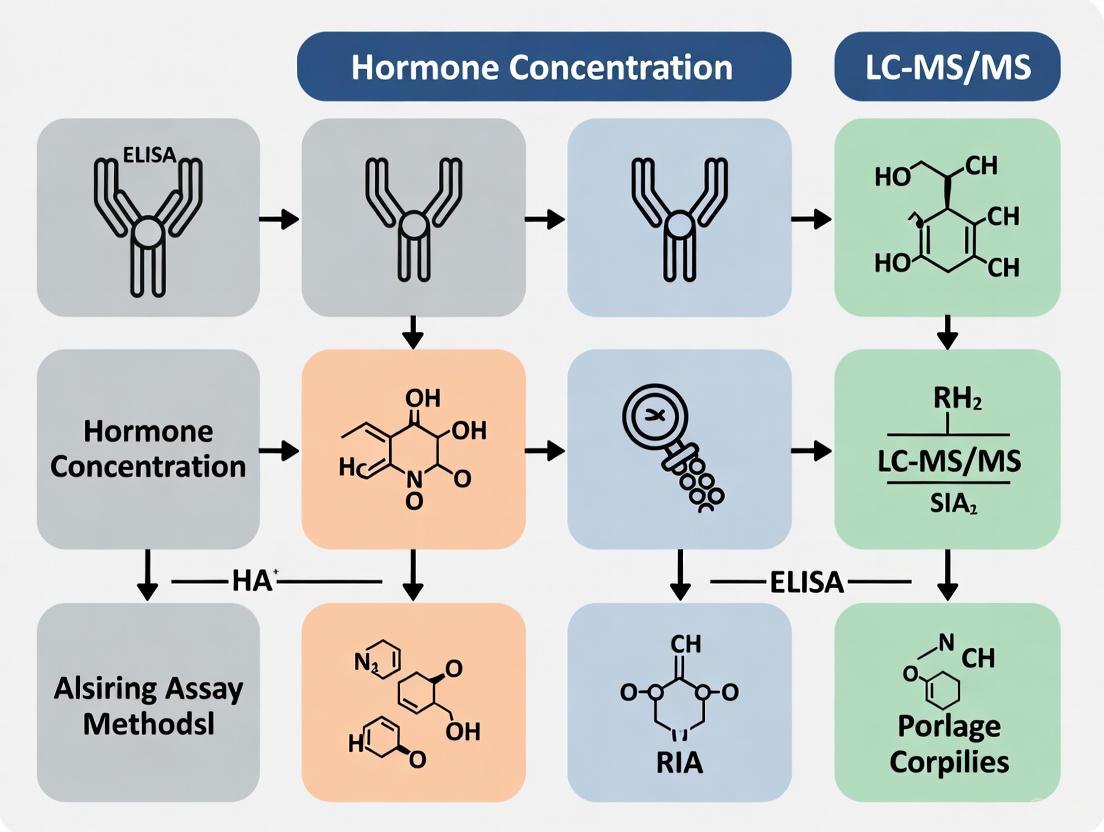
Accurate hormone quantification is foundational to endocrine research, clinical diagnostics, and drug development.
Immunoassay vs. Mass Spectrometry: A Modern Guide to Hormone Quantification for Research and Drug Development
Abstract
Accurate hormone quantification is foundational to endocrine research, clinical diagnostics, and drug development. This article provides a comprehensive comparison of the two predominant analytical techniques—immunoassay and liquid chromatography–tandem mass spectrometry (LC-MS/MS). We explore the foundational principles of each method, detail their specific applications across different matrices like serum and saliva, and address critical troubleshooting and optimization strategies to ensure data validity. A thorough validation and comparative analysis highlights the distinct performance characteristics of each technique, offering scientists and drug development professionals a clear framework for selecting the optimal method based on their specific requirements for throughput, cost, specificity, and sensitivity.
The Pillars of Hormone Assays: Understanding Immunoassay and Mass Spectrometry Principles
Immunoassays have served as a cornerstone of biomedical research and clinical diagnostics for over half a century, providing essential tools for quantifying hormones, drugs, and other biomarkers in biological samples [1]. The journey from manual, radioactive methods to fully automated, non-isotopic platforms represents a remarkable evolution in analytical science, driven by the dual needs of improved performance and enhanced practicality. This transition began with the introduction of radioimmunoassays (RIAs) in the 1960s, which first demonstrated the potential of antibody-based quantification but required special handling of radioactive materials and involved cumbersome procedures [2]. The subsequent development of enzyme-linked immunosorbent assays (ELISAs) marked a significant safety improvement through the replacement of radioisotopes with enzyme labels, though these often remained manual or semi-automated processes.
The field has since progressed toward increasingly sophisticated automation, exemplified by various automated immunoassay platforms (AIAs) that now dominate modern clinical and research laboratories [1]. These include fluorescence enzyme immunoassays (FEIAs), chemiluminescent immunoassays (CLIAs), and electrochemiluminescence immunoassays (ECLIAs), all offering enhanced performance characteristics while eliminating manual intervention [3] [4] [5]. Most recently, liquid chromatography-tandem mass spectrometry (LC-MS/MS) has emerged as a highly specific reference method, though it requires significant instrumentation expertise and financial investment [1] [6]. This guide provides a comprehensive technical comparison of these methodologies, focusing specifically on their application in hormone concentration measurement for research and drug development applications.
Technical Comparison of Immunoassay Platforms
Fundamental Methodological Principles
Radioimmunoassay (RIA): Utilizes radiolabeled (typically I-125) antigens that compete with unlabeled sample antigens for limited antibody binding sites [2]. After separation of bound and free fractions, the radioactive signal is measured, with intensity inversely proportional to analyte concentration in competitive formats [7].
Enzyme-Linked Immunosorbent Assay (ELISA): Employs enzyme-labeled antibodies or antigens that produce a measurable colorimetric, fluorescent, or chemiluminescent signal upon substrate addition [2]. Both competitive and sandwich formats are utilized, with the latter common for larger molecules like protein hormones.
Chemiluminescent Immunoassay (CLIA): Uses enzyme-labeled conjugates that generate light emission through chemical reaction with substrates such as acridinium esters or luminol derivatives [2]. The light intensity is measured with a luminometer and is proportional to analyte concentration.
Fluorescence Enzyme Immunoassay (FEIA): Relies on enzyme-labeled antibodies that convert a substrate into a fluorescent product, with signal detection via fluorometry [3] [5]. The Tosoh AIA series represents automated implementations of this technology.
Electrochemiluminescence Immunoassay (ECLIA): Incorporates ruthenium complex labels that emit light upon electrochemical stimulation at electrode surfaces [4]. Platforms like Roche Elecsys utilize this technology, which offers wide dynamic ranges and minimal background signal.
Liquid Chromatography-Tandem Mass Spectrometry (LC-MS/MS): Separates analytes chromatographically before ionization and highly specific mass-to-charge ratio detection [6]. This reference method minimizes antibody cross-reactivity issues through physical separation and offers unparalleled specificity.
Performance Characteristics Across Platforms
Table 1: Analytical Performance Comparison of Immunoassay Platforms for Hormone Testing
| Platform | Sensitivity | Intra-Assay Precision (CV%) | Inter-Assay Precision (CV%) | Dynamic Range | Sample Throughput |
|---|---|---|---|---|---|
| RIA | High (pg/mL) | 5-10% [7] | 8-15% [7] | Moderate | Low (manual) |
| ELISA | Moderate-High | 5-8% | 8-12% | Moderate | Moderate |
| CLIA | High | 2-5% [5] | 3-7% [5] | Wide | High (automated) |
| FEIA | High | 1.8-5.2% [3] [5] | 2.2-5.7% [3] [5] | Wide | High (automated) |
| ECLIA | High (TSH: 0.005 mIU/L) [4] | 1.1-7.8% [4] | 1.5-12.3% [4] | Very Wide | High (automated) |
| LC-MS/MS | Very High (pg/mL-fg/mL) [6] | 2-8% [6] | 5-10% [6] | Wide | Moderate-High |
Table 2: Practical Considerations for Immunoassay Platform Selection
| Platform | Cost Considerations | Handling Requirements | Multiplexing Capability | Approximate Sample Volume | Automation Compatibility |
|---|---|---|---|---|---|
| RIA | Low reagent cost, high regulatory cost | Radioactive safety protocols | Limited | 50-200 μL | Low |
| ELISA | Low-Moderate | Standard laboratory procedures | Moderate | 50-100 μL | Semi-automated |
| CLIA | Moderate-High | Standard procedures | Limited | 20-50 μL | Full automation |
| FEIA | Moderate-High | Standard procedures | Limited | 30-100 μL | Full automation |
| ECLIA | High | Standard procedures | Limited | 20-150 μL | Full automation |
| LC-MS/MS | Very High (instrumentation) | Specialized technical expertise | High (multi-analyte panels) | 50-200 μL | Partial automation |
Experimental Data: Method Comparison Studies
Insulin Assay Performance Comparison
A 2025 method comparison study evaluated six immunoassays for equine insulin quantification using RIA as the reference method [3]. The Tosoh AIA-360 FEIA demonstrated excellent correlation with RIA (r² = 0.94, p < 0.0001) with a constant bias of -23.8 μIU/mL and a Passing-Bablok fit of y = -8.9 + 0.78x [3]. The FEIA showed mean coefficients of variation of 1.8% for intra-assay and 5.7% for inter-assay precision, with mean recovery upon dilution of 104.2% [3]. The Cobas e CLIA showed acceptable agreement with RIA in the clinically crucial <100 μIU/mL range, while approximately 10% of results from Immulite 2000 and 2000XPi CLIA analyzers showed spuriously high results (2 to >10-fold of RIA results), rendering their agreement poor [3].
Sex Hormone Assay Performance
A 2024 comparison of AIA and LC-MS/MS for sex hormone quantification in rhesus macaques demonstrated excellent agreement for 17β-estradiol (E2) and progesterone (P4) across menstrual cycles [1]. However, the AIA consistently overestimated E2 at concentrations >140 pg/mL and underestimated P4 at concentrations >4 ng/mL compared to LC-MS/MS [1]. For testosterone, AIA consistently underestimated concentrations relative to LC-MS/MS, highlighting significant method-dependent differences for certain hormones [1].
A 2022 validation of a third-generation FEIA for canine progesterone showed excellent correlation with CLIA (Passing-Bablok regression) with linearity of 75-97% and 86-94% for high (37.0 ng/mL) and medium (3.8 ng/mL) pool serum samples respectively [5]. Recovery ranged from 86.4-119%, with intra-assay CVs of 2.6-5.2% and inter-assay CVs of 2.22-2.53% [5].
Thyroid Hormone and Vitamin D Assays
A method comparison study of thyroid hormones demonstrated that ECLIA achieved a minimum detectable concentration of 0.005 mIU/L for TSH, significantly lower than ELISA (0.3 mIU/L) or IRMA (0.1 mIU/L) [4]. Intra-assay coefficients of variation were <2.3% for TSH, 2.3% for FT4, and 7.8% for T3 [4].
For vitamin D quantification, a comparison of HPLC, RIA, and ECLIA showed no statistically significant differences between methods (p=0.8 for HPLC vs RIA; p=0.37 for RIA vs ECLIA) [7]. Passing-Bablok regression between RIA and ECLIA yielded: ECLIA = 3.21 + 0.9(RIA) nmol/L, demonstrating good agreement [7].
Experimental Protocols for Method Validation
Protocol for Automated FEIA Validation
The following protocol is adapted from the validation procedures for the Tosoh AIA-360 FEIA system [3]:
Linearity Testing: Prepare serial dilutions (1:2, 1:4, 1:8, 1:16) of high-concentration pool serum using low-concentration pool serum as diluent. Analyze each dilution in five replicates using the same test cup lot. Calculate linearity as observed:expected percentage (O:E %) [5].
Recovery Testing: Prepare working solutions of known concentrations (e.g., 0.5, 1, 2, 4, 8, 10, 15 ng/mL for progesterone) by successive dilutions in ethanol. Analyze each concentration in five replicates. Calculate recovery percentage as (observed concentration/expected concentration) × 100% [5].
Precision Assessment: For intra-assay precision, analyze three pooled serum samples with low, medium, and high hormone concentrations consecutively ten times in the same run. For inter-assay precision, analyze two pooled serum samples with concentrations in clinically relevant ranges on five separate days using five different test cup lots. Calculate coefficients of variation (CV%) for both parameters [3] [5].
Method Comparison: Assay 100+ patient samples using both the reference method (typically RIA or LC-MS/MS) and the test method. Use Passing-Bablok regression and Bland-Altman analysis to assess constant and proportional error, along with limits of agreement [3].
Protocol for LC-MS/MS Steroid Hormone Analysis
A validated LC-MS/MS protocol for comprehensive steroid profiling includes these critical steps [6]:
Sample Preparation: Perform protein precipitation using methanol or acetonitrile. Apply solid-phase extraction (SPE) using Oasis HLB 96-well μElution Plates for purification. Incorporate stable isotope-labeled internal standards for each analyte to correct for matrix effects and recovery variations.
Chromatographic Separation: Utilize ACQUITY UPLC BEH C18 column (2.1 mm × 100 mm, 1.7 μm) with gradient elution using mobile phases consisting of water and methanol/acetonitrile with ammonium fluoride or formic acid additives. Maintain column temperature at 40-50°C with a flow rate of 0.3-0.4 mL/min.
Mass Spectrometric Detection: Operate triple quadrupole mass spectrometer with electrospray ionization in positive and/or negative mode. Optimize multiple reaction monitoring (MRM) transitions for each steroid hormone. Use scheduled MRM for large panels to ensure sufficient data points across chromatographic peaks.
Validation Parameters: Establish linearity across physiological and pathological ranges (e.g., 3-4 orders of magnitude). Determine intra-day and inter-day precision with CV% <15% (preferably <10% at lower limit of quantification). Evaluate accuracy using spiked samples and certified reference materials when available.
Signaling Pathways and Experimental Workflows
Diagram 1: Hormone signaling and detection pathway. This diagram illustrates the TSH receptor (TSHR) signaling cascade culminating in cAMP production, which serves as a key endpoint in functional immunoassays for thyroid disruptor screening [8].
Diagram 2: Immunoassay technology evolution timeline, highlighting key technological advancements and performance improvements driving each transition phase.
Essential Research Reagent Solutions
Table 3: Key Research Reagents for Immunoassay Development and Implementation
| Reagent Category | Specific Examples | Functional Role | Technical Considerations |
|---|---|---|---|
| Capture Antibodies | Monoclonal anti-insulin antibody [3], Guinea pig anti-human insulin antibody [3] | Target analyte recognition; Determines assay specificity | Species reactivity, affinity constants, cross-reactivity profiles |
| Detection Labels | Ruthenium complexes [4], Acridinium esters [2], Europium chelates [2], Horseradish peroxidase [2] | Signal generation; Determines sensitivity and dynamic range | Stability, compatibility with detection instrumentation |
| Solid Phases | Magnetic beads [2], Microplate wells, Microparticles [4] | Immobilization of immunocomponents; Separation of bound/free fractions | Binding capacity, uniformity, non-specific binding properties |
| Calibrators | WHO international standards, Certified reference materials [7] | Quantification reference; Standard curve generation | Commutability with patient samples, stability, matrix effects |
| Separation Reagents | Coated tubes, Secondary antibodies [3] | Separation of antibody-bound analyte from free analyte | Efficiency, reproducibility, compatibility with automation |
| Signal Reagents | Luminol derivatives, Tripropylamine [4], Fluorogenic substrates | Generation of measurable signal | Kinetics, linear range, background signal, stability |
| Matrix Modifiers | Heterophilic blocking reagents [3], Protein stabilizers | Minimization of interference; Sample preservation | Compatibility with assay components, effectiveness |
The method comparison data presented in this guide demonstrates that modern automated immunoassay platforms generally provide excellent correlation with traditional methods while offering significant advantages in throughput, precision, and operational safety. The Tosoh AIA-360 FEIA shows exceptional precision (intra-assay CV of 1.8%) and good correlation with RIA (r² = 0.94) for insulin quantification [3], while ECLIA platforms achieve remarkable sensitivity for TSH detection (0.005 mIU/L) [4]. Nevertheless, significant method-specific biases persist, particularly for certain hormones like testosterone where AIA consistently underestimates concentrations compared to LC-MS/MS [1].
LC-MS/MS continues to establish itself as the reference method for steroid hormone analysis due to its superior specificity and ability to simultaneously quantify multiple analytes [6]. However, the high instrumentation costs and technical expertise required currently limit its widespread implementation in routine clinical laboratories. For research applications requiring the highest specificity, or when developing assays for novel biomarkers not yet available on automated platforms, LC-MS/MS remains the technology of choice.
Future directions in immunoassay technology include increased integration of mass spectrometry as a reference method, development of more multiplexed platforms, and the emergence of non-invasive saliva-based testing as a complement to traditional serum measurements [9]. As method harmonization efforts continue across the field, researchers and drug development professionals must maintain critical awareness of the methodological differences that can significantly impact hormonal data interpretation across different platforms.
Steroid hormones, synthesized from cholesterol in the gonads, adrenal glands, and placenta, play vital roles in numerous physiological processes, including metabolism, immune function, electrolyte balance, and reproductive physiology [10]. Dysregulation of steroid balance is implicated in the progression of various adrenal-related diseases, including adrenal insufficiency, hyperaldosteronism, adrenal tumors, congenital adrenal hyperplasia, Cushing's syndrome, and polycystic ovary syndrome [6] [11]. The accurate quantification of steroid hormones is therefore essential for the diagnosis, subtyping, and therapeutic monitoring of these conditions [6].
For decades, the measurement of steroid hormones relied primarily on immunoassay (IA) techniques, including radioimmunoassays (RIA) and later chemiluminescence immunoassays (CLIA) [10]. These methods gained widespread adoption due to their accessibility, ease of use, and suitability for high-throughput testing in routine clinical laboratories [11]. However, the structural similarity among different steroid hormones presents a fundamental challenge to analytical specificity—a challenge that immunoassays often failed to overcome adequately. Traditional IA methods are limited by significant cross-reactivity with structurally similar compounds, matrix interference, and narrow detection ranges, leading to inaccuracies particularly at low and extremely high hormone concentrations [6] [10]. These limitations are particularly problematic when measuring steroids in women, children, and testosterone-deficient men, where concentrations are naturally low [10].
The emergence of liquid chromatography-tandem mass spectrometry (LC-MS/MS) has addressed these limitations, revolutionizing steroid hormone analysis with superior specificity, sensitivity, and the ability to simultaneously quantify multiple steroids in a single analytical run [6] [10]. This technological advancement has transformed the laboratory assessment of endocrine disorders, enabling more precise diagnosis and personalized treatment approaches.
Comparative Analysis: LC-MS/MS Versus Immunoassay Performance
Direct comparison studies consistently demonstrate the superior analytical performance of LC-MS/MS compared to various immunoassay platforms. The following tables summarize key performance metrics from recent validation studies.
Table 1: Method Comparison for Urinary Free Cortisol Measurement (2025 Study) [12]
| Method | Correlation with LC-MS/MS (Spearman r) | Analytical Bias | Diagnostic AUC for Cushing's Syndrome | Sensitivity/Specificity |
|---|---|---|---|---|
| LC-MS/MS (Reference) | 1.00 | - | 0.969 (Reference) | 94%/93% (Reference) |
| Mindray CLIA | 0.998 | Positive | 0.969 | 93.10%/93.33% |
| Snibe CLIA | 0.967 | Positive | 0.963 | 89.66%/96.67% |
| Roche ECLIA | 0.951 | Positive | 0.958 | 89.66%/95.00% |
| Autobio CLIA | 0.950 | Positive | 0.953 | 89.66%/95.00% |
Table 2: Analytical Performance of a Multi-Steroid LC-MS/MS Method [6]
| Performance Parameter | Results | Clinical Significance |
|---|---|---|
| Steroids Quantified | 17 steroid hormones + 2 drugs (dexamethasone, fludrocortisone) | Comprehensive adrenal profiling |
| Sample Volume | 100 μL | Suitable for pediatric and multi-test panels |
| Extraction Recovery | 89.2%-109.8% | Efficient and consistent sample preparation |
| Matrix Effects | 85.5%-113.2% | Reliable quantification in complex samples |
| Precision (CV) | <10% for all analytes | Reproducible results across runs |
| Linearity | R² > 0.99 for all analytes | Accurate across physiological ranges |
The data reveal that while modern immunoassays show strong correlation with LC-MS/MS, they consistently exhibit a proportional positive bias, potentially leading to overestimation of hormone concentrations [12]. This bias stems primarily from antibody cross-reactivity with steroid metabolites and synthetic analogs. For example, 6-methylprednisolone and prednisolone demonstrate high cross-reactivity in cortisol immunoassays, potentially causing clinically significant misinterpretation in patients receiving these medications [10].
LC-MS/MS methods provide exceptional specificity through two-dimensional separation—chromatographic separation coupled with mass-based detection—virtually eliminating cross-reactivity issues [6]. Furthermore, LC-MS/MS enables simultaneous measurement of precursors, active hormones, and metabolites, providing a comprehensive steroid profile that offers clinical insights beyond what single steroid measurements can provide [6].
Experimental Workflows: From Sample to Result
LC-MS/MS Methodology
The typical workflow for steroid hormone analysis via LC-MS/MS involves several critical steps that ensure accurate quantification:
Sample Preparation:
- Protein Precipitation: Addition of organic solvents (acetonitrile or methanol) to remove proteins and other macromolecules [6] [11].
- Liquid-Liquid Extraction: Using methyl tert-butyl ether (MTBE) to transfer steroids from aqueous sample to organic phase [11].
- Solid-Phase Extraction (SPE): High-throughput SPE on Oasis HLB 96-well µElution Plates provides cleaner extracts with reduced matrix effects [6].
- Derivatization: For some methods, isonicotinoyl chloride is used to derivative steroids with alcoholic hydroxyl groups, enhancing ionization efficiency and sensitivity, particularly for estrogens [11].
Chromatographic Separation:
- Column: Reverse-phase C18 or PFP columns (e.g., ACQUITY UPLC BEH C18, 2.1 mm × 100 mm, 1.7 μm) [6] [11].
- Mobile Phase: Binary gradient with water and methanol (or acetonitrile) with additives such as formic acid or ammonium acetate [6].
- Separation: Achieves baseline separation of structurally similar steroids before mass spectrometric detection.
Mass Spectrometric Detection:
- Ionization: Electrospray ionization (ESI) in positive or negative mode [6] [11].
- Detection: Triple quadrupole mass spectrometer operating in multiple reaction monitoring (MRM) mode [6].
- Quantification: Using stable isotope-labeled internal standards for each analyte to correct for matrix effects and ionization variability [6] [11].
LC-MS/MS Analytical Workflow
Immunoassay Methodology
Traditional immunoassay methods follow a fundamentally different approach:
Direct Immunoassay (Without Extraction):
- Principle: Competitive or sandwich binding using antibodies conjugated to enzymes or chemiluminescent compounds [10] [12].
- Procedure: Sample is incubated with specific antibody and labeled antigen, with bound complex separated and measured [10].
- Limitations: Vulnerable to cross-reactivity and matrix effects without purification steps [12].
Immunoassay with Extraction:
- Additional Step: Organic solvent extraction (e.g., ethyl acetate) prior to immunoassay to improve specificity [12].
- Trade-off: Improved specificity at the cost of increased complexity, time consumption, and safety concerns [12].
Clinical Applications and Diagnostic Impact
The superior analytical performance of LC-MS/MS has significant implications for clinical diagnosis and patient management:
Congenital Adrenal Hyperplasia (CAH): LC-MS/MS enables simultaneous measurement of 17-hydroxyprogesterone, androstenedione, 21-deoxycortisol, and 11-deoxycortisol, providing more accurate diagnosis and monitoring of CAH patients compared to single-analyte immunoassays [13].
Cushing's Syndrome: The combination of cortisol and dexamethasone measurement in a single LC-MS/MS method after dexamethasone suppression test ensures adequate drug absorption and reduces false positive rates in diagnosing Cushing's syndrome [6]. For urinary free cortisol measurement, LC-MS/MS serves as the reference method against which immunoassays are calibrated [12].
Primary Aldosteronism Subtyping: LC-MS/MS allows quantification of hybrid steroids (18-oxocortisol and 18-hydroxycortisol) that substantially differentiate aldosterone-producing adenomas from bilateral hyperplasia, guiding appropriate therapeutic interventions [6].
Adrenocortical Carcinoma: The cortisol precursor 11-deoxycortisol and 17-hydroxypregnenolone show marked increases in adrenocortical carcinoma and provide the best discrimination value from non-malignant cases [6].
Table 3: Clinical Applications of Multi-Steroid LC-MS/MS Profiling [6] [13]
| Clinical Condition | Key Diagnostic Steroids | LC-MS/MS Advantage |
|---|---|---|
| Congenital Adrenal Hyperplasia | 17-OHP, 21-deoxycortisol, 11-deoxycortisol | Simultaneous measurement of multiple pathway steroids |
| Cushing's Syndrome | Cortisol, dexamethasone, cortisone | Monitoring drug levels and endogenous hormones together |
| Primary Aldosteronism | Aldosterone, 18-oxocortisol, 18-hydroxycortisol | Subtype differentiation for targeted therapy |
| Adrenocortical Carcinoma | 11-deoxycortisol, 17-hydroxypregnenolone | Improved discrimination from benign tumors |
| Polycystic Ovary Syndrome | Testosterone, androstenedione, DHEAS | Accurate measurement of low-level androgens in women |
Essential Research Reagents and Materials
Successful implementation of LC-MS/MS for steroid hormone analysis requires specific reagents and materials that ensure analytical accuracy and reproducibility.
Table 4: Essential Research Reagent Solutions for Steroid LC-MS/MS
| Reagent/Material | Function | Examples/Specifications |
|---|---|---|
| Stable Isotope-Labeled Internal Standards | Correct for matrix effects and recovery variations | Cortisol-d4, Testosterone-d3, Estradiol-d2 [11] |
| Chromatography Columns | Separation of structurally similar steroids | ACQUITY UPLC BEH C18 (2.1 mm × 100 mm, 1.7 μm) [6] |
| Mass Spectrometry Instruments | Detection and quantification of steroids | Triple quadrupole mass spectrometers (TSQ Endura, SCIEX Triple Quad) [6] [11] |
| Extraction Materials | Sample cleanup and analyte enrichment | Oasis HLB 96-well µElution Plates (2 mg) for SPE [6] |
| Certified Reference Materials | Method validation and accuracy assessment | SRM 971, BCR 576, 577, 578 [11] |
| Derivatization Reagents | Enhance ionization efficiency for low-level steroids | Isonicotinoyl chloride for estrogens [11] |
| Quality Control Materials | Monitor assay performance and reproducibility | MassCheck Steroid Panel Serum Controls [11] |
Logical Decision Pathway for Method Selection
The choice between immunoassay and LC-MS/MS for steroid hormone analysis depends on multiple factors, including clinical context, required precision, and available resources.
Method Selection Decision Pathway
The evolution of steroid hormone analysis from immunoassays to LC-MS/MS represents a paradigm shift in endocrine diagnostics. While immunoassays remain useful for high-throughput screening in cases where extreme precision is not critical, LC-MS/MS has become the reference method for steroid quantification due to its superior specificity, sensitivity, and ability to provide comprehensive steroid profiles [6] [10].
The diagnostic accuracy afforded by LC-MS/MS has transformed clinical practice, enabling earlier detection of endocrine disorders, more precise subtyping of conditions like primary aldosteronism and Cushing's syndrome, and better monitoring of treatment efficacy [6] [12]. Furthermore, the development of age- and sex-adjusted reference intervals for steroids measured by LC-MS/MS has enhanced the clinical interpretation of results [13].
Despite its higher initial costs and technical complexity, LC-MS/MS continues to become more accessible to clinical laboratories through commercial reagent kits and standardized protocols [13]. As technology advances and methodologies become more harmonized, LC-MS/MS is poised to become the new standard for steroid hormone analysis, ultimately improving patient care through more accurate diagnosis and personalized treatment approaches.
The accurate measurement of hormone concentrations is a cornerstone of endocrine research and drug development. Selecting the appropriate analytical method is paramount, as it directly impacts data reliability, translational potential, and research outcomes. The choice often involves a critical balance between three key parameters: throughput (the number of samples processed per unit time), cost (encompassing reagents, equipment, and labor), and specificity (the ability to uniquely identify the target analyte amidst complex biological matrices). This guide provides an objective comparison of the primary assay methodologies—immunoassays, mass spectrometry, and emerging techniques—framed within the context of these core parameters. Understanding the performance landscape of these methods enables researchers to make informed decisions that align with their experimental goals and constraints, ultimately strengthening the validity of scientific findings in hormone research [14].
Comparative Analysis of Hormone Assay Methods
The table below summarizes the key characteristics of the major assay types used in hormone measurement, providing a direct comparison of their performance across the critical parameters.
Table 1: Core Comparison of Hormone Assay Methodologies
| Assay Method | Typical Throughput | Relative Cost | Specificity & Key Limitations | Ideal Application |
|---|---|---|---|---|
| Immunoassays (e.g., ELISA, RIA) | High (can be automated for 96/384-well plates) [15] | Low to Medium (commercial kits, minimal specialized equipment) [14] | Moderate to Low. Prone to cross-reactivity with structurally similar hormones and metabolites (e.g., DHEAS cross-reacts in testosterone assays). Suffers from matrix effects and interference from binding proteins [14] [16]. | High-throughput screening where ultimate specificity is not critical; measuring peptide hormones with sandwich immunoassays [14]. |
| Liquid Chromatography-Tandem Mass Spectrometry (LC-MS/MS) | Medium (requires chromatographic separation) [14] | High (specialized equipment, skilled operators, method development) [14] [16] | Very High. Superior specificity due to physical separation (chromatography) and mass-based detection. Can measure multiple hormones simultaneously (multiplexing) [14] [17]. | Gold standard for steroid hormones (testosterone, estradiol, aldosterone) at low concentrations, especially in pediatric, female, and hypogonadal populations [16]. |
| High-Throughput Holdup Assay | Very High (up to 1000 domain-ligand affinities per day) [18] | Information Missing | High for specific interactions. A chromatographic approach for measuring equilibrium binding affinities, benchmarked against known standards [18]. | Quantitative mapping of specific domain-motif interactions (e.g., PDZome recognition), not for general hormone panels [18]. |
| Novel Smartphone-Based Monitor | Low (single samples for home use) | Presumed Low (consumer device) | Moderate. Validated against laboratory ELISA for urinary E3G, PdG, and LH. Shown to accurately capture hormone trends [15]. | Home-based, longitudinal monitoring of fertility hormones (LH, E3G, PdG) for personal use or decentralized clinical trials [15]. |
Detailed Experimental Protocols and Data
Protocol: Validation of a Quantitative LC-MS/MS Method for Hormones in Complex Matrices
The following protocol, adapted from a study determining hormones in various bovine matrices, highlights the rigorous validation required for a specific LC-MS/MS application [17].
- 1. Sample Preparation: Tissues (liver, kidney) are homogenized. Samples (including bile and hair) undergo a solid-phase extraction (SPE) or matrix solid-phase dispersion (MSPD) to isolate hormones from the complex biological matrix.
- 2. Liquid Chromatography (LC): The extracted sample is injected into an LC system. Analytes are separated on a reverse-phase C18 column using a gradient of water and methanol or acetonitrile as mobile phases. This step is critical for separating the target hormone from isobars and matrix interferences.
- 3. Mass Spectrometry (MS) Detection:
- The eluent from the LC is ionized using an electrospray ionization (ESI) source.
- The tandem mass spectrometer (MS/MS) first selects the precursor ion of the target hormone (first quadrupole).
- The selected ion is fragmented in a collision cell (second quadrupole) using an inert gas like argon or nitrogen.
- The resulting characteristic product ions are analyzed in the final quadrupole.
- Quantification is performed by monitoring specific precursor-product ion pairs, known as Multiple Reaction Monitoring (MRM), which confers high specificity.
- 4. Method Validation: The method is validated according to guidelines (e.g., European Decision 2002/657/EC) by assessing parameters including selectivity (no interference in blank matrices), linearity, recovery (accuracy), repeatability and reproducibility (precision), decision limit (CCα), and detection capability (CCβ) [17].
Experimental Data: Immunoassay vs. LC-MS/MS Performance
Data from proficiency testing surveys starkly illustrate the specificity challenges of immunoassays. In one survey, for a testosterone sample with a reference method value of 36.7 ng/dL, LC-MS/MS methods reported a median of 37 ng/dL. In contrast, various commercial immunoassays showed significant bias, with median values ranging from 21 ng/dL to 51 ng/dL—a discrepancy of up to 44% [16]. This inaccuracy is most pronounced at low hormone concentrations (e.g., in women, children, and hypogonadal men), where immunoassays tend to overestimate concentrations due to cross-reactivity with other steroids [16]. For instance, a Dutch study found that a radioimmunoassay incorrectly showed a decrease in testosterone after oral contraceptive use, a result disproven when the samples were reanalyzed with an accurate LC-MS/MS method [14].
Visual Guide to Assay Selection and Workflow
Assay Selection Pathway
The following diagram outlines a logical decision-making process for selecting a hormone assay method based on core research requirements.
High-Throughput Interaction Screening Workflow
The HT-PELSA method demonstrates a modern, high-throughput workflow for profiling protein-ligand interactions, which can be adapted for certain hormone-related studies [19].
The Scientist's Toolkit: Key Research Reagent Solutions
Table 2: Essential Reagents and Materials for Hormone Assay Development
| Item | Function/Application | Key Considerations |
|---|---|---|
| Deuterated Internal Standards | Used in LC-MS/MS for quantification. Corrects for losses during sample preparation and ion suppression/enhancement during ionization [17]. | Essential for achieving high accuracy and precision. Must be added to the sample at the earliest possible step. |
| Specific Antibodies | The core component of immunoassays, determining specificity. | Validation is critical. Must check for cross-reactivity against a panel of structurally similar compounds [14]. |
| SPE Cartridges / Plates | For solid-phase extraction to clean up and concentrate samples before analysis (LC-MS/MS or immunoassay). | Select sorbent chemistry (e.g., C18, ion-exchange) based on the polarity and chemical properties of the target hormone[sciencedirect]. |
| Chromatography Columns | Separate analytes in LC-MS/MS to reduce matrix effects and resolve isobaric interferences. | Column chemistry (e.g., C18, phenyl), particle size, and length directly impact resolution, sensitivity, and run time [17]. |
| Quality Control (QC) Materials | Independent samples with known concentrations used to monitor assay performance over time [14]. | Should be independent of kit manufacturer and span the assay's measuring range. Crucial for both research and clinical assays [14]. |
| 96-/384-Well Plates & Equipment | Enable high-throughput processing for immunoassays and modernized MS-prep workflows like HT-PELSA [19] [15]. | Automation-compatible plates and liquid handlers significantly increase throughput and reproducibility. |
The landscape of hormone measurement is defined by a clear trade-off between the high throughput and accessibility of immunoassays and the superior specificity and accuracy of mass spectrometry. As the data demonstrates, LC-MS/MS is the unequivocal gold standard for applications requiring definitive quantification, particularly for steroid hormones at low concentrations and in complex matrices where immunoassay interference is prevalent [14] [16]. However, for high-volume screening where absolute specificity is secondary, well-validated immunoassays remain a viable and cost-effective tool. Emerging technologies, such as highly automated peptide stability assays and connected consumer devices, are expanding the boundaries of throughput and real-world monitoring [19] [15]. The informed researcher must therefore weigh the core parameters of throughput, cost, and specificity against their specific research question, using this comparative framework to select the most appropriate tool for generating robust and reliable hormone data.
In the field of endocrinology, the accurate quantification of hormone concentrations is foundational to both research and clinical diagnostics. The selection of an appropriate analytical method directly determines the reliability, accuracy, and clinical relevance of the generated data. Researchers and drug development professionals face a complex landscape of available technologies, each with distinct performance characteristics, limitations, and applications. This guide provides a structured framework for method selection by objectively comparing the performance of major assay techniques used in hormone concentration measurement, supported by experimental data and clear visualization of workflows. The critical importance of this decision is underscored by documented issues with method reliability; for instance, a comparative study of commercial ELISA kits for corticosterone quantification found significantly different values across kits when analyzing identical serum samples, highlighting how method choice alone can dramatically alter results [20].
Comparative Framework: Analytical Method Performance
The following section provides a data-driven comparison of the most common analytical platforms used in hormone research, focusing on their technical performance characteristics, capabilities, and limitations to inform your selection process.
Performance Specifications for Key Hormonal Assays
Table 1: Allowable Total Analytical Error (TEa) Specifications for Common Hormone Assays Across Various Guidelines
| Hormone/Analyte | CLIA TEa | Rilibak 2024 TEa | RCPA 2022 TEa | China WS/T 2024 TEa |
|---|---|---|---|---|
| Estradiol | ± 30% | ± 18.3% (Des) | ± 35% | ± 25 pmol/L; 25% @ 100 pmol/L |
| Follicle Stimulating Hormone (FSH) | ± 2 IU/L or 18% | ± 17.6% (Des) | ± 21% | ± 1.0 IU/L; 10% @ 10.0 IU/L |
| Cortisol | ± 20% | ± 22.2% (Des) | ± 30% | ± 15 nmol/L; 15% @ 100 nmol/L |
| Testosterone | Information not available in search results | ± 19.3% (Des) | Information not available in search results | Information not available in search results |
| Human Chorionic Gonadotropin (BhCG) | ± 18% or ± 3 mIU/mL (greater) | Information not available in search results | ± 20% | ± 1 IU/L; 10% @ 10 IU/L |
Note: CLIA = Clinical Laboratory Improvement Amendments; Des = Desirable specification; TEa = Total Allowable Error [21]
Methodology Comparison: Immunoassay vs. Mass Spectrometry
Table 2: Direct Comparison of Immunoassay and Chromatographic Methods for Hormone Analysis
| Parameter | Immunoassay (ELISA) | Liquid Chromatography-Tandem Mass Spectrometry (LC-MS/MS) |
|---|---|---|
| Principle | Antibody-antigen binding with enzymatic or chemical signal detection | Physical separation followed by mass-to-charge ratio detection |
| Throughput | Generally high | Moderate to high |
| Sensitivity | Variable; kit-dependent | High (typically superior) |
| Specificity | Subject to cross-reactivity | Very high due to physical separation and mass detection |
| Multiplexing Capability | Limited in conventional formats | High (can measure multiple analytes simultaneously) |
| Sample Volume | Typically low | Low to moderate |
| Cost per Sample | Generally lower | Higher |
| Experimental Evidence | Significant variability between commercial kits observed [20] | Superior performance for salivary sex hormones vs. ELISA [22] |
Experimental Protocols and Workflows
This section details the specific methodologies employed in key comparative studies, providing researchers with reproducible experimental frameworks.
Protocol: Comparative Evaluation of Commercial ELISA Kits
Objective: To evaluate the agreement between four different commercial ELISA kits for quantifying corticosterone in identical rat serum samples [20].
Sample Preparation:
- Blood samples were collected from 32 male Wistar rats via trunk blood after decapitation.
- Samples were allowed to coagulate at room temperature for 1 hour.
- Centrifugation at 10,000 rpm for 10 minutes in an Eppendorf 5415R centrifuge.
- Serum was aliquoted and frozen at -20°C until analysis.
ELISA Analysis:
- Each serum sample (n=32) was analyzed in duplicate with four different ELISA kits: DRG EIA-5186, DRG EIA-4164, Enzo ADI-900-097, and Arbor Assays K014-H1.
- All kits were used according to manufacturers' instructions.
- Absorbance was read at 405 nm using a Wallac 1420 Multilabel counter plate reader.
- Concentrations were determined based on standard curves run in duplicate on each plate.
Quality Control:
- For DRG kits, internal quality control was performed using provided high and low assay control samples.
- Coefficient of variation (CV%) was calculated from multiple replicates of controls to assess intra-assay variation.
Statistical Analysis:
- Non-parametric statistical analyses were applied due to significant heterogeneity of variance.
- Kruskal-Wallis test was used to assess differences between kits.
- Spearman Rank Order Correlations were used to test associations between assays [20].
Protocol: Immunoassay versus LC-MS/MS Comparison for Salivary Hormones
Objective: To compare the performance of ELISA and LC-MS/MS for measuring salivary estradiol, progesterone, and testosterone in healthy adults [22].
Study Population:
- 72 combined oral contraceptive (COC) users
- 99 naturally cycling (NC) women in early follicular and pre-ovulatory phases
- 47 men
Methodological Comparison:
- Salivary sex hormone data were acquired from both ELISA (Salimetrics) and LC-MS/MS platforms.
- Multivariate and computational approaches, including machine learning classification models, were applied to compare techniques.
Analytical Approach:
- The between-methods relationship was strong for salivary testosterone only when using ELISA.
- LC-MS/MS showed expected differences in estradiol and testosterone in women.
- Machine-learning classification models revealed better results with LC-MS/MS data.
- The study concluded that LC-MS/MS was superior despite its quantification challenges, highlighting its value for generating reliable findings on hormone-behavior relationships [22].
Protocol: HPLC Method Development for Peptide Hormone Analysis
Objective: To develop and validate a reversed-phase HPLC method for the determination of cetrorelix acetate, a synthetic decapeptide with gonadotropin-releasing hormone (GnRH) antagonistic activity [23].
Chromatographic Conditions:
- Column: Lichrospher C18, 250 × 4.60 mm, 5μm
- Mobile Phase: A (0.1% TFA in water) and B (0.1% TFA in acetonitrile)
- Gradient Program: 90% A for 5min, from 90% A to 70% B in 15 min, 70% B for 10 min, from 70% B to 90% A in 5 min and 90% A for 30 min
- Flow Rate: 1 mL/min
- Detection: UV at 275 nm
- Injection Volume: 20 μL
- Total Run Time: 65 minutes
Method Validation:
- Linearity: Six calibration standards (1250-62.5 μg/mL) with r² = 0.999
- Accuracy: > 97%
- Precision: Intra-day RSD < 0.3%, Inter-day RSD < 1.6%
- Specificity: Excellent resolution from excipients and degradation products
- Sensitivity: LOD = 15.6 μg/mL, LOQ = 62.5 μg/mL [23]
Visualizing Method Selection Workflows
The following diagrams provide visual representations of key decision processes and experimental workflows in hormone assay method selection.
Hormone Assay Method Selection Algorithm
HPLC Workflow for Peptide Hormone Analysis
Essential Research Reagent Solutions
The following table details key reagents and materials essential for implementing the hormone assay methods discussed in this guide.
Table 3: Essential Research Reagents and Materials for Hormone Assay Methods
| Reagent/Material | Function/Application | Method | Key Considerations |
|---|---|---|---|
| C18 Chromatography Columns | Stationary phase for reversed-phase separation of peptides and small molecules | HPLC/UPLC | Particle size, pore size, column dimensions affect resolution [23] |
| Trifluoroacetic Acid (TFA) | Ion-pairing agent for mobile phase; improves peak shape | HPLC/UPLC | Concentration critical for reproducibility (typically 0.1%) [23] [24] |
| Acetonitrile (HPLC Grade) | Organic modifier for mobile phase | HPLC/UPLC | Purity essential for low background noise [23] |
| Antibody Pairs | Molecular recognition elements for specific hormone detection | Immunoassay | Specificity, affinity, and cross-reactivity profile determine assay performance [20] |
| Enzyme Conjugates | Signal generation system (e.g., HRP, ALP) | ELISA | Stability, catalytic efficiency affect sensitivity [20] |
| Mass Spectrometry Internal Standards | Isotope-labeled analogs for quantification normalization | LC-MS/MS | Should be identical to analyte but for isotopic composition [22] |
| Solid Phase Extraction Cartridges | Sample cleanup and preconcentration | Sample Preparation | Selectivity for target analytes, recovery efficiency |
The selection of an appropriate analytical method for hormone quantification requires careful consideration of multiple factors, including required sensitivity, specificity, sample type, and available resources. The experimental evidence presented in this guide demonstrates that while immunoassays offer practical advantages for high-throughput screening, chromatographic methods coupled with mass spectrometry provide superior specificity and reliability for critical applications, particularly for steroid hormones and peptide analytes. As the field advances toward increasingly personalized medicine approaches, the implementation of a structured decision framework, as outlined in this guide, will empower researchers and drug development professionals to select optimal methodologies that generate reliable, reproducible, and clinically relevant hormone concentration data.
From Theory to Practice: Implementing Hormone Assays in Research Settings
Serum analysis is a fundamental tool in clinical and research laboratories, carried out on a sample of blood serum to detect antibodies, antibody-like substances, or other analytes in association with diseases, infections, or physiological states [25]. The selection of an appropriate analytical method is a critical first step in any experimental design, profoundly influencing the validity, reproducibility, and clinical relevance of the resulting data. This is particularly true for the measurement of hormone concentrations, a core activity in endocrinology, pharmacology, and drug development research.
The central thesis of this guide is that methodological choice is not one-size-fits-all but must be informed by the specific requirements of the research question, balancing factors such as throughput, specificity, cost, and the required level of quantification. For years, automated immunoassays (AIAs) have been the workhorse of routine hormone testing. However, technological advancements have established liquid chromatography-tandem mass spectrometry (LC-MS/MS) as a gold standard for many applications, particularly where high specificity and accurate quantification of multiple analytes are paramount [26] [22]. This guide provides an objective comparison of these dominant methodologies, supported by experimental data and detailed protocols, to equip researchers with the information needed to make informed decisions for their hormone concentration measurement research.
Comparative Analysis of Methodologies
The following table summarizes the core characteristics of AIA and LC-MS/MS, providing a high-level overview of their performance in steroid hormone analysis.
Table 1: Method Comparison for Steroid Hormone Serum Analysis
| Feature | Automated Immunoassay (AIA) | Liquid Chromatography-Tandem Mass Spectrometry (LC-MS/MS) |
|---|---|---|
| Principle | Antibody-antigen binding with enzymatic or chemiluminescent detection [25] | Physical separation followed by mass-based detection [26] |
| Throughput | High [26] | Moderate to High [26] |
| Analytical Specificity | Susceptible to cross-reactivity with structurally similar compounds [22] | High specificity; distinguishes between isomers and closely related molecules [26] |
| Multiplexing Capability | Limited to single or few analytes per test run [25] | High; capable of simultaneous quantification of multiple steroids [26] |
| Sensitivity | Good for many clinical applications | Excellent; superior for low-concentration analytes [26] |
| Cost per Sample | Lower | Higher |
| Data Output | Single quantitative value per analyte | Quantitative and qualitative (spectral) data for multiple analytes |
| Standardization | Varies between manufacturers and lots; a key issue in serology [25] | Highly standardized with stable isotopic labels; facilitates harmonization [25] |
Supporting Experimental Data from Comparative Studies
Direct comparative studies reveal critical performance differences that may not be apparent from theoretical specifications. A 2024 study on rhesus macaques provides compelling quantitative data on the agreement between AIA and LC-MS/MS for key sex hormones [26].
Table 2: Method Agreement from a Rhesus Macaque Study [26]
| Hormone | Overall Agreement | Bias at High Concentrations | Notes |
|---|---|---|---|
| 17β-Estradiol (E2) | Excellent (Passing-Bablok regression) | AIA overestimated at concentrations >140 pg/mL | AIA is an excellent tool for daily monitoring. |
| Progesterone (P4) | Excellent (Passing-Bablok regression) | AIA underestimated at concentrations >4 ng/mL | LC-MS/MS is preferable in situations where AIA is inaccurate. |
| Testosterone | Poor | AIA consistently underestimated vs. LC-MS/MS | Results were significantly different. |
These findings are corroborated by human studies. Research on salivary sex hormones concluded that despite its challenges, "LC-MS/MS was found to be superior" to enzyme-linked immunosorbent assay (ELISA), with the latter showing much less validity for estradiol and progesterone measurement [22]. The study further noted that machine-learning classification models revealed better results with LC-MS/MS data, underscoring the importance of accurate measurement for exploring intricate relationships between hormones, brain, behavior, and mental health [22].
Detailed Experimental Protocols
Protocol 1: Automated Immunoassay (AIA) for Hormones
The AIA protocol leverages automated immunochemistry analyzers for rapid, high-throughput analysis [25].
1. Sample Preparation: Serum is separated from whole blood via centrifugation. Typically, no extensive pre-processing is required, making it straightforward for routine labs. 2. Reaction Incubation: The serum sample is added to a reaction vessel containing specific antibodies for the target hormone (e.g., E2 or P4). These antibodies are often conjugated to a enzyme (e.g., horseradish peroxidase) or a chemiluminescent compound. The mixture undergoes incubation to allow for antibody-antigen binding [25]. 3. Signal Generation and Washing: Multiple automated washing steps remove unbound substances. A substrate is then added to trigger a colorimetric or chemiluminescent reaction, the intensity of which is proportional to the hormone concentration [25]. 4. Detection and Quantification: A photomultiplier or similar detector measures the signal intensity. The hormone concentration is calculated by comparing the signal to a calibration curve run concurrently [25].
Key Considerations: The entire process, from loading samples to obtaining results, can be completed within an hour on modern platforms like the Roche cobas e411 analyzer [26]. The main limitation is potential cross-reactivity, where the antibody binds to structurally similar molecules, leading to overestimation [22].
Protocol 2: LC-MS/MS for Steroid Hormones
LC-MS/MS is renowned for its high specificity and accuracy, which comes from coupling physical separation with highly selective mass-based detection. The workflow for analyzing steroid hormones from serum is as follows.
Diagram: LC-MS/MS Workflow for Serum Hormone Analysis
1. Sample Preparation:
- Protein Precipitation: An organic solvent (e.g., acetonitrile) is added to serum to precipitate and remove proteins. This is often followed by centrifugation to clarify the supernatant [27].
- Solid-Phase Extraction (SPE): For enhanced sensitivity and cleaner samples, SPE is employed using cartridges or plates (e.g., Hybrid SPE or SupelSwift HLB). This step selectively retains the analytes of interest while removing salts and phospholipids [27].
- Derivatization (Optional): For hormones with poor ionization efficiency, a chemical derivatization step may be introduced to enhance MS signal [27].
2. Liquid Chromatography (LC):
- The prepared sample is injected into the LC system.
- Analytes are separated on a high-performance column (e.g., Ascentis or Purospher STAR) using a gradient of solvents (e.g., water and acetonitrile with modifiers like formic acid). This step is critical for separating isobaric steroids that the mass spectrometer cannot distinguish on its own [27].
3. Mass Spectrometry (MS/MS):
- Ionization: The eluent from the LC is nebulized and ionized, typically using Electrospray Ionization (ESI).
- Mass Selection and Fragmentation: The first mass analyzer (Quadrupole, Q1) selects ions of a specific mass-to-charge ratio (m/z) corresponding to the target hormone. These "precursor ions" are then fragmented in a collision cell (CID) using an inert gas.
- Detection: The second mass analyzer (Quadrupole or Orbitrap, Q2) then selects characteristic "product ions" from the fragments. The intensity of these specific product ions is used for highly selective and sensitive quantification [26] [27].
4. Quantification:
- Quantification is achieved by comparing the peak areas of the target analytes to a calibration curve constructed from Certified Reference Materials (CRMs). The use of stable isotope-labeled internal standards (e.g., deuterated hormones) for each analyte is critical to correct for losses during preparation and ionization variability [27].
The Scientist's Toolkit: Essential Research Reagent Solutions
Successful implementation of these protocols, especially LC-MS/MS, relies on high-quality reagents and materials. The following table details key solutions for a robust LC-MS/MS workflow for hormone analysis.
Table 3: Key Research Reagent Solutions for LC-MS/MS Hormone Analysis
| Item | Function/Description | Example Use-Case |
|---|---|---|
| Certified Reference Materials (CRMs) | Rigorously validated and calibrated "gold standard" materials for creating accurate calibration curves [27]. | Quantification of estradiol, progesterone, testosterone against known standards. |
| Stable Isotope-Labeled Internal Standards | Analytically identical to the target but with a different mass; corrects for sample loss and matrix effects [27]. | Added at the start of sample prep to track recovery of each specific hormone. |
| Hybrid SPE-Phospholipid Removal Plates | Specialized solid-phase extraction plates designed to efficiently remove phospholipids, a major source of matrix effect in MS [27]. | Pre-treatment of serum samples to improve assay robustness and sensitivity. |
| LC-MS Grade Solvents | Ultra-pure solvents (water, acetonitrile, methanol) with minimal impurities to reduce background noise and ion suppression [27]. | Mobile phase preparation for high-resolution chromatography. |
| High-Efficiency LC Columns | Columns engineered for superior resolution (e.g., Ascentis series), critical for separating complex steroid mixtures [27]. | Achieving baseline separation of cortisol from cortisone in a single run. |
| β-Glucuronidase/Sulfatase Enzymes | Enzymes used to hydrolyze conjugated hormones (e.g., glucuronidated androgens) back to their free forms for total hormone measurement [27]. | Measurement of total testosterone levels in urine or serum. |
The comparative data and protocols presented in this guide clearly illustrate that while automated immunoassays offer a fast, cost-effective solution for high-volume routine monitoring, LC-MS/MS currently provides a superior gold standard for research requiring the highest levels of specificity, accuracy, and multiplexing capability for hormone concentration measurement.
The future of serology testing lies in the continued harmonization and standardization of methods [25]. As one expert notes, "the single biggest improvement that can be made in serology testing... is to achieve a higher degree of intermethod standardization" [25]. LC-MS/MS, with its capability for absolute quantification using certified standards, is poised to drive this effort forward. Furthermore, emerging technologies like vibrational spectroscopy are being explored for quantitative analysis of serum, potentially offering new, label-free approaches for clinical translation [28]. For researchers and drug development professionals, the strategic selection of a serum analysis method, grounded in a clear understanding of the capabilities and limitations of each platform, remains fundamental to generating reliable and impactful scientific data.
Saliva has emerged as a compelling biological matrix for hormone analysis, presenting a paradigm shift in endocrine diagnostics. Its non-invasive collection and accessibility offer a viable alternative to traditional blood-based testing, enabling the detection of biomarkers that reflect physiological and pathological conditions [29]. For researchers and drug development professionals, salivary hormone detection provides a practical tool for large-scale studies and repeated-measures designs where serial sampling is essential. The fundamental principle underpinning its utility is that saliva contains the free, biologically active fraction of hormones, which passively diffuses from capillaries into salivary glands, unbound by transporter proteins [9] [30]. This offers a more direct correlate of tissue-available hormone levels compared to total serum measurements. This guide objectively compares the performance of prevailing salivary hormone detection methodologies, examining their feasibility, analytical challenges, and specific applications within research contexts.
Feasibility and Advantages of Salivary Hormone Detection
The adoption of saliva as a diagnostic fluid is driven by several distinct advantages that address specific research and clinical needs.
- Non-Invasive Collection: Saliva sampling is pain-free, stress-free, and can be performed by participants at home, eliminating the need for clinical visits and phlebotomy services. This dramatically improves participant compliance, particularly in studies requiring frequent sampling, and avoids stress-related distortions in hormone results (e.g., for cortisol) [9].
- Measurement of Bioavailable Hormones: Unlike blood tests that measure total hormone levels (including protein-bound fractions), saliva reflects only the unbound, biologically active hormones that are available to target tissues. This can provide a more accurate insight into actual hormonal activity and symptomology [9].
- Logistical and Economic Benefits: Saliva samples are generally stable and can be transported by post, facilitating decentralized studies. The collection process is approximately 48% cheaper than blood collection, factoring in the reduced need for specialized personnel and equipment [9].
- High-Resolution Hormonal Profiling: The ease of collection makes saliva ideal for capturing dynamic hormonal fluctuations, such as the diurnal rhythm of cortisol or the changing levels of estradiol and progesterone across the menstrual cycle. Obtaining such profiles through serial blood draws would be impractical and prohibitively expensive [9] [31].
Key Detection Methodologies and Performance Comparison
The accurate quantification of hormones in saliva is technically challenging due to their low concentrations and the complex salivary matrix. The two primary methodological approaches are Immunoassays and Mass Spectrometry, each with distinct performance characteristics.
Immunoassays
Immunoassays, such as Enzyme-Linked Immunosorbent Assay (ELISA) and automated immunoassays (AIAs), use antibodies for hormone detection. They are known for high throughput, rapid turnaround, and relatively low cost [1]. However, they can be prone to cross-reactivity with structurally similar compounds, potentially compromising specificity, especially at the low concentrations typical in saliva [30].
Mass Spectrometry
Liquid Chromatography coupled with Tandem Mass Spectrometry (LC-MS/MS) offers greater specificity and selectivity by separating and identifying analytes based on their mass-to-charge ratio. It allows for the simultaneous analysis of multiple steroids and is considered highly reliable for low-concentration analytes [29] [30]. The main limitations are higher instrument costs, operational complexity, and the need for specialized expertise [1].
Comparative Performance Data
Direct comparative studies reveal significant differences in the performance of these methods. The table below summarizes key findings from recent research.
Table 1: Method Comparison for Salivary Hormone Quantification
| Hormone | Method Comparison | Key Finding | Reference |
|---|---|---|---|
| Estradiol, Progesterone, Testosterone | ELISA (Salimetrics) vs. LC-MS/MS | Poor agreement for estradiol and progesterone. Between-methods relationship was strong for testosterone only. LC-MS/MS was superior. | [22] |
| 17beta-Estradiol (E2), Progesterone (P4) | Automated Immunoassay (AIA) vs. LC-MS/MS (Serum) | Excellent agreement for E2 and P4 overall, but AIA overestimated E2 at >140 pg/mL and underestimated P4 at >4 ng/mL. | [1] |
| Testosterone | Automated Immunoassay (AIA) vs. LC-MS/MS (Serum) | AIA consistently underestimated concentrations relative to LC-MS/MS. | [1] |
| Multiple Steroids | LC-MS/MS with ESI vs. UniSpray (USI) Ionization | USI provided a 2.0–2.8-fold higher response than Electrospray Ionization (ESI) and a higher signal-to-noise ratio, improving sensitivity. | [30] |
These findings underscore that method choice is critical. While well-characterized immunoassays can be suitable for certain hormones like testosterone [22] or for high-throughput applications [1], LC-MS/MS generally provides superior specificity and reliability, particularly for estradiol and progesterone in saliva.
Critical Challenges and Limitations
Despite its promise, salivary hormone diagnostics face several hurdles that researchers must navigate.
- Analytical Variability and Methodological Concerns: As shown in Table 1, immunoassays can demonstrate significant inaccuracies. A machine-learning study found that ELISA was substantially less valid for measuring salivary estradiol and progesterone compared to LC-MS/MS [22].
- Pre-Analytical Variables: Sample collection can be influenced by external factors, including the time of day, dietary intake, oral health, and the presence of blood contamination [29] [30]. Standardized protocols are essential to mitigate these variables.
- Context-Dependent Diagnostic Accuracy: The value of salivary hormones for determining menstrual cycle phase is context-dependent. One study concluded that a single salivary hormone assessment does not significantly improve phase prediction over adequate counting methods or urinary ovulation kits. However, accuracy significantly improves when hormone levels are assessed at more than one time-point [31].
- Technological and Logistical Barriers: Although LC-MS/MS is highly accurate, its cost and complexity can be prohibitive. Furthermore, the lack of fully standardized testing procedures across laboratories can lead to inconsistencies in results [32].
Applications in Research and Drug Development
Salivary hormone profiling holds significant potential in various research domains.
- Stress Physiology and HPA Axis Research: Salivary cortisol is a well-established biomarker for monitoring the hypothalamic-pituitary-adrenal (HPA) axis activity and diurnal rhythm, greatly facilitated by the non-invasive nature of saliva collection [33].
- Menstrual Cycle and Fertility Studies: Tracking estrogen and progesterone in saliva can help delineate menstrual cycle phases. Emerging technologies are exploring the use of artificial intelligence (AI) to analyze salivary "ferning" patterns for ovulation prediction, offering a potential future tool for individuals with irregular cycles [34].
- Personalized Medicine and Therapeutic Monitoring: Saliva testing is particularly useful for monitoring hormone therapy (e.g., topical, oral, injectable), as it reflects tissue uptake of hormones more accurately than serum levels for certain delivery routes [9].
- Large-Scale Epidemiological Studies: The development of high-throughput LC-MS/MS methods, such as the 96-well solid-phase extraction (SPE) protocol, makes saliva a feasible matrix for large-scale studies requiring robust and sensitive steroid hormone profiling [30].
Detailed Experimental Workflow: A High-Throughput LC-MS/MS Example
To illustrate a modern, robust approach, here is a detailed methodology from a recent study that developed a high-throughput LC-MS/MS method for salivary steroids [30].
Research Reagent Solutions and Materials
Table 2: Essential Materials for Salivary Steroid Analysis via LC-MS/MS
| Item | Function/Description | Example (from study) |
|---|---|---|
| Saliva Collection Aid | Enables hygienic and standardized sample collection via passive drooling. | Salimetrics saliva collection aid [30] |
| Solid-Phase Extraction (SPE) Plate | Extracts and purifies analytes from the complex saliva matrix, reducing interfering components. | Oasis HLB µElution Plate (2 mg) in a 96-well format [30] |
| Internal Standards (IS) | Isotope-labeled analogs of target analytes; correct for losses during sample preparation and matrix effects during analysis. | Hydrocortisone-d4, Progesterone-d9, Testosterone-2,3,4-13C3 [30] |
| LC-MS/MS Instrument | Performs chromatographic separation followed by highly specific and sensitive mass spectrometric detection. | Shimadzu-Nexera-LCMS-8060 system [1] |
| Mobile Phase Solvents | High-purity solvents for the liquid chromatography system to separate analytes. | Methanol, acetonitrile, water (Optima HPLC grade) with formic acid [30] |
Step-by-Step Protocol
- Sample Collection: Participants provide saliva via passive drooling, having refrained from eating, drinking, or brushing teeth for at least one hour prior. Samples are visually inspected for blood contamination [30].
- Storage and Pre-processing: Samples are stored at -80°C to break down mucopolysaccharides. Before analysis, they are thawed and centrifuged (e.g., 10 min at 4500 g) to obtain a clear supernatant [30].
- Sample Preparation (SPE): a. A 200 µL aliquot of saliva supernatant is acidified with 200 µL of 4% formic acid. b. An internal standard mixture is added. c. The mixture is loaded onto a pre-conditioned Oasis HLB µElution SPE plate. d. The plate is washed with 5% methanol to remove impurities. e. Analytes are eluted with 2 x 50 µL of methanol [30].
- LC-MS/MS Analysis: a. The extract is injected into the LC-MS/MS system. b. Steroids are separated chromatographically. c. Detection and quantification are performed using tandem mass spectrometry with UniSpray ionization (USI), which was shown to enhance sensitivity compared to standard electrospray ionization [30].
- Data Analysis: Concentrations are calculated using a calibration curve. The method validation reported intra- and inter-assay coefficients of variation below 7% and 20%, respectively, with detection limits between 1.1 and 3.0 pg/mL [30].
Salivary hormone detection represents a rapidly advancing field with clear feasibility for specific research and clinical applications. The choice between immunoassays and mass spectrometry is a critical decision point, trading off between throughput, cost, and analytical specificity. While challenges related to pre-analytical variables and methodological accuracy persist, technological advancements—particularly in high-throughput LC-MS/MS and novel ionization sources—are steadily overcoming these barriers. For researchers and drug development professionals, salivary diagnostics offer a powerful, non-invasive tool for understanding endocrine function, monitoring interventions, and conducting large-scale physiological studies, positioning them as a cornerstone of modern, personalized biomedical research.
The accurate measurement of steroid hormones is fundamental to clinical research, drug development, and diagnostic testing. For decades, immunoassays (IAs) served as the primary method for hormone quantification in biological samples. However, the inherent limitations of IAs, particularly their susceptibility to cross-reactivity due to the structural similarity of steroid molecules, have driven the adoption of more advanced technologies [10]. Liquid chromatography-tandem mass spectrometry (LC-MS/MS) has emerged as the gold standard for steroid hormone analysis, offering superior specificity and sensitivity [35]. This guide focuses on the most significant advancement in this field: the multiplexing power of LC-MS/MS, which enables the simultaneous, precise quantification of multiple steroid hormones from a single, small-volume sample. This capability provides a more comprehensive and accurate hormonal profile, which is crucial for research into complex endocrine disorders, therapeutic drug monitoring, and the development of new hormone-based therapies.
Method Comparison: Immunoassay vs. LC-MS/MS
The choice of analytical method directly impacts the reliability of hormone data. The following table summarizes the core differences between the two main methodologies.
Table 1: Core Methodologies for Steroid Hormone Measurement
| Feature | Immunoassay (IA) | LC-MS/MS |
|---|---|---|
| Principle | Antigen-antibody binding and colorimetric, chemiluminescent, or radioactive detection [10]. | Physical separation by liquid chromatography followed by mass-based detection [35]. |
| Specificity | Prone to cross-reactivity with structurally similar steroids, leading to inaccurate results [10]. | High specificity; distinguishes between steroids with minimal mass difference [35]. |
| Multiplexing Capability | Traditionally single-analyte; multiplex bead arrays exist but face antibody interference challenges [36] [37]. | True multi-analyte; can simultaneously quantify dozens of steroids in one run [35]. |
| Sample Volume | Higher volume required per analyte tested. | Small volume sufficient for a full steroid panel [37]. |
| Dynamic Range | Can be limited, potentially requiring sample dilution. | Broad dynamic range, often eliminating the need for re-analysis [37]. |
| Throughput & Cost | Lower equipment cost; higher reagent cost per data point in multiplexed studies. | Higher initial instrument cost; lower cost per analyte in a multiplexed setting [37]. |
The Limitations of Immunoassays in Practice
While widely used, immunoassays have documented drawbacks. Studies have shown that commercially available IA kits for hormones like testosterone and estradiol cannot guarantee accuracy at the low concentrations found in women, children, and testosterone-deficient men [10]. This lack of reliability at low concentrations has led major endocrine societies to recommend against their use for such applications and to advocate for mass spectrometry-based methods instead [10] [35].
LC-MS/MS Performance and Instrumentation
The performance of an LC-MS/MS system is defined by key metrics that directly influence the quality of multiplexed steroid analysis.
Table 2: Key LC-MS/MS Performance Metrics for Steroid Hormone Analysis
| Performance Metric | Impact on Multiplexed Steroid Analysis |
|---|---|
| Mass Accuracy (< 1 ppm) | Provides confident identification of each steroid hormone by precisely matching its theoretical mass [38]. |
| High Resolving Power (120,000+) | Separates steroid ions from nearly isobaric interferences in the sample matrix, reducing background noise [38]. |
| Scan Speed (Up to 40 Hz) | Allows the instrument to collect enough data points across narrow chromatographic peaks for multiple steroids, ensuring accurate quantification [38]. |
| Polarity Switching (~1.4 Hz) | Enables the simultaneous detection of steroids that ionize best in positive mode (e.g., testosterone) and negative mode (e.g., cortisol) in a single run [38]. |
Modern high-resolution mass spectrometers, particularly Orbitrap-based systems, are engineered to deliver the performance required for advanced multiplexing. The following table compares several systems relevant for hormone research.
Table 3: Comparison of Select Orbitrap LC-MS Systems for Hormone Analysis
| Instrument Model | Resolving Power @ m/z 200 | Scan Speed | Polarity Switching | Ideal Applications |
|---|---|---|---|---|
| Orbitrap Exploris 120 MS | 120,000 | 22 Hz | 1.4 Hz | Targeted/semi-targeted metabolomics, clinical research, pharmaceuticals [38]. |
| Orbitrap Exploris 240 MS | 240,000 | 22 Hz | 1.4 Hz | Forensic toxicology, lipidomics, biopharma development [38]. |
| Q Exactive Plus MS | 140,000 | 12 Hz | 1 Hz | Metabolomics, lipidomics, clinical research [38]. |
Advanced data acquisition techniques like Data-Independent Acquisition (DIA) and its more sophisticated version, Multiplexed MS/MS (MSX), further enhance multiplexing power. MSX improves precursor selectivity by analyzing multiple narrow isolation windows per scan, which reduces fragment ion interference and yields cleaner data for more confident identification and quantification of steroids in complex mixtures [39].
Experimental Protocol: A Representative Multiplexed Steroid Panel
The following workflow details a generalized protocol for the simultaneous quantification of a panel of steroid hormones (e.g., testosterone, estradiol, cortisol, progesterone, aldosterone) from human serum or plasma using LC-MS/MS.
Diagram 1: LC-MS/MS steroid analysis workflow.
Detailed Methodological Steps
- Sample Preparation: Protein precipitation is a common first step. Further purification and preconcentration using Solid-Phase Extraction (SPE) or Liquid-Liquid Extraction (LLE) are often essential to remove interfering lipids and salts and to enhance sensitivity [35]. For some steroids like estradiol, chemical derivatization is used to improve ionization efficiency and lower the limit of detection [35].
- Liquid Chromatography (LC): Separation is typically achieved on a C18 reversed-phase column using a water/organic solvent (e.g., methanol or acetonitrile) gradient. The LC method is optimized to chromatographically resolve isobaric steroids (e.g., testosterone and dehydroisoandrosterone) that the mass spectrometer might otherwise struggle to distinguish.
- Mass Spectrometry (MS):
- Ionization: The eluent from the LC is ionized via Electrospray Ionization (ESI), often with rapid polarity switching.
- Detection & Quantification: The tandem mass spectrometer operates in Selected Reaction Monitoring (SRM) or Multiple Reaction Monitoring (MRM) mode. For each target steroid, the instrument filters for a specific precursor ion, fragments it in a collision cell, and then monitors for one or more characteristic product ions. This two-stage filtering provides high specificity. Stable isotope-labeled internal standards (e.g., deuterated testosterone) are added at the beginning of the sample preparation process to correct for matrix effects and losses during analysis [35].
Essential Research Reagent Solutions
Successful implementation of a multiplexed LC-MS/MS steroid assay requires a suite of high-quality reagents and materials.
Table 4: Key Reagent Solutions for Steroid LC-MS/MS
| Research Reagent / Material | Critical Function |
|---|---|
| Stable Isotope-Labeled Internal Standards | Corrects for sample matrix effects and variability in extraction efficiency; essential for accurate quantification [35]. |
| Certified Reference Material / Calibrators | Provides traceable and accurate calibration for each steroid in the panel [10]. |
| Quality Control Materials | Monitors assay precision, accuracy, and reproducibility across analytical runs. |
| Solid-Phase Extraction (SPE) Cartridges | Purifies and concentrates the sample, removing interfering compounds and improving sensitivity [35]. |
| Chemical Derivatization Reagents | Enhances ionization efficiency for low-abundance steroids (e.g., estradiol), improving signal strength [35]. |
| Ultra-Pure LC-MS Solvents & Additives | Minimizes chemical background noise and prevents instrument contamination. |
Method-Comparison Studies: Validating Performance
When introducing a new multiplexed LC-MS/MS method, a rigorous comparison against an established method is critical. The method-comparison experiment is the standard approach for assessing systematic error, or bias [40] [41].
Experimental Design for Method Comparison
- Sample Selection: A minimum of 40 patient specimens is recommended, carefully selected to cover the entire working range of the assay and to represent the expected pathological spectrum [40].
- Study Execution: Each patient sample is analyzed by both the new LC-MS/MS method (test method) and the established comparative method (e.g., a legacy IA or a reference LC-MS/MS method). Analyses should be performed over multiple days to account for run-to-run variability [40].
- Data Analysis: The paired results are analyzed statistically and graphically.
- Bland-Altman Plot: This is the preferred graphical tool, where the difference between the two methods (test - comparative) is plotted against their average. It visually reveals the bias (mean difference) and the limits of agreement (bias ± 1.96 standard deviations), showing how much the two methods are likely to differ for an individual measurement [41].
- Linear Regression: For data covering a wide range, regression analysis (y = a + bx) can quantify proportional (slope, b) and constant (y-intercept, a) errors [40].
This validation framework ensures that the multiplexing power of a new LC-MS/MS method does not come at the cost of accuracy, providing researchers with confidence in their data.
Colorimetric chemosensor arrays represent a significant advancement in analytical chemistry, offering a rapid, visual, and often equipment-free method for detecting and quantifying specific analytes. Unlike traditional sensors designed for a single target, chemosensor arrays utilize a collection of non-specific sensors that create a unique, fingerprint-like response pattern when exposed to a sample. This approach is particularly powerful for discriminating between structurally similar compounds in complex mixtures. The core principle relies on the interaction between the target analyte and various sensing elements, which induces a color change that can be observed with the naked eye or analyzed with simple digital imaging tools. These color changes are quantified by measuring shifts in the Red, Green, Blue (RGB) color space, allowing for both qualitative identification and quantitative analysis [42].
The application of this technology is rapidly expanding into fields such as medical diagnostics, food safety, and environmental monitoring. A prime example of its versatility is the recent development of a colorimetric chemosensor array based on an indicator displacement assay (IDA). This specific array has demonstrated the capability not only to visualize minute differences in the structures of steroid hormones but also to quantitatively detect sex hormones within their mixtures. Notably, this system has achieved the detection of a steroid hormone in a clinically relevant and complex medium: diluted human saliva. This highlights its potential for non-invasive diagnostic applications [43] [44].
Comparative Analysis of Hormone Detection Methods
Traditional methods for hormone detection, such as liquid chromatography-mass spectrometry (LC-MS) and enzyme-linked immunosorbent assay (ELISA), are well-established for their high sensitivity and selectivity. However, they often require sophisticated instrumentation, extensive sample preparation, and skilled technicians, limiting their use for rapid, on-site testing [45] [46]. Emerging techniques like colorimetric chemosensor arrays and others have been developed to address these limitations, offering advantages in speed, cost, and portability.
The following table provides a structured comparison of these novel methods against traditional techniques, summarizing their key performance metrics based on recent experimental data.
Table 1: Comparison of Traditional and Emerging Rapid Detection Methods for Hormones
| Detection Method | Principle | Key Performance Data | Advantages | Limitations |
|---|---|---|---|---|
| Colorimetric Chemosensor Array [43] [44] | Indicator displacement assay producing color changes in an array format. | Quantitative detection in hormone mixtures; successful detection in diluted human saliva. | Rapid; visual readout; potential for high-throughput; discriminates structurally similar hormones. | Relatively new technology; performance in complex matrices requires further validation. |
| Electrochemical Sensor [45] | Measures electrical signal change from redox reactions of the target. | Detection limit for estradiol (E2) as low as 0.7 pM (aptamer-based) [45]. | High sensitivity; fast response; portable equipment. | Electrode can be fouled by oxidation products; often requires complex electrode modification. |
| Polydiacetylene (PDA)-Based Sensor [47] | Optical transition of conjugated polymer backbone from blue to red upon stimulus. | Testosterone detection showed >3.4x higher sensitivity vs. β-estradiol and progesterone [47]. | Dual-mode (colorimetric & fluorogenic); simple formulation. | Challenge detecting water-insoluble hormones requires special solvent systems. |
| Molecularly Imprinted Polymer (MIP) Colorimetric Sensor [48] | Synthetic polymer with cavities complementary to the target molecule. | High selectivity in complex samples; integrated with smartphones for on-site analysis [48]. | High stability; low cost; reusable; robust in harsh conditions. | Specificity may not match biological receptors; potential for incomplete template removal. |
| Traditional Methods (LC-MS, ELISA) [45] [46] | Chromatographic separation with mass detection or antibody-based recognition. | Considered the "gold standard" with high sensitivity and reproducibility. | High accuracy and sensitivity; well-established protocols. | Time-consuming; expensive equipment; requires skilled operators; lab-based. |
Experimental Protocols for Key Emerging Techniques
Protocol for Colorimetric Chemosensor Array Based on Indicator Displacement
This protocol outlines the steps for utilizing an IDA-based chemosensor array for steroid hormone detection, as described in recent literature [43] [44].
Key Research Reagent Solutions:
- Receptor-Dye Complexes: The core sensing elements are solutions containing specific receptors (e.g., metal complexes or synthetic hosts) pre-mixed with a colored indicator dye.
- Sensor Array Substrate: A multi-well plate (e.g., a 96-well plate) is used to physically separate the different receptor-dye solutions, forming the array.
- Buffer Solutions: These are used to prepare the receptor-dye complexes and dilute samples, ensuring a consistent pH and ionic strength for reliable interactions.
- Analyte Standards: Solutions of known concentrations of the target steroid hormones (e.g., testosterone, estradiol, progesterone) for calibration and validation.
Procedure:
- Array Fabrication: Dispense each unique receptor-dye complex solution into individual wells of the multi-well plate.
- Sample Introduction: Add the sample solution (e.g., a purified hormone mixture or diluted saliva) to each well of the array.
- Competitive Binding (Indicator Displacement): The target hormone in the sample competitively binds to the receptor, displacing the indicator dye. This displacement induces a visible color change in each well, the nature of which depends on the specific receptor-dye-hormone interaction.
- Data Acquisition: Capture an image of the entire multi-well plate under controlled, consistent lighting conditions using a digital camera or a smartphone.
- Data Analysis: Use software to extract the RGB values from each well in the image. Analyze the pattern of color changes across the entire array using statistical methods like linear discriminant analysis (LDA) for hormone identification or construct calibration curves from the RGB values for quantitative concentration measurement [42].
The logical workflow of this experimental process is summarized in the following diagram:
Protocol for Polydiacetylene (PDA)-Based Sensor for Testosterone
This protocol details a method for detecting hydrophobic hormones like testosterone using PDA-based sensors, which address the challenge of analyzing water-insoluble analytes [47].
Key Research Reagent Solutions:
- PCDA Monomer: 10,12-Pentacosadiynoic acid, the building block for forming PDA liposomes.
- Cross-linking Agents: 1-(3-Dimethylaminopropyl)-3-ethylcarbodiimide hydrochloride (EDC) and N-hydroxysuccinimide (NHS) for conjugating biorecognition elements to the PDA surface.
- Bioreceptor: Anti-testosterone antibody (T Ab) for providing specificity to the target hormone.
- Co-solvent Medium: A mixture of acetonitrile and distilled water, optimized to solubilize the hydrophobic hormone while minimizing false optical signaling from the PDA assembly.
Procedure:
- PDA Liposome Preparation: Dissolve PCDA monomer in acetone and inject it into distilled water. Sonicate the suspension and allow it to incubate at 4°C overnight to form liposomes.
- Surface Functionalization: Activate the carboxylic acid groups on the PDA liposomes using EDC/NHS chemistry. Add the anti-testosterone antibody to the activated liposomes to form PDA-Ab conjugates. Remove unreacted residues by centrifugation and washing.
- Polymerization: Expose the PDA-Ab conjugate solution to UV light (254 nm) to polymerize the diacetylene monomers, forming the deep blue-colored PDA.
- Hormone Detection: Incubate the polymerized PDA-Ab solution with the testosterone sample dissolved in the acetonitrile/water co-solvent medium.
- Signal Measurement: The binding event between the antibody and testosterone induces a stress on the PDA backbone, causing a colorimetric transition from blue to red and a simultaneous turn-on of fluorescence. Measure the Colorimetric Response (CR%) using UV-Vis spectroscopy or quantify the fluorescence intensity. The CR is calculated as:
CR (%) = [(PB_i - PB_f) / PB_i] × 100, where PB is the percentage of blue phase, and the subscripts i and f denote initial and final states [47].
Signaling Pathways and Conceptual Frameworks
The operation of colorimetric chemosensors and related arrays is governed by well-defined chemical signaling pathways. The indicator displacement assay (IDA), a key mechanism, functions as a supramolecular competitive binding process. The conceptual framework of this pathway can be visualized as follows:
This diagram illustrates the core signaling pathway of an IDA. Initially, a receptor (Host) binds to a colored indicator, resulting in one color state (Color A). When the target analyte is introduced, it competes with the indicator for the binding site on the receptor. Since the analyte has a higher binding affinity, it displaces the indicator, which is released into solution, reverting to its original color (Color B). This displacement produces a measurable color change that serves as the analytical signal [43] [44]. This mechanism is particularly valuable because it transcribes a molecular recognition event, which is difficult to observe directly, into a simple and conspicuous visual output.
Essential Research Reagent Solutions
The development and implementation of these novel sensing platforms rely on a suite of specialized materials and reagents. The following table details key components and their functions in the featured experiments.
Table 2: Key Research Reagent Solutions for Colorimetric Sensor Development
| Reagent / Material | Function in the Experiment | Example Application |
|---|---|---|
| Colorimetric Sensor Array Dyes [42] | Sensitive elements that undergo color change upon interaction with the target analyte. | Fuchsine, Giemsa, Thionine used for detection and discrimination of organic/inorganic bases. |
| Receptor Molecules (for IDA) [43] [44] | Synthetic hosts (e.g., metal complexes, macrocycles) that selectively bind the target analyte. | Forms the core of the indicator displacement assay for steroid hormone recognition. |
| Polydiacetylene (PDA) Monomer [47] | A diacetylene-containing molecule that can be polymerized into a conjugated polymer with stimulus-responsive optical properties. | Used as the backbone for sensors showing blue-to-red colorimetric transition upon binding. |
| Molecularly Imprinted Polymer (MIP) [48] | A synthetic polymer with tailor-made cavities that mimic biological receptors for specific analyte binding. | Used as a robust and stable recognition element in colorimetric sensors for organic compounds. |
| Bio-Recognition Elements (Antibodies, Aptamers) [47] [46] | Provides high specificity and affinity for the target hormone. | Anti-testosterone antibody conjugated to PDA for specific detection [47]; aptamers used in electrochemical sensors [45]. |
| Smartphone with RGB Analysis App [49] [42] | Serves as a portable detector and data analyzer for colorimetric signals. | Used for capturing images of sensor arrays and extracting quantitative RGB values for analysis. |
The emergence of novel techniques like colorimetric chemosensor arrays marks a paradigm shift in hormone detection, moving analysis away from centralized laboratories towards rapid, on-site, and user-friendly applications. As demonstrated, these methods offer compelling advantages in terms of speed, cost, and visual simplicity, while demonstrating impressive capabilities in discriminating structurally similar steroids and functioning in complex biological matrices like saliva [43] [44].
When objectively compared to other emerging methods such as highly sensitive electrochemical aptasensors [45] and specific PDA-based platforms [47], colorimetric arrays stand out for their pattern-based discrimination power and minimal instrumentation needs. However, the choice of an optimal assay method ultimately depends on the specific requirements of the research or application, balancing factors such as required sensitivity, specificity, sample complexity, and available resources. The continued development and integration of these technologies, particularly with smartphone-based readout systems [49] [42], promise to further democratize analytical testing and enhance our ability to monitor hormone concentrations in real-time across diverse settings.
Overcoming Laboratory Pitfalls: Ensuring Accuracy and Reproducibility
The Cross-Reactivity Challenge in Immunoassays and Its Impact on Data
Immunoassays are foundational tools in clinical and research laboratories, enabling the quantification of hormones, biomarkers, and therapeutic drugs with high sensitivity. However, their fundamental reliance on antibody-antigen interactions makes them susceptible to cross-reactivity, a form of analytical interference where antibodies bind to non-target molecules that share structural similarities with the intended analyte. This challenge can lead to inaccurate data, potentially driving incorrect scientific conclusions or clinical diagnoses. This guide objectively compares immunoassay performance with alternative technologies like Liquid Chromatography-Tandem Mass Spectrometry (LC-MS/MS), providing a framework for researchers to select the most appropriate method for hormone concentration measurement.
Understanding Immunoassay Cross-Reactivity and Common Interferents
Cross-reactivity occurs when interferents—substances other than the target analyte—are mistakenly recognized and bound by the assay's capture or detection antibodies. The resulting signal inflation or suppression compromises data accuracy [50] [51]. The mechanisms are primarily tied to assay design: competitive immunoassays, often used for small molecules like steroids and thyroid hormones, are highly susceptible to cross-reaction from structurally similar molecules and metabolites. Sandwich immunoassays, used for larger proteins, are less prone to this issue but are vulnerable to interference from endogenous antibodies [51].
Key interferents include:
- Structurally Similar Molecules: Metabolites, precursor hormones, or synthetic analogs can be misidentified by the assay antibodies. For example, 11-deoxycortisol and prednisolone are known to cross-react in various cortisol immunoassays [52] [51].
- Human Anti-Animal Antibodies (HAAA): Patients can develop antibodies against animal immunoglobulins (e.g., Human Anti-Mouse Antibodies or HAMA). In sandwich assays, these can bridge the capture and detection antibodies, even in the analyte's absence, causing a false-positive signal [53] [50].
- Rheumatoid Factor (RF): This autoantibody, often elevated post-SARS-CoV-2 infection, binds to the Fc region of assay antibodies, creating false immune complexes and leading to false positives [53].
- Biotin: High concentrations of biotin from supplements interfere with streptavidin-biotin detection systems, causing falsely low results in competitive assays and falsely high results in sandwich assays [52] [51].
- Cross-Reactive Pathogen Antibodies: Recent studies document cross-reactivity between SARS-CoV-2 antibodies and HIV-1 antigens, leading to elevated false-positive rates in fourth-generation HIV Ag/Ab ELISA tests [54].
The diagram below illustrates how common interferents disrupt the assay signal.
Performance Comparison: Immunoassay vs. LC-MS/MS
While immunoassays offer speed and convenience, Liquid Chromatography-Tandem Mass Spectrometry (LC-MS/MS) is increasingly recognized as the gold standard for specificity, particularly for small molecules. The following table summarizes a direct performance comparison.
Table 1: Analytical Performance Comparison for Hormone Assays
| Performance Metric | Immunoassay | LC-MS/MS | Supporting Data |
|---|---|---|---|
| Specificity & Cross-Reactivity | Lower. Prone to interference from metabolites and heterophile antibodies [51]. | Higher. Physical separation reduces interference [55]. | Estradiol (E2) immunoassays showed significant cross-reactivity with other steroids; correlation with MS was only moderate (rS=0.53-0.76) [55]. |
| Sensitivity | Excellent for most clinical applications. | Superior. Can reach sub-picomolar levels. | LC-MS/MS provides a lower limit of quantification, crucial for measuring post-menopausal E2 and testosterone [55]. |
| Analyte Multiplexing | Typically single-analyte. | High. Can quantify multiple analytes simultaneously. | Not directly covered in results, but is a hallmark of MS technology. |
| Throughput & Workflow | High. Automated, rapid (minutes to hours). | Lower. Requires extensive sample prep (extraction, chromatography). | Urinary Free Cortisol (UFC) immunoassays simplify workflow versus LC-MS/MS [12]. |
| Cost & Accessibility | Lower. Widely available on automated platforms. | Higher. Requires significant capital investment and expertise. | LC-MS/MS is not widely available due to cost and complexity [12]. |
A clear example of the specificity gap is found in estradiol (E2) measurement. A large-scale study comparing immunoassay and MS measurements in men found only a moderate correlation (Spearman rS 0.53–0.76) [55]. Furthermore, E2 levels measured by immunoassay showed a significant but spurious association with C-reactive protein (CRP) levels (rS = 0.29), suggesting the assay was interfered with by CRP or a CRP-related factor. This interference was absent in the MS data, underscoring its superior specificity [55].
Table 2: Diagnostic Performance of Urinary Free Cortisol Immunoassays vs. LC-MS/MS A 2025 study compared four new direct immunoassays with LC-MS/MS for diagnosing Cushing's syndrome (CS) [12].
| Assay Platform | Correlation with LC-MS/MS (Spearman r) | Area Under Curve (AUC) | Diagnostic Cut-off (nmol/24h) | Sensitivity (%) | Specificity (%) |
|---|---|---|---|---|---|
| Autobio | 0.950 | 0.953 | 178.5 | 89.66 | 93.33 |
| Mindray | 0.998 | 0.969 | 272.0 | 93.10 | 96.67 |
| Snibe | 0.967 | 0.963 | 221.3 | 91.95 | 94.17 |
| Roche | 0.951 | 0.958 | 216.0 | 90.80 | 95.00 |
This data demonstrates that while modern immunoassays show strong correlation and high diagnostic accuracy for CS, their reported absolute values and optimal clinical cut-offs vary significantly. This highlights the critical need for method-specific reference ranges and cautions against comparing absolute values obtained from different platforms.
Experimental Protocols for Detecting and Mitigating Interference
When immunoassay results are clinically or experimentally discordant, specific protocols can be used to identify and overcome interference.
Spike-and-Recovery Experiment
This test assesses whether matrix effects interfere with analyte detection.
- Procedure:
- Prepare Samples: Create three sets: a neat (unspiked) sample matrix, a control with a known analyte concentration spiked into assay buffer, and a test with the same concentration spiked into the patient sample matrix.
- Run Assay: Measure all samples in duplicate or triplicate.
- Calculate Recovery:
% Recovery = (Test Result – Neat Result) / Spiked Concentration * 100.
- Interpretation: Recovery of 80–120% is generally acceptable. Significantly lower recovery indicates signal suppression, while recovery over 120% suggests signal enhancement or cross-reactivity [50].
Serial Dilution and Linearity
This helps identify non-specific interference or the high-dose hook effect.
- Procedure:
- Create a series of dilutions (e.g., 1:2, 1:4, 1:8) of the patient sample using the appropriate zero calibrator or assay buffer.
- Measure the analyte concentration in each dilution.
- Interpretation: In a non-interfered sample, results should show linearity, with the measured concentration decreasing proportionally with dilution. Non-linearity suggests the presence of interference [52].
Using a Alternative Platform or Method
The most definitive confirmation is to re-test the sample using a different method.
- Procedure:
- Interpretation: Concordant results between methods validate the initial finding. Discordant results strongly indicate method-specific interference.
The following diagram outlines a logical workflow for troubleshooting suspicious immunoassay results.
The Scientist's Toolkit: Key Reagents and Materials
Selecting the right reagents is critical for developing robust immunoassays and mitigating known interference.
Table 3: Research Reagent Solutions for Immunoassay Development
| Reagent / Material | Function & Application | Key Consideration |
|---|---|---|
| Monoclonal Antibodies | Provide high specificity for a single epitope, reducing cross-reactivity with structural analogs [51]. | Superior to polyclonal antibodies for minimizing cross-reactivity. |
| Recombinant Antibodies/Fab Fragments | Engineered antibodies lacking the Fc region. Essential for eliminating interference from RF and HAMA, which bind the Fc portion [53]. | Critical for assay robustness in populations with high autoimmunity or post-infection. |
| Heterophilic Antibody Blockers | Commercial blocking reagents (e.g., normal animal sera, specific blockers like TRU Block) that bind interfering antibodies like HAMA and RF before they can disrupt the assay [53] [50]. | Should be validated using post-COVID or other relevant sample panels to ensure efficacy [53]. |
| Biotin-Free Assay Designs | Assays that avoid the biotin-streptavidin amplification system prevent interference from high endogenous biotin [50]. | Ask patients to discontinue biotin supplements 72 hours before sampling if clinically safe [52]. |
| Matrix-Matched Calibrators | Calibrators prepared in a matrix that closely mimics the patient sample (e.g., hormone-stripped serum). | Reduces matrix effects, improving spike-and-recovery performance and accuracy [50]. |
| LC-MS/MS Reference Method | Used as a definitive method to confirm immunoassay results and establish reference values [55] [12]. | The gold standard for validating new immunoassays and resolving discrepant results. |
Immunoassays remain powerful tools for high-throughput hormone analysis, but their vulnerability to cross-reactivity is a significant limitation that can impact data integrity. As demonstrated, method choice directly influences experimental and clinical outcomes. While newer immunoassays show improving performance, LC-MS/MS consistently provides superior specificity and is the unambiguously preferred method for critical applications requiring high accuracy, such as sex hormone measurement in post-menopausal women or children, and steroid profiling.
The decision between these technologies involves a careful trade-off between throughput, cost, and analytical specificity. For researchers, a prudent strategy involves using automated immunoassays for high-volume screening while maintaining access to LC-MS/MS for method validation, troubleshooting discordant results, and quantifying analytes where immunoassay performance is known to be inadequate. Adhering to this rigorous, method-aware approach ensures the generation of reliable, high-quality data in hormone research and drug development.
Accurate measurement of hormone concentrations is foundational to biomedical research and clinical diagnostics. However, a significant challenge in achieving this accuracy is the matrix effect, where the sample matrix itself—such as serum, plasma, or dried blood—interferes with the analytical measurement. This interference is profoundly influenced by the complex composition of biological fluids, particularly the presence of specific binding proteins like Sex Hormone-Binding Globulin (SHBG) and albumin, as well as the fundamental type of sample collected (e.g., serum vs. plasma vs. dried blood spots) [56]. These factors can alter the apparent concentration of a hormone, leading to inaccurate results that can misguide research conclusions and clinical decisions.
The core of the problem lies in the fact that most hormones in circulation are not free. For example, in blood, approximately 98% of estradiol (E2) is bound to proteins, primarily albumin and SHBG, with only about 2% existing in its free, biologically active form [56]. Standard assay methods may struggle to access or account for this bound fraction uniformly, and differences in sample handling or matrix composition can shift the equilibrium, directly impacting the final quantitative result. Understanding and controlling for these variables is therefore not merely a technical detail but a prerequisite for reliable data. This guide objectively compares the performance of modern analytical platforms in managing these matrix effects, providing researchers with the experimental data needed to select the most appropriate method for their work.
Comparison of Analytical Platforms
The choice of analytical platform significantly impacts how matrix effects are managed and the resulting quality of hormone quantification. The table below provides a performance comparison of the most common technologies used in hormone research.
Table 1: Performance Comparison of Hormone Assay Platforms in Managing Matrix Effects
| Platform | Core Principle | Key Strengths | Key Limitations | Sample Type Suitability | Reported Quantitative Agreement with LC-MS/MS |
|---|---|---|---|---|---|
| Automated Immunoassays (AIAs) | Competitive binding using labeled antigen and antibody [57] | High throughput, rapid turnaround, low cost, automation [1] | Prone to cross-reactivity; may over/underestimate at high concentrations [1] | Serum, Plasma [1] | E2: Overestimation >140 pg/mL; P4: Underestimation >4 ng/mL; T: Consistent underestimation [1] |
| Liquid Chromatography-Tandem Mass Spectrometry (LC-MS/MS) | Physical separation and mass-based detection | High specificity, multiplexing, wide dynamic range [58] [1] | Complex manual sample prep, high instrument cost, matrix effect without extensive cleanup [58] [1] | Serum, Plasma [58] | Considered the reference method for comparison |
| Immunologic Mass Spectrometry (iMS) | Immunoaffinity enrichment followed by LC-MS/MS | Automated, minimizes matrix effect, high specificity, no need for matrix-matched standards [58] | Requires specific immunologic reagents (e.g., magnetic beads) | Serum [58] | Overcomes matrix effect of LC-MS/MS and cross-reactivity of immunoassays [58] |
| DNA-based Electrochemical Biosensors (E-DNA) | Aptamer-target binding with electrochemical signal | Potential for point-of-care, cost-effective, uses stable aptamers [56] | Challenging in whole blood; binding efficiency in serum is questionable [56] | Diluted Serum, Buffer [56] | Competitive dynamic range (38.6 pM–100 nM) with clinical methods [56] |
| Multiplexed Immunoassays (Luminex) | Antibody-conjugated magnetic beads with fluorescent detection | Multiplexing (multiple analytes from one sample), high precision [59] | Matrix- and protein-dependent accuracy [59] | Plasma, Quantitative Dried Blood Spots (qDBS) [59] | High concordance with plasma (r=0.88 to 0.99); accuracy varies [59] |
The Impact of Sample Type
Beyond the analytical platform, the physical nature of the sample collected is a major source of quantitative variation. Different sample types introduce unique matrix effects that must be understood.
Table 2: Influence of Sample Type on Hormone Quantification
| Sample Type | Description | Advantages | Disadvantages & Matrix Effects | Documented Performance |
|---|---|---|---|---|
| Serum/Plasma | Liquid fraction from venous blood (clotted or anticoagulated) | Gold standard; well-established reference ranges | Complex matrix with binding proteins; venipuncture required [56] [59] | Standard for clinical validation. Protein binding significantly impacts assay accessibility [56]. |
| Quantitative Dried Blood Spots (qDBS) | Volumetric capillary blood from finger-prick, dried on filter paper [59] | Home-sampling possible; stable at room temperature; minimal invasiveness | Hematocrit effect (traditional DBS); volume uncertainty (traditional DBS); lower sample volume [59] | Modern qDBS devices (e.g., CapitainerB) show high concordance with plasma (r=0.88-0.99) for protein hormones, though absolute concentrations are lower [59]. |
| Alternative Fluids (Saliva, Sweat) | Secretions collected non-invasively | Non-invasive; potential for wearable sensors [56] | Lower hormone concentrations; high and variable matrix effects; correlation with blood levels not always established | E2 detection demonstrated in sweat, but concentrations are lower and fluctuate more than in blood [56]. |
Detailed Experimental Protocols
To ensure reproducibility and provide a clear understanding of how the key data in this guide were generated, detailed methodologies from pivotal studies are outlined below.
Protocol: Automated Immunologic MS (iMS) for Steroid Hormones
This protocol, developed by Yi et al. (2025), describes an automated method to overcome matrix effects for steroids like testosterone, progesterone, and estradiol in serum [58].
- 1. Immunologic Enrichment: Serum samples are incubated with immunologic magnetic beads (IMBs) coupled with monoclonal antibodies specific to the target hormones. This occurs in an automated sample preparation system. The antibodies selectively capture the target hormones from the complex serum matrix [58].
- 2. Washing: The IMBs with bound hormones are automatically washed with a buffer solution. This critical step removes non-specifically bound matrix components (e.g., proteins, lipids, salts) that could cause ion suppression or enhancement in the mass spectrometer [58].
- 3. Elution: The captured hormones are released from the antibodies using an optimized elution buffer [58].
- 4. LC-MS/MS Analysis: The eluate is injected into the LC-MS/MS system. Hormones are separated by liquid chromatography and quantified by tandem mass spectrometry using multiple reaction monitoring (MRM) for high specificity. Isotope-labeled internal standards (e.g., T-d3, P-d9, E2-d3) are used throughout the process to correct for any procedural losses or variability [58].
Protocol: Comparison of AIA and LC-MS/MS for Menstrual Cycle Hormones
This protocol, from a 2024 non-human primate study, directly compares Automated Immunoassays (AIAs) and LC-MS/MS for measuring 17β-estradiol (E2) and progesterone (P4) [1].
- 1. Sample Collection: Serial blood samples were collected every 4 days across multiple menstrual cycles from 12 rhesus macaques. Serum was separated and stored frozen [1].
- 2. Automated Immunoassay (AIA) Analysis: Serum concentrations of E2 and P4 were measured on a Roche cobas e411 analyzer using commercial Elecsys electrochemiluminescence immunoassay kits. These are competitive binding assays where the hormone in the sample competes with a labeled hormone for a limited amount of antibody binding sites [1].
- 3. LC-MS/MS Analysis: The same serum samples were analyzed using a Shimadzu-Nexera-LCMS-8060 system. The LC-MS/MS method involved protein precipitation and solid-phase extraction for sample cleanup before analysis to mitigate matrix effects [1].
- 4. Data Analysis Agreement: Quantitative agreement between the two platforms was assessed using Passing-Bablok regression for correlation and Bland-Altman plots to evaluate systematic bias [1].
Protocol: Volumetric Dried Blood Spot (qDBS) Analysis for Protein Hormones
This 2025 protocol by Cappon et al. validates the use of quantitative dried blood spots for multiplexed analysis of protein hormones like LH, FSH, and TSH [59].
- 1. Volumetric Sampling: Paired venous blood (in EDTA tubes) and capillary blood from a finger prick are collected. Capillary blood is applied to a CapitainerB qDBS microsampling card, which uses a microfluidic channel to meter an exact volume of 10 µL of whole blood onto a pre-cut filter paper disc [59].
- 2. Sample Elution: The dried blood spot disc is punched (manually or via an automated card handler) into a 96-well plate. Proteins are extracted by adding 100 µL of an elution buffer (PBS with 0.05% Tween 20 and protease inhibitors) and incubating for 60 minutes with shaking [59].
- 3. Multiplexed Immunoassay: The extracted samples are analyzed using a Bio-Rad multiplex bead-based immunoassay (Luminex xMAP technology). The assay simultaneously quantifies luteinizing hormone beta (LHB), follicle-stimulating hormone beta (FSHB), thyroid-stimulating hormone beta (TSHB), prolactin (PRL), and growth hormone (GH1) [59].
- 4. Data Comparison: Hormone concentrations from qDBS eluates are compared to those from paired plasma samples analyzed by both the multiplex assay and, for validation, a clinical chemistry analyzer (Roche Cobas Pro) [59].
The Scientist's Toolkit: Key Research Reagent Solutions
Successfully navigating matrix effects requires a carefully selected toolkit of reagents and materials. The following table details essential solutions used in the featured experimental protocols.
Table 3: Essential Research Reagents for Managing Matrix Effects
| Research Solution | Function | Example Application |
|---|---|---|
| Immunologic Magnetic Beads (IMBs) | Monoclonal antibody-coated magnetic beads for selective capture and enrichment of target analytes from complex samples. | Automated iMS method for purifying steroid hormones from serum, effectively removing matrix interferents [58]. |
| Stable Isotope-Labeled Internal Standards (SIL-IS) | Chemically identical analogs of the target analyte labeled with heavy isotopes (e.g., Deuterium, Carbon-13). | Used in LC-MS/MS and iMS to correct for analyte loss during sample preparation and for matrix-induced ion suppression/enhancement during MS analysis [58]. |
| Monoclonal vs. Polyclonal Antibodies | Binding reagents for immunoassays. Monoclonal are epitope-specific; polyclonal are a mixture targeting multiple epitopes. | Monoclonal antibodies offer high specificity to reduce cross-reactivity, while polyclonals can be more robust to antigen heterogeneity [57]. |
| Volumetric DBS Devices (e.g., CapitainerB) | Microfluidic cards that meter an exact volume of capillary blood for dried blood spot sampling. | Enables quantitative analysis from DBS by eliminating volume and hematocrit effects associated with traditional DBS sampling [59]. |
| Aptamers (Functional DNA) | Single-stranded DNA or RNA molecules that bind a specific target molecule, used as recognition elements in biosensors. | Serve as stable, cost-effective alternatives to antibodies in E-DNA biosensors for hormone detection, though serum binding efficiency can be a challenge [56]. |
| Heparin | A glycosaminoglycan often used as an anticoagulant. | Reported to enhance the binding efficiency between estradiol and its DNA aptamer in serum, improving the performance of DNA-based biosensors [56]. |
Matrix effects, driven by binding proteins and sample type, present a formidable challenge in hormone quantification. No single analytical platform is universally superior; each offers a distinct balance of specificity, throughput, cost, and resistance to matrix interference. Automated immunoassays offer practicality but can lack specificity, while standard LC-MS/MS provides high specificity but remains vulnerable to matrix effects without extensive sample cleanup. Emerging hybrid technologies like immunologic MS (iMS) demonstrate the powerful synergy of combining immunological extraction with mass spectrometric detection to effectively neutralize matrix effects [58]. Simultaneously, novel sampling methods like volumetric DBS are expanding the possibilities for remote and longitudinal monitoring, though they require careful validation against established matrices [59].
The choice of method must be guided by the specific research question, the required level of analytical specificity, and the practical constraints of sample collection. For research requiring the highest level of accuracy for low-concentration steroids, iMS or well-validated LC-MS/MS methods are recommended. For high-throughput clinical monitoring or large-scale studies, modern AIAs remain a viable option, provided their limitations are understood. As the field advances, the integration of more robust reagents like engineered antibodies and aptamers, coupled with automated and standardized protocols, will continue to improve the reliability of hormone measurement data across all disciplines.
The Critical Role of Assay Verification and Internal Quality Controls
In the field of hormone concentration measurement research, the reliability of experimental data is paramount. Assay verification and internal quality control (IQC) are critical processes that ensure the accuracy, precision, and reproducibility of analytical results. These practices are especially vital when comparing different methodological approaches, such as immunoassays versus mass spectrometry, where differences in specificity, sensitivity, and susceptibility to interference can significantly impact research outcomes and therapeutic decisions. This guide explores the fundamental principles of assay verification and IQC, providing researchers with practical frameworks for methodological comparison and ongoing quality assurance in hormone research.
Understanding Assay Verification and Quality Control
Fundamental Definitions and Distinctions
Assay verification and quality control represent complementary components of a comprehensive quality management system in analytical laboratories:
- Assay Verification involves proving that a method works as intended for its specific application. This includes demonstrating that validation parameters such as precision, accuracy, and sensitivity meet predefined acceptance criteria for the intended use [60].
- Internal Quality Control (IQC) comprises the ongoing day-to-day practices that monitor the analytical process. IQC involves the routine analysis of control materials with known target values to ensure the continued accuracy and precision of laboratory results [61].
The Analytical Method Lifecycle
The development and implementation of analytical methods follow a structured lifecycle that ensures continued reliability:
- Method Design and Development: Establishing analytical target profiles and defining goals and acceptance criteria [60].
- Method Validation/Verification: Proving the method is fit-for-purpose through rigorous testing [60].
- Procedure Performance Qualification: Demonstrating the method performs reliably under actual operating conditions [60].
- Continuous Performance Monitoring: Ongoing quality control during routine use [61] [60].
- Method Improvement: Revising procedures based on performance data and troubleshooting issues [60].
This lifecycle approach ensures methods remain reliable throughout their operational use and adapt to new requirements or identified limitations.
Key Parameters for Method Comparison and Validation
Essential Validation Parameters
When comparing assay methods or validating a new method, specific performance characteristics must be evaluated:
- Precision and Assay Range: Precision refers to the reproducibility of measurements, while assay range defines the interval between the upper and lower concentrations where the method provides accurate results. The limit of detection (LOD) identifies the lowest value distinguishable from zero, calculated as LOD = mean blank value + [3.29*(standard deviation)]. The limit of quantitation (LOQ) represents the lowest concentration where acceptable precision is achieved, typically where the coefficient of variation is less than 20% [62].
- Accuracy and Bias: Accuracy measures how close results are to the true value, often expressed as bias. Bias is calculated as the difference between the laboratory mean and the group mean (from peer comparisons) divided by the group mean [61].
- Specificity and Interfering Substances: Specificity refers to the method's ability to measure the analyte accurately in the presence of other components. Interfering substances can cause deviations from linearity, requiring sample dilution or additional purification steps [62].
- Linearity: The ability of the method to produce results that are directly proportional to analyte concentration within a given range [62].
Quality Control Monitoring Statistical Tools
Effective IQC programs utilize specific statistical approaches to monitor assay performance:
- Levey-Jennings Control Charts: Visual tools that plot QC results over time with control limits typically set at 1s, 2s, and 3s standard deviations [61].
- Westgard Rules: Statistical rules used to interpret QC data and identify potential errors, enhancing error detection while minimizing false rejections [61].
- Peer Group Comparison: Many manufacturers establish peer groups where laboratories with similar methods, equipment, and reagents compare results, allowing bias estimation against a group mean [61].
Comparative Analysis of Hormone Assay Methodologies
Immunoassays vs. Mass Spectrometry: Technical Foundations
The two primary methodologies for hormone analysis differ significantly in their technical principles:
- Immunoassays (including ELISA and automated platforms) rely on antibody-antigen interactions. These methods offer high throughput, rapid turnaround, and lower operational costs but may suffer from specificity issues due to antibody cross-reactivity with structurally similar compounds [1] [22].
- Liquid Chromatography-Tandem Mass Spectrometry (LC-MS/MS) separates analytes chromatographically before detection based on mass-to-charge ratios. This approach provides superior specificity, the ability to simultaneously analyze multiple steroids, and reduced susceptibility to matrix effects, though with higher instrumentation costs and operational complexity [1] [17] [22].
Performance Comparison Data
Direct comparison studies reveal significant differences in performance characteristics between methodological approaches:
Table 1: Method Comparison for Hormone Analysis
| Parameter | Immunoassays | LC-MS/MS | Comparative Findings |
|---|---|---|---|
| Specificity | Variable; antibody-dependent cross-reactivity [1] | High; based on mass separation [1] [22] | LC-MS/MS shows superior specificity, particularly for low-level steroids [1] |
| Throughput | High; automated platforms available [1] | Moderate to high [1] | Immunoassays maintain advantage for routine high-volume testing [1] |
| Cost Profile | Lower instrument cost and consumables [1] | High instrument cost (>$600,000) [1] | Immunoassays more accessible for budget-limited laboratories [1] |
| Sensitivity | Adequate for clinical ranges [1] | Superior for trace-level detection [1] [22] | LC-MS/MS preferred for low-concentration applications [1] |
| Multiplexing | Typically single-analyte | Simultaneous multi-analyte capability [1] | LC-MS/MS more efficient for steroid panels [1] |
Table 2: Quantitative Comparison of Hormone Measurement Between Methods
| Hormone | Sample Type | Immunoassay Results | LC-MS/MS Results | Discrepancy Notes |
|---|---|---|---|---|
| Testosterone | Serum (Rhesus macaque) [1] | Consistent underestimation [1] | Reference values [1] | Significant differences observed [1] |
| 17β-Estradiol (E2) | Serum (Rhesus macaque) [1] | Overestimation >140 pg/mL [1] | Reference values [1] | Good agreement at lower concentrations [1] |
| Progesterone (P4) | Serum (Rhesus macaque) [1] | Underestimation >4 ng/mL [1] | Reference values [1] | Good agreement at lower concentrations [1] |
| Sex Hormones | Saliva (Human) [22] | Poor performance for estradiol and progesterone [22] | Superior reliability [22] | Testosterone showed better between-methods correlation [22] |
| Fecal Cortisol Metabolites | Feces (Atlantic Salmon) [63] | Variable by kit; some showed poor correlation [63] | Reference method [63] | Only specific ELISA kits (Neogen, Cayman) showed strong correlation [63] |
Experimental Protocols for Method Validation
Method Comparison Experiment Protocol
The comparison of methods experiment is critical for assessing systematic error when introducing a new methodology:
- Specimen Selection and Number: A minimum of 40 patient specimens should be selected to cover the entire working range of the method and represent the spectrum of diseases expected in routine application. Specimens should be carefully selected based on concentration rather than random selection [40].
- Experimental Timeline: The experiment should include several different analytical runs on different days (minimum of 5 days recommended) to minimize systematic errors that might occur in a single run [40].
- Measurement Approach: While single measurements are common practice, duplicate measurements provide a check on validity and help identify problems from sample mix-ups or transposition errors [40].
- Data Analysis: Results should be graphed using difference plots (test result minus comparative result versus comparative result) or comparison plots (test result versus comparative result). Statistical analysis should include regression analysis for wide analytical ranges or average difference (bias) for narrow ranges [40].
Protocol for ELISA Kit Validation
When implementing commercial ELISA kits, rigorous validation is essential:
- Biological Validation: Demonstrate that the assay detects biologically meaningful changes, such as stress response in salmon showing increased fecal cortisol metabolites after farm operations [63].
- Precision and Accuracy Assessment: Determine intra-assay and inter-assay coefficients of variation and evaluate accuracy through recovery experiments [63].
- Parallelism: Demonstrate that diluted samples show linear changes in concentration, indicating consistent antibody recognition across expected concentrations [63].
- Specificity Testing: Evaluate cross-reactivity with structurally similar compounds and metabolites to understand potential interference [63].
- Comparison with Reference Method: Correlate results with a validated reference method such as LC-MS/MS to establish method reliability [63].
Research Reagent Solutions and Essential Materials
Table 3: Essential Research Reagents and Materials for Hormone Assay
| Item Category | Specific Examples | Function and Application |
|---|---|---|
| Immunoassay Platforms | Roche Elecsys Estradiol Gen III, Progesterone Gen III, Testosterone Gen II [1] | Automated immunoassays for high-throughput clinical hormone testing |
| LC-MS/MS Instrumentation | Shimadzu-Nexera-LCMS-8060 [1] | High-sensitivity mass spectrometry for specific hormone quantification |
| Chromatography Columns | Hypercarb column (2.0 mm i.d. × 150 mm, 5 μm) [64] | LC separation of analytes prior to mass spectrometry detection |
| Reference Standards | Cerilliant hormone standards (1.000 ± 0.005 mg/ml) [1] | Certified reference materials for instrument calibration and quantification |
| Sample Preparation Materials | Immunoaffinity columns, solid-phase extraction cartridges [17] | Sample cleanup and concentration to reduce matrix effects |
| Enzymatic Reagents | Keratanase II [64] | Enzymatic digestion of complex molecules for metabolite analysis |
| Quality Control Materials | Commercially available control sera, in-house prepared pools [61] [62] | Monitoring assay performance and long-term precision |
Implementation of Quality Control Strategies
Developing an Effective IQC Strategy
A scientifically sound IQC strategy must include several key components:
- IQC Materials Selection: Control samples should mimic patient samples as closely as possible and include multiple concentration levels (low, normal, high) [61].
- Frequency of IQC Measurement: The timing and frequency of IQC should be based on the stability of the analytical system and sample throughput [61].
- Statistical Monitoring Approach: Use of Levey-Jennings control charts with Westgard rules for interpretation provides both visual and statistical assessment of method performance [61].
- Response to Rule Violations: Established procedures for troubleshooting and corrective action when QC rules are violated, including clinician notification if patient results may be affected [61].
Continuous Improvement in Quality Management
Both assay verification and quality control should be viewed as dynamic processes:
- Continuous Evaluation: Regular assessment of the IQC program is necessary to maximize error detection while minimizing false error signals [61].
- Method Performance Review: Periodic review of validation parameters ensures methods continue to perform adequately as reagents, equipment, and sample types change [60].
- Adaptation to New Requirements: As analytical needs evolve, methods may require revalidation or improvement to address new challenges [60].
The critical role of assay verification and internal quality controls in hormone concentration measurement research cannot be overstated. As methodological comparisons consistently demonstrate, technique selection significantly impacts data quality, with LC-MS/MS generally providing superior specificity particularly for complex matrices, while immunoassays remain valuable for high-throughput applications. By implementing rigorous validation protocols, maintaining robust quality control systems, and understanding the comparative strengths and limitations of available methodologies, researchers can ensure the generation of reliable, reproducible data that advances both scientific knowledge and therapeutic applications in hormone research.
The accurate and reliable measurement of hormone concentrations is a cornerstone of clinical diagnostics and biomedical research. Inconsistent results from different laboratories can directly impact patient diagnosis, treatment decisions, and the validity of scientific data. Standardization programs are therefore critical for aligning measurement results across different methods, instruments, and laboratories, ensuring that a test result from one lab is comparable to that from another. This guide objectively compares the current state of standardization for key hormones, focusing on the performance characteristics of different testing platforms and the empirical data from recent large-scale harmonization studies. The context is a broader thesis on assay method comparison, which necessitates a deep understanding of both the technological capabilities of various assays and the organized efforts to make their results interchangeable.
Current State of Hormone Assay Standardization
The Free Thyroxine (fT4) and Thyrotropin (TSH) Interlaboratory Comparison
A seminal 2025 interlaboratory comparison study, organized by the Centers for Disease Control and Prevention (CDC) Clinical Standardization Programs, provides a clear snapshot of the current performance of thyroid hormone assays. The study involved 21 fT4 and 17 TSH assays measuring 41 blinded individual-donor sera [65].
Key Findings: The study revealed a stark contrast between the harmonization status of TSH and fT4. Pre-recalibration, TSH assays showed a median bias of only -1.2% against the all-lab mean (ALM), demonstrating good agreement across methods [65]. In contrast, fT4 assays exhibited a significant negative median bias compared to the CDC reference measurement procedure (RMP), which was more pronounced in commercial immunoassays (IAs) (-20.3%) than in laboratory-developed tests (LDTs) (-4.5%) [65]. This variability led to poor diagnostic agreement; of 40 individual-donor samples, only 21 were uniformly classified by all fT4 assays based on their reference intervals [65].
The study powerfully demonstrated that recalibration using linear regression based on the RMP can effectively correct these discrepancies. Post-recalibration, the median bias for fT4 IAs improved to -0.2%, and the number of uniformly classified samples increased to 33 out of 40 [65]. This confirms that standardization is not only necessary but achievable.
Harmonization of Reference Intervals
Beyond aligning instrument measurements, a key goal of standardization is the establishment of common reference intervals (RIs). A 2025 Canadian best practice guideline from the CSCC working group on reference interval harmonization (CSCC WG-hRI) has recommended evidence-based harmonized RIs for 13 analytes, including Thyroid Stimulating Hormone (TSH) [66]. This effort, which analyzed two years of patient data from across Canada, is a major step toward standardized clinical decision-making. The success of such initiatives depends on the demonstrated minimal bias across measurement procedures, a state that has already been achieved for TSH but remains a work in progress for fT4 and many steroid hormones [65] [66].
Comparative Performance Data of Hormone Testing Methods
The following tables summarize quantitative data on the performance and characteristics of different hormone testing methodologies, based on the cited interlaboratory studies and analytical validations.
Table 1: Performance of fT4 and TSH Immunoassays in an Interlaboratory Comparison Study (2025) [65]
| Analyte & Assay Type | Number of Assays | Pre-Recalibration Median Bias vs. Target | Post-Recalibration Median Bias vs. Target | Inter-assay Classification Agreement (Pre/Post) |
|---|---|---|---|---|
| fT4 (Immunoassays - IAs) | Not Specified | -20.3% (vs. CDC RMP) | -0.2% (vs. CDC RMP) | Improved from 21/40 to 33/40 samples uniformly classified |
| fT4 (Lab-Developed Tests - LDTs) | Not Specified | -4.5% (vs. CDC RMP) | -0.3% (vs. CDC RMP) | |
| TSH (All Assays) | 17 | -1.2% (vs. All-Lab Mean) | Not Detailed | Good agreement observed pre-recalibration |
Table 2: Comparison of Common Immunoassay Techniques Used in Hormone Measurement [51] [67] [2]
| Assay Type | Typical Format | Key Advantages | Key Disadvantages | Common Hormone Applications |
|---|---|---|---|---|
| Enzyme-Linked Immunosorbent Assay (ELISA) | Direct, Indirect, Sandwich, Competitive | Cost-effective; high-throughput; no radiation hazards; relatively safe and easy to use [67] | Can have limitations in sensitivity and specificity compared to other methods [2] | Polypeptide hormones, steroids, thyroid hormones [51] |
| Chemiluminescence Immunoassay (CLIA) | Sandwich, Competitive | High sensitivity and specificity; wide dynamic range; automated and fast turnaround [2] | Reagents and instruments can be expensive; requires specialized equipment [2] | Widely used in clinical labs for various hormones (e.g., thyroid, reproductive) |
| Radioimmunoassay (RIA) | Competitive | Historically high sensitivity; well-established for some analytes | Uses radioactive isotopes; special handling and disposal; longer processing time [67] [2] | Smaller molecules like T3, T4, steroids [51] |
| Gas Chromatography-Tandem Mass Spectrometry (GC-MS/MS) | Chromatographic Separation | High specificity and accuracy; can measure multiple steroids simultaneously; considered a reference method [68] [69] | Cumbersome sample preparation; requires derivatization; high technical expertise [69] | Steroid hormones (e.g., testosterone, estradiol, progesterone) [68] |
Detailed Experimental Protocols from Key Studies
Protocol: Interlaboratory Comparison for fT4 and TSH Standardization
The following methodology was used in the 2025 CDC-based study to evaluate and improve the harmonization of fT4 and TSH testing [65].
- Sample Preparation: Forty-one (41) blinded individual-donor serum samples, including one from a pregnant woman (for fT4 analysis only) and three serum pools, were distributed to participating laboratories. The fT4 concentrations ranged from 11.3-32.1 pmol/L (0.881-2.49 ng/dL) and TSH from 0.337-21.6 mIU/L.
- Testing Procedure: Each laboratory measured all samples in duplicate over two separate days using their routine fT4 (21 assays) and TSH (17 assays) methods. These included commercial immunoassays (IAs) and laboratory-developed tests (LDTs).
- Data Analysis - Pre-Recalibration: Passing-Bablok regression analysis was performed to compare the results from each assay to the gold standard CDC fT4 Reference Measurement Procedure (RMP) or the TSH All-Lab Mean (ALM). Sample classification agreement was assessed based on each assay's specific reference interval (RI).
- Recalibration Intervention: A linear regression-based recalibration of each assay's results was performed to align them with the CDC fT4 RMP or the TSH ALM.
- Data Analysis - Post-Recalibration: The median percent bias and sample classification agreement were re-evaluated after recalibration to measure improvement in harmonization.
Protocol: GC-MS/MS Determination of Steroid Hormones with Solid-Phase Derivatization
A 2022 study detailed a novel, efficient sample preparation method for quantifying steroid hormones in urine, which is a key technology for developing reference methods [69].
- Sample Preparation: Hydrolysis of urine samples is often first required to deconjugate steroid glucuronides or sulfates. The optimized protocol uses Solid-Phase Analytical Derivatization (SPAD) on a Phenomenex Strata C18-E (100 mg, 1 mL) cartridge. This hybrid technique combines clean-up, preconcentration, and derivatization into a single step.
- Derivatization: After loading the sample onto the cartridge, 100 µL of an undiluted derivatization reagent (MSTFA/NH4I/DTT) is passed through. The cartridge is then thermostated at 80°C for 10 minutes to form the trimethylsilyl (TMS) derivatives of the steroid hormones directly on the solid phase.
- Analysis: The derivatives are eluted and analyzed by GC-MS/MS. Separation is achieved using a temperature gradient program (150°C to 315°C). Detection and quantification are performed using a triple quadrupole mass spectrometer operating in Multiple Reaction Monitoring (MRM) mode for high specificity.
- Method Comparison: The recovery, limit of detection (LOD: 1.0–2.5 ng/mL), and limit of quantification (LOQ: 2.5–5 ng/mL) of this SPAD method were compared to those obtained using conventional liquid-liquid extraction (LLE), showing higher recovery and comparable sensitivity with a shorter processing time [69].
Signaling Pathways and Workflows
The Scientist's Toolkit: Research Reagent Solutions
Table 3: Essential Materials for Hormone Standardization and Advanced Analysis
| Research Reagent / Material | Function and Application in Standardization |
|---|---|
| CDC fT4 Reference Measurement Procedure (RMP) | Serves as the higher-order reference method to establish the "true" value for fT4 in commutable samples, forming the basis for recalibrating routine assays [65]. |
| Blinded Individual-Donor Sera Panels | A critical set of well-characterized, commutable human serum samples used in interlaboratory comparisons to objectively evaluate the bias and variability of different assay methods without pre-conceived expectations [65]. |
| MSTFA/NH4I/DTT Derivatization Reagent | A mixture used to prepare trimethylsilyl (TMS) derivatives of steroid hormones for GC-MS/MS analysis. This reaction increases volatility and improves detection sensitivity, which is vital for developing reference methods [69]. |
| Phenomenex Strata C18-E Cartridges | Solid-phase extraction (SPE) cartridges used for sample clean-up and preconcentration. They are also the solid support for the innovative SPAD technique, which integrates derivatization into the extraction process [69]. |
| No-Stain Protein Labeling Reagent | A fluorescent reagent used in quantitative western blotting for total protein normalization (TPN). TPN provides a more accurate and linear loading control than traditional housekeeping proteins, improving data reliability in protein expression studies [70]. |
| SuperSignal West Dura Chemiluminescent Substrate | An HRP substrate optimized for quantitative western blotting. It offers a wide dynamic range and linear signal response, which is essential for accurately quantifying protein abundance without signal saturation [70]. |
The empirical data clearly demonstrates that harmonization of hormone measurements is an achievable but unevenly distributed goal. While assays for hormones like TSH show excellent agreement, significant work remains for others, particularly fT4. The success of recalibration exercises proves that standardization programs, such as those led by the CDC, are powerful tools for closing these gaps. The future of hormone measurement standardization will rely on the continued development and adoption of higher-order reference methods, the production of commutable reference materials, and the implementation of evidence-based harmonized reference intervals. For researchers and drug developers, this evolving landscape underscores the importance of selecting assay methods that are traceable to reference standards and of critically evaluating the standardization status of any hormone test used in their work.
Head-to-Head: A Data-Driven Comparison of Assay Performance and Clinical Utility
The accurate quantification of steroid hormones—particularly 17β-estradiol (E2), progesterone (P4), and testosterone—is fundamental to both clinical diagnostics and physiological research. The choice of analytical methodology can significantly influence results, with implications for patient diagnosis, treatment monitoring, and scientific conclusions. For decades, automated immunoassays (AIAs) have been the workhorse of clinical laboratories due to their high throughput and operational convenience [1]. However, the emergence of liquid chromatography-tandem mass spectrometry (LC-MS/MS) has established a new benchmark for specificity and accuracy, prompting critical re-evaluation of method performance across different physiological concentration ranges [6] [1]. This guide objectively compares the performance of these two predominant methodologies, focusing on their agreement and the presence of analytical bias when measuring E2, P4, and testosterone in various physiological contexts. Understanding these methodological characteristics is essential for researchers and drug development professionals to appropriately interpret data, select analytical platforms, and advance biomarker development.
The core distinction between AIA and LC-MS/MS lies in their analytical principles. AIAs rely on the competitive binding of an antigen (the hormone) and a labeled antigen to a specific antibody, with the signal intensity corresponding to hormone concentration. A significant limitation of this approach is the potential for cross-reactivity, where structurally similar molecules are recognized by the antibody, leading to overestimation of the target analyte [6].
In contrast, LC-MS/MS is a physical separation method coupled with highly specific detection. It first separates hormone molecules chromatographically based on their physicochemical properties, followed by detection based on their unique mass-to-charge ratio. This two-tiered specificity minimizes cross-reactivity and allows for the simultaneous quantification of multiple steroids, making it the preferred method for complex panels and when high specificity is required [6] [1]. A direct comparison of their characteristics is shown in Table 1.
Table 1: Fundamental Characteristics of Automated Immunoassays and LC-MS/MS
| Feature | Automated Immunoassay (AIA) | Liquid Chromatography-Tandem Mass Spectrometry (LC-MS/MS) |
|---|---|---|
| Analytical Principle | Antibody-based recognition and binding | Physical separation and mass-based detection |
| Specificity | Susceptible to cross-reactivity with structurally similar compounds [6] | High specificity due to dual separation (chromatography and mass) [6] [1] |
| Throughput | High | Moderate to High |
| Multiplexing Capability | Limited; typically single analyte per test | High; capable of simultaneously quantifying multiple steroids in a single run [6] [1] |
| Sample Volume | Low | Low to Moderate |
| Approximate Instrument Cost | Lower (e.g., <$100,000) [1] | Higher (e.g., >$600,000) [1] |
| Key Advantage | Operational convenience, fast turnaround, low cost | Superior specificity, accuracy, and multi-analyte profiling |
The following diagram illustrates the fundamental workflow differences between these two methodologies, highlighting the additional separation step in LC-MS/MS that confers its superior specificity.
Experimental Data & Performance Comparison
Quantitative Agreement Across Physiological Ranges
A direct comparison of AIA (Roche Elecsys) and LC-MS/MS for measuring sex hormones in rhesus macaque serum—a validated model for human reproductive physiology—reveals a complex picture of method agreement that is highly dependent on the specific hormone and its concentration range [1].
Table 2: Summary of Method Comparison Data for Sex Hormone Measurement [1]
| Hormone | Overall Agreement (Passing-Bablok) | Identified Bias (Bland-Altman) | Physiological Context |
|---|---|---|---|
| 17β-Estradiol (E2) | Excellent agreement | AIA overestimates concentrations >140 pg/mL compared to LC-MS/MS | Bias is most relevant during the pre-ovulatory surge and in high-estrogen states. |
| Progesterone (P4) | Excellent agreement | AIA underestimates concentrations >4 ng/mL compared to LC-MS/MS | Bias impacts the accurate assessment of the luteal phase peak. |
| Testosterone (T) | Significantly different | AIA consistently underestimates concentrations relative to LC-MS/MS | Affects measurement across all ranges, particularly critical in males and low-concentration scenarios. |
The observed biases have direct implications for data interpretation. The overestimation of E2 by AIA at higher concentrations could lead to an exaggerated perception of peak ovulatory levels. Conversely, the underestimation of P4 by AIA during the luteal phase might obscure the identification of a deficient luteal phase. The consistent underestimation of testosterone by AIA underscores its limitation for applications requiring high accuracy, such as diagnosing male hypogonadism or monitoring androgen suppression therapy [1] [71].
Detailed Experimental Protocols
To ensure the validity and reproducibility of the data presented in Table 2, the following standardized protocols were employed.
1. Sample Collection and Handling:
- Subjects: The study used 12 adult female rhesus macaques (Macaca mulatta), a well-established model for human reproductive endocrinology [1].
- Procedure: Morning blood samples were collected every 4 days across multiple menstrual cycles. Serum was separated via centrifugation and stored frozen at -20°C until analysis [1].
2. Automated Immunoassay (AIA) Protocol:
- Instrument: Roche cobas e411 analyzer [1].
- Assays: Elecsys Estradiol Gen III, Progesterone Gen III, and Testosterone Gen II assay reagents.
- Principle: Competitive electrochemiluminescence immunoassay (ECLIA). Briefly, sample hormones compete with ruthenium-complex-labeled hormones for binding sites on biotinylated antibodies. The immunocomplex is captured by streptavidin-coated microparticles, and a voltage-induced chemiluminescent signal is measured, inversely proportional to hormone concentration [1].
- Sample Volume: Required 275 μL for measurement of E2 (35 μL), P4 (30 μL), and T (20 μL) [1].
3. Liquid Chromatography-Tandem Mass Spectrometry (LC-MS/MS) Protocol:
- Instrumentation: Shimadzu-Nexera-LCMS-8060 system [1]. Methods were modified from established protocols [1].
- Sample Preparation: A critical step involving protein precipitation, followed by a high-throughput solid-phase extraction (SPE) protocol using Oasis HLB µElution plates to purify and concentrate analytes, thereby reducing matrix effects [6] [1].
- Liquid Chromatography (LC): Separation was achieved using a reversed-phase C18 column (e.g., ACQUITY UPLC BEH C18) with a gradient elution to resolve the steroid hormones from potential interferents [6].
- Mass Spectrometry (MS): Detection was performed using tandem mass spectrometry with electrospray ionization (ESI) in positive mode. The specific multiple reaction monitoring (MRM) transitions for each hormone and its stable isotope-labeled internal standard (e.g., E2-d5, T-¹³C₃) were tracked for highly specific quantification [6] [1].
The following workflow synthesizes the key steps of the LC-MS/MS protocol, which is considered the gold-standard methodology for steroid hormone analysis.
The Scientist's Toolkit: Essential Research Reagents & Materials
The execution of robust hormone assays requires a suite of specialized reagents and materials. The following table details key solutions used in the LC-MS/MS methodology, which provides the foundation for high-quality results.
Table 3: Key Research Reagent Solutions for Steroid Hormone Analysis by LC-MS/MS
| Item | Function / Description | Experimental Note |
|---|---|---|
| Stable Isotope-Labeled Internal Standards (e.g., E2-d5, T-¹³C₃) | Corrects for sample loss during preparation and variability in ionization efficiency; essential for accuracy and precision [6] [1]. | Typically added to the sample at the very beginning of the preparation process. |
| Solid-Phase Extraction (SPE) Plates (e.g., Oasis HLB µElution) | A micro-elution 96-well plate format for high-throughput purification, concentration, and removal of matrix interferents from serum/plasma samples [6]. | Enables processing of many samples simultaneously, improving throughput and consistency. |
| LC-MS/MS Grade Solvents (e.g., Methanol, Acetonitrile, Water) | High-purity solvents are critical for mobile phase preparation and sample reconstitution to minimize background noise and ion suppression. | Contaminants in lower-grade solvents can significantly compromise sensitivity and data quality. |
| Certified Reference Standard Solutions | Precisely quantified pure steroid compounds (e.g., from Cerilliant) used to create calibration curves for absolute quantification [1]. | The foundation of method accuracy; must be traceable to certified reference materials. |
| Protein Precipitants (e.g., Methanol, Acetonitrile) | Used as the initial step to denature and remove proteins from serum samples, protecting the LC column and reducing matrix effects [6]. | Evaluation of different precipitants is needed to optimize extraction efficiency and minimize matrix effects [6]. |
The performance comparison between AIA and LC-MS/MS reveals a clear trade-off between analytical convenience and analytical specificity. For E2 and P4, well-characterized AIAs show excellent overall agreement with LC-MS/MS, making them a suitable tool for applications like tracking menstrual cycle phases where high throughput and rapid turnaround are prioritized, and where clinicians are aware of the potential for bias at extreme concentrations [1]. In stark contrast, for testosterone, AIA demonstrates a consistent negative bias, rendering it less reliable for situations demanding high accuracy, such as clinical diagnosis of hypogonadism or precise monitoring of therapeutic interventions [1] [71].
The choice of methodology must therefore be guided by the specific research or clinical question. For drug development and research requiring the highest level of accuracy, multi-analyte profiling, or measurement in challenging matrices, LC-MS/MS is the unequivocal gold standard. Its superior specificity and growing accessibility continue to redefine the standards for steroid hormone analysis, pushing the field toward more precise and personalized approaches.
Polycystic ovary syndrome (PCOS) is a prevalent heterogeneous endocrine disorder affecting 11-13% of women worldwide, with profound implications for fertility and long-term metabolic health [72]. The accurate measurement of hormone concentrations is fundamental to both PCOS diagnosis and subtyping, yet method discrepancies present significant challenges in both research and clinical practice. The heterogeneous nature of PCOS manifests through varied clinical presentations, including hormonal imbalances, menstrual abnormalities, and metabolic disturbances [73]. This variability necessitates precise and reliable hormone measurement methods to ensure accurate diagnosis and effective personalized treatment strategies.
The complexity of PCOS is further highlighted by recent research identifying four distinct reproducible subtypes: hyperandrogenic (HA-PCOS), obese (OB-PCOS), high-sex hormone-binding globulin (SHBG-PCOS), and high-luteinizing hormone-anti-Müllerian hormone (LH-PCOS) [72]. Each subtype demonstrates unique hormonal profiles and clinical trajectories, requiring precise measurement of specific hormones including testosterone, luteinizing hormone (LH), follicle-stimulating hormone (FSH), anti-Müllerian hormone (AMH), and sex hormone-binding globulin (SHBG) for proper identification. The limitations of current hormone detection methodologies become particularly problematic when applied to these specific PCOS subpopulations, potentially leading to misclassification and suboptimal management.
Methodological Challenges in Hormone Detection
Technical Limitations of Immunoassays
Immunoassays, while widely used in hormone detection, present several analytical challenges that are particularly problematic in PCOS populations. These limitations primarily stem from cross-reactivity issues, where antibodies bind to structurally similar molecules, leading to falsely elevated results. Steroid hormone immunoassays are especially notorious for specificity problems [14]. For instance, dehydroepiandrosterone sulfate (DHEAS) cross-reacts with several testosterone immunoassays, leading to falsely high testosterone concentrations—a critical concern in women with suspected hyperandrogenic PCOS [14].
Additionally, immunoassays frequently suffer from matrix effects, where differences in binding protein concentrations significantly impact results. This is particularly relevant in populations with altered protein levels, such as women using oral contraceptives or those with specific PCOS subtypes [14]. The problem is exemplified by a Dutch study where serum testosterone concentrations measured via radioimmunoassay showed a decrease after oral contraceptive use, but when the same samples were reanalyzed using LC-MS/MS, no change was observed, indicating the initial conclusion was incorrect due to SHBG interference [14].
Sample Matrix Considerations
The choice of sample matrix introduces another layer of complexity in hormone detection for PCOS research. Salivary and urinary methods have gained popularity due to their non-invasive nature and feasibility in field settings, but they present distinct methodological challenges [74]. Saliva reflects the bioavailable fraction of hormones, while urine contains hormone metabolites, making direct comparisons with serum measurements challenging [74]. A scoping review highlighted inconsistencies in definitions and a scarcity of reported hormone values for menstrual cycle phases using these alternative matrices, further complicating their application in PCOS research where precise cycle phase determination is often crucial [74].
Comparative Analysis: Immunoassay vs. Mass Spectrometry
Direct Performance Comparison
Recent comparative studies have provided quantitative data on the performance differences between immunoassay and mass spectrometry methods for hormone detection. The following table summarizes key findings from direct comparison studies:
Table 1: Method Comparison between Immunoassay and LC-MS/MS for Hormone Detection
| Hormone | Sample Matrix | Method Comparison Findings | Clinical/Research Implications |
|---|---|---|---|
| Testosterone | Saliva | Between-methods relationship was strong for salivary testosterone [22]. | Reasonable agreement for this analyte |
| Estradiol | Saliva | Poor performance of ELISA for measuring salivary estradiol [22]. | Questionable validity for PCOS hyperandrogenism assessment |
| Progesterone | Saliva | Poor performance of ELISA for measuring salivary progesterone [22]. | Limited utility for ovulation detection in PCOS |
| Free Thyroxine (fT4) | Serum | All fT4 immunoassays showed negative median bias to RMP (-20.3%); improved to -0.2% after recalibration [65]. | Standardization needed for accurate assessment |
| Testosterone | Serum | LC-MS/MS methods are superior to immunoassays due to cross-reactivity issues [14]. | Critical for accurate hyperandrogenism diagnosis |
The comparative performance between techniques has significant implications for PCOS subtyping. Machine-learning classification models revealed better results with LC-MS/MS compared to ELISA, underscoring its superiority for generating reliable hormonal profiles in healthy adults and PCOS populations alike [22].
Impact on PCOS Subtype Classification
The methodological discrepancies in hormone measurement directly impact the accurate classification of PCOS subtypes. Each subtype exhibits distinct hormonal characteristics that require precise quantification:
- HA-PCOS (25% of cases): Characterized by high testosterone and DHEAS levels, requiring accurate androgen measurement [72]
- OB-PCOS (26%): Features higher BMI, fasting glucose, and insulin levels with moderate androgen elevation [72]
- SHBG-PCOS (26%): Distinguished by highest SHBG levels and lowest testosterone among subtypes [72]
- LH-PCOS (23%): Marked by elevated LH, FSH, and AMH levels [72]
The limitations of immunoassays in accurately measuring testosterone, SHBG, and other key hormones can lead to misclassification between these subtypes, potentially affecting treatment decisions and long-term management strategies.
Experimental Protocols for Method Validation
Comparison of Methods Experiment
To address method discrepancies, rigorous experimental protocols for method validation are essential. The comparison of methods experiment is critical for assessing systematic errors that occur with real patient specimens [40]. The following protocol outlines key considerations:
Table 2: Experimental Protocol for Method Comparison Studies
| Parameter | Recommendation | Rationale |
|---|---|---|
| Sample Size | Minimum of 40 patient specimens; 100-200 for specificity assessment [40] | Ensure adequate analytical range and disease spectrum representation |
| Sample Selection | Cover entire working range; represent spectrum of diseases [40] | Assess performance across clinical scenarios encountered in PCOS |
| Measurement Replicates | Single vs duplicate measurements; duplicates preferred [40] | Identify sample-specific interferences and transcription errors |
| Time Period | Minimum of 5 days; ideally 20 days [40] | Account for day-to-day analytical variation |
| Specimen Stability | Analyze within 2 hours; define handling procedures [40] | Prevent handling-related discrepancies |
| Statistical Analysis | Linear regression for wide analytical range; average difference for narrow range [40] | Appropriate error estimation based on concentration range |
Data Analysis and Interpretation
The data analysis phase requires careful statistical approaches and graphical representation to properly interpret method comparison results. Difference plots display the difference between test and comparative results versus the comparative result, allowing visual identification of constant or proportional systematic errors [40]. For methods covering a wide analytical range, linear regression statistics are preferable, providing estimates of systematic error at medically important decision concentrations and information about the proportional or constant nature of the error [40].
For comparison results covering a narrow analytical range, calculating the average difference between results (bias) is typically more appropriate, along with the standard deviation of differences [40]. The correlation coefficient (r) is mainly useful for assessing whether the data range is wide enough to provide reliable estimates of slope and intercept, with values ≥0.99 indicating adequate range [40].
Method Comparison Workflow: A step-by-step experimental protocol for validating hormone detection methods.
Essential Research Reagent Solutions
The selection of appropriate reagents and materials is crucial for ensuring reliable hormone measurement in PCOS research. The following table details key research reagent solutions and their specific functions:
Table 3: Essential Research Reagent Solutions for Hormone Detection
| Reagent/Material | Function | Application Notes |
|---|---|---|
| LC-MS/MS Calibrators | Reference standards for mass spectrometry quantification | Should be traceable to reference measurement procedures [65] |
| Immunoassay Kits | Antibody-based hormone detection | Requires verification with PCOS samples due to potential cross-reactivity [14] |
| Quality Control Materials | Monitoring assay precision and accuracy | Should include concentrations spanning clinical decision points [14] |
| Sample Collection Materials | Standardized tubes for serum, saliva, urine | Matrix-specific collection devices to prevent interference [74] |
| Binding Protein Blockers | Reduce interference in immunoassays | Critical for accurate free hormone measurement [14] |
| Sample Preservation Reagents | Maintain analyte stability during storage | Particularly important for salivary and urinary hormones [74] |
Implications for Research and Clinical Practice
Impact on PCOS Diagnosis and Subtyping
The methodological discrepancies in hormone detection have direct consequences for PCOS diagnosis and subtyping. Recent research has demonstrated that the four PCOS subtypes exhibit distinct long-term outcomes, emphasizing the importance of accurate hormonal characterization [72]. During a 6.5-year follow-up, these subtypes showed remarkable differences in PCOS remission rates, metabolic complications, and reproductive outcomes:
- OB-PCOS exhibited the most severe metabolic complications but the highest remission rate (49.1%) [72]
- LH-PCOS had the lowest remission rate (25.2%) and greatest risk of ovarian hyperstimulation [72]
- SHBG-PCOS demonstrated favorable reproductive outcomes and the lowest incidence of diabetes and hypertension [72]
- HA-PCOS showed the highest risk of second-trimester pregnancy loss and dyslipidemia incidence [72]
These findings highlight how method-dependent inaccuracies in hormone measurement could lead to incorrect subtype classification, potentially affecting personalized treatment approaches and prognostic information provided to patients.
Standardization Initiatives and Future Directions
The significant method discrepancies observed in hormone detection have prompted standardization initiatives across the field. Interlaboratory comparison studies reveal substantial variability in hormone assay performance, particularly for free thyroxine (fT4) immunoassays, which showed a median bias of -20.3% compared to reference measurement procedures [65]. Recalibration efforts demonstrated that this bias could be effectively addressed, improving to -0.2% post-recalibration and enhancing diagnostic classification consistency [65].
Similar standardization approaches are needed for sex hormone measurements in PCOS populations. The development of common reference intervals through standardization would enable the universal application of evidence-based clinical guidelines in PCOS management [65]. As the field moves toward precision medicine, accurate hormone measurement becomes increasingly critical for identifying distinct PCOS endotypes and developing targeted interventions that address the specific pathological mechanisms underlying each subtype.
Method Impact on PCOS Subtyping: How detection method selection influences accurate classification of PCOS subtypes.
Method discrepancies in hormone concentration measurement present significant challenges for PCOS research and clinical management. The limitations of immunoassays, including cross-reactivity and matrix effects, particularly impact the accurate characterization of PCOS subtypes, each with distinct hormonal profiles and clinical trajectories. As research advances toward personalized medicine approaches for PCOS, prioritizing method validation, implementing standardization initiatives, and selecting appropriate detection technologies becomes increasingly critical. Liquid chromatography-tandem mass spectrometry (LC-MS/MS) demonstrates superior performance for steroid hormone analysis compared to immunoassays, offering enhanced specificity and reliability for PCOS subtyping. By addressing these methodological challenges, researchers and clinicians can improve diagnostic accuracy, enable personalized treatment strategies, and advance our understanding of PCOS heterogeneity.
Immunoassays remain a cornerstone technology for quantitative measurement of hormones, antibodies, and other biomarkers in both clinical and research settings. These assays, including the enzyme-linked immunosorbent assay (ELISA), lateral flow immunoassay (LFA), and chemiluminescence immunoassay (CLIA), operate on the principle of antibody-antigen recognition to provide sensitive detection of target analytes. However, despite their widespread adoption and technological refinements, immunoassays face significant challenges in achieving both high sensitivity and specificity, particularly when measuring analytes at low concentrations. The fundamental limitation stems from the difficulty in discriminating true signal generated by target molecules versus non-specific background interference, a problem that becomes increasingly pronounced as analyte concentrations decrease.
The reliability of immunoassay data is especially crucial in endocrine research and drug development, where precise hormone measurement informs critical decisions about physiological status, therapeutic efficacy, and treatment protocols. Recent comparative studies have highlighted substantial variability in the performance of different immunoassay platforms and manufacturers, raising concerns about the reproducibility of scientific findings and their clinical applicability. This comprehensive analysis examines the specific limitations of various immunoassay formats when operating at low analyte concentrations, supported by experimental data from method comparison studies across different biological matrices and analyte classes.
Comparative Performance of Immunoassay Platforms
Methodological Approaches for Performance Evaluation
The comparative data presented in this analysis were derived from systematic evaluations of immunoassay performance using standardized methodologies. Typically, these studies assess sensitivity (the ability to correctly identify true positives) and specificity (the ability to correctly identify true negatives) across different assay platforms. For hormone measurements, mass spectrometry-based methods—particularly gas chromatography or liquid chromatography coupled with tandem mass spectrometry (GC-MS/MS or LC-MS/MS)—are increasingly employed as reference methods due to their superior structural specificity [22] [75].
In these comparative studies, pre-characterized samples with known analyte concentrations are tested across multiple immunoassay platforms. Specificity is often evaluated using pre-pandemic sera or samples confirmed negative for the target analyte, while sensitivity is assessed using samples from confirmed positive cases or spiked samples with known concentrations [76] [77]. Statistical analyses typically include calculation of sensitivity and specificity with 95% confidence intervals, Cohen's kappa score for agreement between techniques, Deming regression, and Bland-Altman analysis to assess bias [76] [78]. These methodological approaches allow for direct comparison of the operational characteristics of different immunoassay formats.
Quantitative Performance Across Platforms
Table 1: Comparative Performance of Immunoassay Platforms for SARS-CoV-2 Antibody Detection
| Immunoassay Platform | Specificity (%) | Overall Sensitivity (%) | Sensitivity >14 Days Post-Symptom Onset | Limit of Detection |
|---|---|---|---|---|
| LFA (Alltest) | 100.0 | 61.3 | >85% | Not reported |
| LFA (One Step) | 100.0 | 73.8 | 97.6% | Not reported |
| LFA (SeroFlash) | 96.7 | 67.5 | 95.1% | Not reported |
| ELISA (Dia.Pro) | 100.0 | 85.9 | >97% | Not reported |
| CLIA (Elecsys) | 100.0 | 88.0 | >97% | Not reported |
| CLIA (COV2T) | 100.0 | 92.0 | 100% | Not reported |
A comprehensive evaluation of six immunoassays for detecting antibodies against SARS-CoV-2 revealed significant differences in performance characteristics [76]. The study compared three lateral flow immunoassays (LFAs), one ELISA, and two chemiluminescence assays (CLIAs) using 60 pre-pandemic sera for specificity assessment and 80 serum samples from PCR-positive patients for sensitivity evaluation. All platforms demonstrated improved sensitivity when testing was performed more than 14 days after symptom onset, highlighting the impact of analyte concentration on immunoassay performance. The CLIA platforms generally showed superior sensitivity (88.0%-92.0%) compared to LFA (61.3%-73.8%) and ELISA (85.9%) formats, though all assays achieved sensitivities exceeding 85% after the two-week mark [76].
Table 2: Method Comparison for Thyroid Hormone Measurement
| Analyte | Method Comparison | Spearman's rho | Bias | Significant Differences |
|---|---|---|---|---|
| TSH | ELISA vs. LFA | 0.845 | -0.315 | Yes (p < 0.05) |
| fT4 | ELISA vs. LFA | 0.348 | -0.013 | Not significant |
A cross-sectional study comparing TSH and fT4 measurements between ELISA and LFA platforms demonstrated notable differences in agreement between methods [78]. While TSH measurements showed reasonable correlation (Spearman's rho = 0.845) despite statistically significant differences between methods, fT4 measurements exhibited poor correlation (Spearman's rho = 0.348). The consistently high bias for fT4 across the concentration range studied indicates that LFA may be unsuitable for measuring this analyte with acceptable precision. These findings underscore the analyte-dependent nature of immunoassay performance and highlight the particular challenges associated with measuring low-concentration free hormones compared to protein hormones like TSH [78].
Critical Limitations at Low Analyte Concentrations
Non-Specific Binding and Background Interference
The primary challenge for immunoassays operating at low analyte concentrations is discriminating true signal from non-specific background. Conventional sandwich immunoassays use capture and detection antibodies to generate signal only when both bind to the target, but these assays remain vulnerable to background signal arising from non-specific antibody binding to assay substrates or interferent proteins [79]. This limitation becomes particularly problematic at low analyte concentrations, where the signal-to-noise ratio is unfavorable.
Recent research has quantified the pernicious effects of non-specific background in immunoassays. In a systematic evaluation, increasing concentrations of detection antibody led to substantial increases in non-specific binding. At a detection antibody concentration of 500 nM in the absence of target analyte, single-color measurement methods detected 92 ± 23 non-specifically bound antibodies per field of view, while a two-color colocalization method confirmed that virtually all these binding events were non-specific [79]. This background problem is exacerbated by substrate heterogeneity, where the stochastic distribution of capture antibodies on solid surfaces leads to significant variance in measured signals between replicates. These fundamental limitations underscore why immunoassays struggle to maintain precision and accuracy at low analyte concentrations.
Cross-Reactivity with Structurally Similar Molecules
Immunoassays frequently demonstrate limited specificity due to antibody cross-reactivity with molecules sharing structural similarities with the target analyte. This problem is particularly pronounced in steroid hormone measurements, where slight structural differences between hormones challenge the discriminatory capacity of immunoassay antibodies.
Longitudinal analysis of external quality assessment data for steroid hormone measurement reveals persistent accuracy problems with immunoassays [75]. For testosterone, progesterone, and 17β-estradiol measurements, some manufacturer-specific immunoassays consistently demonstrated median biases exceeding ±35% compared to reference measurement values determined by GC-ID/MS. The direction of bias varied between analytes and manufacturers, with some assays consistently overestimating while others underestimated hormone concentrations. The study authors attributed these inaccuracies primarily to cross-reactivity with structurally similar steroids, highlighting this as a fundamental challenge for antibody-based detection systems [75]. These findings have serious implications for research and clinical practice, as misclassification of hormonal status can lead to erroneous conclusions about physiological state or treatment efficacy.
Diagram 1: Immunoassay limitations at low concentrations. This flowchart illustrates how low analyte concentrations exacerbate key limitations in immunoassay technology, leading to compromised performance characteristics.
Advanced Approaches to Enhance Sensitivity and Specificity
Innovative Technological Solutions
Researchers have developed several innovative approaches to overcome the sensitivity and specificity limitations of conventional immunoassays. Single-Molecule Colocalization Assay (SiMCA) represents a significant advancement that addresses the fundamental challenge of discriminating specific from non-specific binding events [79]. This technique employs orthogonally labeled capture and detection antibodies with distinct fluorophores and uses total internal reflection fluorescence microscopy to quantify target proteins based on colocalization of both signals. By specifically counting only colocalized signals and normalizing to capture antibody distribution, SiMCA can eliminate background from non-specifically bound detection antibodies and account for substrate heterogeneity.
The performance advantages of SiMCA are substantial. When applied to TNF-α detection, SiMCA achieved a three-fold lower limit of detection compared to conventional single-color assays (7.6 ± 1.9 pM versus 26 ± 5.8 pM) and maintained consistent performance across different biological matrices including buffer, 70% chicken serum, and 70% whole human blood [79]. This represents a significant improvement for low-concentration measurements in complex biological samples, where matrix effects typically compromise assay performance. Other innovative approaches include mechanically enhanced specificity systems that improve discrimination without compromising sensitivity through physical force application, though these technologies are still in developmental stages [80].
Mass Spectrometry as a Reference Standard
The limitations of immunoassays at low concentrations have prompted increased utilization of mass spectrometry-based methods as reference standards for analyte measurement. Liquid chromatography-tandem mass spectrometry (LC-MS/MS) offers superior structural specificity compared to immunoassays, enabling precise discrimination between closely related molecules and accurate quantification even at low concentrations [22].
Comparative studies demonstrate the clear advantages of LC-MS/MS for hormone quantification. In a direct comparison of ELISA and LC-MS/MS for measuring salivary sex hormones, the results revealed poor ELISA performance for estradiol and progesterone, with testosterone being the only hormone showing reasonable correlation between methods [22]. Machine-learning classification models consistently yielded better results with LC-MS/MS data, underscoring the impact of measurement accuracy on downstream statistical analyses. Similarly, for parathyroid hormone (PTH) measurement, mass spectrometry offers specific detection of intact 1-84 PTH and enables discrimination of clinically relevant fragments that often cross-react with immunoassays [81]. The structural specificity of mass spectrometry makes it particularly valuable for measuring low-concentration analytes in complex matrices where immunoassays struggle with accuracy and precision.
Diagram 2: Comparative workflows for immunoassay and mass spectrometry. This diagram contrasts the fundamental processes of immunoassay and mass spectrometry methods, highlighting the specific steps where limitations emerge in immunoassays and advantages manifest in mass spectrometry.
Research Reagent Solutions for Optimal Performance
Table 3: Essential Research Reagents for Immunoassay Optimization
| Reagent Category | Specific Examples | Function in Assay Performance | Impact on Sensitivity/Specificity |
|---|---|---|---|
| Capture Antibodies | Biotinylated anti-TNF-α with Alexa-546; Anti-SARS-CoV-2 nucleocapsid protein antibodies | Target molecule immobilization with proper orientation; Impacts assay specificity through epitope recognition | High-affinity antibodies improve sensitivity; Epitope-specific binding reduces cross-reactivity |
| Detection Antibodies | Anti-TNF-α with Alexa-647; Anti-SARS-CoV-2 spike protein antibodies | Signal generation upon target binding; Fluorophore conjugation enables colocalization detection | Proper labeling maintains antibody affinity; Orthogonal labeling enables background discrimination |
| Surface Passivation | PEG/PEG-biotin mixture; Neutravidin-coated surfaces | Minimizes non-specific binding to solid substrates; Oriented immobilization of capture antibodies | Critical for reducing background signal at low analyte concentrations |
| Reference Materials | Certified reference materials for testosterone, progesterone, 17β-estradiol; NMIJ CRM standards | Calibration and standardization across platforms; Establishing metrological traceability | Enables accurate quantification and method harmonization |
| Blocking Agents | Protein-based blockers; Surfactant solutions | Reduce non-specific binding by occupying reactive sites | Improve signal-to-noise ratio, especially critical for low-concentration detection |
The selection of appropriate research reagents profoundly impacts immunoassay performance at low analyte concentrations. High-quality antibodies with well-characterized epitope recognition and minimal cross-reactivity are fundamental to achieving both sensitivity and specificity. For sandwich immunoassays, matched antibody pairs that recognize non-overlapping epitopes without steric hindance are essential. Surface chemistry reagents that enable oriented immobilization of capture antibodies while minimizing non-specific adsorption significantly reduce background signal [79]. Certified reference materials and isotopic internal standards are increasingly important for assay standardization, particularly as the field moves toward greater harmonization of results across platforms and laboratories [75].
Advanced reagent systems now include fluorophore-labeled antibodies with optimized spectral properties for multiplexed detection and single-molecule imaging. Site-specific biotinylation reagents enable controlled immobilization of capture antibodies with preserved antigen-binding capacity. For mass spectrometry applications, isotopic internal standards (e.g., ¹³C₂-testosterone, ¹³C₂-progesterone, ¹³C₂-estradiol) are essential components that correct for variability in sample preparation and ionization efficiency, thereby improving quantification accuracy [75]. These specialized reagents represent critical tools for researchers seeking to overcome the inherent limitations of conventional immunoassays when working with low-concentration analytes.
The comprehensive comparison of immunoassay performance at low analyte concentrations reveals a consistent pattern of limitations across platforms and applications. While newer immunoassay formats like CLIA demonstrate improved sensitivity compared to traditional ELISA and LFA methods, all antibody-based platforms struggle with non-specific binding, cross-reactivity, and matrix effects that compromise accuracy and precision when measuring low-concentration analytes. The fundamental challenge of discriminating true signal from background noise remains the primary obstacle to reliable low-level detection.
Future directions in the field include continued refinement of single-molecule detection methods like SiMCA that actively discriminate specific from non-specific binding events, development of novel antibody and aptamer reagents with enhanced specificity for target epitopes, and increased integration of mass spectrometry as a reference method for validating immunoassay results. Standardization initiatives led by organizations such as the International Federation of Clinical Chemistry and Laboratory Medicine represent crucial efforts to improve harmonization across platforms [81]. For researchers and drug development professionals, the optimal approach increasingly involves leveraging the complementary strengths of immunoassays (throughput, accessibility, cost-effectiveness) and mass spectrometry (specificity, accuracy, multiplexing capability) based on specific application requirements. Through continued methodological innovations and rigorous performance validation, the field moves closer to overcoming the persistent challenge of sensitive and specific detection at low concentrations.
The accurate measurement of hormone concentrations is fundamental to numerous research areas, including endocrinology, drug discovery, and clinical diagnostics. Selecting the appropriate analytical platform requires a thorough understanding of the cost-benefit relationship involving instrumentation, reagent, and operational expenses. This guide provides an objective comparison of the primary technologies used in hormone concentration measurement: Immunoassay Analyzers (including fully automated systems and semi-automated ELISA workflows) and Clinical Chemistry Analyzers. Each platform presents a distinct balance between initial capital investment, ongoing reagent costs, operational throughput, and data quality. For research and drug development professionals, optimizing this balance is crucial for both budgetary planning and scientific efficacy, particularly as assays grow more complex and screening libraries expand. The following sections break down these cost and performance factors to inform strategic laboratory procurement and assay development decisions.
Platform Comparison: Technology and Workflow
The core technologies for hormone measurement differ significantly in their detection principles, which directly influences their application, sensitivity, and cost structure.
- Immunoassay Analyzers rely on the specific binding of an antibody to its target hormone. This antibody-antigen interaction is typically detected using enzymatic, chemiluminescent (CLIA), or fluorescent (FIA) labels [82]. These systems are exceptionally suited for measuring hormones and other low-abundance biomarkers due to their high sensitivity and specificity, capable of detecting picomolar to nanomolar concentrations [82]. They can be further divided into fully automated, random-access systems and semi-automated, plate-based ELISA systems.
- Clinical Chemistry Analyzers generally measure hormones and other analytes using principles of spectrophotometry/colorimetry, where a chemical reaction produces a color change proportional to the analyte's concentration [82]. While highly efficient for high-volume, routine testing of small molecules and ions, their sensitivity is lower than immunoassays, making them suitable for analytes typically found in micromolar to millimolar concentrations [82].
The workflow differences between a traditional manual ELISA and an automated immunoassay are substantial, impacting both labor requirements and time-to-results, as illustrated below.
Cost-Benefit Analysis: Quantitative Data Comparison
A comprehensive cost analysis must extend beyond the initial instrument price to include recurring reagent costs, consumables, labor, and the total cost per reportable result. The following tables summarize key cost and performance indicators across different platforms.
Table 1: Instrumentation & Operational Cost Breakdown
| Platform Type | Example Systems | Initial Instrument Cost | Throughput | Hands-on Time per 40 Results | Total Time to Results |
|---|---|---|---|---|---|
| Benchtop ELISA/FIA | bioMérieux VIDAS, Radiometer AQT90 | $5,000 - $25,000 [83] | Low to Moderate | ~90 minutes [84] | ~4.5 hours [84] |
| Mid-Range Automated Immunoassay | Roche cobas e 411, Beckman Coulter Access 2 | $30,000 - $100,000 [83] | 100-400 tests/hour [82] | Minimal after loading | ~1.5 hours [84] |
| High-Throughput Immunoassay | Abbott ARCHITECT i2000SR, Siemens ADVIA Centaur | $100,000 - $250,000+ [83] | 100-400 tests/hour [82] | Minimal after loading | Varies by assay |
| High-Throughput Chemistry Analyzer | Beckman Coulter AU5800 Series | Varies (generally lower than comparable immunoassay) [82] | 2,000-4,000 tests/hour [82] | Minimal after loading | Very fast (minutes) |
Table 2: Reagent & Consumable Cost Analysis
| Parameter | Traditional ELISA | Automated Immunoassay (e.g., Ella) | Refurbished System Consideration |
|---|---|---|---|
| Cost per Assay | $655 (for 96-well plate) [84] | $865 (for 72-sample cartridge) [84] | Lower upfront instrument cost, but verify ongoing reagent compatibility and cost [83]. |
| Reportable Results per Assay | 40 (samples in duplicate) [84] | 72 (samples in triplicate) [84] | - |
| Cost per Reportable Result | $16.38 [84] | $12.01 [84] | - |
| Sample Volume Required | ~200 µL (for duplicate) [84] | ~25 µL (for triplicate) [84] | - |
| Key Cost Driver | Labor, reagents, plates | Proprietary reagent cartridges | Service contracts, maintenance [83] |
Total Cost of Ownership (TCO) and Hidden Expenses
The true cost of an assay platform is captured by its Total Cost of Ownership (TCO) over 3-5 years. The initial instrument price is often a small fraction of the TCO, which is dominated by recurring expenses [83]. Key components include:
- Reagents and Consumables: This is typically the largest recurring cost. Platforms requiring proprietary reagents can have a higher cost-per-test [83] [82].
- Labor: Manual methods like traditional ELISA have a high labor cost, which is significantly reduced with automation. One study found personnel costs accounted for over 36% of total laboratory costs [85].
- Maintenance and Service Contracts: Annual contracts can add 10-20% to the initial system cost but are essential for maintaining uptime [83].
- Quality Control and Calibration: Regular QC and calibration materials contribute to ongoing operational costs.
- Waste Disposal: Costs associated with disposing of chemical and biohazard waste.
Experimental Protocols for Assay Comparison
To ensure a fair and accurate cost-benefit analysis, the following protocol outlines a standardized method for comparing different hormone assay platforms.
Protocol: Cross-Platform Validation for Hormone Measurement
1. Objective: To compare the accuracy, precision, sensitivity, and cost-per-result of different assay platforms (e.g., Automated Immunoassay vs. ELISA) for measuring a specific hormone (e.g., Cortisol or TSH).
2. Materials and Reagents:
- Samples: A panel of human serum or plasma samples with hormone concentrations spanning the clinical range (low, medium, high). Include certified reference materials if available.
- Platforms: The automated and manual platforms to be compared.
- Reagent Kits: Commercially available, FDA-cleared or CE-marked reagent kits for the target hormone on each platform.
3. Methodology:
- Precision Testing: Run three levels of quality control samples (low, medium, high) in replicates of five, twice daily for five days. Calculate the intra-assay and inter-assay Coefficient of Variation (%CV).
- Accuracy/Recovery: Spike a known quantity of the pure hormone into a pooled serum sample. Measure the concentration before and after spiking. Calculate the percentage recovery.
- Method Comparison: Measure the panel of patient samples on both the test platform and a reference method. Perform correlation analysis (e.g., Passing-Bablok regression) to assess agreement.
- Sensitivity: Determine the Limit of Blank (LoB) and Limit of Detection (LoD) following CLSI guidelines.
- Workflow and Cost Tracking: Document the hands-on time, total time to results, and all consumed materials for a standardized batch of samples (e.g., 40 reportable results).
4. Data Analysis:
- Compare precision profiles and accuracy recovery between platforms.
- Assess the correlation coefficient and slope of the regression line from the method comparison.
- Calculate the total cost per reportable result, incorporating reagents, consumables, and estimated labor costs.
Essential Research Reagent Solutions
The reliability of hormone concentration data is directly linked to the quality of research reagents. The following table details key materials essential for conducting these analyses.
Table 3: Key Research Reagent Solutions for Hormone Immunoassays
| Item | Function & Importance in Hormone Assays |
|---|---|
| Coated ELISA Kits | Pre-coated plates with capture antibody provide a ready-to-use format, ensuring low inter-assay variability and consistent performance. Ideal for labs requiring validated, straightforward kits [86]. |
| Matched Antibody Pairs | Pre-optimized capture and detection antibody pairs offer flexibility for developing custom ELISAs for novel hormone targets or for use across multiple immunoassay platforms [86]. |
| Rapid ELISA Kits | Kits with condensed workflows and single wash steps reduce total assay time to ~90 minutes, balancing the need for speed with the economy of ELISA [86]. |
| Recombinant Protein Standards | Highly purified and quantified protein standards are critical for generating accurate standard curves, which are the foundation for quantifying hormone concentrations in unknown samples [86]. |
| Signal Generation Reagents | Enzyme conjugates (e.g., Streptavidin-HRP) and their corresponding substrates (e.g., TMB) produce the detectable signal. Their quality and stability directly impact assay sensitivity and dynamic range [86]. |
| Assay Diluents & Blocking Buffers | Optimized buffers are essential for preventing non-specific binding, maintaining analyte stability, and ensuring that the antibody-antigen interaction is specific, which improves accuracy and reduces background noise [86]. |
Future Trends and Economic Outlook
The field of bioanalysis is being shaped by technological advancements that directly impact cost-benefit calculations.
- Automation and Miniaturization: The adoption of automated workcells and microfluidic technologies (e.g., Lab-on-a-Chip) continues to reduce sample and reagent volumes, lowering per-test costs and increasing throughput [87] [88]. The High-Throughput Screening (HTS) market, valued at USD 26-32 billion in 2025, is projected to grow at a CAGR of ~10%, reflecting this trend [88] [89].
- The Impact of AI and In-Silico Triage: Artificial Intelligence (AI) and machine learning are being integrated to virtually screen compound libraries, potentially shrinking the required wet-lab library size by up to 80%. This concentrates physical screening on the most promising hits, dramatically improving cost efficiency [87].
- Shift to Cell-Based and 3D Assays: In drug development, there is a growing demand for physiologically relevant cell-based and 3D assays, which improve predictive accuracy and reduce late-stage attrition costs. This represents a shift in spending towards more complex, but ultimately more cost-effective, assay systems in the long run [87] [89].
- The Rise of CDMOs and Outsourcing: For many organizations, especially smaller biotechs, outsourcing to Contract Development and Manufacturing Organizations (CDMOs) provides access to high-throughput platforms without the burden of high capital expenditure, offering a flexible operational model [87] [89].
The following diagram summarizes the key decision factors and their interrelationships when selecting a hormone assay platform.
Conclusion
The choice between immunoassay and LC-MS/MS is not one-size-fits-all but must be guided by the specific goals of the research or clinical question. While well-characterized automated immunoassays offer an excellent tool for high-throughput, cost-effective monitoring, LC-MS/MS is unequivocally superior when high specificity, sensitivity at low concentrations, and multiplexing capabilities are required. The future of hormone quantification lies in the continued standardization of methods, particularly for LC-MS/MS, and the cautious integration of emerging technologies. For drug development and advanced biomedical research, investing in the rigorous validation and application of LC-MS/MS is paramount to generating reliable, reproducible, and clinically meaningful data.
References
- 1. Comparison of assay methods for quantifying sex hormone ... [https://pmc.ncbi.nlm.nih.gov/articles/PMC11327312/]
- 2. Comparison of Elisa with other commonly used Immunoassa [https://www.mybiosource.com/learn/comparison-of-elisa-with-other-commonly-used-immunoassa/]
- 3. Evaluation of an Automated Fluorescence Enzyme ... [https://pmc.ncbi.nlm.nih.gov/articles/PMC11884604/]
- 4. Performance characteristics of three automated ... [https://pmc.ncbi.nlm.nih.gov/articles/PMC3861902/]
- 5. Analytical and clinical performance of a fluorescence ... [https://pmc.ncbi.nlm.nih.gov/articles/PMC9597340/]
- 6. Reliable in-house LC-MS/MS method for steroid hormone ... [https://www.sciencedirect.com/science/article/pii/S0009898125004899]
- 7. Comparison of high performance liquid chromatography ... [https://www.sciencedirect.com/science/article/abs/pii/S0009912011003250]
- 8. Advances in thyroid hormone system disruption testing [https://www.sciencedirect.com/science/article/abs/pii/S0887233325001651]
- 9. Saliva-Based Hormone Testing [https://articles.medixbiochemica.com/saliva-hormone-testing-a-non-invasive-revolution-in-endocrine-diagnostics]
- 10. Rapidity and Precision of Steroid Hormone Measurement [https://pmc.ncbi.nlm.nih.gov/articles/PMC8879901/]
- 11. An LC/MS/MS method for analyzing the steroid ... [https://pmc.ncbi.nlm.nih.gov/articles/PMC7112139/]
- 12. Comparative evaluation of four new immunoassays and LC ... [https://pmc.ncbi.nlm.nih.gov/articles/PMC12205834/]
- 13. and sex-adjusted reference intervals for steroid hormones ... [https://pubmed.ncbi.nlm.nih.gov/37938144/]
- 14. Improving Science by Overcoming Laboratory Pitfalls With ... [https://pmc.ncbi.nlm.nih.gov/articles/PMC7993596/]
- 15. Validation of urinary reproductive hormone measurements ... [https://www.nature.com/articles/s41598-023-36539-w]
- 16. Clinical utility of laboratory developed mass spectrometry ... [https://pmc.ncbi.nlm.nih.gov/articles/PMC9900367/]
- 17. LC-MS/MS method for the determination of hormones [https://www.sciencedirect.com/science/article/abs/pii/S0278691520300922]
- 18. Quantifying domain-ligand affinities and specificities by ... [https://pmc.ncbi.nlm.nih.gov/articles/PMC4521981/]
- 19. High-throughput peptide-centric local stability assay ... [https://www.nature.com/articles/s41594-025-01699-y]
- 20. Comparison of commercial ELISA assays for quantification ... [https://www.nature.com/articles/s41598-017-06006-4]
- 21. Consolidated Comparison of Immunoassay Performance ... [https://www.westgard.com/clia-a-quality/quality-requirements/consolidated-comparison-of-immunoassay-performance-specifications.html]
- 22. Comparing immunoassay and mass spectrometry ... [https://www.sciencedirect.com/science/article/pii/S0306453025001027]
- 23. Development and Validation of a Reversed-phase HPLC ... [https://pmc.ncbi.nlm.nih.gov/articles/PMC3977052/]
- 24. Development and validation of RP-HPLC and RP-UPLC ... [https://www.sciencedirect.com/science/article/pii/S2095177911000712]
- 25. Serology Testing: Striving for the Gold Standard [https://clpmag.com/diagnostic-technologies/hematology-serology/serology-testing-striving-for-the-gold-standard/]
- 26. Comparison of assay methods for quantifying sex hormone ... [https://pubmed.ncbi.nlm.nih.gov/38685627/]
- 27. Clinical Testing – LC-MS Workflow [https://www.sigmaaldrich.com/HK/en/campaigns/lc-ms-workflow?srsltid=AfmBOoqcHH-oshEqiAT7lj1bCbCzZ059BkGz49Y3F0JBowBK-lbHS8bb]
- 28. Quantitative analysis of human blood serum using ... [https://www.sciencedirect.com/science/article/pii/S2666054720300041]
- 29. Saliva-based Hormone Diagnostics: advances, ... [https://pubmed.ncbi.nlm.nih.gov/40354119/]
- 30. Non-invasive assessment of free steroid hormones [https://link.springer.com/article/10.1007/s00216-025-06005-9]
- 31. Evaluating the added value of salivary hormones in ... [https://www.sciencedirect.com/science/article/pii/S0306453025002185]
- 32. Saliva Hormone Test Kits Analysis 2025 and Forecasts 2033 [https://www.archivemarketresearch.com/reports/saliva-hormone-test-kits-307841]
- 33. Optimization of Serum and Salivary Cortisol Interpolation ... [https://pmc.ncbi.nlm.nih.gov/articles/PMC12030809/]
- 34. How AI, Saliva, and Smartphones Could Soon Help People ... [https://hsph.harvard.edu/mahalingaiah-lab/news/how-ai-saliva-and-smartphones-could-soon-help-people-with-irregular-cycles-predict-ovulation/]
- 35. Measuring steroid sex hormones by mass spectrometry [https://www.sciencedirect.com/science/article/abs/pii/S0009912019314110]
- 36. Multiplex Bead Array Assays: Performance Evaluation and ... [https://pmc.ncbi.nlm.nih.gov/articles/PMC1534009/]
- 37. Guide to Multiplex Immunoassays: Multiplex ELISA and More [https://www.thermofisher.com/blog/life-in-the-lab/guide-to-multiplex-immunoassays-multiplex-elisa-and-more/]
- 38. Orbitrap LC-MS Comparison Chart [https://www.thermofisher.com/us/en/home/industrial/mass-spectrometry/liquid-chromatography-mass-spectrometry-lc-ms/lc-ms-systems/orbitrap-lc-ms/orbitrap-lc-ms-comparison-chart.html]
- 39. Multiplexed MS/MS for Improved Data Independent ... [https://pmc.ncbi.nlm.nih.gov/articles/PMC3881977/]
- 40. The Comparison of Methods Experiment [https://www.westgard.com/lessons/basic-method-validation/lesson23.html]
- 41. Design, Analysis and Interpretation of Method-Comparison ... [https://pmc.ncbi.nlm.nih.gov/articles/PMC2944826/]
- 42. Colorimetric sensor array for versatile detection and ... [https://bmcchem.biomedcentral.com/articles/10.1186/s13065-024-01181-8]
- 43. Colorimetric quantitative detection of steroid hormones ... [https://pubs.rsc.org/en/content/articlelanding/2025/cc/d4cc05791k]
- 44. Colorimetric quantitative detection of steroid hormones ... [https://www.sciencedirect.com/org/science/article/pii/S1359734524025850]
- 45. Recent Advances on Rapid Detection Methods of Steroid ... [https://www.mdpi.com/2079-6374/15/4/216]
- 46. Advancements in biosensing of hormones [https://www.sciencedirect.com/science/article/abs/pii/S0165993624000827]
- 47. Development of Polydiacetylene-Based Testosterone ... [https://www.mdpi.com/2227-9040/9/7/176]
- 48. Colorimetric Molecularly Imprinted Polymer-Based Sensors ... [https://www.mdpi.com/2227-9040/13/5/163]
- 49. Smartphone-based colorimetric sensor application for ... [https://www.sciencedirect.com/science/article/pii/S221418042100009X]
- 50. An Introduction To Immunoassay Interference | Blog [https://www.biosynth.com/blog/immunoassay-interference]
- 51. Hormone Immunoassay Interference: A 2021 Update - PMC [https://pmc.ncbi.nlm.nih.gov/articles/PMC8368230/]
- 52. Spurious Serum Hormone Immunoassay Results [https://touchendocrinology.com/general-endocrinology/journal-articles/spurious-serum-hormone-immunoassay-results-causes-recognition-management/]
- 53. Antibody Interference Challenges for Assay Developers [https://www.meridianbioscience.com/lifescience-blog/rise-in-antibody-interference-post-covid-impacts-on-diagnostic-assay-developers/?country=US]
- 54. Cross-reactivity mediated by SARS-CoV-2 antibodies: ... [https://www.sciencedirect.com/science/article/abs/pii/S0732889325004110]
- 55. Comparisons of Immunoassay and Mass Spectrometry ... - PMC [https://pmc.ncbi.nlm.nih.gov/articles/PMC3667264/]
- 56. Tailored microenvironment of functional DNA enables ... [https://www.sciencedirect.com/science/article/abs/pii/S0956566325002945]
- 57. Competitive Binding Assay - an overview [https://www.sciencedirect.com/topics/medicine-and-dentistry/competitive-binding-assay]
- 58. Steroid hormones as the example [https://www.sciencedirect.com/science/article/abs/pii/S0039914024014206]
- 59. Multiplex quantification of endocrine proteins in volumetric ... [https://pmc.ncbi.nlm.nih.gov/articles/PMC12063380/]
- 60. Points to Consider in Quality Control Method Validation ... [https://www.bioprocessintl.com/qa-qc/points-to-consider-in-quality-control-method-validation-and-transfer]
- 61. Internal Quality Controls in the Medical Laboratory [https://pmc.ncbi.nlm.nih.gov/articles/PMC11475633/]
- 62. Analytical Validation and Quality Control ... [https://pmc.ncbi.nlm.nih.gov/articles/PMC10264544/]
- 63. Comparison and Validation of Commercial Elisa Kits for ... [https://papers.ssrn.com/sol3/papers.cfm?abstract_id=5012212]
- 64. Comparison of Liquid Chromatography–Tandem Mass ... [https://pmc.ncbi.nlm.nih.gov/articles/PMC3140273/]
- 65. Evaluation of the Current State of Thyroid Hormone Testing ... [https://pubmed.ncbi.nlm.nih.gov/40333029/]
- 66. Best practice guidelines on reference interval ... [https://pubmed.ncbi.nlm.nih.gov/40763882/]
- 67. Comparison between enzyme immunoassay and ... [https://www.elisakits.co.uk/blog/comparison-between-enzyme-immunoassay-and-radioimmunoassay/]
- 68. Determination of steroid hormones in blood by GC-MS/MS [https://pubmed.ncbi.nlm.nih.gov/21533798/]
- 69. GC-MS/MS Determination of Steroid Hormones in Urine ... [https://www.mdpi.com/1420-3049/27/18/5796]
- 70. Quantitative Western Blot Analysis [https://www.thermofisher.com/us/en/home/life-science/protein-biology/protein-biology-learning-center/protein-biology-resource-library/pierce-protein-methods/quantitative-western-blot-analysis.html]
- 71. Testosterone Deficiency Guideline [https://www.auanet.org/guidelines-and-quality/guidelines/testosterone-deficiency-guideline]
- 72. Data-driven subtypes of polycystic ovary syndrome and ... [https://www.nature.com/articles/s41591-025-03984-1]
- 73. Comparative Management Methods for Adolescents With ... [https://pmc.ncbi.nlm.nih.gov/articles/PMC11003559/]
- 74. Complexities in salivary and urinary methodology for ... [https://gremjournal.com/journal/01-2025/complexities-in-salivary-and-urinary-methodology-for-ovulation-and-menstrual-cycle-hormone-detection-a-scoping-review/]
- 75. Longitudinal analysis of external quality assessment ... [https://www.frontiersin.org/journals/molecular-biosciences/articles/10.3389/fmolb.2024.1345356/full]
- 76. Comparative evaluation of six immunoassays for the detection ... [https://pmc.ncbi.nlm.nih.gov/articles/PMC7832212/]
- 77. Comparison of commercial lateral flow immunoassays and ... [https://pmc.ncbi.nlm.nih.gov/articles/PMC7323682/]
- 78. of Enzyme‐Linked Immunosorbent Comparison and Lateral... Assay [https://pmc.ncbi.nlm.nih.gov/articles/PMC12089790/]
- 79. Improved immunoassay sensitivity and specificity using ... [https://www.nature.com/articles/s41467-022-32796-x]
- 80. Force-dependent rapid immunoassay of high specificity ... [https://www.sciencedirect.com/science/article/pii/S294990702400024X]
- 81. Frontiers | Parathyroid hormone standardization in CKD-MBD... assay [https://www.frontiersin.org/journals/endocrinology/articles/10.3389/fendo.2025.1702206/full]
- 82. Chemistry vs Immunoassay Analyzers: Key Differences [https://www.diamonddiagnostics.com/blog/chemistry-vs-immunoassay-analyzers-key-differences]
- 83. How Much Does an Immunoassay Analyzer Cost? [https://www.excedr.com/blog/immunoassay-analyzer-cost]
- 84. Immunoassay Platform Ella Saves on ELISA Cost [https://www.bio-techne.com/instruments/simple-plex/cost-advantages]
- 85. Cost-price estimation of clinical laboratory services based on ... [https://pmc.ncbi.nlm.nih.gov/articles/PMC5459275/]
- 86. ELISA Kits and ELISA Components [https://www.thermofisher.com/us/en/home/life-science/antibodies/immunoassays/elisa-kits.html.html]
- 87. High-throughput Screening Market Size & Share Analysis [https://www.mordorintelligence.com/industry-reports/high-throughput-screening-market]
- 88. High Throughput Screening Market [https://www.futuremarketinsights.com/reports/high-throughput-screening-market]
- 89. High Throughput Screening Market Forecast, 2025-2032 [https://www.coherentmarketinsights.com/industry-reports/high-throughput-screening-market]